
My Father and Qaddafi: An Award-Winning Documentary Turns Libya’s Painful History Into a Universal Story of Hope, Healing, and Human Connection
30 Oct 2026

The story of filmmaker Jihan K’s quest to unravel her father's disappearance under Muammar Qaddafi's regime, ‘My Father and Qaddafi’ is an internationally acclaimed documentary. Having premiered at the 2025 Venice International Film Festival and subsequently received recognition across prestigious international film festivals, the documentary is now being positioned for consideration in the 2027 Academy Awards cycle.
At a time when geopolitical conflicts, political divisions, and humanitarian crises continue to reshape the world, cinema has the extraordinary power to remind us of what connects humanity beyond borders, ideologies, and generations.
My Father and Qaddafi, the acclaimed documentary directed by Libyan filmmaker Jihan K, offers precisely this perspective. What begins as a daughter's search for her father, who disappeared under Muammar Qaddafi's regime in 1993, unfolds into a deeply moving exploration of love, resilience, historical memory, and the enduring human desire for truth and belonging.
Beyond its international recognition and political significance, My Father and Qaddafi carries a message that resonates far beyond Libya: even when history divides nations, families, and communities, the pursuit of truth, empathy, and human connection can create possibilities for healing.
The documentary is not simply about the tragedy of disappearance. It is about the courage to remember, the strength to confront painful histories, and the hope that future generations can reclaim the stories that authoritarianism attempted to erase.
A daughter's search for her father becomes a nation's search for identity
At the heart of My Father and Qaddafi is the story of Mansur Rashid Kikhia, a distinguished Libyan human rights lawyer, former foreign minister, and ambassador to the United Nations.
Once part of Qaddafi's government, Kikhia became an influential advocate for peaceful political opposition and democratic reform. In December 1993, he disappeared from a hotel in Cairo, leaving behind a family searching for answers and a nation deprived of one of its significant political voices.
His daughter, Jihan, was only six years old.
For nearly two decades, the family lived with uncertainty, while Jihan's mother, Baha Al Omary, pursued an extraordinary international campaign to uncover the truth. Following the fall of Qaddafi's regime, Kikhia's body was discovered in Libya, bringing a devastating revelation to a family that had spent nineteen years searching for him.
For Jihan, however, discovering what happened to her father was only part of a much larger journey.
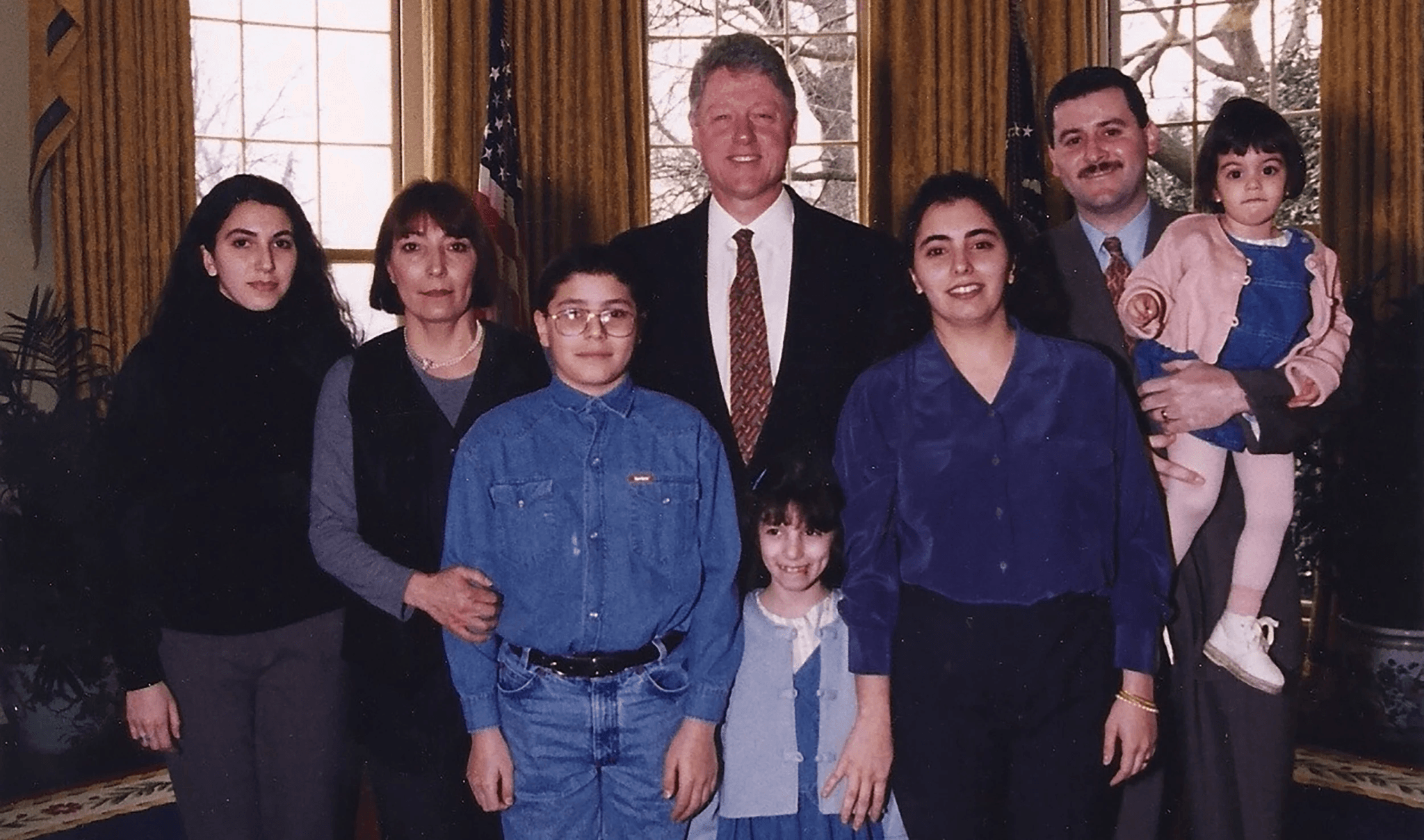
Through archival footage, family recordings, historical testimonies, and conversations with people who knew him, she began reconstructing the life of a man she barely remembered.
In the process, she discovered something equally profound: understanding her father meant understanding Libya itself.
"I don't want my father to disappear a second time," Jihan explains in her director's statement.
Her determination to preserve his memory became the foundation of a documentary that examines nearly a century of Libyan history, from Italian colonialism and the discovery of oil to political repression, international intervention, and the enduring consequences of authoritarian rule.
But rather than reducing her father to a political symbol, Jihan seeks to rediscover his humanity.
She approaches him not only as a public figure whose voice was silenced, but as a father, husband, idealist, and imperfect human being whose absence shaped the lives of those who loved him.
This transformation from political investigation to personal reconnection gives the documentary its extraordinary emotional depth.
Finding hope in the aftermath of loss
One of the film's most remarkable qualities is its refusal to allow suffering to become the only defining feature of its narrative.
Despite the political violence, displacement, and uncertainty that surround Jihan's childhood, My Father and Qaddafi is also a story about the human capacity to preserve joy.
Central to this perspective is Jihan's mother, Baha Al Omary, a Syrian-American artist whose determination to find her husband became an extraordinary demonstration of courage.
While confronting political authorities and navigating international diplomacy, Baha simultaneously worked to protect her children's emotional world.
She filled their home with creativity, music, humor, and affection, refusing to allow the family's tragedy to extinguish their capacity for happiness.
In an interview with Hollywood Hills Magazine, Jihan reflected on the profound influence of her mother's example:
"She taught us that while life is dangerous and unjust, we can still choose love and joy."
That philosophy becomes one of the documentary's most powerful messages.
Hope, in this context, is not the denial of injustice or the expectation that every tragedy will find a satisfying resolution. It is the conscious decision to preserve one's humanity despite circumstances that threaten to destroy it.
Through Baha's resilience and Jihan's determination, the film demonstrates how love and compassion can coexist with grief, and how families can create meaningful lives even when answers remain incomplete.
For audiences experiencing displacement, political instability, or personal loss, this message extends far beyond the specific historical circumstances of Libya.
It suggests that resilience is not simply about surviving tragedy, but about protecting the relationships, memories, and values that make life worth living.
Reconciliation begins with understanding, not forgetting
While My Father and Qaddafi confronts the devastating consequences of authoritarianism, its deeper ambition is not to perpetuate hatred or division.
Instead, the documentary creates space for understanding, reflection, and the possibility of reconciliation.
Jihan's filmmaking process involved engaging with people whose experiences and political positions were often shaped by conflicting interpretations of Libya's history.
Through these encounters, she discovered the importance of listening to individuals as human beings rather than reducing them to representatives of competing political ideologies.
In an interview with Abbas Zahedi published by The Dispatch, Jihan explained:
"I felt that to complete my mission it was more important to learn and understand than to judge."
This perspective offers an important contribution to contemporary conversations about reconciliation in societies emerging from political violence.
Reconciliation does not require erasing history, minimizing injustice, or abandoning accountability. Rather, it begins with acknowledging the complexity of human experience and creating opportunities for different generations to confront the past with honesty.
For Libya, a country still navigating the consequences of dictatorship, political fragmentation, and instability, such conversations remain particularly significant.
Jihan's documentary offers a space in which historical memory can be examined through personal testimony rather than political rhetoric alone.
The film does not present reconciliation as an accomplished reality. Instead, it explores the emotional and cultural foundations upon which meaningful reconciliation might eventually become possible.
By restoring individual voices to a history often dominated by powerful political figures, My Father and Qaddafi reminds audiences that healing begins when people are seen, heard, and remembered.
Rebuilding human connection across generations
One of the documentary's most moving dimensions is its exploration of the relationships between generations separated by political upheaval, exile, and historical silence.
During nearly a decade of filmmaking, Jihan interviewed more than sixty people, including relatives, diplomats, former political figures, and members of her father's generation.
Many carried memories of a Libya that younger generations had never experienced.
Their testimonies became more than historical evidence. They became opportunities to reconnect people whose experiences had been separated by decades of instability.
For Jihan, filmmaking gradually evolved into an act of intergenerational exchange.
Through the memories of others, she could reconstruct fragments of her father's personality, values, and relationships. In return, those who participated were given an opportunity to preserve their experiences for future generations.
The documentary thus becomes a bridge between the past and the present, transforming private recollections into a shared cultural inheritance.
This is especially significant in societies where authoritarian governments have attempted to control historical narratives or suppress alternative perspectives.
By preserving oral histories and personal archives, documentary cinema can protect memories that might otherwise disappear.
Jihan's search also reflects the experiences of diaspora communities around the world, many of whom inherit identities shaped by countries they know primarily through family stories, photographs, and cultural traditions.
Her journey demonstrates that identity is not merely determined by geography or citizenship. It is also constructed through memory, relationships, and the continuous effort to understand where we come from.
A mother's courage challenges conventional narratives about Arab women
Beyond its examination of political repression, My Father and Qaddafi presents a compelling portrait of female agency, leadership, and resilience.
Baha Al Omary emerges as one of the documentary's defining figures.
As an artist, mother, and determined advocate for justice, she challenged powerful political institutions while navigating patriarchal expectations and male-dominated diplomatic environments.
Her campaign took her across international political circles and even brought her face to face with Muammar Qaddafi.
Yet the documentary refuses to define Baha solely through her suffering.
Instead, she is portrayed as a multidimensional woman whose strength encompasses courage, humor, creativity, affection, and an unwavering commitment to her family.
Her story challenges simplistic representations of Arab women as passive victims of political or social circumstances.
It also demonstrates how women frequently become custodians of collective memory during periods of conflict, preserving family histories and cultural identities when political institutions fail to do so.
Through Baha and Jihan, the documentary places women's experiences at the center of Libya's historical narrative.
Their stories illustrate how personal courage can become a form of resistance and how the determination to protect human dignity can influence generations.
Cinema as an Act of Remembrance, Justice, and Healing
At its core, My Father and Qaddafi demonstrates the extraordinary capacity of storytelling to transform personal grief into a meaningful act of remembrance.
Jihan began the documentary searching for answers about her father's disappearance. Over time, the process became an opportunity to reconnect with her family, her heritage, and a national history she had struggled to understand.
The film's significance lies not only in the historical truths it investigates, but also in the emotional relationships it restores.
In an interview with MILLE WORLD, Jihan described the documentary's underlying purpose:
"At its core, the film is a love letter. To a father. To a country that was about to disappear from memory."
That sentiment captures the documentary's enduring relevance.
In an increasingly polarized world, where political disagreements can overshadow shared humanity, My Father and Qaddafi reminds us that empathy can create connections across generations, cultures, and historical divides.
It also offers a different understanding of hope.
Hope is not always found in definitive answers, political victories, or the resolution of every injustice.
Sometimes, hope emerges through the simple but powerful acts of remembering someone who has been forgotten, listening to another person's story, or discovering that a painful history can become the foundation for renewed understanding.
For Wisdomia's global audience, My Father and Qaddafi represents more than an important documentary about Libya.
It is a testament to the resilience of the human spirit, the transformative power of storytelling, and the belief that even the most painful histories can create opportunities for empathy, connection, and healing.
Because while history may separate people through borders, ideologies, and generations, the human need for love, dignity, belonging, and hope remains universal.


