
citiesabc, resources-impakt, first_page
Two Countries. One Food Future: Then I Found a British Strawberry Farm Predicting the Future
30 Oct 2026

In the previous article, I wrote about a contradiction that has stayed with me.
The farmer often knows the field better than anyone.
He knows the soil.
The crop.
The behaviour of the land.
The small changes that an outsider would probably miss.
And yet, despite knowing so much about what is happening now, he often has very little visibility of what happens next.
Weather.
Disease.
Yield.
Demand.
Price.
Buyer requirements.
That led me to a simple conclusion:
Information after the decision is history.
Information before the decision is intelligence.
Then I came across what is happening in British strawberry farming.
And suddenly that idea became much more real.
It Started With a Strawberry
At first, the story sounds almost too simple.
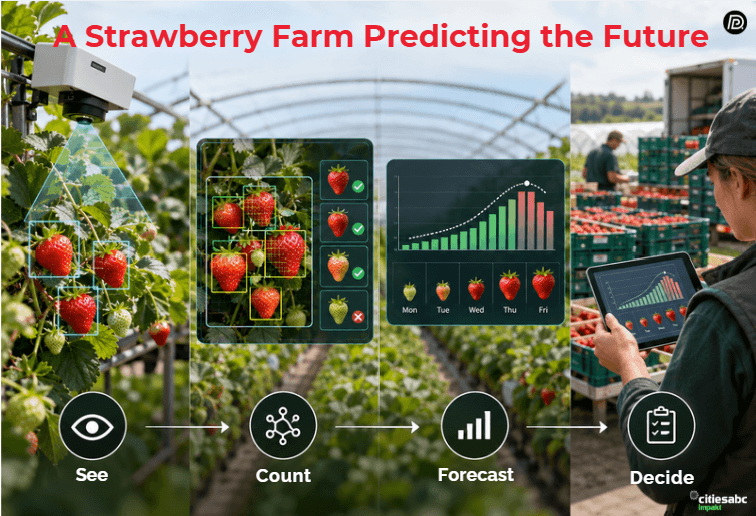
A camera moves through a strawberry crop.
It sees fruit.
Artificial intelligence counts it.
It identifies different stages of fruit development.
Weather and crop information are combined.
The system starts estimating how much fruit will be ready for harvest before it has been picked.
One British company, FruitCast, says its technology is now used across farms producing around 35% of the UK's strawberry crop.
It has analysed more than 400 million fruits, and says its forecasts typically come within around 10% of actual picked volume one week ahead and 17% three weeks ahead.
Those numbers are impressive.
But they are not what caught my attention.
The important question was:
What changes when the farmer knows the harvest before the harvest happens?
That is where the story becomes much bigger than strawberries.
The Fruit Was Not the Real Story
Imagine a grower expecting 40 tonnes next week.
Then imagine the crop suddenly develops faster because of temperature and sunlight.
The actual harvest may be 55 tonnes.
That difference affects almost everything.
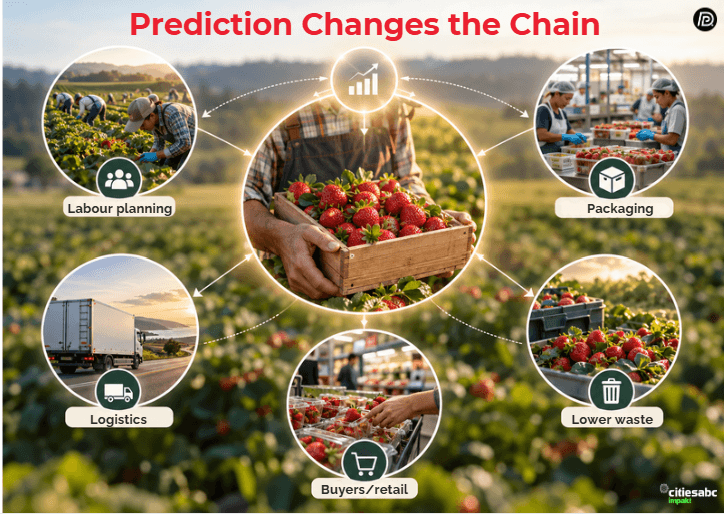
How many people do we need to pick?
How many trays?
How much packaging?
How much cold-storage capacity?
How many trucks?
How much supermarket demand should we commit to?
How much fruit could be wasted if the supply chain is not ready?
The problem is not merely estimating strawberries.
The problem is coordinating the entire system around them.
FruitCast itself describes forecasting as a tool not only for crop prediction, but also for labour planning, supply-chain management, weather intelligence and farm operations.
That changed the way I looked at the technology.
The AI did not simply count fruit.
It moved the decision earlier.
And once the decision moves earlier, everyone around the farmer can begin behaving differently.
Prediction Changes the Economics of Agriculture
This sounds obvious once you see it.
But I think it represents an important shift.
Traditional agriculture is highly reactive.
Something happens.
Then the farmer responds.
Disease appears.
Spray.
Rain fails.
Irrigate.
Harvest arrives.
Find labour.
Crop reaches the market.
Discover the price.
Quality fails.
Understand why.
But prediction starts reversing that sequence.
Instead of:
Event → Reaction
we begin moving toward:
Signal → Prediction → Decision → Action
That might be one of the most important transitions taking place in agriculture today.
Not because prediction eliminates uncertainty.
It never will.
Agriculture works with biology, weather and nature.
But even slightly better visibility can have enormous value when decisions involve thousands of workers, tonnes of food and narrow harvest windows.
Britain Is Investing in This Direction
The strawberry example is not happening in isolation.
The UK is investing heavily in agricultural innovation.
In February 2026, the government announced £345 million for farming productivity, technology, and infrastructure.
In April, around £50 million of public and private investment was announced to accelerate technologies including robotics and AI into practical farm use.
Then in August, another £20 million competition was launched specifically for agricultural automation and robotics, covering systems that could plant, manage and harvest crops. The government said the wider Farming Innovation Programme had £123 million available that year for farming research and technology.
And in September, another £13 million was announced to help move promising agricultural technologies from research toward real-world use.
This tells me something important.
Britain is not simply experimenting with agricultural technology.
It is trying to build an environment where technology moves from:
research → trial → farm → commercial deployment.
That journey matters.
Because agriculture has seen many impressive demonstrations that never become useful tools for farmers.
But There Is an Important Detail
The technology companies themselves are saying something that I find very encouraging.
FruitCast's founder Raymond Martin describes the company's approach as combining grower knowledge with machine learning rather than attempting to replace the grower.
Another British system, GreenView AI, uses camera footage to forecast soft-fruit yields. Growers using the technology have similarly emphasised that AI does not fully replace experienced judgement, particularly when weather, varieties and seasonal conditions change.
This matters enormously.
Because it connects directly with what I learned while studying the agricultural chain in India.
The farmer is not the missing intelligence.
The farmer already has intelligence.
The opportunity is to give that intelligence a wider field of vision.
AI can see patterns across thousands or millions of observations that one person cannot.
The farmer can understand context that the machine may not.
Together, they potentially become stronger.
This Made Me Think About India Again
Whenever I see agricultural technology in Britain now, I increasingly ask myself two questions.
First: Could this solve an Indian problem?
And second: What would have to change before it could?
Because transferring agricultural technology from Britain to India is not as simple as exporting software.
Take strawberry forecasting.
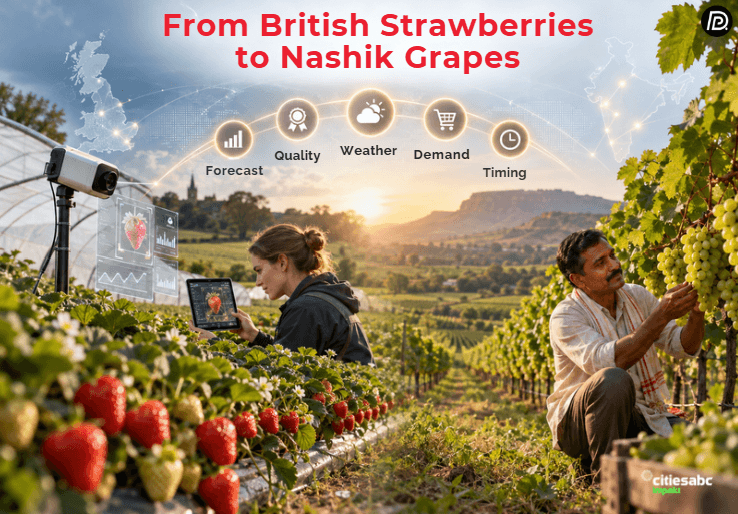
Could the same principle work for grapes in Nashik?
Probably.
Could it work for onions?
Pomegranates?
Mangoes?
Cotton?
Tomatoes?
Chillies?
Perhaps.
But the model would have to understand an entirely different environment.
Different weather.
Different varieties.
Different farm sizes.
Different cultivation practices.
Different irrigation.
Different labour.
Different disease patterns.
Different levels of technology adoption.
And potentially hundreds of thousands of farms rather than a small number of large commercial growers.
That is not simply localisation.
It is a completely different scale of learning.
From British Strawberries to Nashik Grapes
Grapes are where this becomes particularly interesting for me.
India is already a meaningful exporter of fresh grapes, and Maharashtra dominates Indian production.
Now imagine a vineyard in Nashik.
Instead of estimating yield mostly through manual observation, the grower gradually builds a digital picture of the crop.
Camera observations.
Weather.
Satellite information.
Growth stage.
Disease risk.
Input history.
Residue records.
Expected yield.
Expected harvest window.
Now connect the exporter.
The exporter knows buyer demand.
Connect the British importer.
The importer knows supermarket programmes.
Connect logistics.
Connect certification.
Suddenly, the AI forecast is no longer simply helping the farmer predict grapes.
It could begin helping the entire trade corridor predict supply.
That is a very different proposition.
What If the Buyer Could See the Crop Before Harvest?
This is where I think agricultural forecasting becomes genuinely provocative.
Today, much of international agricultural trade still becomes highly visible only after produce begins moving.
But what if the buyer could see:
expected volume,
expected harvest timeline,
expected quality,
crop condition,
weather risk,
and compliance status
weeks before harvest?
The buyer could plan earlier.
Shipping could be planned earlier.
Packing could be planned earlier.
Insurance could understand risk earlier.
And importantly, the farmer could potentially understand demand earlier.
That begins moving agriculture from:
produce → harvest → find market
towards:
predict → plan → produce → monitor → harvest → deliver
The difference is profound.
AI Is Not Predicting the Future
We should also choose our words carefully.
AI does not actually know the future.
A forecast can be wrong.
A storm can arrive.
Temperature can change.
Disease can appear.
Labour can disappear.
The market can move.
Even the best model is still estimating probability.
But farmers have always worked with uncertainty.
The real question is not:
Can AI predict agriculture perfectly?
It cannot.
The better question is:
Can it reduce uncertainty enough to improve the next decision?
That is a much more realistic standard.
And perhaps a much more useful one.
The Difference Between 70% and 90% Can Be Commercially Huge
Suppose a grower normally forecasts harvest volumes with reasonable accuracy.
But the prediction is still wrong by 25–30%.
Now imagine reducing that error significantly.
Even if the system is not perfect, the commercial impact can be substantial.
Too many workers create unnecessary labour costs.
Too few workers leave fruit unpicked.
Too much packaging becomes waste.
Too little packaging creates disruption.
Underestimating supply can mean missed sales.
Overestimating supply can create excess stock and food waste.
The economic value therefore does not come from saying:
"Our AI is 90% accurate."
The real value comes from asking:
What decisions become better because the forecast improved?
That should be the measurement.
This Is Where I Think We Often Get AI Wrong
Technology companies understandably talk about models.
Accuracy.
Computer vision.
Machine learning.
Automation.
But farmers don't buy an algorithm.
He buys an outcome.
Lower labour cost.
Reduced waste.
Higher yield.
Better quality.
Lower risk.
More reliable supply.
Better price.
So perhaps the most important question for agricultural AI is not:
How sophisticated is the technology?
It is:
Which decision does it improve, and what is that decision worth?
That is how I increasingly want to evaluate agricultural technology.
What I Learned
The British strawberry example changed how I think.
In Article 1, I argued that the farmer should be able to see around the corner.
Now I could see what that actually meant.
It does not require knowing the future.
It requires bringing enough signals together early enough to improve the decision.
That is the difference between:
data
and
decision intelligence.
The farmer does not need to know everything.
He needs to know what matters next.
But Britain Also Has Something India Should Study Carefully
It is not only technology.
It is the ecosystem surrounding the technology.
Researchers.
Startups.
Growers.
Government funding.
Innovate UK.
Commercial farms.
Trials.
Investors.
Technology companies.
These actors are being encouraged to work together to move innovation onto farms. Current UK programmes are explicitly designed around collaboration between farmers, researchers and businesses and around testing technologies under real farm conditions.
That is valuable learning for India.
Agricultural innovation doesn't scale because a government announces an AI strategy.
It scales when the farmer actually uses it.
And that requires:
trust,
proof,
economics,
training,
support,
ownership
and measurable benefit.
India, However, Has Something Britain Does Not
Scale.
And not simply scale in numbers.
Scale in complexity.
A technology that performs across India's agricultural diversity has to survive almost everything.
Large farms.
Small farms.
Irrigated farms.
Rain-fed farms.
High-value horticulture.
Staple crops.
Export agriculture.
Multiple languages.
Multiple climates.
Huge differences in farmer income and digital capability.
That complexity is often described as a problem.
I increasingly see it as an asset.
Because if we can develop agricultural intelligence that works within that complexity, it becomes relevant to many other parts of the world.
India could become one of the world's most important stress-testing environments for agricultural technology.
Perhaps This Is Where India and Britain Become Interesting Together
Britain can provide:
precision,
advanced agricultural R&D,
robotics,
computer vision,
commercial validation,
high-value farming environments.
India can provide:
scale,
diversity,
AI engineering,
frugal innovation,
multiple crops,
millions of farmers,
and enormous real-world complexity.
This is not Britain teaching India.
Nor India teaching Britain.
It is a case of two very different agricultural systems exposing each other's blind spots.
And that is perhaps more valuable.
What Could Change Tomorrow?
I would take six practical lessons from the British strawberry example.
1. Start with one expensive decision.
Don't start by asking where AI can be used. Begin with a costly uncertainty such as yield, labour, disease or harvest timing.
2. Measure economic value, not technical novelty.
If forecast accuracy improves, quantify what that saves in labour, waste, logistics or lost sales.
3. Keep the farmer in the loop.
Use AI to strengthen experienced judgement, not dismiss it.
4. Connect forecasting to the wider chain.
Yield prediction becomes far more valuable when buyers, packhouses and logistics can act on it.
5. Train models locally.
A British strawberry model cannot simply become an Indian grape model.
6. Build around real farms.
The best agricultural laboratory is ultimately the field itself.
The Question I Am Carrying Forward
The British strawberry showed me that prediction is not really about seeing the future.
It is about creating enough time to make a better decision.
But that raises another question.
A highly sophisticated technology can work beautifully on a British farm.
What happens when you take that idea into Indian agriculture?
Across millions of farmers.
Different crops.
Different languages.
Different economics.
Different levels of mechanisation.
Does it scale?
Does it become affordable?
Does it survive complexity?
Or does it fail the moment it leaves the demonstration farm?
That takes us to the next article.
Next:
What Britain Has That India Needs & What India Has That Britain Cannot Replicate


