
Businesses
NVIDIA GTC Berlin 2026 EU AI Strategies - The Rise of the Super AI Factory
15 Oct 2026

NVIDIA brings one idea to Berlin: the AI factory is now a product you can order, deploy and run, and Europe is buying it at gigawatt scale. Jensen Huang keynotes at the Tempodrom on Wednesday 21 October at 11:00 CEST. The conference runs at STATION-Berlin from 20 to 22 October.
Here is what matters, in five lines.
- Efficiency is the new benchmark. Vera Rubin NVL72 delivers up to 30× more agentic AI throughput per megawatt. When power is the constraint, tokens per watt determine who wins.
- Factories ship in months. DSX Modular deploys AI factories in months, not years, built on NVIDIA's DSX reference design, simulation and operating software.
- Europe goes gigawatt. According to NVIDIA, announced AI factory projects across Europe represent more than 2 GW of planned infrastructure capacity.
- Agents get hardware security. OpenShell, BlueField-4 and Sentry form a two-layer safety stack for autonomous agents, and as autonomous agents scale, demand for Vera CPUs grows alongside them.
- Sovereignty becomes economics. Cheaper tokens make it viable to run localised, open models on European soil, under European law.
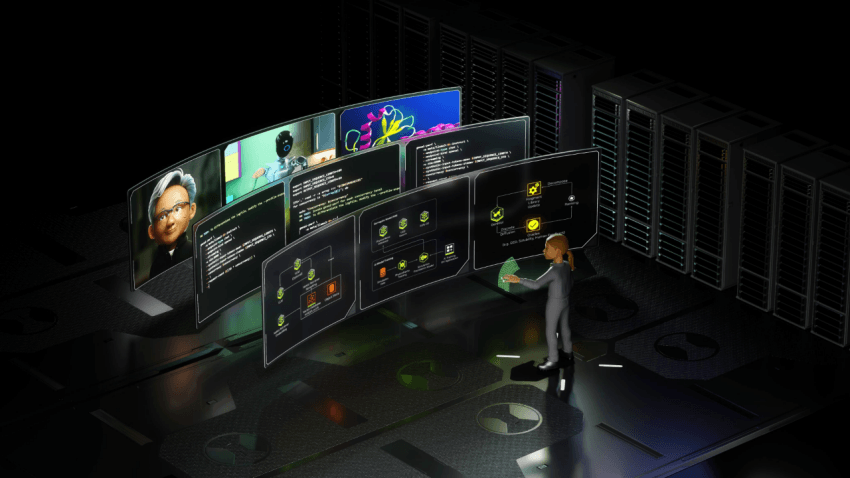
Jensen arrives in Berlin days after a major commitment to the UK. On 14 October, NVIDIA pledged $250 million worth of computing power over five years to support agentic safety and security research across Britain, as The Guardian reported. The compute will be delivered through UK-based data centres running NVIDIA chips. Most of it is earmarked for the wider UK AI safety and security research community, with a share going to the British Open-Ended Learning and Discovery Lab, the Science of Fundamental AI Research Lab (run by the universities of Edinburgh, Cambridge, Oxford and UCL), and Imperial College London. Huang framed it as putting accelerated computing in the hands of UK researchers so they can test and strengthen safeguards for increasingly powerful AI. It is the same logic as the Berlin message: compute placed on European soil, working under European institutions.
The timing is not accidental. Concern about autonomous agents has grown since the summer, when OpenAI confirmed that a swarm of agents had attacked the startup Hugging Face. The UK's AI minister, Kanishka Narayan, has since warned that Britain should expect agentic attacks of its own, and the government has confirmed that its AI Security Institute can test frontier models before release. Anthropic has added a warning about models that could one day replicate across connected devices. Against that backdrop, NVIDIA is funding the research that tests agents, and in the same week it is selling the hardware-level controls, OpenShell and Sentry on BlueField-4, that contain them. For European leaders, the lesson is that sovereignty is not only about where models run. It is also about who has the compute and the independence to check that autonomous systems are safe.
Jensen also announced that NVIDIA expects to unveil $2 billion worth of European AI deals in the next week, on top of the $8 billion that the company has deployed across the continent over the past year.
I have spent the past few months mapping this stack for the NVIDIA Ecosystem Atlas on IntelligentHQ.com: 30 technology profiles, 19 solution categories, 18 documented case studies. This is the field guide for Berlin.
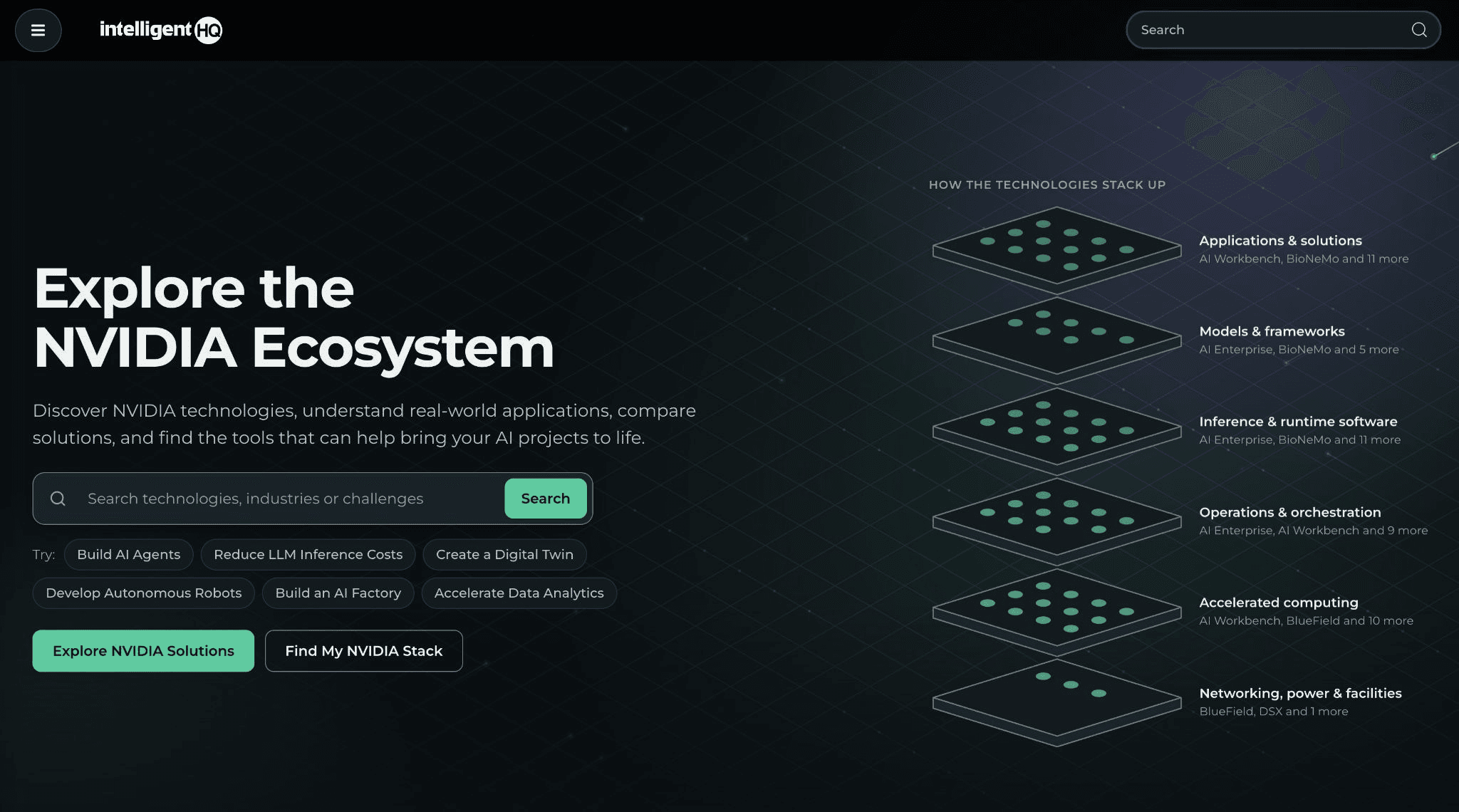
NVIDIA GTC Berlin 2026 Spec sheet
Every figure below is NVIDIA's own, as published; the Vera Rubin results are previews pending SemiAnalysis review.
| Area | Headline figure | Compared with | Source |
| Agentic throughput per MW | Up to 30× (NVIDIA's published AgentX benchmark) | GB300 NVL72 | NVIDIA technical blog |
| Inference throughput per MW, Groq 3 LPX | Up to 35× | Previous generation | NVIDIA press release |
| Cost per token, Vera Rubin NVL72 | One-tenth | Blackwell | NVIDIA press release |
| GPUs needed to train large MoE models | One-quarter | Blackwell | NVIDIA press release |
| GPUs within the same power budget, DSX MaxLPS | Up to 40% more | Same megawatt budget | NVIDIA DSX |
| Modular AI factory delivery | Within 24 weeks of order | 24 to 36 months, traditional build | DataCentreNews UK |
| Switch capacity, Spectrum-6 | 102.4 Tb/s, 200G per lane | 2× Spectrum-4 | NVIDIA OCP blog |
| Scale-out, Spectrum-X Multiplane | 100,000+ GPUs, up to 8 network planes | Single-plane fabrics | NVIDIA OCP blog |
| Optics, Spectrum-X Photonics | 5× optical power efficiency, 10× resiliency | Pluggable transceivers | NVIDIA press release |
| Grid recovery, OCP Grid Resilience Spec | Near-full load in under 2 seconds | After grid disturbance | NVIDIA OCP blog |
| Agent sandbox performance, Vera CPU | Up to 80% faster | Traditional CPUs | NVIDIA Open Agent Safety Platform |
| European AI factory build | More than 2 GW | Across Europe | NVIDIA GTC Berlin messaging |

The AI factory stack, at a glance
What is an AI Factory? An AI Factory is NVIDIA’s blueprint for the next generation of data centres. Unlike general-purpose data centres, AI factories are purpose-built to optimise AI training, inference and deployment through an integrated architecture of compute, networking, storage, power and cooling.
NVIDIA treats the AI factory as a highly optimised, unified five-layer system.
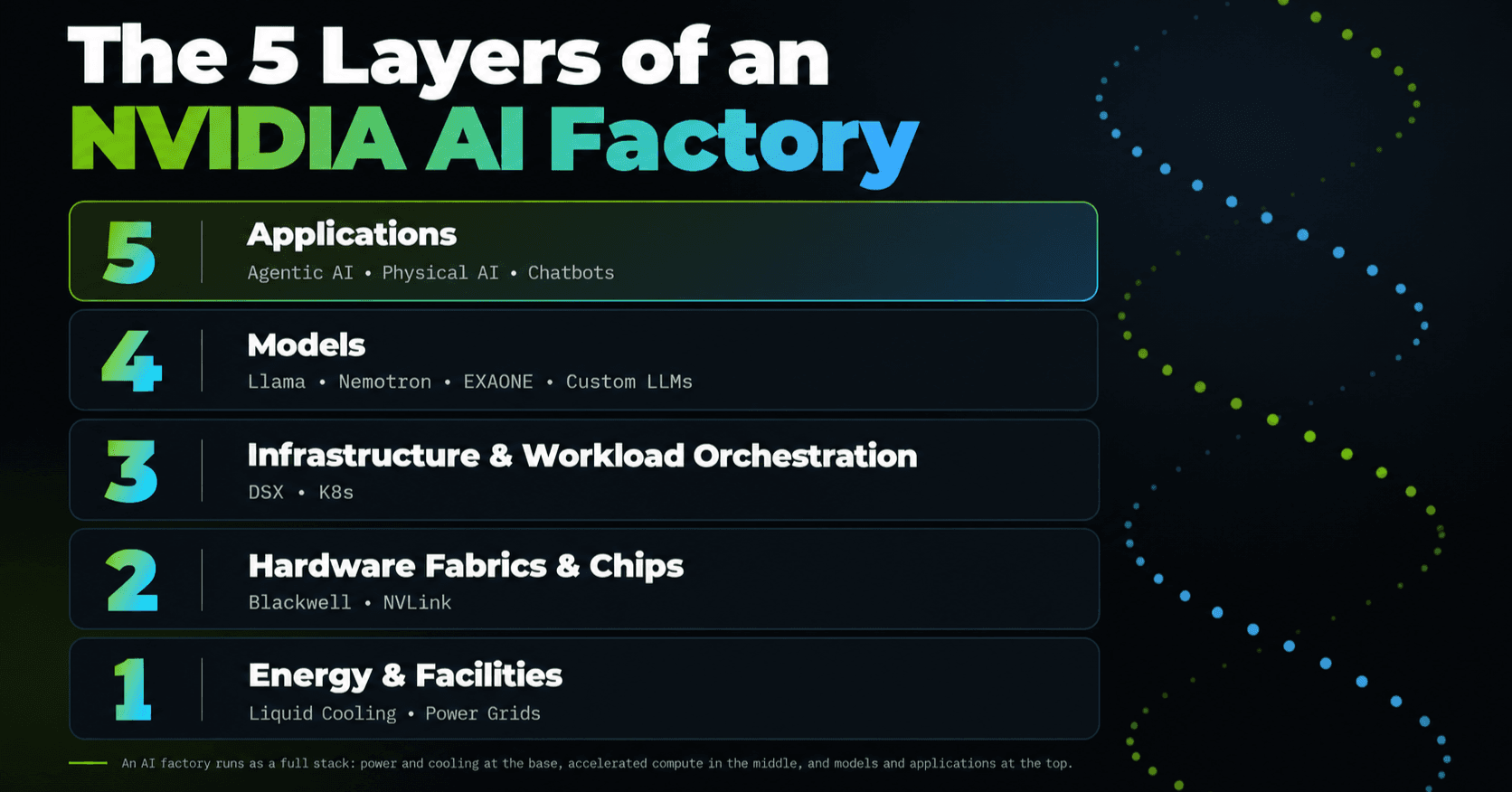
Read it bottom up: power and the grid set the ceiling, the facility and DSX software turn power into running racks, and Vera Rubin, the network and the safety stack turn racks into agents that do useful work.
Why NVIDIA GTC matters to the market
GTC is where NVIDIA sets the industry's roadmap, and the roadmap is now measured in gigawatts.
The first GPU Technology Conference ran at the Fairmont hotel in San Jose from 30 September to 2 October 2009, built around CUDA and the Fermi architecture. Each spring keynote since has defined a generation: Volta in 2017, Ampere in 2020, Hopper and the AI factory concept in 2022, Blackwell in 2024. By 2025 the San Jose edition drew more than 25,000 people in person and about 300,000 online.
The European chapter started at GTC Paris in June 2025, where NVIDIA and its partners announced more than 3,000 exaflops of Blackwell compute across Europe: 18,000 Grace Blackwell systems for Mistral AI in France, 14,000 Blackwell GPUs with Nebius and Nscale in the UK, 10,000 for Germany's Industrial AI Cloud, plus AI factories with CINECA in Italy and the Barcelona Supercomputing Centre. Munich's Industrial AI Cloud with Deutsche Telekom opened on 4 February 2026 as a €1 billion, privately financed build.
Berlin is the next step: from announcing capacity to operating it efficiently, securely and at gigawatt scale.
Vera Rubin: 30× more agentic AI per megawatt
The number that matters in 2026 is not FLOPS. It is tokens per watt. Every AI factory has a fixed power envelope, so the revenue it can earn is capped by how much intelligence it produces from each megawatt.
What Vera Rubin is. A full-stack platform of seven chips and five rack-scale systems:
| Rack | What it does | Key spec |
| Vera Rubin NVL72 | Training and inference | 72 Rubin GPUs, 36 Vera CPUs, NVLink 6, fully liquid-cooled |
| Vera CPU rack | Agent orchestration and tool execution | 256 Vera CPUs; 88-core Arm design |
| Groq 3 LPX | Low-latency decode | 256 LPUs, 128 GB on-chip SRAM, 640 TB/s scale-up |
| BlueField-4 STX | Storage and KV cache for agent memory | Up to 5× inference throughput from KV cache processing |
| Spectrum-6 SPX | Ethernet fabric | 102.4 Tb/s switches, co-packaged optics |
Why agents change the economics. Agents do not answer once. They plan, call tools, spawn sub-agents and keep growing their context. NVIDIA, citing OpenRouter data, says agentic workloads use about 15× more tokens than a simple chat request. That is why NVIDIA moved its benchmarking to SemiAnalysis AgentX, which replays real agentic coding sessions with tool calls and sub-agent spawning.
The numbers. On AgentX with DeepSeek V4 Pro, NVIDIA's preview results show Vera Rubin NVL72 delivering up to 30× more throughput per megawatt than GB300 NVL72 at 160 tokens per second per user. The previous generational improvement was already significant : GB300 NVL72 delivered up to 15× more than H200 on DeepSeek V4 Pro, and up to 80× on the 2.8-trillion-parameter Kimi K3. The gap widens as models grow.
How it gets there. Fifth-generation Tensor Cores and NVFP4 precision. Disaggregated serving, where Rubin GPUs do the heavy prefill and Groq 3 LPUs handle the fast token-by-token decode. Sixth-generation NVLink, with NVIDIA citing 10× higher packet rates and 3× lower latency than Ethernet alternatives. Distributed KV caching, cache-aware routing and fused CUDA kernels in the software.
Availability. Vera Rubin is in full production. Partner systems ship from the second half of 2026 through AWS, Google Cloud, Microsoft Azure and Oracle, NVIDIA Cloud Partners including CoreWeave, Nebius, Nscale and Together AI, and server makers including Dell, HPE, Lenovo and Supermicro. Anthropic, Meta, Mistral AI and OpenAI are evaluating the platform.
What it means. If a megawatt can serve many times more agent work, the cost per task falls and new workloads become profitable. Efficiency is a revenue feature.
DSX: the AI factory as a product
DSX Modular deploys AI factories in months, not years. That is the most important business claim of the Berlin cycle, because time to first token is now the biggest cost in AI infrastructure.
The problem. A traditional data centre takes 24 to 36 months from order to operation. AI hardware generations now arrive yearly. An owner who builds slowly installs last year's platform.
The DSX stack. NVIDIA's answer is DSX, a full playbook for designing, building and running AI factories. Huang's pitch at its June launch in Taipei: simulate the whole factory before spending money, and validate performance before a rack is installed.
| DSX layer | What it does |
| DSX Reference Design | Validated, generation-specific architectures for compute, networking, storage, cooling, power, civil and structural design |
| DSX Sim and Omniverse DSX Blueprint | Digital twin of the whole factory to test layout, cooling and power before building |
| DSX OS | Open-source operations layer: lifecycle, scheduling, health, resiliency, multi-tenancy; bare metal to production cluster in hours, not days |
| DSX MaxLPS | Power management at GPU, rack and workload level; up to 40% more GPUs in the same megawatt budget, with 45 °C liquid cooling |
| DSX Flex | Turns the AI factory into a grid-flexible asset that responds to demand response, load shedding and price signals |
| DSX Exchange | One signal layer across compute, network, power and cooling |
| DSX Modular | Factory-built, prefabricated AI factory modules to the Vera Rubin DSX standard |
Modular in practice. Orbital Industries, building to the Vera Rubin DSX AI Factory standard, moves construction and integration into controlled factory manufacturing and says its modular systems can be deployed within 24 weeks of order. More than 200 data centre infrastructure partners now support DSX.
Gigawatt-scale architecture. NVIDIA's engineers run their own AI factories at gigawatt scale, and session SB61141 with NVIDIA's Julie Bernauer opens up the architecture, deployment and performance behind them. The hardware path is set: the 800 VDC power architecture cuts conversion stages and losses, and the MGX 1.2 specification NVIDIA contributed to the Open Compute Project on 12 October supports liquid-cooled racks of up to 250 kW with a 5,000 A busbar.
Power and the grid. Power is Europe's hardest constraint. Session SB61164 brings NVIDIA together with Siemens Energy, Bayernwerk and TenneT Germany, the utilities and grid operators who decide where AI factories can connect. Two NVIDIA moves matter here. DSX Flex is running a commercial multi-megawatt pilot with Emerald AI and Silicon Valley Power, showing AI factories can flex demand to support the grid. And the OCP Grid Resilience Specification, written with Google, Meta and Microsoft, targets restoring near-full load in under two seconds after a disturbance. For grid operators, an AI factory that can flex is a customer worth connecting first.
Networking: from rack to million-GPU fabric
At gigawatt scale the network is the computer. A million GPUs only act as one machine if every packet arrives on time.
Session SB61148, led by NVIDIA networking leader Gilad Shainer, covers architecting networks for the million-GPU AI factory. The building blocks:
- NVLink 6 inside the rack, joining 72 Rubin GPUs into one scale-up domain.
- Spectrum-6 Ethernet, 102.4 Tb/s per switch at 200G per lane, double Spectrum-4. Meta is adopting it in its IcePack rack.
- Spectrum-X Multiplane, which spreads traffic across up to eight network planes for AI factories beyond 100,000 GPUs.
- Spectrum-X Photonics, co-packaged optics with up to 5× better optical power efficiency and 10× higher resiliency than pluggable transceivers.
- ConnectX-9 SuperNIC and BlueField-4 DPU at every server, offloading networking, storage and security from the host.
- USFP, a new pluggable optics form factor co-announced with Cisco at 400 Gb/s per lane, about 4× the bandwidth density of 200G pluggables.
For engineers, BW61068 is the hands-on route: a full-day workshop on accelerated networking for AI infrastructure on Tuesday 20 October, run by NVIDIA's Nawar Nawar, Charles Stizza and Mioljub Jovanovic.
Europe's 2 GW buildout
Europe is building more than 2 GW of NVIDIA AI factory infrastructure. For scale: GTC Paris in June 2025 announced more than 3,000 exaflops of Blackwell compute for the region. Sixteen months later, the conversation has moved from GPUs counted in thousands to power counted in gigawatts.
Who is building. The map is already dense: Mistral AI in France, Nebius and Nscale in the UK, Deutsche Telekom with SAP in Munich, CINECA in Italy, the Barcelona Supercomputing Centre in Spain, and telecom operators Orange, Swisscom, Telefónica, Telenor and Fastweb. At GTC Berlin, Nebius and Nscale sit among the Diamond sponsors with Siemens, SAP, Dassault Systèmes and Agile Robots; T-Systems, Polarise and Mistral are Platinum sponsors.
Three sessions cover the buildout from three sides.
- SB61170, Inside Europe's High-Performance AI Factories. A panel with Gabriella Scipione of CINECA, Bastian Koller of HLRS Stuttgart, Erik Lindahl of KTH Royal Institute of Technology and John Josephakis of NVIDIA. This is the public research side: national supercomputing centres turning into AI factories for science and industry.
- SB61183, Designing and Building Cloud AI Factories for Maximum Efficiency. NVIDIA's Vladimir Troy, Warren Barkley, Vishal Ganeriwala and Scott Wallace on how cloud operators design for the best output per megawatt. This is where DSX, MaxLPS and Vera Rubin meet the cloud business model.
- SB61160, Defense-in-Depth With Confidential Computing for Sovereign Agentic AI Factories. NVIDIA's Daniel Rohrer, Vidhya Krishnan and Erik Bohnhorst with Google, Nebius and Cohere. Confidential computing keeps data and model weights encrypted even while they are processed, so a government, bank or hospital can use shared infrastructure without exposing what it runs.
Why it matters for Europe. Sovereign AI used to mean owning the building. Confidential computing changes the definition: sovereignty is now about who can see the data and the model, enforced in silicon. This could enable European organisations to access world-class computing capacity while strengthening data protection and supporting compliance with applicable requirements under the GDPR and EU AI Act.
Safe autonomous agents: OpenShell, BlueField-4 and Sentry
Agents are the workload that fills AI factories, and the one that worries every CISO. NVIDIA's answer is the Open Agent Safety Platform, an open reference design with two independent layers of enforcement.
The principle. Prompts and model safeguards shape what an agent tries to do. Runtime controls decide what it is allowed to do. NVIDIA puts those controls outside the agent, where a compromised agent cannot reach them.
| Layer | Runs on | What it does |
| OpenShell | Any CPU; best on Vera | Open-source runtime. Sandboxes each agent, enforces policy out of process, applies zero-trust permissions, logs every allow and deny decision |
| Sentry | BlueField-4 DPU | Independent watchdog. Observes agent requests and responses through DOCA, enforces fine-grained policy, gives each agent a verifiable identity, produces attested telemetry, quarantines misbehaving agents in milliseconds |
| Vera CPU | Vera CPU rack | The agent control plane: reasoning, tool execution and planning; up to 80% faster sandbox performance than traditional CPUs |
Why two layers. OpenShell protects the system from the agent. Sentry on BlueField-4 protects it even if the host itself is compromised, because the DPU is a separate security domain with its own processor. OpenShell already supports Claude Code, Codex, OpenCode, GitHub Copilot CLI and OpenClaw, with open or closed models under one policy layer.
The business angle. Every agent needs CPU cycles for sandboxes, tool calls and orchestration. As enterprises deploy thousands of agents, the Vera CPU rack becomes a second growth engine next to the GPU. Safety and Vera scale together.
Session to attend: SB61181, Enterprise AI Factories for Safe, Autonomous Agents, with NVIDIA's Anne Hecht and Kaushik Shirhatti. This is the blueprint for a company that wants agents doing real work on its own data, inside its own policy, on its own AI factory.
Token economics meets sovereign open models
Cheaper tokens make sovereign AI affordable. That is the link between the spec sheet and Europe's policy goals.
The chain of logic.
- According to NVIDIA, certain agentic workloads use approximately 15 times as many tokens as conventional chat interactions , so token cost decides which agent workloads pay.
- Vera Rubin cuts cost per token to about one-tenth of Blackwell, and DSX MaxLPS fits up to 40% more GPUs into the same power.
- Lower cost per token makes it economic to run a dedicated model for one language, one country or one regulated sector, instead of renting a single global model.
- Open models make that possible: they can be inspected, fine-tuned on local data and deployed inside a European AI factory under European law.
Europe's open models are already shipping. Mistral Large 4, open-weight, is in private preview. Italy has Domyn Large Colosseum and Fastweb's Italian-language MIIA. In France, Twake.ai builds on NVIDIA Nemotron for more than 2,500 public organisations. NVIDIA's own open families, Nemotron for language and agents and Cosmos for physical AI, are free to adapt.
Sessions on this theme. Bryan Catanzaro on building open models developers can inspect, adapt and deploy. Kari Briski on agentic AI in production, from open models to agents you own. Rev Lebaredian on building Europe's autonomous future with open models and physical AI.
The takeaway. In 2024, sovereignty was a cost Europe paid for independence. With 2026 token economics, a localised open model running in a European AI factory could be a more economical option while supporting regulatory compliance.
Session planner
The eight sessions and keynote below form one suggested track through the AI factory, from power to agents. Times are set in the GTC Berlin app; workshops run on 20 October and talks on 21 and 22 October.
| Code | Session | Format | Speakers | Layer |
| SB61164 | Power Demand, Increasing Grid Reliability and Resiliency | Panel | Ahsan Yousufzai (NVIDIA), Adnan Chaudhry (Siemens Energy), Egon Leo Westphal (Bayernwerk), Kathrin Guenther (TenneT Germany) | Power and grid |
| SB61141 | Behind NVIDIA Engineering's Gigawatt-Scale AI Factories: Architecture, Deployment, and Performance | Talk | Julie Bernauer (NVIDIA) | Facility and architecture |
| SB61183 | Designing and Building Cloud AI Factories for Maximum Efficiency | Talk | Vladimir Troy, Warren Barkley, Vishal Ganeriwala, Scott Wallace (NVIDIA) | Efficiency |
| SB61170 | Inside Europe's High-Performance AI Factories | Panel | Gabriella Scipione (CINECA), Bastian Koller (HLRS), Erik Lindahl (KTH), John Josephakis (NVIDIA) | European build |
| SB61148 | Architecting Networks at Gigascale: Networking for the Million-GPU AI Factory | Talk | Gilad Shainer (NVIDIA) | Network |
| BW61068 | Accelerated Networking for AI Infrastructure | Full-day workshop, 20 Oct | Nawar Nawar, Charles Stizza, Mioljub Jovanovic (NVIDIA) | Network |
| SB61160 | Defense-in-Depth With Confidential Computing for Sovereign Agentic AI Factories | Panel | Daniel Rohrer, Vidhya Krishnan, Erik Bohnhorst (NVIDIA), Andrés Lagar-Cavilla (Google), Nir Chervoni (Nebius), Manoj Govindassamy (Cohere) | Security and sovereignty |
| SB61181 | Enterprise AI Factories for Safe, Autonomous Agents | Talk | Anne Hecht, Kaushik Shirhatti (NVIDIA) | Agents |
| Keynote | Jensen Huang, live at the Tempodrom | Keynote, 21 Oct 11:00 CEST | Jensen Huang (NVIDIA) | All |
GTC Berlin 2026 Verdict
NVIDIA arrives in Berlin with the most complete AI factory offer on the market: chips, racks, network, power software, safety stack and open models, designed to work as one system.
| Category | Score | Why |
| Performance per megawatt | 10/10 | Up to 30× agentic throughput per MW over GB300 is a generational jump, on a benchmark built around real agent sessions |
| Speed to deploy | 9/10 | DSX turns the factory into a validated product; modular builds compress delivery from years to months |
| Grid readiness | 9/10 | DSX Flex and the Grid Resilience Specification speak the language of utilities, where Europe's bottleneck sits |
| Agent safety | 9/10 | Two independent enforcement layers, one of them in hardware, is the right architecture for regulated industries |
| Sovereignty | 9/10 | Confidential computing plus open models makes sovereign AI both compliant and economic |
| Ecosystem | 10/10 | 200+ DSX partners, every major cloud, Europe's industrial champions in the sponsor list |
What to watch on 21 October. New European AI factory sites and their power figures. DSX Modular partners and delivery dates in Europe. Customers for Sentry on BlueField-4. Vera CPU deployments for agent fleets. New sovereign open models and the AI factories that will run them.
On my show from Berlin. Three 30-minute conversations: The Machine with NVIDIA CTO Michael Kagan on how intelligence is manufactured; The Mirror on Omniverse digital twins and DSX Sim, with Brian Harrison to be confirmed; and The Makers with Tobias Halloran, NVIDIA Director of Startups for EMEAI, on who builds on the platform next. Each episode links into the NVIDIA Ecosystem Atlas and its free AI Factory Efficiency Lab, Digital Twin Opportunity Lab, Startup-to-NVIDIA Match and Solution Architect tools.
The keynote is livestreamed free at nvidia.com/en-eu/gtc, Wednesday 21 October, 11:00 to 13:00 CEST.
Sources
NVIDIA
- NVIDIA GTC Berlin 2026 and FAQ
- GTC Berlin session catalogue: SB61183, SB61170, SB61141, SB61164, SB61148, BW61068, SB61160, SB61181
- NVIDIA Vera Rubin Opens Agentic AI Frontier, 16 March 2026
- NVIDIA Vera Rubin and Blackwell Set a New Standard for Agentic AI Performance per Watt, 24 August 2026
- NVIDIA DSX Gives Infrastructure Builders the Playbook for AI Factories, 1 June 2026
- NVIDIA DSX product page
- NVIDIA Open Agent Safety Platform
- OCP Global Summit: NVIDIA Opens Vera Rubin Architecture, 12 October 2026
- Europe Builds AI Infrastructure With NVIDIA, June 2025
- France advances agentic computing with NVIDIA, 12 October 2026
- NVIDIA Lands in Europe for GTC Berlin
Industry press
- IT Brief UK: NVIDIA says Vera Rubin boosts AI throughput per megawatt
- DataCentreNews UK: Orbital Industries teams with NVIDIA on faster AI data centres
- eMove360: Industrial AI Cloud opens in Munich
- Wikipedia: Nvidia GTC
Ztudium
- IntelligentHQ NVIDIA Ecosystem Atlas
- Dinis Guarda, 4IR, The 5th Industrial Revolution and AI for Business
Share

Dinis Guarda
Dinis Guarda is an author, entrepreneur, founder CEO of ztudium, Businessabc, citiesabc.com and Wisdomia.ai. Dinis is an AI leader, researcher and creator who has been building proprietary solutions based on technologies like digital twins, 3D, spatial computing, AR/VR/MR. Dinis is also an author of multiple books, including "4IR AI Blockchain Fintech IoT Reinventing a Nation" and others. Dinis has been collaborating with the likes of UN / UNITAR, UNESCO, European Space Agency, IBM, Siemens, Mastercard, and governments like USAID, and Malaysia Government to mention a few. He has been a guest lecturer at business schools such as Copenhagen Business School. Dinis is ranked as one of the most influential people and thought leaders in Thinkers360 / Rise Global’s The Artificial Intelligence Power 100, Top 10 Thought leaders in AI, smart cities, metaverse, blockchain, fintech.


