
first_page, citiesabc
Real Estate Tokenisation: Digitising the $379 Trillion Industry with Programmable Property
16 Jun 2026

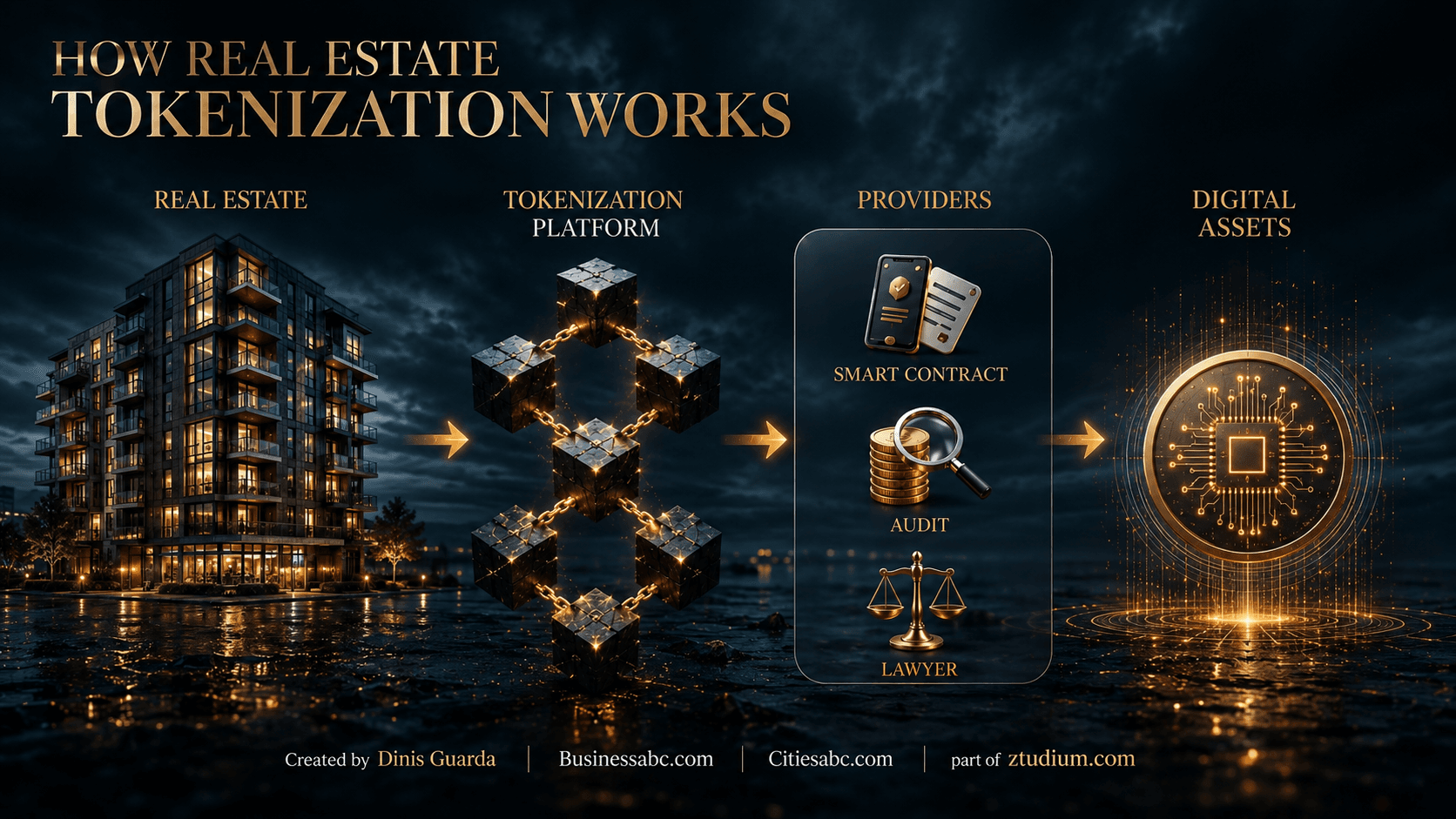
Landmark Case Studies
BrickMark and the Zurich Bahnhofstrasse Transaction
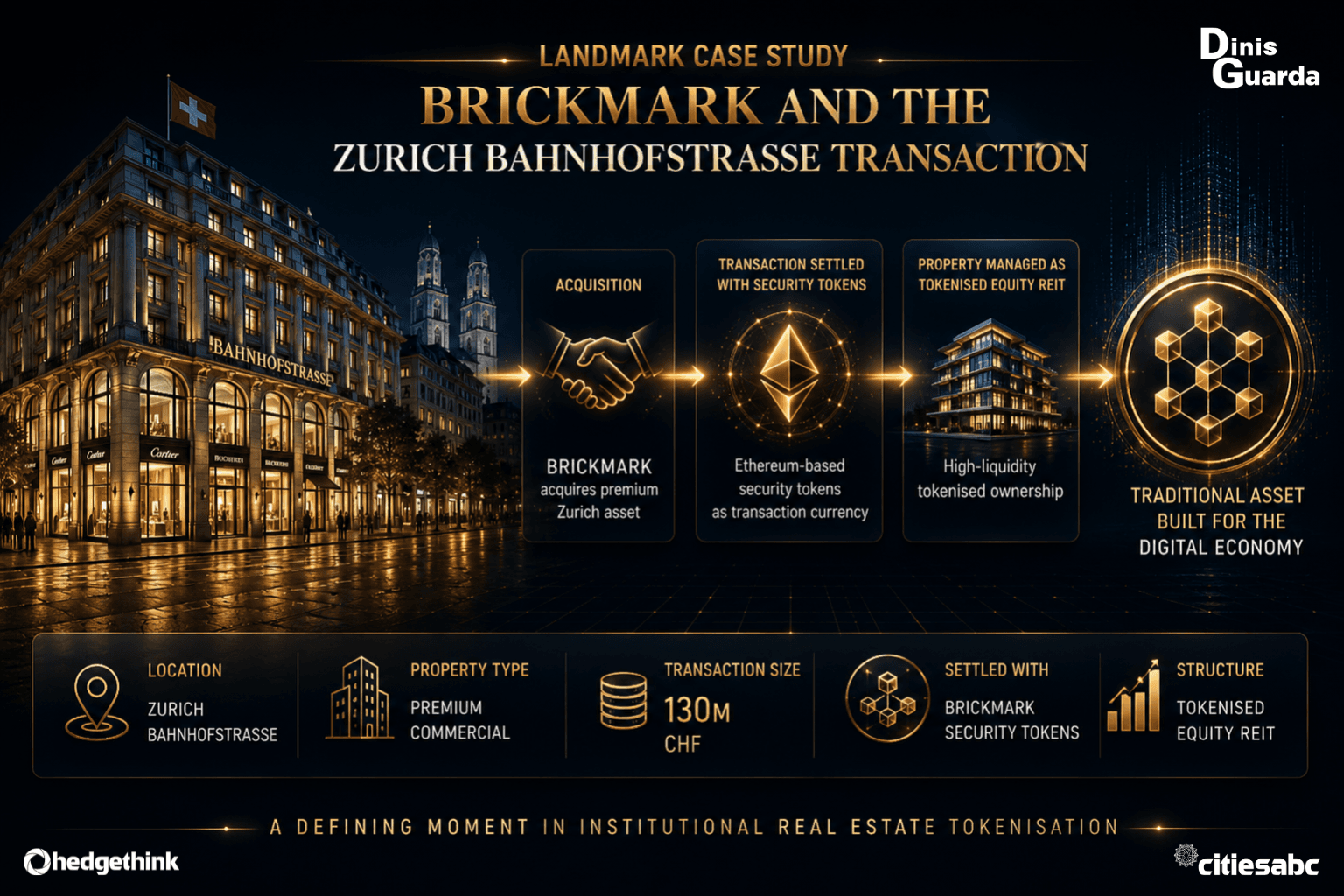
In one of the most significant single-asset tokenisation transactions in history, BrickMark acquired a premium commercial building on Zurich's Bahnhofstrasse — Switzerland's most prestigious commercial thoroughfare — from RFR Holding for 130 million Swiss Francs. The breakthrough: a material portion of the purchase price was settled using BrickMark's proprietary Ethereum-based security tokens rather than fiat currency, with the property subsequently managed as a high-liquidity tokenised Equity REIT.
The BrickMark transaction demonstrated, at institutional scale, that tokenised property equity could function as genuine transaction currency — not merely as a speculative instrument but as a recognised unit of value capable of settling a nine-figure commercial real estate acquisition. It remains a foundational data point in the industry's case for institutional credibility.
GORO and Southeast Asia's Retail Democratisation

Operating across Indonesia's rapidly expanding luxury tourism and residential real estate sector, GORO has grown into Southeast Asia's premier consumer-facing fractional real estate application, onboarding over 100,000 active retail users. Its significance lies not merely in the technology but in the socio-economic context: by solving local financial exclusivity barriers — historically, Indonesian real estate investment was dominated by institutional developers and wealthy overseas buyers — GORO proved that fractionalised resort economies could operate sustainably across developing APAC markets under rigorous digital regulatory compliance.
The platform addresses a deep structural inequality: in a nation of 270 million people with one of the world's fastest-growing tourism sectors, the vast majority of citizens lacked any mechanism to participate in the capital appreciation of the resort properties being built in their own landscapes. Tokenisation offered a partial but meaningful correction.
Propy and the On-Chain Deed
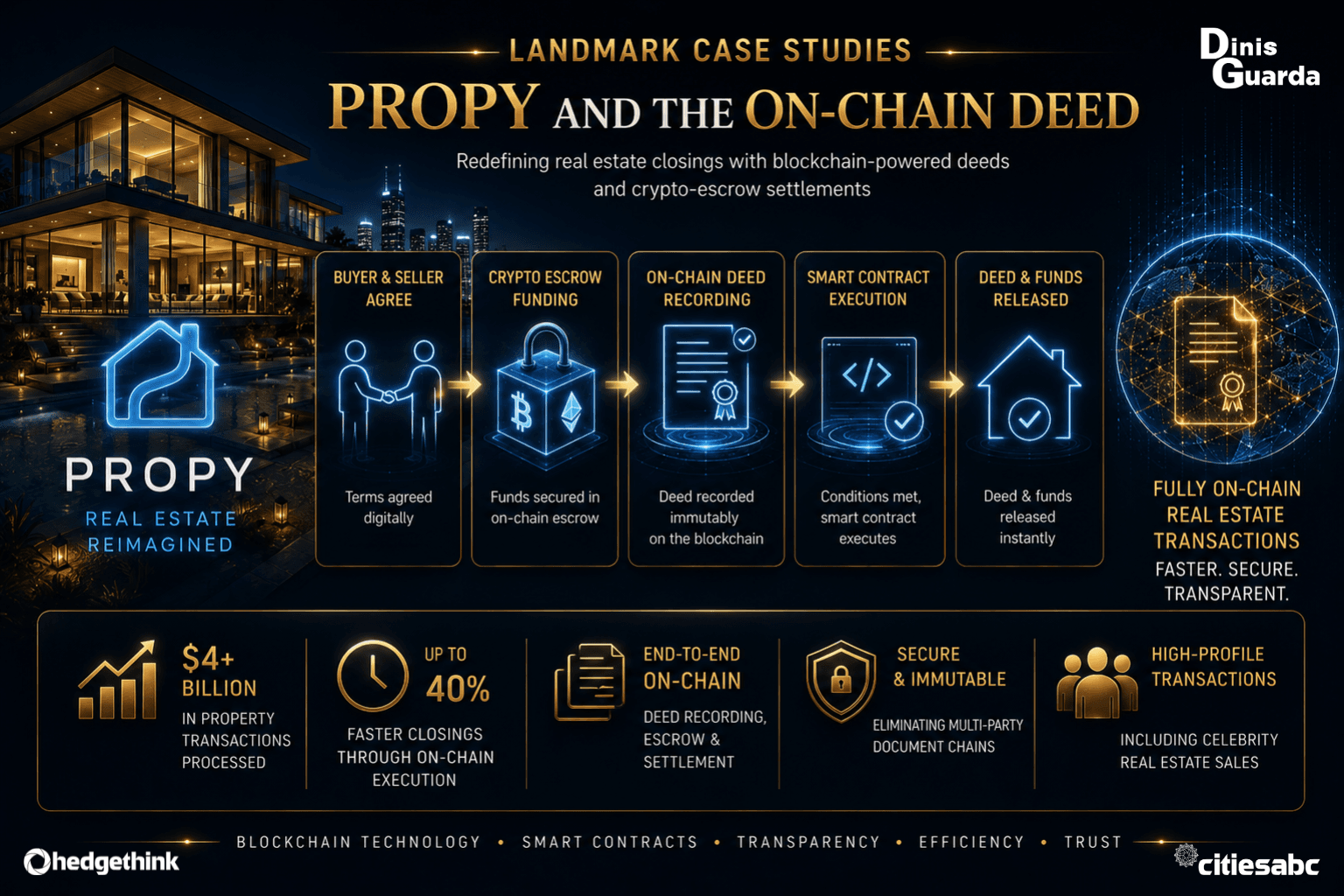
Propy has pursued the most direct assault on the traditional real estate closing process, recording land deeds and escrow natively on blockchain and executing full crypto-escrow settlements with smart contract deed distribution. Having processed over $4 billion in property transactions — including high-profile celebrity real estate sales — Propy has demonstrated that entire transaction lifecycles can be compressed by up to 40% through on-chain execution, eliminating the multi-party document chains that make traditional real estate closings notoriously slow and error-prone.
Bergen County, New Jersey: Government-Grade Land Registry on Avalanche
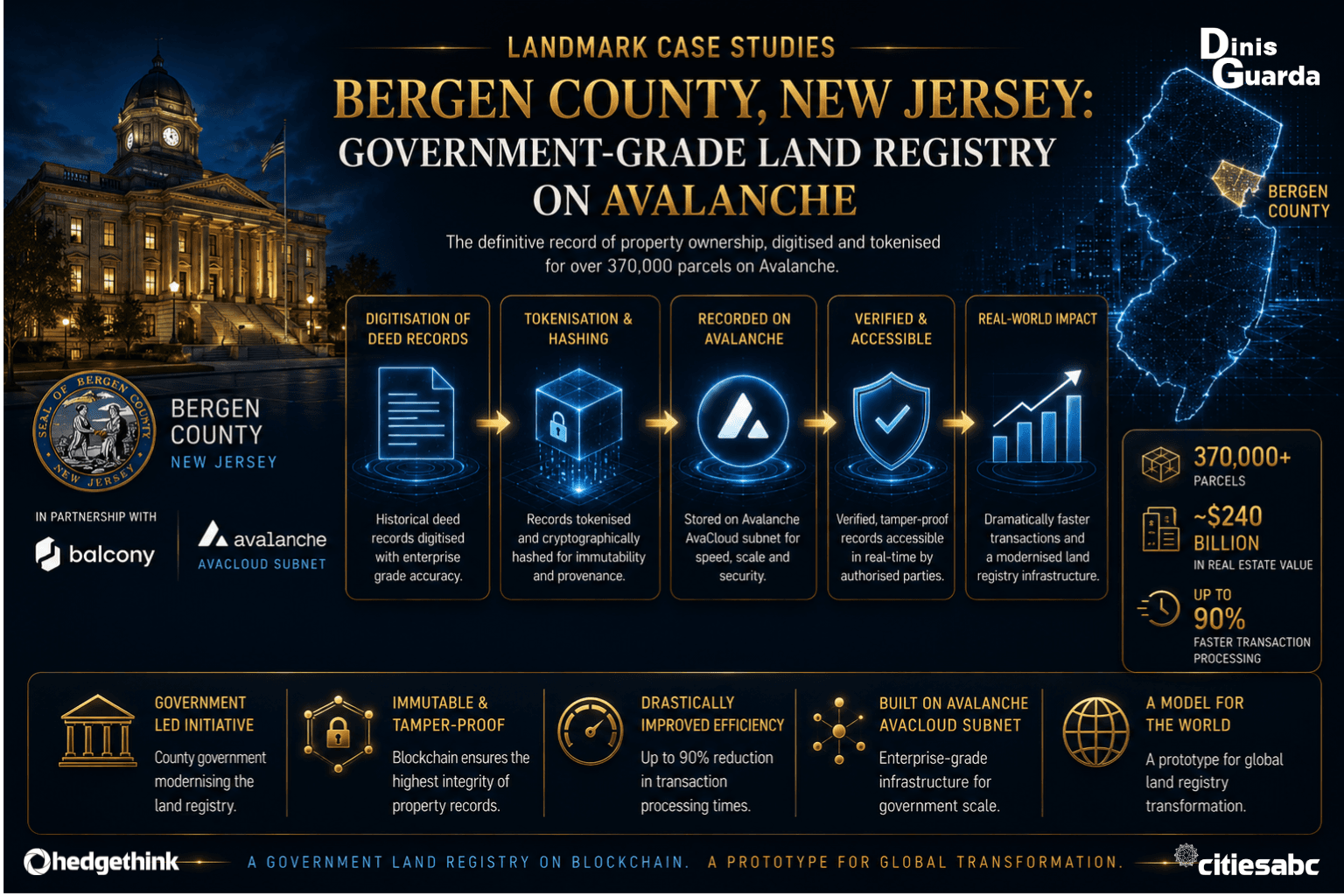
Perhaps the most strategically significant case study in the sector is the ongoing Bergen County initiative in New Jersey, where the county government, in partnership with infrastructure firm Balcony, is digitising and tokenising property deed records for over 370,000 parcels representing approximately $240 billion in real estate value using Avalanche's AvaCloud subnet architecture. Transaction processing times have been reduced by up to 90%.
This is not a private platform experiment. This is a government institution migrating the definitive record of property ownership, the land registry itself, onto a blockchain. When government land registries begin to adopt tokenised architectures, the structural gap between the on-chain digital token and the off-chain legal title begins to close. Bergen County is a prototype for a global transition.
Special Case Study: LynKey — Time-Sharing Tokenisation in Vietnam
"LynKey was not merely a platform. It was a proof that the ancient human desire to own a piece of paradise, to say this corner of the earth belongs, in some measure, to me, could be made universal through technology."
The Strategic Vision and Market Gap
The LynKey case study represents a pioneering framework in Fourth Industrial Revolution (4IR) property-tech, combining blockchain, artificial intelligence, and smart tourism to revolutionise the traditional real estate time-sharing model in Vietnam. Co-founded and led by Dinis Guarda, the project targeted the fractionalisation and digitisation of over $8 billion in premium luxury resorts and tourism experiences across Vietnam and the broader Asia-Pacific region.
Traditional time-sharing models in Vietnam's rapidly expanding luxury hospitality sector suffered from steep entry barriers, high administrative overhead, clunky localised paperwork, and extreme illiquidity. Standard time-share contracts locked buyers into 10–20 year commitments with no viable resale mechanism. The objective was to replace rigid long-term contracts with liquid, programmable, and universally tradable digital utility instruments.
The Ecosystem Architecture
The platform combined a native LYNK utility token with utility NFTs mapped to physical property-based experiences — luxury hotel nights, resort villas, exclusive tourism services. The "LynK + Key" concept decoupled financial asset tracking from user experiential licences, utilising the token framework as a keyspace mechanism to book, trade, and experience real-world luxury assets with instant digital execution.
This dual-layer architecture — fungible financial tokens (LYNK) paired with non-fungible experiential licences (NFTs) — solved a fundamental design problem in tourism tokenisation: the financial investment and the physical experience are intrinsically different in nature and require different token mechanics. Separating them allowed each layer to be optimised independently.
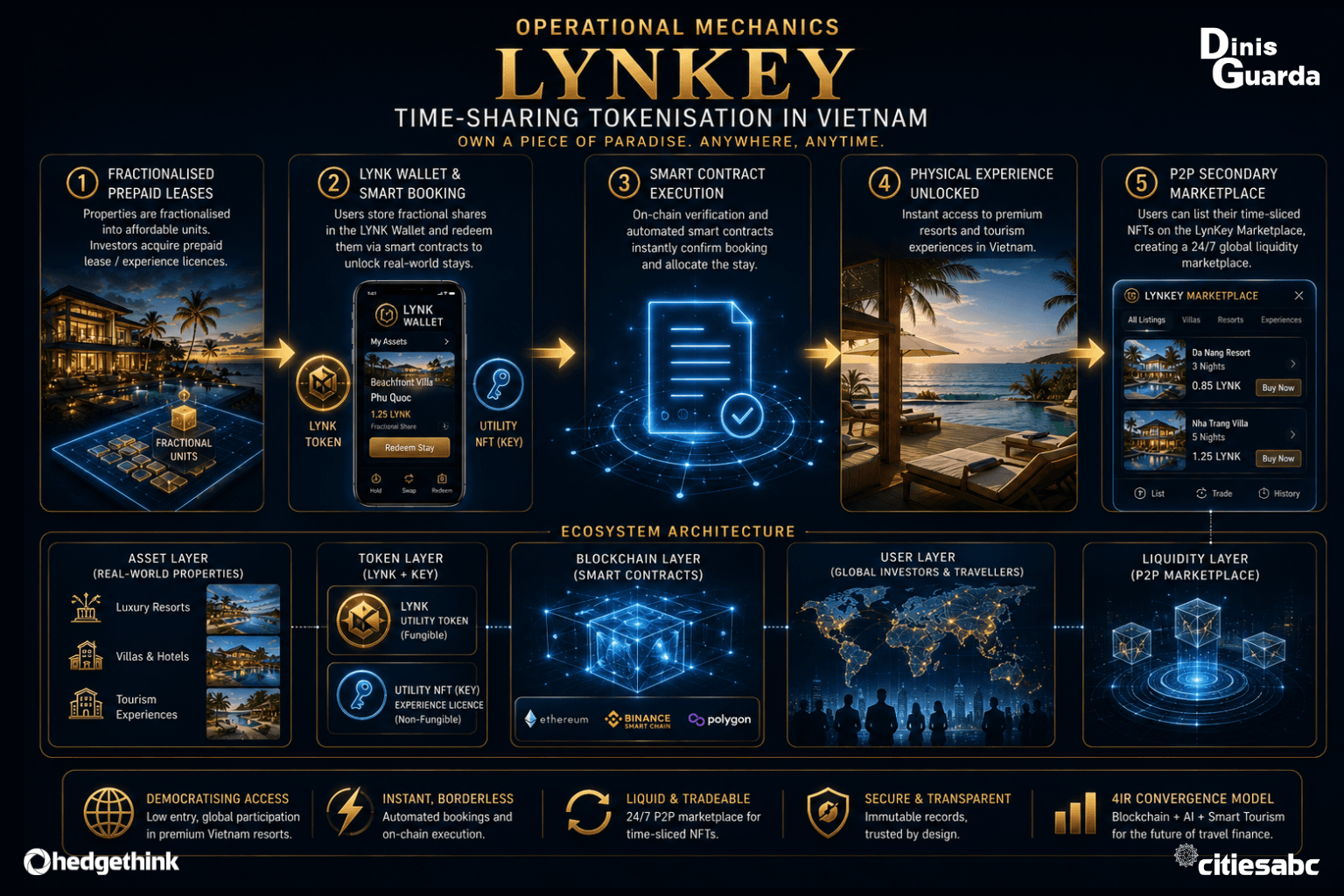
Operational Mechanics
- Fractional and Prepaid Leases. Properties were fractionalised into affordable units, allowing global and local investors to acquire a "prepaid lease" or experience licence with low capital constraints — democratising access to Vietnam's luxury resort sector for ordinary citizens and international retail investors alike.
- The LYNK Wallet and Smart Booking. Users managed assets through a dedicated LYNK Wallet where property-based fractional shares could be stored, swapped, or instantly redeemed to unlock physical holiday allocations via automated smart contracts — collapsing the traditional booking and ownership experience into a single digital interface.
- P2P Secondary Marketplace. Rather than remaining locked into a rigid decade-long timeshare, users could list their time-sliced NFTs on the LynKey Marketplace, creating an active 24/7 secondary market for global buyers. This is the liquidity innovation at the heart of the model: ownership of the experience, not merely the right to use it.
Regulatory Backing and Macro Timing
The implementation aligned with a critical legislative pivot point in Vietnam's approach to digital assets. The government accelerated pilot programmes through Resolution No. 05/2025/NQ-CP, establishing a five-year nationwide sandbox for trading digital tokens backed by real economic assets — one of the first national-level regulatory frameworks in Southeast Asia to explicitly legitimise tokenised real estate and tourism instruments.
The position championed throughout LynKey's development was that Real-World Asset tokenisation should not be treated as a distant 2030 objective but as an immediate inflection point. The LynKey deployment, set against Vietnam's surging inbound tourism and the government's regulatory liberalisation, represented precisely that confluence of technology readiness, market demand, and legislative will that characterises genuine inflection moments.
Outcomes and Industry Impact
The platform's legacy extends across four dimensions. First, the democratisation of premium tourism: international retail capital was connected directly to premium Vietnamese beach resorts and master-planned holiday destinations previously accessible only to institutional developers and wealthy domestic buyers. Second, the elimination of operational friction: on-chain KYC, fractional ownership registries, and immutable booking records removed middleman brokerage fees and cross-border currency conversion friction entirely.
Third, LynKey established a 4IR convergence model — the blueprint for integrating AI-driven personalisation, blockchain ownership verification, and smart contract automation into a unified consumer-facing tourism finance product. And fourth, the project directly informed subsequent theoretical frameworks on Programmable Finance Infrastructure and the convergence of tokenised assets, stablecoins, and AI agents — frameworks that have since been published across Benzinga, the AI.DNA Newsletter, and Businessabc.net.
Philosophical Position: The 12-to-24-Month Inflection Window

The Market Is Mispricing the Timeline
The market consensus that treats real-world asset tokenisation as a "2030 bet" is not a cautious reading of an uncertain situation. It is an empirically incorrect one. The argument is not speculative — it is grounded in infrastructure that already exists and transactions that are already processing.
JP Morgan's Kinexys platform (formerly Onyx) has processed over $1.5 trillion in transaction volume on permissioned Ethereum infrastructure. BlackRock's BUIDL tokenised fund operates simultaneously across Ethereum, Solana, Avalanche, and Polygon, normalising multi-chain institutional settlement at scale. The U.S. regulator has aligned capital treatment frameworks for tokenised securities. The European Union's MiCA regulation has delivered the first comprehensive crypto-asset framework in a major economy. The question is no longer whether the market will tokenise — it is which assets, on which chains, governed by which compliance protocols, will lead the transition.
Programmable Finance Infrastructure
The cornerstone of the current research agenda is the concept of programmable finance infrastructure: the argument that genuine economic value unlocks only when three technological layers converge.
The first layer is tokenised hard assets—real estate, gold, infrastructure — functioning as programmable stores of value with embedded governance and income distribution. The second is stablecoins, functioning as the instant, borderless, zero-friction settlement layer between those assets. The third is AI agents, functioning as autonomous, programmable treasury operators that can balance, route, and optimise capital allocations between tokenised assets and stablecoin positions in real time, without human intervention.
This three-layer convergence — explored extensively in the AI.DNA Newsletter's "Tokenised Trust: Gold, AI & Stablecoins" (Edition #18) and the Benzinga essay on RWA inflection — transforms money from a static instrument into an intelligent system. When a rental property's income stream is tokenised and distributed via stablecoin, managed by an AI treasury agent that dynamically reallocates yield into higher-performing tokenised assets, the entire architecture of wealth management changes.
The Digital Nervous System of Real Estate
Tokenisation's ultimate benefit is not fractional ownership per se, but the creation of what this analysis terms the "on-chain digital nervous system" of global real estate markets. When an asset is tokenised, its complete financial history — provenance, ownership chain, income distribution record, governance votes, maintenance expenditures — becomes permanently encoded on an immutable public ledger: transparent, auditable, and machine-readable.
This has profound implications for artificial intelligence. The chronic opacity of traditional property markets — where due diligence requires weeks of manual document review, where ownership chains across complex SPV structures defy rapid analysis, where rental income is recorded in incompatible proprietary systems — represents a massive friction cost borne by every participant. On-chain tokenisation eliminates that opacity. Enterprise AI agents can parse the complete financial history of a tokenised property in milliseconds, compressing risk analysis, compliance verification, and investment decision timelines from weeks to seconds.
Smart Cities and Urban Tokenisation
Through Citiesabc — the research platform dedicated to the intersection of urbanism, technology, and civilisational intelligence — a growing body of research examines how tokenisation can address the structural pressures of rapid urbanisation. This work explores the deployment of digital tokens and digital twins to fractionalise infrastructure funding, democratise local citizens' access to real estate appreciation, establish decentralised green-energy trading markets, and enable participatory urban governance.
The programmable city is not merely a technological proposition — it is a democratic one. If the infrastructure of a city — its roads, energy grids, transit systems, commercial districts — can be tokenised into fractional instruments accessible to citizens at low entry points, the relationship between resident and urban environment transforms from passive taxation to active co-ownership. This is the civilisational thesis underlying the Citiesabc research agenda.
The ancient grammar of property, first written in clay at Jericho, is being rewritten in code. The inflection window is not approaching. It is open.
Blockchain Ecosystems: The Infrastructure of Tokenised Property
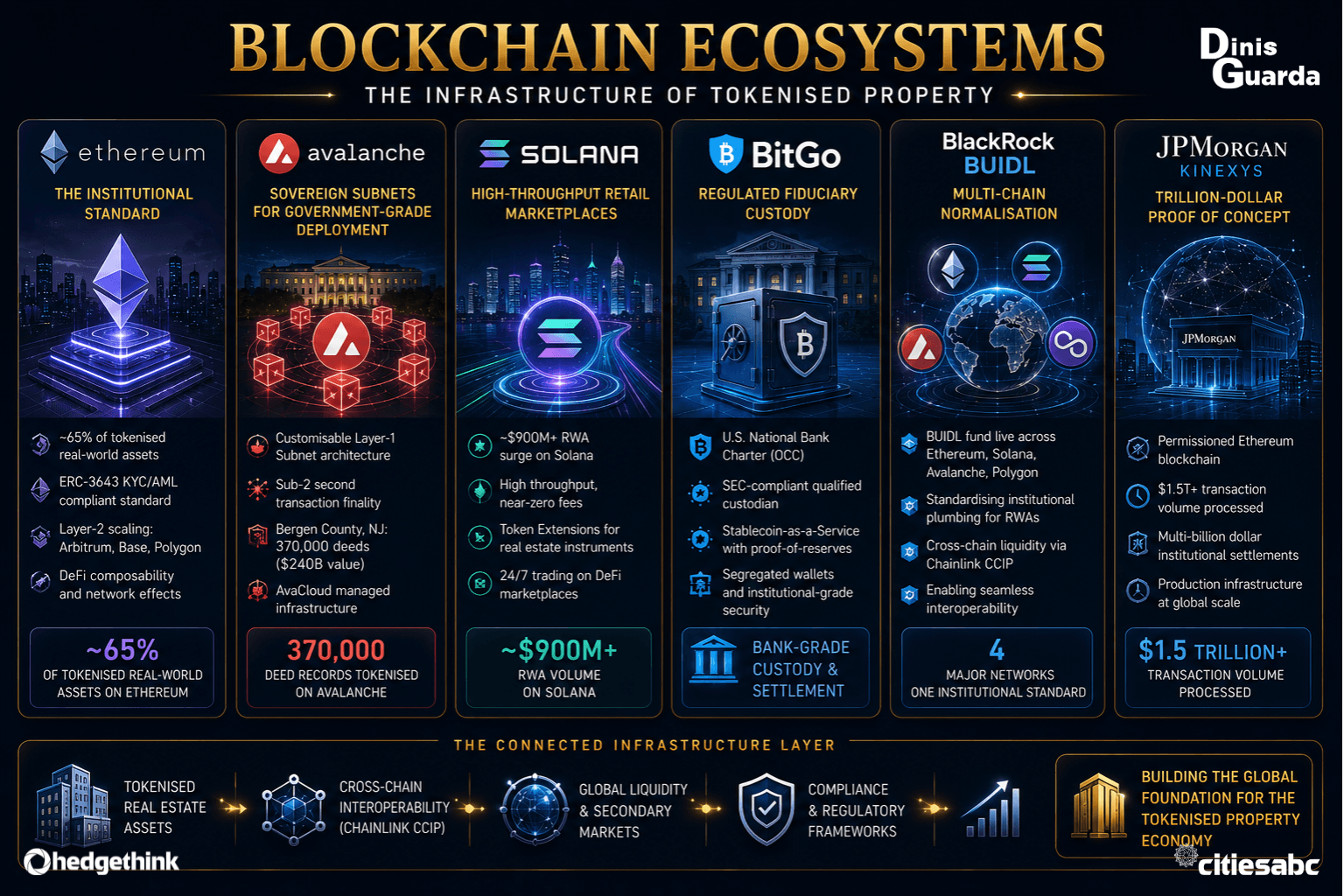
Ethereum: The Institutional Standard
Ethereum hosts approximately 65% of all tokenised real-world assets, functioning as the primary DeFi composability layer for the sector. Its dominance reflects network effects, developer depth, and the maturity of its compliance infrastructure — particularly the ERC-3643 standard which embeds KYC/AML verification directly into the smart contract logic governing every token transfer.
High transaction fees on the main Ethereum network have driven active real estate issuance toward Layer-2 scaling networks — Arbitrum, Base, and Polygon — which maintain Ethereum's security guarantees while reducing the per-transaction cost of daily rental yield distributions to near zero. The migration to Layer-2 has democratised Ethereum's compliance infrastructure for lower-value fractional transactions that would be economically unviable on mainnet.
Avalanche: Sovereign Subnets for Government-Grade Deployment
Avalanche has established itself as the premier network for large-scale enterprise and government-backed real estate projects through its customisable Layer-1 Subnet architecture. Each Subnet functions as a sovereign blockchain with its own validators, fee structures, and compliance rules, while retaining Avalanche's sub-2-second transaction finality.
The Bergen County, New Jersey initiative — digitising and tokenising 370,000 property deed records representing $240 billion in real estate value — is powered by AvaCloud, Avalanche's managed infrastructure platform. This deployment demonstrates that government land registries, the foundational legal infrastructure of all property ownership, can migrate onto blockchain architectures that preserve data sovereignty, regulatory compliance, and operational reliability at institutional scale.
Solana: High-Throughput Retail Marketplaces
Solana functions as the hyper-fast, low-cost engine transforming consumer-facing real estate markets, capturing an institutional RWA surge of nearly $900 million on its chain. While Ethereum handles rigid institutional structures, Solana's Token Extensions framework enables highly liquid real estate instruments that trade 24/7 with near-zero transaction fees.
Solana focuses on the velocity of money: platforms leverage its throughput to allow retail investors to trade real estate stakes or index pools instantly on decentralised exchanges, with the aspiration of functioning as a faster, globally accessible analogue to NASDAQ for real-world assets. The combination of BlackRock's BUIDL fund operating on Solana alongside Ethereum and Avalanche has conferred institutional legitimacy on its RWA infrastructure layer.
BitGo: Regulated Fiduciary Custody
As tokenised real estate migrates into institutional fund structures, regulated custody becomes non-negotiable. BitGo's achievement of a U.S. National Bank Charter from the Office of the Comptroller of the Currency — creating BitGo Bank & Trust in the same federal regulatory tier as traditional banks — positions it as the SEC-compliant qualified custodian for registered investment advisers managing tokenised real estate portfolios.
Beyond custody, BitGo provides Stablecoin-as-a-Service architecture: allowing real estate platforms to mint their own asset-backed compliant settlement tokens with continuous proof-of-reserves and segregated wallet structures. This transforms the yield distribution layer from a platform-specific mechanism into a regulated financial utility.
BlackRock and the Multi-Chain Normalisation
BlackRock's BUIDL institutional tokenised fund — now deployed across Ethereum, Solana, Avalanche, and Polygon — represents the most powerful normalisation force in the sector. By operating across multiple networks simultaneously, BlackRock is standardising the institutional plumbing of tokenised asset management, making it seamless for real estate fund managers to plug property tokens into a unified cross-chain liquidity network via interoperability protocols such as Chainlink's CCIP.
JPMorgan Kinexys: Trillion-Dollar Proof of Concept
Operating its proprietary permissioned Ethereum blockchain, JPMorgan has processed over $1.5 trillion in transaction volume, settling multi-billion-dollar institutional trades and automating collateral management at global scale. The Kinexys infrastructure proves that large commercial real estate blocks can be tokenised and instantly settled between multinational counterparties on permissioned ledger infrastructure without relying on the legacy correspondent banking system. This is not a pilot. This is production infrastructure operating at the scale of traditional financial markets.
Technical Architecture: ERC-3643 and AvaCloud
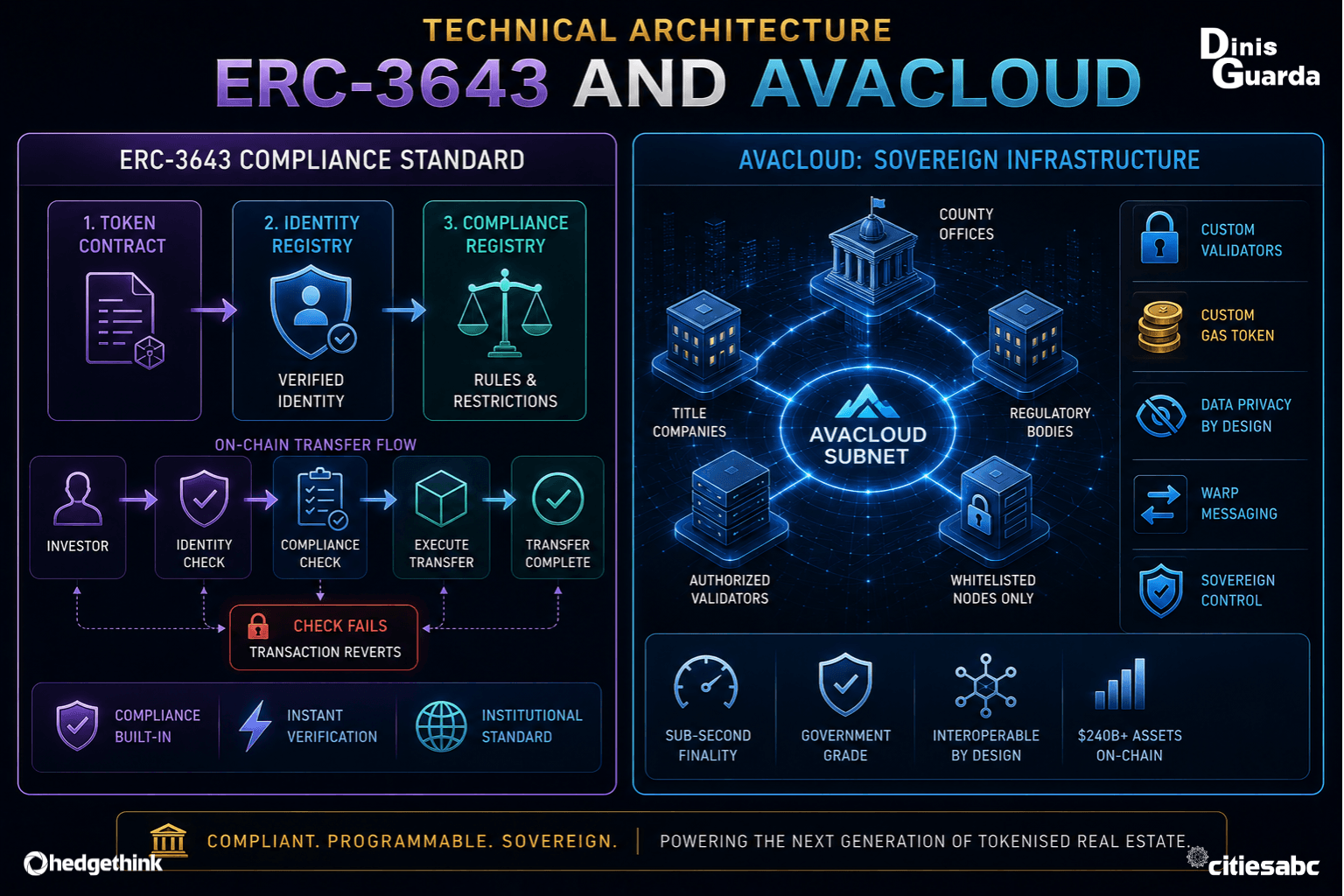
The ERC-3643 Compliance Standard
Traditional real estate securities cannot trade freely on open blockchains as speculative instruments do. Under standard ERC-20 token architecture, tokens transfer anonymously between any wallets. The application of that architecture to regulated securities — which are legally restricted to verified investors, subject to transfer limitations, and embedded with jurisdiction-specific rules — requires a fundamentally different approach.
ERC-3643 (formerly the T-REX protocol, developed by Tokeny) was created specifically to hardcode compliance, identity verification, and legal rules directly into the Ethereum smart contract governing every token. It has become the de facto institutional standard for permissioned security tokens.
The standard decouples token logic into three distinct smart contract layers. The Token Contract handles basic transactions, balance tracking, and transfer call initiation. The Identity Registry connects on-chain wallet addresses to verified real-world digital identities via ONCHAINID — cryptographic identity claims issued by accredited KYC/AML providers. The Compliance Registry holds the localised legal rules of the specific real estate asset — investor caps, geographic restrictions, mandatory holding periods, transfer lock-ups.
When an investor attempts to buy, sell, or transfer a tokenised real estate fraction, the smart contract executes a sequential cryptographic verification before the transaction can complete. If identity verification passes, the contract queries the Compliance Registry to enforce the asset-specific legal rules. If either check fails, the smart contract triggers an instant hard revert: the transaction fails on-chain without requiring human intervention, legal review, or regulatory overhead.
This architecture compresses what traditionally required lawyers, compliance officers, and multiple institutional sign-offs into an instantaneous, autonomous cryptographic verification. The regulatory compliance layer is not bolted onto the token as an afterthought — it is constitutive of the token itself.
Avalanche AvaCloud: Sovereign Infrastructure for Governments
While Ethereum's ERC-3643 standard operates at the application layer, the Bergen County land registry initiative required an entirely different architectural approach: a sovereign, isolated, government-grade operating environment with full control over validators, fee structures, and data privacy. This is achieved through Avalanche Subnets provisioned via AvaCloud.
Custom validator whitelisting restricts validation rights entirely to authorised nodes — county offices, trusted title companies, and state regulatory bodies — creating a sovereign consensus layer where only legally accountable institutions participate in the verification of property records. Gas token customisation ensures operationally predictable costs for the management of public property records. Land registries containing highly sensitive personal ownership data are isolated into permissioned ledgers, with public verifications managed through zero-knowledge proofs or cryptographic hashes — enabling any party to prove clear chain of title without exposing private ownership details to public blockchain surveillance. Through Avalanche Warp Messaging, the Bergen County ledger can securely communicate with other compliant Subnets or public networks without relying on third-party asset bridges, preserving the sovereignty of the government's data while enabling verified cross-chain information exchange.
Further Reading: Key Publications by Dinis Guarda
The following publications constitute the primary reference corpus for the philosophical and strategic arguments advanced in this analysis.
"Real-World Asset Tokenisation Is No Longer a 2030 Bet" — Published across Benzinga and distributed via major economic networks including DailyHunt and Sahm Capital, this essay represents the clearest statement of the market timing thesis: that the infrastructure for institutional real estate tokenisation is already operational, and that the 12-to-24-month inflection window has opened. The essay details the transition of tokenised assets into AI-readable, on-chain financial records and argues that markets are systematically mispricing the adoption timeline. Read on Benzinga
"Tokenised Trust: Gold, AI & Stablecoins" — AI.DNA Newsletter, Edition #18. This editorial constructs the full architectural formula for Programmable Finance Infrastructure, arguing that money is transforming from a static asset into an intelligent system through the convergence of tokenised hard assets, stablecoins, and AI treasury agents. First published on LinkedIn and Citiesabc with YouTube distribution, the piece has become a reference document for practitioners building the intersection of DeFi and real-world asset management. Read on Citiesabc
"Tokenomics and NFTs for Web 3.0" — Co-authored with Web3 ecosystem builders and published across Businessabc.net and IntelligentHQ, this research examines the design principles for self-sustaining token economies that map physical utility to digital assets. It directly addresses the legal and operational foundations for structuring time-sharing tokenisation networks of the LynKey type. Read on IntelligentHQ
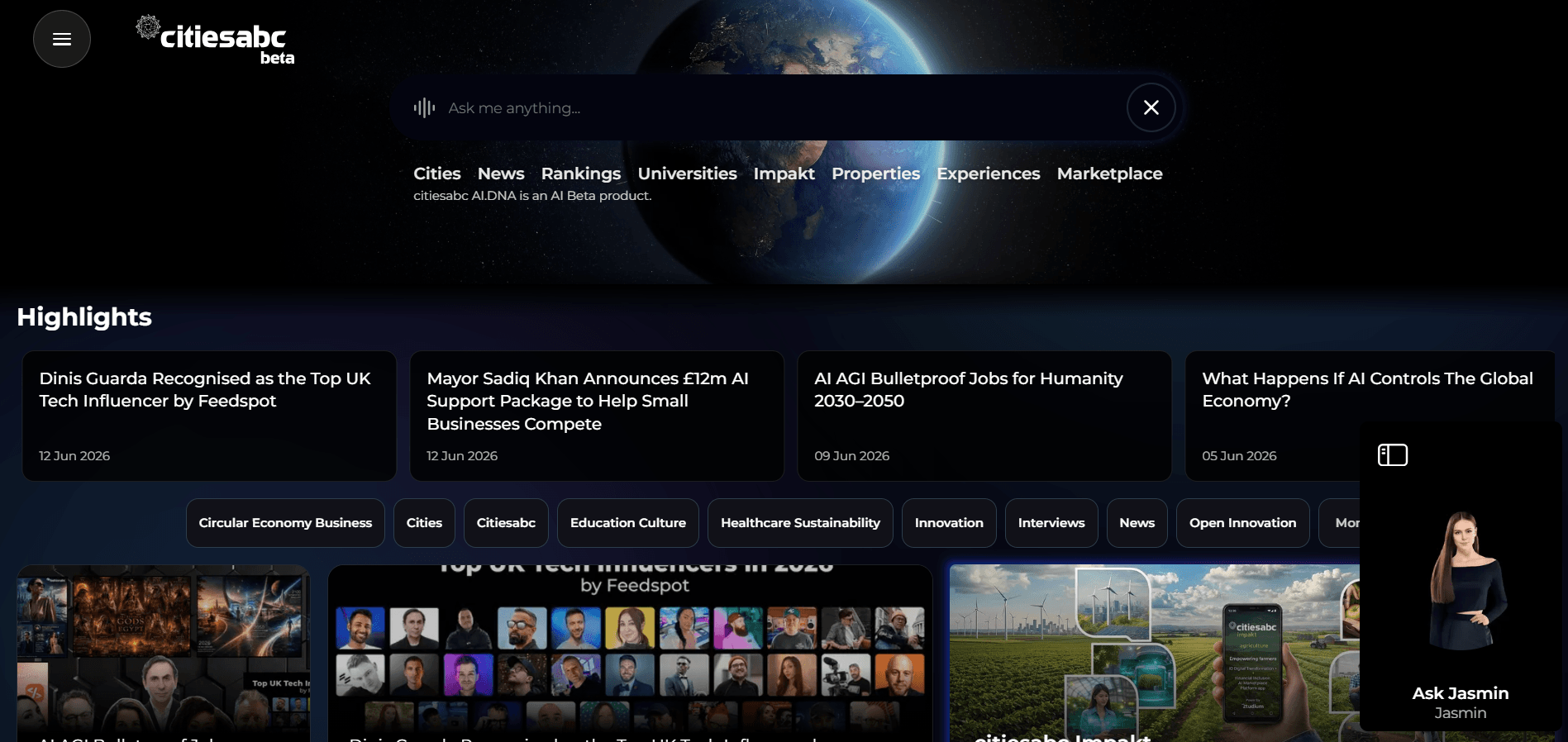
Smart Cities and Urban Tokenisation — Citiesabc. The Citiesabc platform publishes ongoing research into tokenisation as an urban governance and finance mechanism, including digital twin applications for infrastructure funding, decentralised green energy trading, and participatory citizen co-ownership models. The platform's smart tourism vertical — informed directly by the LynKey deployment — provides one of the most extensive bodies of practitioner research on APAC real estate tokenisation. Explore on Citiesabc
Sources
- Baum, A. (2021). Tokenisation: The Future of Real Estate Investment? Oxford Future of Real Estate Initiative, Saïd Business School, University of Oxford.
- Benedetti, H. & Rodríguez-Garnica, G. "Real Estate Tokenization: A Conceptual Framework." Journal of Property Research.
- Schär, F. University of Basel — Centre for Innovative Finance. Research on DLT neutrality principles and Title Token frameworks.
- Citi GPS. (2023). Money, Tokens, and Games: Blockchain's Next Billion Users and Trillions in Value. Citigroup Global Perspectives and Solutions.
- McKinsey & Company. (2024). Tokenized Financial Assets: From Pilot to Scale.
- Boston Consulting Group. (2024). Relevance of On-Chain Asset Tokenization.
- Roland Berger. Approaching the Tokenization Tipping Point.
- Tokeny & ERC-3643 Association. Real Estate Tokenization Handbook.
- Binance Research. Real World Assets: State of the Market.
- Guarda, D. "Real-World Asset Tokenisation Is No Longer a 2030 Bet." Benzinga / DailyHunt / Sahm Capital.
- Guarda, D. "Tokenised Trust: Gold, AI & Stablecoins." AI.DNA Newsletter, Edition #18. Citiesabc / LinkedIn.
- Guarda, D. "Tokenomics and NFTs for Web 3.0." Businessabc.net / IntelligentHQ.
- Vietnam Resolution No. 05/2025/NQ-CP — National Sandbox for Digital Token Trading.
- Avalanche / AvaCloud. Bergen County, New Jersey Land Registry Initiative.
- BlackRock. BUIDL Tokenised Fund — Multi-Chain Deployment Documentation.
- JPMorgan. Kinexys (formerly Onyx) — Platform Transaction Volume Reports.
- BitGo. OCC National Bank Charter Filing and Stablecoin-as-a-Service Architecture Documentation.


