


business resources
Ten Thousand Calls: What Each Price Tier Actually Costs a Month
16 Sept 2026

Per-million rates are unreadable as budget figures. Nobody knows what $0.73 per million means for their application, which is why price arguments go in circles until somebody multiplies. OrcaRouter passes list prices through, so the multiplication below produces bills rather than rate cards — and it turns the llm api pricing ladder into monthly numbers you can actually put in a budget.
Prices read 2026-09-09. Output lengths from EQ-Bench Creative Writing v3, an independent LLM-judged benchmark, read 2026-09-08.
Scenario A — generation, 10,000 calls a month
Assume a 500-token brief in and the model's own benchmark output length out.
| Model | Out tokens | Rate /1M | Per call | 10,000 calls |
| DeepSeek V4 Flash | 6,031 | $0.73 | $0.0044 | $44 |
| DeepSeek V4 Pro | 7,444 | $2.18 | $0.016 | $160 |
| Muse Spark 1.2 | 8,618 | $4.25 | $0.037 | $370 |
| Claude Opus 5 | 6,003 | $25.00 | $0.150 | $1,500 |
| GPT-5.6 Sol | 8,548 | $20.00 | $0.171 | $1,710 |
| Claude Fable 5.1 | 5,841 | $50.00 | $0.292 | $2,920 |
| GPT-6 Astra | 6,191 | $50.00 | $0.310 | $3,100 |
Input is excluded — at 500 tokens in against thousands out it is under 2% of the bill on every row.
The number that should stop you: GPT-5.6 Sol costs $210 a month *more* than Claude Opus 5 despite a rate that is 20% cheaper. Ten thousand calls is enough for a 42% verbosity difference to outrun a 20% rate advantage.
Scenario B — read-heavy, 10,000 calls a month
Now invert it: 20,000 tokens of document in, 500 tokens of summary out.
| Model | In cost | Out cost | Per call | 10,000 calls |
| DeepSeek V4 Flash | $0.0048 | $0.00037 | $0.0052 | $52 |
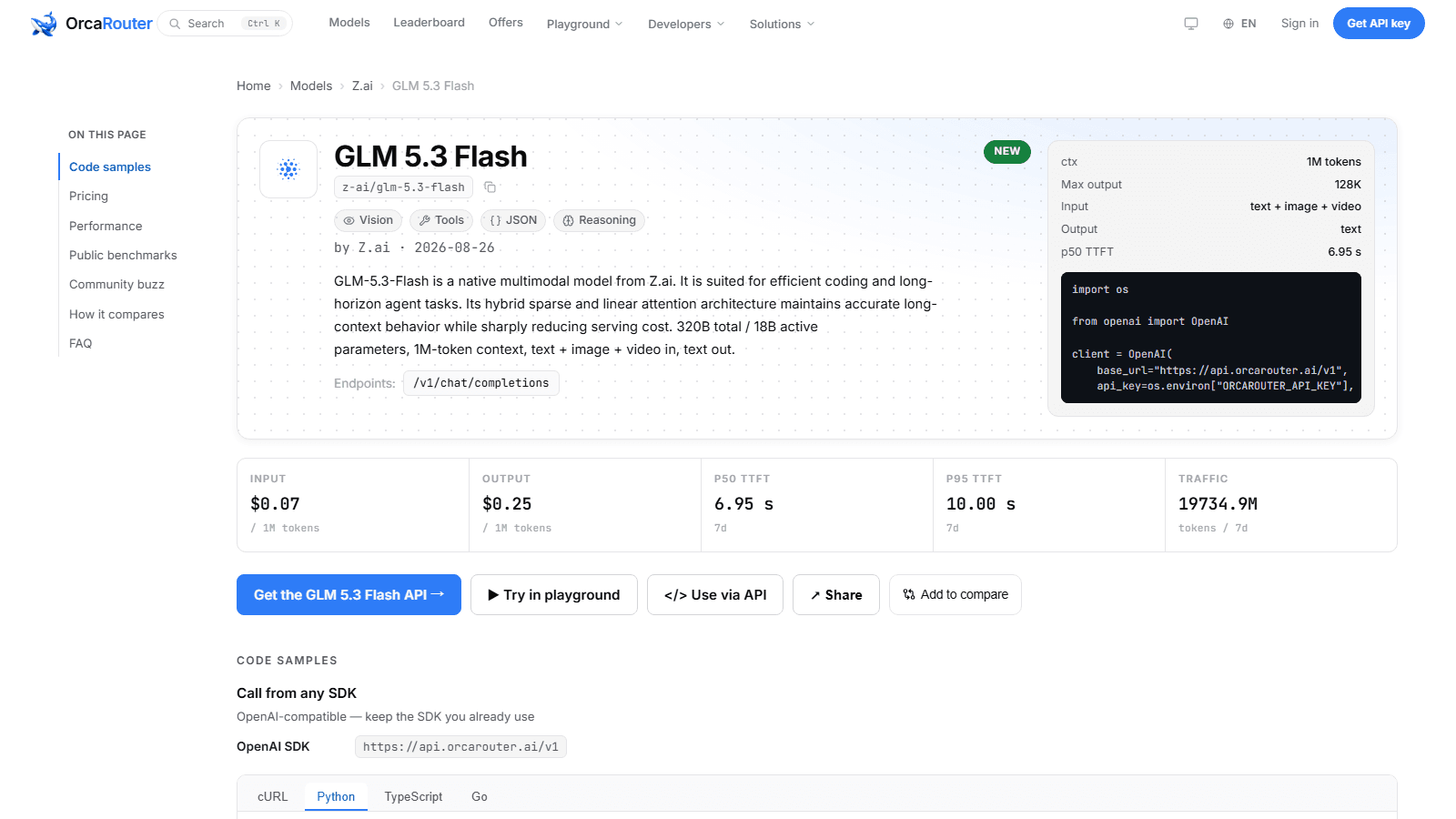
| GLM 5.3 Flash | $0.0014 | $0.000125 | $0.0015 | $15 |
| DeepSeek V4 Pro | $0.0146 | $0.0011 | $0.0157 | $157 |
| Gemini 3.5 Flash | $0.030 | $0.0045 | $0.035 | $345 |
| Claude Opus 5 | $0.100 | $0.0125 | $0.113 | $1,130 |
| GPT-6 Astra | $0.200 | $0.025 | $0.225 | $2,250 |
Two things flip. GLM 5.3 Flash becomes the cheapest by a distance — $15 against DeepSeek V4 Flash's $52 — because its $0.07 input rate is a third of DeepSeek's $0.24 and input is 93% of this call. And Gemini 3.5 Flash climbs, because its 6.0x output ratio is wasted here while its $1.50 input rate is six times DeepSeek's.
The cheapest model in scenario A is not the cheapest in scenario B. Same ten thousand calls, same models, different answer.
Where the volume thresholds actually sit
| Monthly calls | What decides the choice |
| Under 1,000 | Nothing here. The whole table is under $310. Pick on quality. |
| 1,000 – 10,000 | Tier boundaries start to show. Frontier vs workhorse is $1,500 vs $370. |
| 10,000 – 100,000 | The dominant line in the budget. Splitting traffic starts paying. |
| Over 100,000 | Model choice is a headcount decision. $440 vs $31,000 at 100k. |
Below a thousand calls, optimising this is optimising the smallest number in the operation — one engineer-hour costs more than the entire monthly spread. The instinct to save money here is usually misdirected effort.
The split, and what it saves
Above ten thousand, the shape that falls out is not a choice of model but a split by queue. Ten percent of traffic on the frontier tier and ninety on the utility tier, at 100,000 generation calls:
• all GPT-6 Astra: $31,000
• 10% Astra / 90% DeepSeek V4 Flash: $3,100 + $396 = $3,496
• all DeepSeek V4 Flash: $440
The middle row is the one most operations should be on: the tenth of output that someone will actually judge you by gets the expensive model, and the rest does not. That is a per-call model string, not an architecture change.
Four things these numbers assume
Output lengths come from creative-writing prompts. If your generation is constrained — a fixed JSON shape, a capped word count — lengths compress and converge, and the rate column becomes more trustworthy than scenario A suggests.
Caching is excluded. Where available it cuts the input side substantially, which matters most in scenario B where input is 93% of the call. I have not verified caching availability or discount structure across this model set, so it is left out rather than guessed at — but for a long fixed system prompt it can dominate everything above.
Reasoning tokens are excluded. On models with configurable effort, thinking billed as output can multiply scenario A severalfold from a setting rather than a model choice.
Rates move, usually down. These are read 2026-09-09. A cut on a model you already use requires no work from you and quietly improves every figure here.
Why the threshold is lower than people expect
Teams routinely postpone this analysis on the grounds that they are "not at scale yet". The arithmetic disagrees earlier than intuition does.
At 10,000 generation calls a month — a modest internal tool, not a consumer product — the spread across this ladder is $44 to $3,100. The upper end is real money in an annual budget and the lower end is not, and the gap appears without any of the volume people usually associate with scale.
What makes the threshold feel higher than it is: the per-call figures are absurdly small. Nobody looks at $0.310 and feels urgency. The unit hides the aggregate, and the aggregate is the only version that appears on an invoice.
Two practical consequences.
Compute the monthly figure before you choose, not after. Multiply once, at model-selection time, and the tier decision resolves itself. Doing it after the first surprising invoice means you now have a migration rather than a choice.
Re-compute when volume changes by an order of magnitude, not on a calendar. The right model at 1,000 calls and the right model at 100,000 are frequently different, and the crossing happens quietly — usually right after a launch, when nobody is looking at the cost line.
A final note on how to present these figures internally. Monthly totals get budget attention in a way per-call figures never do, but the number that actually wins the argument is usually the annual one against a named alternative: "this route costs $37,000 a year on the current model and $5,300 on the candidate" is a decision, while "$0.31 versus $0.044 per call" is a curiosity. Same arithmetic, different unit, very different outcome.
And one caution about the scenarios themselves. Both assume a single call shape, while real applications mix several — so the honest way to use these tables is as a template rather than as an answer: substitute your own measured mean input and output token counts per endpoint, keep the rates, and re-run the multiplication. The structure of the calculation transfers even when none of the specific numbers do, and it is the structure that most cost reviews are missing rather than the data.
The takeaway
Ten thousand generation calls a month runs from $44 to $3,100 across this ladder — a 70x spread — and the ordering is not the rate ordering: GPT-5.6 Sol's cheaper rate produces a $210 higher monthly bill than Claude Opus 5's. Flip to read-heavy work and the winner changes again, to GLM 5.3 Flash at $15. Below a thousand calls none of this is worth your attention; above ten thousand it is the largest line you control, and the answer is usually a split rather than a single pick.


