
business resources
The Accent Problem Nobody Talks About in Content Creation (And How AI Finally Solves It)
02 Jun 2026

There's a moment most content creators quietly dread. You've written a tight script, your visuals are polished, your edit is clean — and then you listen back to the voiceover and something feels off. Not wrong, exactly. Just generic. Flat. Like it could belong to anyone, anywhere. That's the accent problem, and it matters more than most people realize. A free AI accent generator is now the fastest practical fix — but before I explain why, let's talk about what's actually at stake.
Why Accent Is One of the Most Underestimated Variables in Audio Content
Humans are remarkably sensitive to voice. Long before we consciously process the words being spoken, we've already made a dozen subconscious judgments based on how those words are delivered — the rhythm, the intonation, the regional texture of the voice. Accent is a huge part of that.
For a brand running ads in the UK, a voice that sounds distinctly American doesn't just feel slightly mismatched. To a British listener, it quietly signals: this wasn't really made for you. That signal is subtle enough to be hard to pin down, but strong enough to affect engagement, trust, and ultimately conversion.
The same dynamic plays out in education. An online course targeting learners in Australia feels different — more familiar, more authoritative — when the narration sounds like it belongs to someone from that region. In corporate training, regional linguistic alignment helps employees absorb information more naturally. In entertainment and gaming, accent authenticity is often the difference between a character that feels real and one that breaks immersion every time they speak.
For a long time, the only solution was to hire voice actors with the right regional background. That works, but it's slow, expensive, and remarkably difficult to iterate on. Need to tweak one line of a script two weeks after delivery? You're booking a resession, coordinating schedules, and hoping the acoustic conditions in the studio match the original recording. It's a logistical headache that scales badly.
What an AI Accent Generator Actually Does
The technology has moved faster than most people have noticed. A modern AI accent generator doesn't just apply a generic regional filter on top of a flat robotic voice. It uses deep-learning models trained on real human speech patterns to replicate the authentic pronunciation, rhythm, pacing, and tonal quality of specific accents — producing output that sounds like a native speaker, not a caricature.
The best platforms support a genuinely wide range of options. American English in its various regional forms. British English from standard Received Pronunciation to more distinct regional varieties. Australian, Indian, Irish, Canadian, South African — and increasingly, non-English accent profiles for French, Spanish, German, Portuguese, and more.
Crucially, the output is text-to-speech, which means the workflow is non-destructive and infinitely flexible. You type your script, pick an accent and voice profile, generate the audio, and listen. If something isn't quite right — the pacing feels rushed, the tone is too formal, the emphasis lands on the wrong syllable — you adjust the text or the settings and regenerate within seconds. There's no booking, no waiting, no studio overhead.
That flexibility alone changes how audio content gets made.
Who's Actually Using This — and How
The use cases for this technology are broader than most people initially assume. Here's where the technology is genuinely earning its place:
Content creators and YouTubers working in English often find that a British or Australian accent lends a particular quality to their narration — more authoritative for some topics, more approachable for others. Rather than recording multiple takes or outsourcing to a voice actor, they can generate exactly the voice style they want from their finished script in minutes.
E-learning developers and course creators have some of the strongest use cases here. A course designed for an Indian audience benefits from narration that carries the right regional cadence. A module targeted at the UK market lands differently with a voice that sounds genuinely British rather than vaguely transatlantic. AI accent generation lets course teams localize the audio experience without rebuilding the entire production.
Marketing and advertising teams running campaigns across multiple regions have long known that matching the voice to the market improves performance. What's changed is the cost and timeline. Generating a British-accented version of a US ad script used to mean a full studio day; now it's a task that takes a few minutes.
Language learners and ESL educators use an AI accent generator as a teaching tool. Hearing the same sentence delivered in a neutral American accent versus a natural British one, or comparing how the same words sound in different English dialects, is genuinely valuable for learners building ear training and pronunciation awareness. It's difficult to replicate that exposure in a classroom without technology.
Podcasters and audiobook narrators use accent generation to give voice to characters from different regions. Rather than flattening every character into the same neutral voice, a single creator can produce genuinely distinct voices that serve the narrative.
Game developers and indie studios are using it for character dialogue prototyping, which used to be one of the most expensive parts of early-stage game development. The ability to quickly generate plausible dialogue in different accents makes iteration dramatically faster before committing to full voice actor sessions.
A Practical Look at the Workflow
Part of what makes a good AI accent generator worth recommending is the actual user experience, not just the technical capability. Here's what a typical workflow looks like with a solid platform:
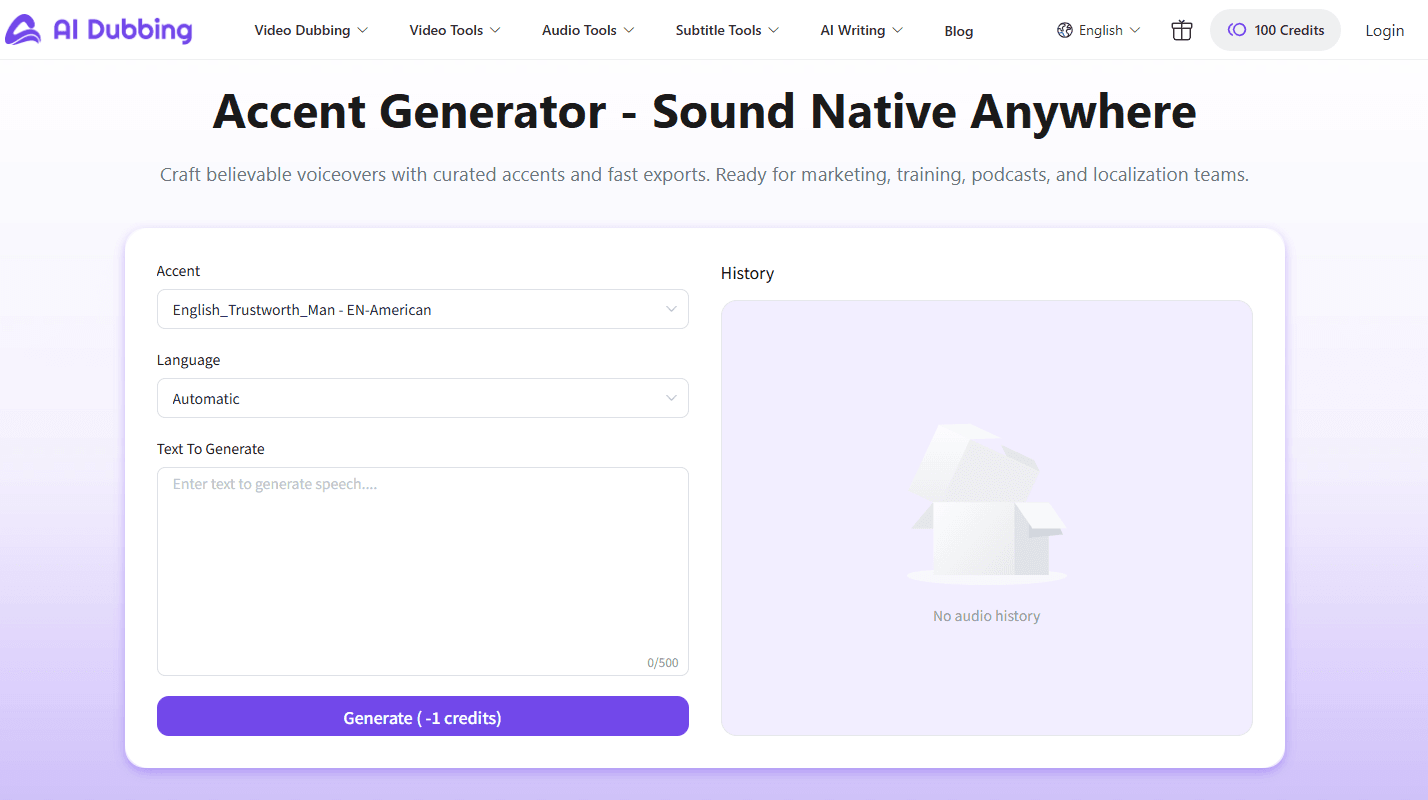
You start with your script — could be a few lines, could be a full page. Paste it in. The tool doesn't care whether it's dialogue, narration, marketing copy, or instructional text. Then you browse the voice library and select the accent, gender, age range, and speaking style that fits your project. Filter options let you narrow the choice down quickly rather than auditioning dozens of voices manually.
Hit generate, and the audio is ready within seconds. Listen to it directly in the browser. If the delivery isn't quite what you needed, adjust your text — sometimes small punctuation changes affect pacing significantly — or try a different voice from the same accent family. When you're satisfied, export in a standard audio format that works with every major editing tool on the market.
The whole process from script to usable audio file can genuinely take under five minutes for most short-to-medium length projects. For teams that previously spent days coordinating voice actor sessions, that compression of timeline is a meaningful productivity shift.
The Quality Question — Addressed Honestly
I want to address the obvious concern directly, because it's fair: AI-generated voices have a reputation for sounding robotic or unnatural, and that reputation isn't entirely undeserved when it comes to older technology.
The current generation of AI voice models is substantially better. The gap between AI and human voice actors has narrowed to the point where most listeners, in most listening contexts, cannot reliably distinguish them. The accent authenticity is particularly strong for major English varieties — American, British, Australian, Indian English — where the training data is rich and the models are well-developed.
For most practical applications — marketing videos, e-learning narration, explainer content, podcasting, app audio — the quality is more than adequate. The remaining edge cases are typically in highly expressive dramatic performance: emotional monologues, comedy timing, very culturally specific delivery. For those, human voice actors still hold an advantage. For everything else, AI has largely closed the gap.
A Note on Workflow Integration
One thing worth flagging for teams evaluating accent generation tools: the most useful platforms don't exist in isolation. The ability to generate accent audio is more powerful when it's part of a broader content production ecosystem — one that also handles video dubbing, subtitle generation, voiceover, and audio localization in a single place.
That kind of integration matters when you're working at any kind of scale. Managing separate tools for each step of the audio pipeline creates friction, version control issues, and additional cost. A platform that handles the full chain from text to localized audio to synchronized video output is meaningfully more useful than a standalone voice generator.
Conclusion
Accent is not a minor stylistic detail in audio and video content. It's one of the primary signals your audience uses to assess whether your content was made for them — or just adapted from something made for someone else. Getting it right used to require budget and logistics that most independent creators and small teams simply didn't have.
That constraint is gone now. The technology to produce natural, regionally authentic voice audio from text exists, it works well, and it's accessible without any recording equipment or audio engineering background.
If your content reaches — or aspires to reach — audiences in more than one region, it's worth spending an afternoon experimenting with what's possible through an accent generator online. The results tend to be more impressive than people expect the first time they try it.


