


The AI Visibility Index: How AI Engines Index, Create Visibility for Brands, Leaders, and Enterprise Value?
24 Jul 2026

And the risk of not taking this seriously?
The digital landscape has crossed a definitive threshold. For over two decades, enterprise visibility was dictated by traditional search engine algorithms: standard PageRank, keyword density, and backlink portfolios. Today, the fundamental mechanism of digital discovery has transformed. Modern consumers, B2B buyers, and decision-makers increasingly bypass standard search bars in favour of generative AI platforms, including ChatGPT, Claude, Perplexity, and Google AI Overviews.
When users ask these AI assistants for advice, recommendations, or vendor evaluations, the AI does not simply return a list of links. It generates a synthesised, definitive answer. If your brand or leadership team is omitted from that synthesised text, your business effectively does not exist for that buyer.
To navigate this shifting landscape, forward-thinking enterprises rely on a crucial marketing benchmark: The AI Visibility Index.
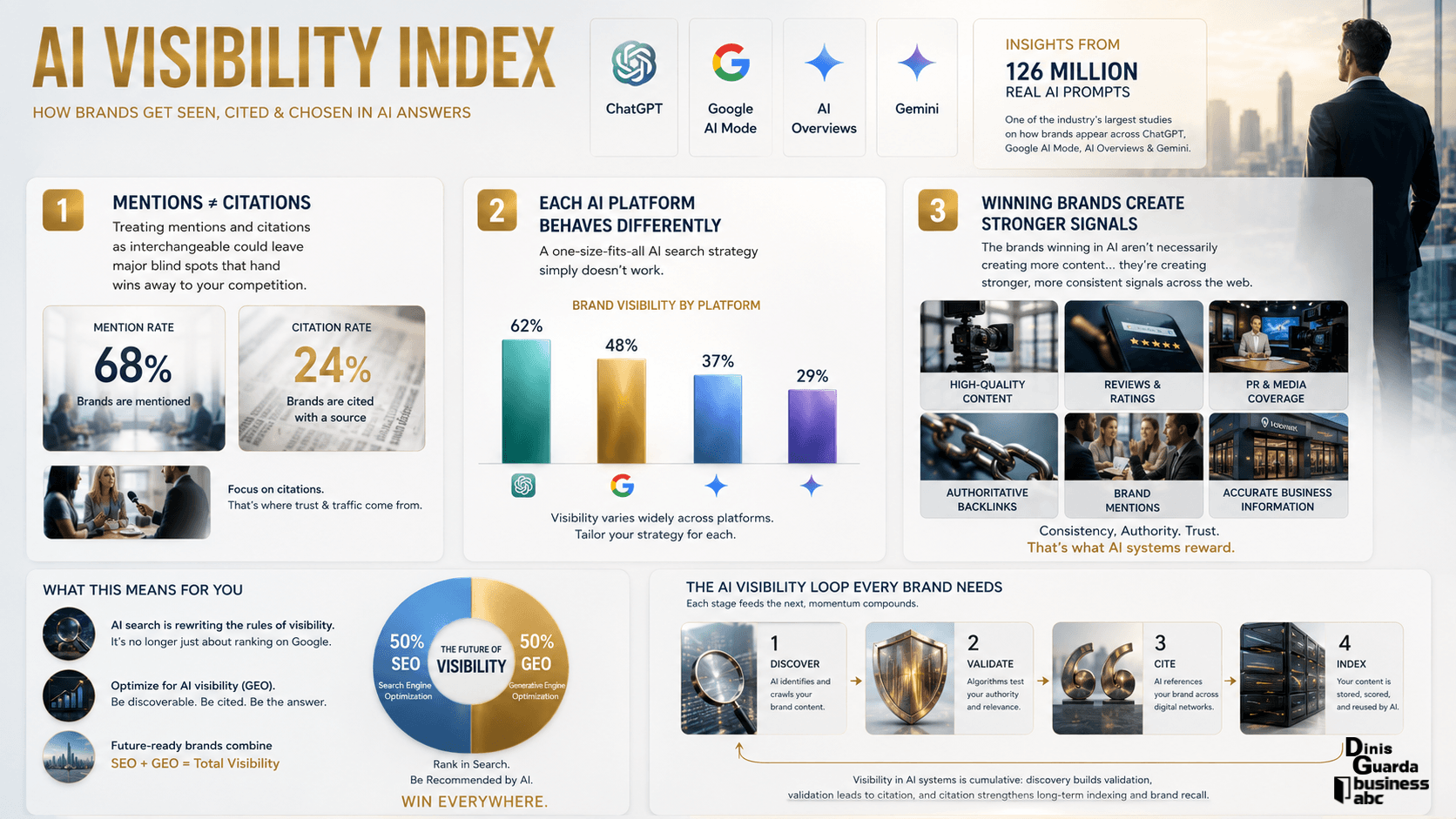
Executive Summary: Key Benchmark Metrics
| Metric / Benchmark | Value | Strategic Implication |
| Analysed AI Prompts (Semrush 2026 Study) | 126 Million | Demonstrates the global scale at which AI search is replacing traditional web search. |
| B2B Discovery Gap (2X B2B Index) | 96% Invisible | 96% of B2B brands fail to appear in top-of-funnel, non-branded AI prompts. |
| "Universal 36" Dominance | 36 Brands | Only 36 global brands maintain top-100 visibility across all major AI engines every month. |
| LLM Conversion Multiplier | 4.4x Higher | Users driven by LLM answers convert at 4.4 times the rate of traditional search traffic. |
| Gemini Mention-Citation Overlap | ~30% | Being mentioned in an AI response overlaps with direct domain citation only 30% of the time. |
| Integrated GEO + SEO Workflow Impact | 81% Success Rate | 81% of integrated teams report increased traffic/leads vs. 36% for siloed teams. |
Under the Hood: How AI Labs Index Businesses, Companies, and Leaders
To understand why an AI Visibility Index is necessary, leaders must first understand how Large Language Model (LLM) labs (OpenAI, Anthropic, Perplexity, Google) capture, structure, and retrieve information about businesses and executives.
Unlike traditional search engines that index individual Web pages based on HTML tags and anchor text, AI platforms build multidimensional entity representations. They evaluate content through two primary mechanisms: Parametric Pre-training Data and Real-Time Retrieval-Augmented Generation (RAG).
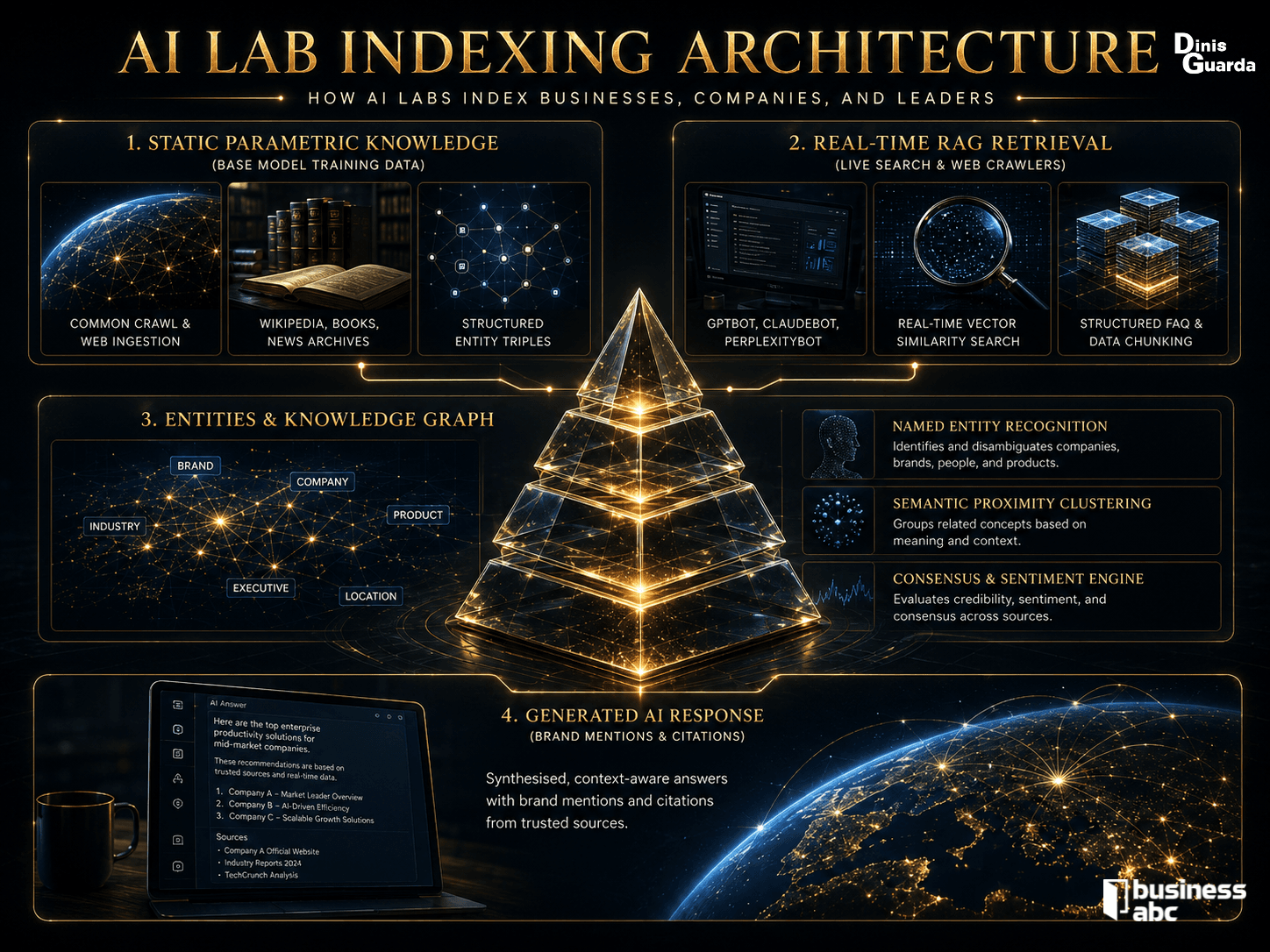
Mechanism A: Entity Extraction and Knowledge Graph Mapping
AI models treat brands, companies, products, and executives as Entities—nodes within a vast web of relationships (Knowledge Graphs).
- Disambiguation: The AI uses contextual signals to differentiate between homonyms (e.g., distinguishing "Apple" the technology firm from "apple" the fruit).
- Entity Triples: Information is stored in subject-predicate-object relationships, such as [Company X] -> [manufactures] -> [Enterprise CRM Software].
- Semantic Proximity: In vector space, concepts that frequently co-occur in authoritative texts are grouped closely together. If your company name regularly co-occurs with words like "reliable," "market leader," and "SOC2 compliant," the model forms a strong probabilistic association.
Mechanism B: Retrieval-Augmented Generation (RAG)
When a user inputs a prompt such as "What are the top three cybersecurity solutions for financial institutions?", live AI engines execute a multi-stage RAG pipeline:
- Query Decomposition: Breaking the prompt into core criteria (Cybersecurity + Financial Sector + Enterprise-Grade).
- Vector Web Search: Crawling the live web (via bots like PerplexityBot or GPTBot) to fetch topically relevant text chunks.
- Synthesis & Ranking: Comparing retrieved chunks against internal confidence weights, filtering for consensus, and formatting a final recommended list.
What Is an AI Visibility Index? The 4 Key Dimensions
An AI Visibility Index provides a composite score from 0 to 100 that quantifies how reliably, prominently, and accurately an AI platform highlights a brand or leadership team across thousands of relevant prompts.
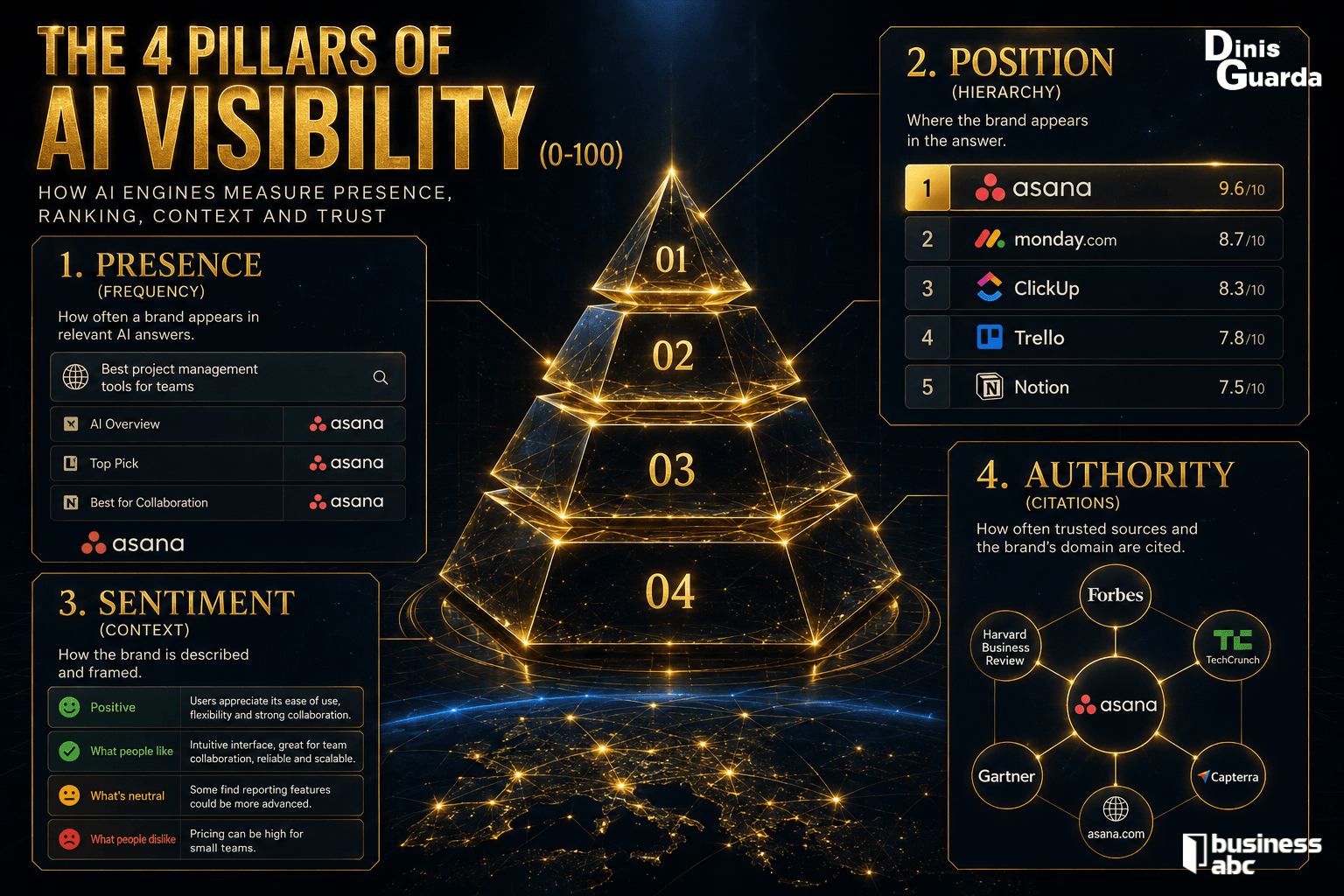
Pillar 1: Presence (Mention Share of Voice)
- What it Measures: The raw percentage of times a brand appears in AI outputs when users ask relevant industry or transactional prompts.
- Why It Matters: If 100 prospects ask ChatGPT to recommend enterprise accounting software, and your brand is mentioned 15 times, your Presence Score is 15%.
Pillar 2: Position (Hierarchy & Recommendation Priority)
- What it Measures: Where your brand appears within the AI's generated response.
- Why It Matters: AI responses follow strong psychological framing. Being listed as the #1 Recommended Solution carries exponentially more weight than being buried at the bottom of a bulleted list of ten alternatives.
Pillar 3: Sentiment & Contextual Framing
- What it Measures: The tone, framing, and qualifications applied to your brand.
- Why It Matters: AI models do not just list names—they assign qualitative adjectives. An engine might mention a company positively ("Known as the gold standard for enterprise security") or with heavy caveats ("Offers robust features, but users frequently report high costs and complex implementation").
Pillar 4: Authority & Citation Share
- What it Measures: How frequently the AI engine explicitly links to and cites your domain as a primary source of factual evidence.
- Why It Matters: Mentions drive awareness, but direct domain citations drive direct, high-intent click-through traffic.
Findings from Global Research & Benchmarks
Recent studies, including the Semrush 2026 AI Visibility Index (analysing 126 million real user prompts across ChatGPT, Claude, Gemini, and Google AI Overviews) and specialised enterprise indexes like the 2X B2B AI Visibility Index, reveal critical shifts in how market share is won.
Industry leaders behind the research have been direct about what the numbers mean for marketing organisations. Andrew Warden, Vice President of Marketing at Adobe and former CMO of Semrush, has said:
AI is now intrinsic to the default search experience, and brands need to adapt. The name of the game is Brand Visibility." Rachel Thornton, CMO of Adobe Enterprise, framed the stakes even more starkly: "Your AI narrative is becoming the decisive entry point to your customer experience.
The same research also points to a measurement gap most organisations haven't closed. Semrush's data shows a large share of marketing leaders cannot accurately measure their brand's visibility inside AI-generated answers, and only a small fraction have tools capable of tracking every relevant metric across platforms, underscoring why a dedicated AI Visibility Index, rather than repurposed SEO dashboards, has become essential.
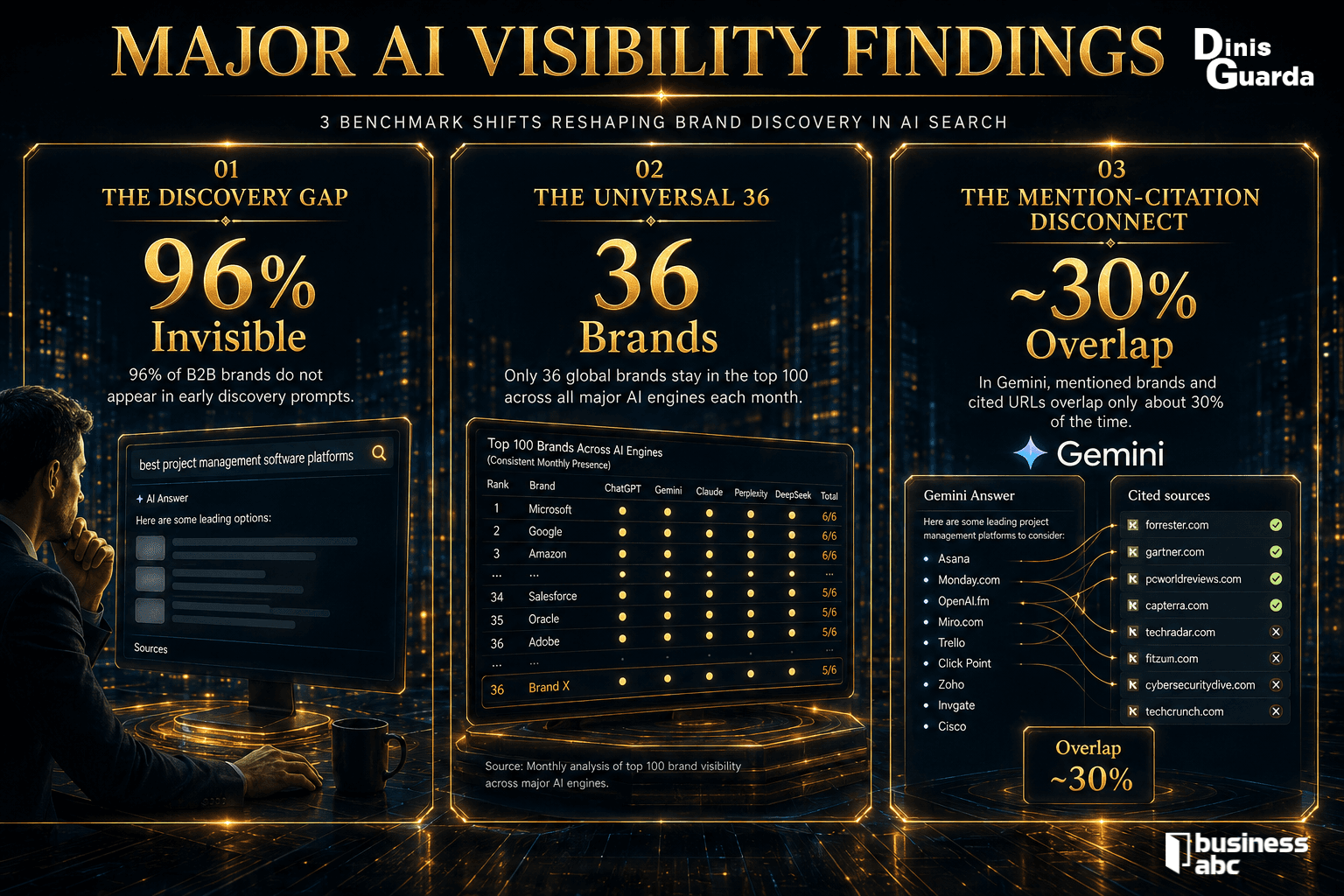
The B2B Discovery Gap
The 2X B2B AI Visibility Index revealed that 96% of B2B brands are completely invisible during early discovery phases. While brands show up when buyers explicitly search for their exact business name, they fail to appear when buyers ask broad, high-intent discovery questions like:
What are the best automated compliance platforms for healthcare startups?
The "Universal 36"
Out of thousands of enterprise organisations analysed across 126 million prompts, only 36 global brands (such as Amazon, Apple, Reddit, Wikipedia, and YouTube) maintained top-100 visibility across every major AI platform every single month. These companies share three distinct traits:
- Universal brand recognition across diverse datasets.
- Continuous user-generated discussions (e.g., active subreddits, community forums).
- High machine-readability and structured web infrastructure.
Case Study: Patagonia's "External Reputation Moat"
How does an outdoor clothing manufacturer achieve a world-class AI Visibility Score of ~80 across multiple platforms?
Semrush data indicates that Patagonia’s visibility is not driven primarily by self-published marketing collateral on its owned website. Instead, AI engines consistently recommend Patagonia because of third-party consensus validation.
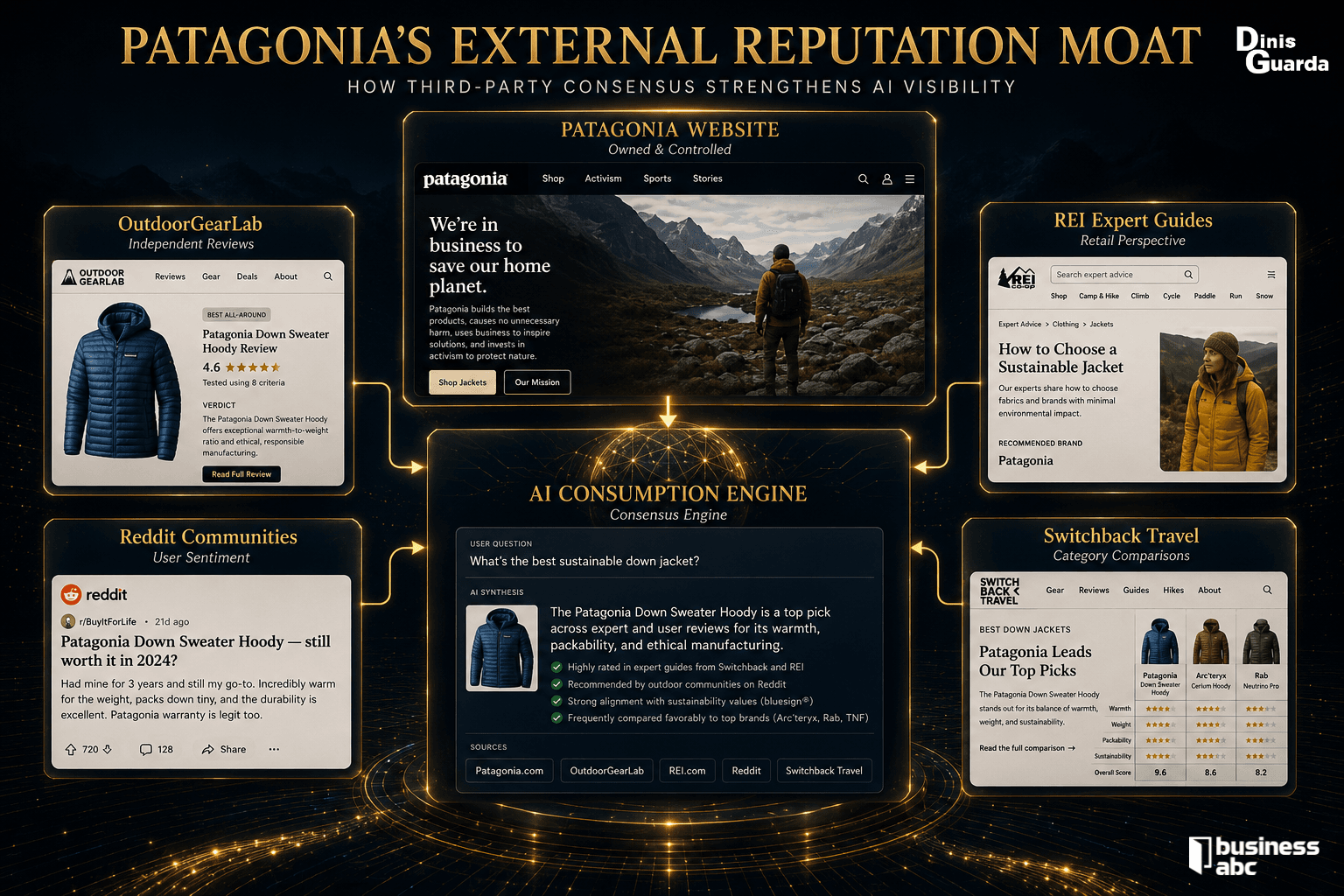
When an AI engine synthesises a response regarding sustainable outerwear, it cross-references independent publishers (GearJunkie, REI, Switchback Travel, OutdoorGearLab) alongside thousands of organic community discussions on Reddit. Because all third-party signals converge on identical sentiment and factual points, the AI engine cites Patagonia with absolute probabilistic confidence.
Case Study: Applying the Reputation Moat at Entity Level — the businessabc Official Wiki Page
Patagonia's advantage is scale: decades of independent press, community discussion, and structured retail data all pointing at the same entity. Most founders, executives, and growing companies don't have that luxury yet. What they can control is whether the first layer of their entity representation, the structured, canonical facts an AI system encounters when it tries to disambiguate who they are, is clean, verifiable, and machine-readable.
This is the gap the businessabc Official Wiki Page is built to close, and it maps directly onto the four pillars above:
- Build a Verified Digital Identity – Transform fragmented online information into a single, verified, authoritative Businessabc Wiki Page that becomes the trusted source for your brand, organisation, or professional profile.
- Increase Visibility Across Search & AI – Optimised for both search engines and generative AI platforms, helping your profile become more discoverable, understandable, and referenceable as AI increasingly shapes how people find information.
- Strengthen Trust & Reputation – A verification badge, official information, and supporting references enhance authenticity, credibility, and confidence among customers, investors, partners, media, governments, and other stakeholders.
- Future-Proof Your Brand Presence – As AI becomes the primary gateway to information, a verified Businessabc Wiki provides the digital infrastructure needed to support long-term reputation, discovery, and business growth.
Learn more : https://businessabc.net/official-wiki-page
Four Reasons Enterprise Leaders Need an AI Visibility Index
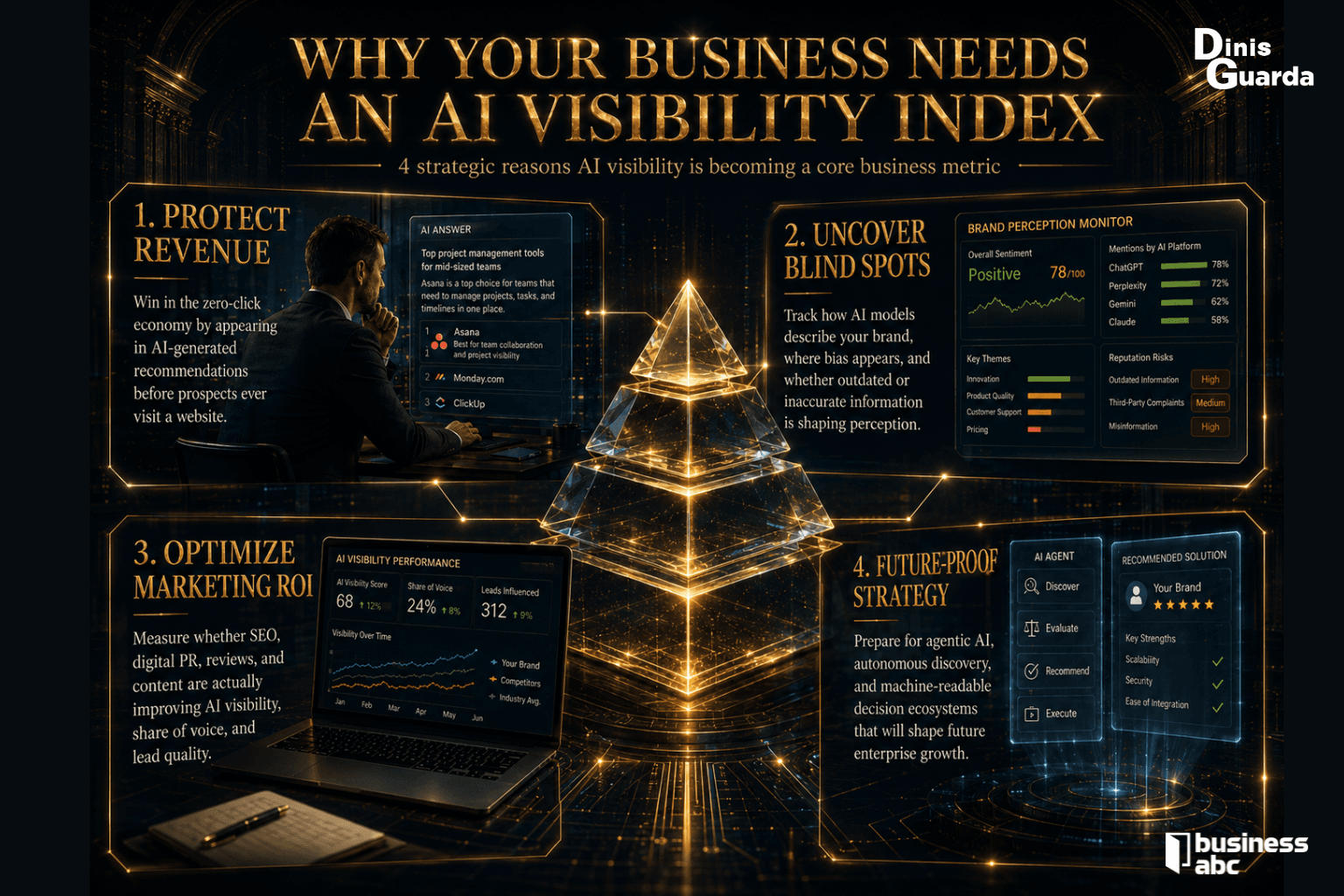
1. Protect Revenue from the "Zero-Click" Economy
In traditional search, a user enters a query, sees a page of ten blue links, and clicks through to various websites. In generative search, the user receives an inline answer—creating a "zero-click" environment.
- High Conversion Value: Users who perform searches via LLMs are 4.4 times more likely to convert than traditional search engine visitors because they have already been pre-qualified by the AI's synthesised recommendation.
- The Risk of Invisibility: If an AI model fails to mention your company during a recommendation summary, you lose high-intent prospects before they ever reach a web browser.
2. Identify Brand Reputation and Sentiment Blind Spots
AI models do not just summarise facts—they synthesise opinions, weigh customer reviews, and assign tone.
- Hallucination Monitoring: An AI Visibility Index alerts leaders if language models are spreading outdated pricing, hallucinating non-existent features, or citing defunct executive leadership.
- Sentiment Tracking: Indexes expose hidden biases where an AI consistently ranks a direct competitor higher due to superior third-party review coverage.
3. Justify and Optimise Marketing Budgets
Traditional SEO metrics (keyword volume, domain authority) fail to predict whether an AI assistant will recommend a business.
- Proving GEO ROI: Marketing executives need concrete, quantifiable metrics to demonstrate the return on investment (ROI) of Generative Engine Optimisation (GEO).
- Eradicating Waste: Visibility tracking shifts marketing investments away from legacy keyword stuffing toward high-impact entity building and digital PR.
4. Inform Future-Proof Corporate Strategy for Agentic Search
The market is shifting toward Agentic AI—autonomous AI agents empowered to perform research, select vendors, execute bookings, and make B2B procurement decisions on behalf of human users.
- Machine-Readability: An AI Visibility Index measures how easily autonomous agents can read, understand, and transact with your enterprise.
Architectural Comparison: Traditional SEO vs. Generative Engine Optimisation (GEO)
To systematically elevate an AI Visibility Score, organisations must shift from traditional search strategy to Generative Engine Optimisation.
| Feature / Dimension | Traditional SEO Pipeline | Generative Engine Optimisation (GEO) |
| Primary Target | Web Crawlers & Indexing Algorithms (e.g., Googlebot). | LLMs, Vector Databases, and RAG Engines (e.g., GPTBot, Perplexity). |
| Optimisation Focus | Target Keywords, Meta Tags, Page Speed, Backlink Counts. | Entity Clarity, Answer-First Content, Structured Data, Semantic Depth. |
| Primary Data Source | Owned Web Domain (Website Landing Pages). | Distributed Consensus (G2, Trustpilot, Reddit, Digital PR, YouTube). |
| User Interaction | User clicks blue link $\rightarrow$ Lands on website $\rightarrow$ Consumes page. | The user receives a direct synthesised answer inside the AI chat interface. |
| Key Metric | Organic Traffic, Keyword Rankings, Click-Through-Rate (CTR). | AI Visibility Score, Share of Voice, Sentiment Score, Citation Rate. |
Practical Playbook: How to Improve Your AI Visibility Score
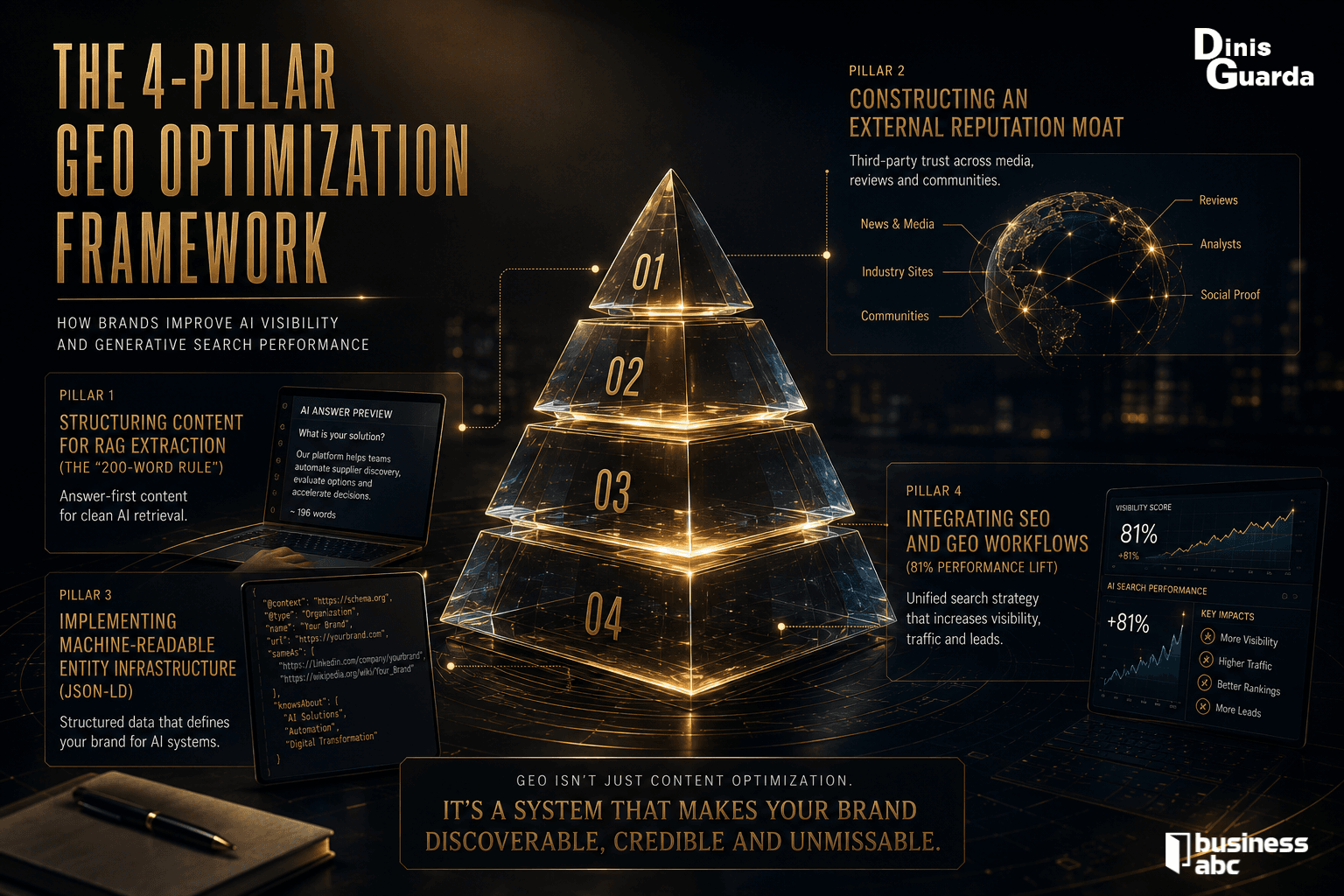
Pillar 1: Structure Content for Direct RAG Extraction (The "200-Word Rule")
Real-time RAG engines evaluate a page's topical relevance primarily on its introductory sections.
- The Strategy: The first 200 words of any key landing page, blog post, or whitepaper should directly and completely answer the primary user query without fluff or promotional filler.
- Format: Structure content using "TL;DR" summary blocks, concise bullet points, and explicit HTML headers (##, ###).
Example of Answer-First Structuring:
Question: What is the standard implementation timeline for Enterprise ERP Software?'
Optimised Answer Block:
The standard enterprise ERP implementation timeline ranges from 6 to 18 months, depending on organisational complexity. Phase 1 (Discovery & Planning) requires 2–3 months; Phase 2 (Data Migration & Configuration) requires 3–6 months; Phase 3 (Testing & Training) requires 2–4 months; and Phase 4 (Go-Live & Support) spans 1–3 months.
Pillar 2: Construct an External "Reputation Moat"
Because AI engines rely heavily on multi-source consensus, owned website optimisation accounts for less than half of your AI visibility.
- Third-Party Directory Management: Maintain active, highly rated profiles on authoritative industry platforms (e.g., G2, Capterra, Trustpilot, Google Business Profile).
- Community Engagement: Monitor and participate in community discussions on platforms like Reddit, Quora, and specialised industry forums. LLMs heavily ingest these spaces to understand authentic user sentiment.
- Digital PR: Secure mention placements in independent news outlets and industry review blogs, ensuring your brand name co-occurs with your core business category.
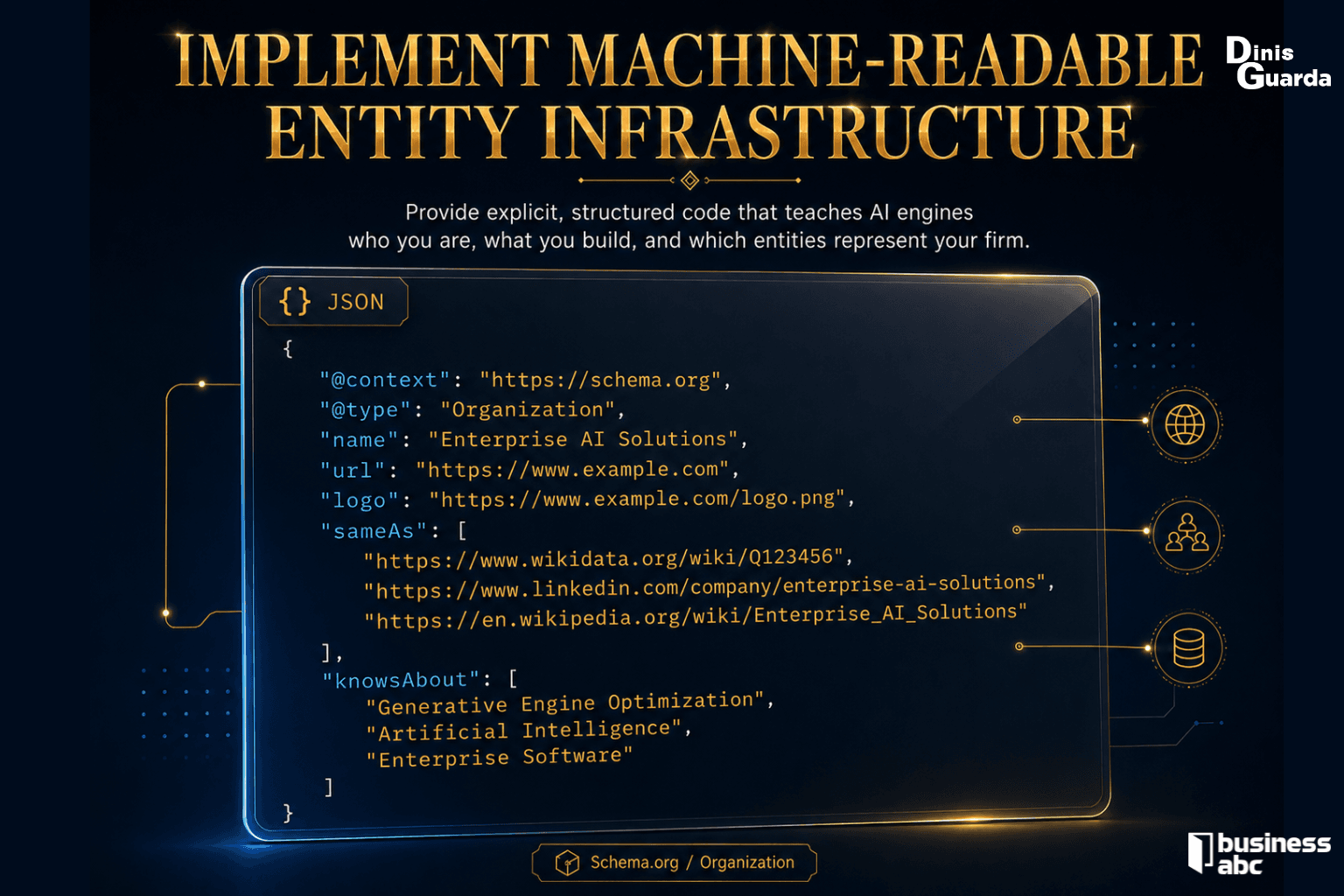
Pillar 3: Implement Machine-Readable Entity Infrastructure
To eliminate ambiguity, provide explicit, structured code that teaches AI engines exactly who you are, what products you build, and which leaders represent your firm.
Pillar 4: Integrate SEO and GEO Workflows
Managing SEO and AI Optimisation in separate corporate silos undermines performance. Data from the Semrush study demonstrates that 81% of organisations with fully integrated SEO and AI workflows saw significant increases in traffic and leads, compared to only 36% of organisations managing them separately.
Strategic Imperatives for Business Leaders
As artificial intelligence platforms solidify their role as the primary interface for decision-making, traditional web traffic metrics no longer offer a complete picture of brand performance. The emergence of zero-click answers, agentic decision-making, and consensus-driven AI recommendations requires a fundamentally new approach to digital strategy.
By adopting an AI Visibility Index, enterprise leaders gain clear, actionable visibility into how language models perceive, frame, and recommend their business. Tracking and optimising these scores allows organisations to protect market share, eliminate brand sentiment blind spots, and ensure long-term competitiveness in an AI-driven economy.
The pattern across every finding in this report is consistent: AI engines reward entities that are unambiguous, well-documented across independent sources, and structurally easy to parse. That is not a one-time campaign—it is infrastructure. The 36 brands that dominate every AI platform every month didn't get there through a single press release; they got there because thousands of independent, consistent signals about who they are and what they do have accumulated across the web over years.
For most organisations and individual leaders, the practical starting point is smaller and more immediate: making sure the canonical facts about who you are and what you do exist somewhere structured, verifiable, and citable. Everything else in the GEO playbook—reputation moats, content structuring, workflow integration—builds on that foundation. Without it, even the best content strategy is optimising a page that AI systems can't confidently attribute to you in the first place.
The window to build this foundation proactively, rather than reactively, is now. Once an AI Visibility Index has already flagged 96% of your category as invisible to top-of-funnel buyers, the fix is a longer, more expensive project than the one available today.
Sources
- Semrush, 2026 AI Visibility Index — ai-visibility-index.semrush.com
- Semrush, "Semrush Releases Expanded 2026 AI Visibility Index, Analyzing 126 Million AI Search Prompts" — semrush.com/news
- Business Wire, "Semrush Releases Expanded 2026 AI Visibility Index, Analyzing 126 Million AI Search Prompts" — businesswire.com
- World Business Outlook, "Semrush Launches 2026 AI Visibility Index Based on 126M AI Prompts" — worldbusinessoutlook.com
- Yahoo Finance, "Semrush Releases Expanded 2026 AI Visibility Index, Analyzing 126 Million AI Search Prompts" — uk.finance.yahoo.com
- Jeff Payne Show, "The Two Currencies of AI Visibility" — jeffpayne.net
- businessabc, Official Wiki Page — businessabc.net/official-wiki-page
- Businessabc wikis - Own Your Al ID Wiki Profile — youtu.be/K_14pZyfoTA


