
Businesses
The Global AI Race
07 Aug 2026

Why are the UK, EU falling behind in AI?
Introduction
AI is moving at the speed of light. No country can see the full picture alone.
— António Guterres, highlighting the necessity of international cooperation and guardrails.
Every country needs to own the production of their own intelligence. You cannot allow that to be done by other people.
— Jensen Huang (CEO, NVIDIA)
Nations have a narrow window to decide whether they shape AI or get shaped by it.
— Kanishka Narayan, the UK’s first Cabinet-level Minister for Artificial Intelligence
Whoever becomes the leader in artificial intelligence will become the ruler of the world.
— Vladimir Putin, President of Russia
If we let the Americans and the Chinese have all the champions, we may have the best regulations in the world, but we won't be regulating anything. Our goal is to refuse to become a vassal.
— Emmanuel Macron, President of France
Artificial intelligence is a major strategy to enhance national strength... We must firmly grasp the historical opportunity of the AI revolution.
— Xi Jinping, President of the People's Republic of China
AI isn't just another technological cycle; it is the fundamental infrastructure upon which the entire modern global economy will be rewritten.
— Rishi Sunak, former Prime Minister of the United Kingdom
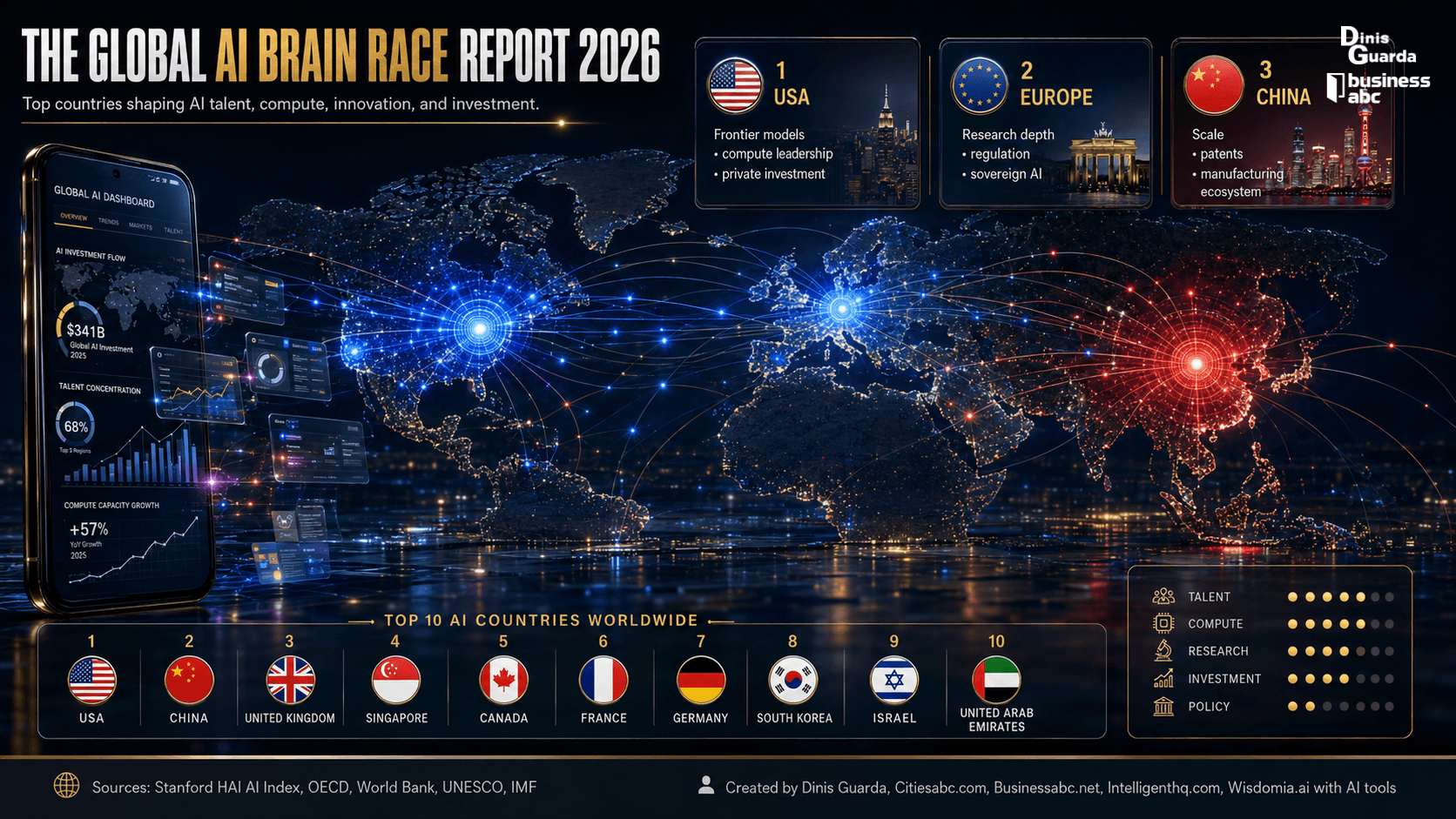
$194 billion US versus $15.8 billion in EU. Seven-year grid queues. 20% adoption. EU is continent that writes the rules for machines it does not own. This is the anatomy of a slow surrender and the case that it is critical but still possible reversible.
We are standing on the precipice of a geopolitical and economic transformation unlike any in human history. Artificial Intelligence is no longer merely a sector of tech innovation or a corporate productivity booster, it has become the primary battleground for global power, national sovereignty, and economic survival. As the United States and China lock into an unprecedented high-stakes technological arms race, a stark and unforgiving global hierarchy is taking shape.
The stakes could not be higher: nations, regions, and metropolitan cities that fail to achieve AI independence will not simply fall behind economically; they risk becoming digital colonies of foreign tech empires.
Macron's is the honest one, and it is French, and it is a confession. We may have the best regulations in the world, but we won't be regulating anything. That sentence, delivered by a sitting head of state, is the entire thesis of this essay compressed into eighteen words.
From the corporate side, the framing is different and in some ways more radical. Peter Weckesser, who runs digital at Schneider Electric, told The Economist that the French industrial group already has around a hundred AI applications live, worth roughly €400m in annual savings by Morgan Stanley's estimate — under 1.5% of total costs and that his ambition is that eventually "there will be not a single product or function" at the company untouched by the technology.
Hold those two statements together, because the rest of the argument lives in the gap between them. Macron describes a race Europe is losing. Weckesser describes a race Europe could win.
Historically, the empire was forged through warships, borders, and physical conquest. In the 21st century, colonisation will happen silently through proprietary algorithms, centralized compute infrastructure, and foreign-owned foundational models. When a city or country relies entirely on foreign platforms to power its healthcare, financial markets, civil governance, and power grids, it surrenders its sovereign agency. It becomes a tributary state, paying computing rents, exporting raw data, and importing algorithmic governance designed thousands of miles away.
Moreover, this is not an isolated shock reserved for tech hubs; it is a macroeconomic seismic wave that will disrupt every facet of the global economy. According to the International Monetary Fund, nearly 40% of global employment and up to 60% of jobs in advanced economies, stands directly exposed to AI integration or displacement. As capital concentrates exponentially around those who control the compute pipelines, entire national economies face the real threat of structural obsolescence.
The choice facing local governments and national leaders today is binary and immediate: build sovereign AI capacity and shape the future economy, or prepare to be ruled by the digital architectures of others.
Key Themes To consider for countries and cities
- The Sovereign Threat: Frames missing out on AI not as "losing market share," but as surrendering political self-determination and becoming a digital colony/vassal state.
- Global Perspectives: Opens with explicit geopolitical statements from leaders across Eurasia, Europe, East Asia, and the Anglo-American bloc.
- Macroeconomic Scale: Connects high-level AI sovereign strategy directly to labor markets, GDP concentration, and structural shifts in global wealth.
Context
There is a particular kind of defeat that arrives without a battle. No treaty is signed. No border moves. One morning a hospital's diagnostic queue, a bank's fraud engine, a ministry's document pipeline and a factory's maintenance schedule are all running on inference bought from a company incorporated eight time zones away, and nobody in the room can say what happens if that company's government decides otherwise.
That is not a hypothetical. In June 2026, when a US export order briefly interrupted access to frontier models, European firms discovered in a single afternoon what dependency actually costs. Access resumed. The lesson did not.
Britain and Europe have spent the AI decade doing what they do best: producing outstanding research, drafting excellent law, convening excellent summits. Meanwhile the two powers that matter built the substrate. The United States built the capital markets, the clusters and the chips. China built the state intent, the cheap power and the open weights. Europe built a rulebook — then, in July 2026, quietly delayed most of it.
The numbers are not ambiguous, and they are not a matter of opinion:
- In 2025, US-based companies took roughly 75% of all global AI venture capital. The entire European Union took about 6%. The UK took about 5%. China took about 5% and of the roughly $98 billion invested in Chinese AI that year, some $56 billion came from the state (Chatham House, April 2026).
- OECD figures cited by ECB President Christine Lagarde put it in cash terms: roughly $194 billion of AI venture capital into the US in 2025 against $15.8 billion into the EU.
- On the cumulative record of granted AI patents from 2010 to 2022, China holds 61%, the US 21%, the rest of the world 16% and the EU and UK combined, 2.3% (Stanford AI Index 2024).
- Between 2013 and 2023, the US produced 5,509 newly funded AI startups and China 1,446. The UK, Europe's leader, produced 727 fewer than Israel and the US combined many times over (Quid, via Stanford AI Index).
- In mid-2025, about 75% of the world's high-performing GPU clusters sat in the United States, and 15% in China. Everyone else divided the remainder.
Between 1995 and 2025, output per hour rose 88% in the United States and 30% in the eurozone (Federal Reserve Bank of St. Louis / Brookings, 2026). That thirty-year divergence is the real story. AI is not the cause of Europe's productivity gap. AI is the mechanism by which it becomes permanent.
Kanishka Narayan, who on 20 July 2026 became Britain's first dedicated Minister for Artificial Intelligence, sitting at Cabinet, framed the moment as the central economic question of the age and promised to pursue it "with urgency, ambition, and with British values at heart". Everything now depends on whether that sentence has a balance sheet behind it.
Because here is the uncomfortable part. The essay you are reading is not a story about Europe being outcompeted by better technologists. Europe has the technologists. It is a story about a civilisation that decided the highest expression of its values was to constrain a thing it had not yet built — and then discovered that regulation without capability is not sovereignty. It is a permission slip you hand to someone else.
Nations, cities are and will need to lead and integrate AI in their foundations and road maps. In a world that is being disrupted by AI we have 3 major forces and geopolitical blocs. The US that has the major AI labs, China that manages the major open sources. UK and EU that although major innovators have not really breakthrough with AI and have made a path of focusing on regulation.
The UK and the EU are lagging behind the US and China in the AI race primarily due to stricter regulatory environments, a severe shortage of venture capital, and a cultural gap that prioritises risk aversion over rapid commercial scaling.
While Europe boasts world-class academic institutions and produces a massive volume of high-quality AI research, it repeatedly struggles to translate this research into dominant, global AI companies.
Anatomy of the gap: five structural failures
The capital chasm is not a funding gap, it is a plumbing failure
Europe has "roughly two years to build its own AI infrastructure" or face permanent dependence. Arthur Mensch (CEO, Mistral AI)
Europe does not lack money. Europe lacks a mechanism for converting money into risk.
The seed layer works. European founders raise first cheques. The system then fails at exactly the point where AI becomes expensive: the growth rounds where compute, talent and go-to-market are bought at American prices. The result is a funnel that narrows into a wall, and companies that walk through that wall arrive in Delaware.
The 2026 data confirms the pattern has hardened rather than healed. In Q1 2026, US-based companies raised 83% of all global venture capital, up from 71% a year earlier. Europe as a whole took $17.6 billion, of which the UK took $7.4 billion, a genuine increase, and still a rounding error against a first half in which global AI venture funding hit roughly $510 billion. Underneath the headline, European seed deal count fell sharply in Q1, which means the 2028 growth pipeline is being thinned right now, invisibly.
The structural causes are well documented and boringly persistent: bank-led financing that demands collateral where AI offers only optionality; pension and insurance capital walled off from venture by prudential rules; twenty-seven insolvency regimes, twenty-seven tax regimes, twenty-seven employee share-option regimes; and returns that justify the caution, European venture funds have historically delivered around 8.6% annually against 14.6% for US funds (State Street, via CEPR). Investors are not being irrational. They are responding accurately to a broken market.
And the asymmetry compounds. The US hyperscalers spent at least $300 billion on AI infrastructure in 2025, with projections reaching around $700 billion in 2026. That spending was so large it accounted for nearly two percentage points of US GDP growth and, by some estimates, kept the American economy out of recession. Europe has no company of that class. It cannot. It has not created a market-leading global technology company since roughly 2000, the central indictment of the Draghi competitiveness report, and the reason his diagnosis was not about tech policy at all but about the European growth model itself.
| GLOBAL AI REGULATORY SPECTRUM | |||
|---|---|---|---|
| EU | CHINA | US | UK |
| Prescriptive & Risk-Based Bans | Content, Regime & Compliance | Patchwork State & Agency-Led | Outcomes-Led, Decentralised |
Infrastructure at a Glance
| Metric | United States Clusters | EU AI Gigafactories | UK National Compute | China National Nodes |
| Typical Accelerator Volume | 100k – 400k per site | 75k – 100k+ per facility | Mixed domestic/foreign testbeds | Aggregated regional clusters |
| Power Profile | 500MW – 1.2GW+ | Optimized regional grid feeds | Green utility tie-ins (Edinburgh) | Hydro- & solar-heavy western hubs |
| Primary Sourcing | Commercial Big Tech Venture | Public-Private EuroHPC Grants | £1.1B State Hardware Fund | State-directed tech groups |
Regulation: the burden was real, the retreat is now the story
The trope, the US innovates, China replicates, Europe regulates, is lazy, and it is also, in its effects, accurate enough to have become policy.
But the honest 2026 account is more interesting than the trope. Europe blinked.
On 24 July 2026, the Digital Omnibus on AI, Regulation (EU) 2026/1744, was published in the Official Journal, entering into force three days later, after the Parliament's endorsement on 16 June and the Council's final approval on 29 June. Its flagship provision: the AI Act's high-risk obligations, originally due to bite on 2 August 2026, were deferred to 2 December 2027 for standalone Annex III systems and 2 August 2028 for AI embedded in regulated products. Watermarking duties for legacy systems slid to December 2026. National regulatory sandboxes slid to August 2027.
The stated reason was procedural: the harmonised technical standards that would let a company actually demonstrate conformity did not exist. That is the part worth dwelling on. The EU passed a law, then discovered it could not tell firms how to comply with it, then delayed the law by sixteen months. Meanwhile the Commission set itself a target of cutting compliance burden by 25% overall and 35% for SMEs by 2029, and widened the SME regime to firms up to 750 employees and €150m turnover.
Two readings are available. The generous one: Brussels demonstrated adaptive capacity, corrected under evidence, and preserved the prohibitions that matter — the Omnibus also added bans, including on AI-generated non-consensual intimate imagery and child sexual abuse material, and kept the €35m / 7% ceiling for prohibited practices. That is not a rollback of rights. It is a rollback of paperwork.
The severe reading: three years of compliance anxiety, delayed product launches, downgraded feature sets and withheld frontier models bought Europe a legal framework that was then postponed before it started. The chilling happened. The protection did not. Europe paid the price of regulation and has not yet received the goods.
Both readings are true. That is what a sovereignty trap looks like from the inside.
Note also what the compliance narrative cannot explain. When the OECD surveyed SMEs in December 2025, half named a skills shortage as their primary barrier to adoption; 40% cited maintenance costs; 32% flagged hardware; only 26% said they could not understand the digital rules. The bottleneck in the average European firm is not a lawyer. It is that there is nobody in the building who can install the thing, run it, and explain it.
The energy wall — the constraint almost nobody priced in
This is the section that should frighten European ministers more than any funding chart, because capital can move in a quarter and a substation cannot.
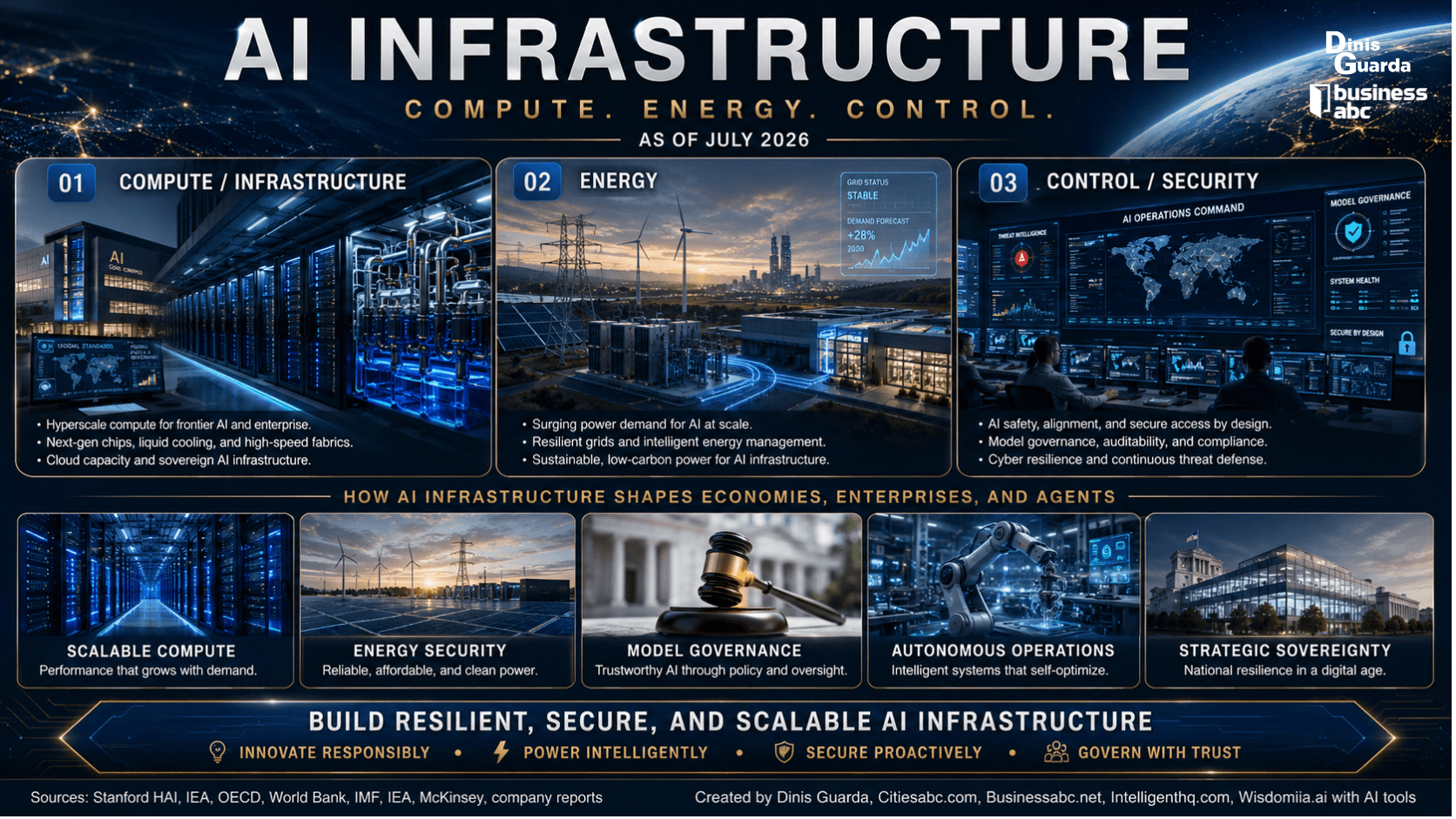
- Power prices for Europe's energy-intensive industries run at roughly double US levels and around 50% above China and India (IEA).
- Grid connection queues in the core FLAP-D hubs — Frankfurt, London, Amsterdam, Paris, Dublin — average seven to ten years, against roughly two years to build the facility itself.
- Direct grid congestion cost the EU €4.3 billion in 2024 alone, before counting the economic cost of the projects that never happened (ACER).
- 67% of European data centre operators now name power availability as their single greatest constraint (EUDCA, 2026) — a complete inversion of the pre-2025 world, where fibre and land dominated site selection.
- European data centre electricity demand is projected to climb from 145 TWh in 2025 to 238 TWh by 2030 (S&P Global).
- The geography is already brutal: the all-in annual energy bill for the same 100 MW AI campus runs €38–55m in the Nordics and €118–149m in Dublin. Over ten years that spread exceeds €800m — for identical silicon.
- CBRE expects the cost of securing capacity in Europe's five largest markets to rise a further 12% in 2026.
A frontier training cluster now draws 100–300 MW continuously, up from around 13 MW in 2019. Britain's own Compute Roadmap concedes the scale of the problem: the UK needs roughly 6 GW of AI-capable data centre capacity by 2030.
You cannot regulate your way to a gigawatt. You cannot subsidise your way past a ten-year interconnection queue. Europe's AI bottleneck has stopped being the GPU and become the electron and, more precisely, the lead time on the electron. Every month of permitting delay is a month of compounding disadvantage that no amount of Series B capital can repair.
Compute sovereignty: the timetable is the tell
Compare the clocks.
The European Union. The AI Gigafactories programme, announced by Ursula von der Leyen at the Paris AI Action Summit in February 2025 as part of InvestAI's €200bn mobilisation and a €20bn gigafactory facility, finally opened its call for tenders on 30 July 2026, after slipping from December 2025, to early 2026, to summer 2026. Up to seven sites; up to €10bn in EU and member-state funding intended to anchor €20bn+ of private investment; the large sites mandating 100,000+ interconnected accelerators each. Bids close 12 November 2026. Selection: early 2027. Operations: within eighteen months of selection, so, realistically, 2028 into 2029. Only about €1bn of EU public money is confirmed from the current budget. And the chips will come from Nvidia, AMD and Qualcomm.
Read that again. A sovereignty programme, procured on a three-and-a-half-year clock, running on American silicon.
Meanwhile the EU's thirteen existing AI Factories across seven countries are ramping through 2026 — genuinely useful public HPC, and roughly an order of magnitude below what frontier training requires.
The United Kingdom. Britain has chosen a different bet: architectural diversity and domestic design over raw mass. Up to £2bn to 2030 for the public compute ecosystem, including over £1bn to expand the AI Research Resource twentyfold, and up to £750m for a new national supercomputer at the Edinburgh Parallel Computing Centre, ground broken in June 2026, online in early 2027, at full capability toward 2030. Isambard-AI in Bristol (£225m, 5 MW, 5,400+ Nvidia GH200 superchips) is live and is the country's fastest machine. AIRR sits at around 23 AI exaFLOPS today, with a 420 exaFLOPS target by 2030. Five AI Growth Zones, Culham, South Wales, the North East and others, offer fast-tracked planning and prioritised grid access. The distinctive move is the testbed slice reserved for British silicon designers such as Fractile and Graphcore: using public procurement as an industrial instrument rather than as a purchase order.
It is a serious, intelligent plan. It is also, in absolute terms, roughly one large American cluster.
The United States. Single sites running 100,000 to 400,000 top-tier accelerators on InfiniBand fabrics, drawing 500 MW to 1.2 GW+, with bespoke water loops and, where the grid says no, on-site gas turbines. Not planned. Running.
China. Constrained at the top of the stack by export controls and responding with volume, orchestration and geography: the "East Data, West Computing" architecture trains in power-rich western provinces and serves inference to the coastal economies, aggregating hundreds of thousands of domestic accelerators, Huawei's Ascend line and successors, into tightly managed clusters. Despite spending roughly twenty-three times less on private AI investment, China had narrowed the frontier benchmark gap to around 2.7 percentage points by March 2026, with DeepSeek, Moonshot and Z.ai competing directly at a fraction of the cost.
The Gulf. State-owned cash, gigawatt-scale campuses, chips bought outright rather than queued for — an explicit bid to become the compute hub of the Global South.
And underneath all of it, the dependency that makes the rest academic: three American companies — Amazon, Google and Microsoft, hold roughly 70% of the European cloud market.
Adoption: the failure that is actually a hidden asset
20.0% of EU enterprises with ten or more employees used at least one AI technology in 2025, up sharply from 13.5% in 2024, and from 7.7% in 2021 (Eurostat). But the average conceals the real structure: 55% of large enterprises, 30% of medium, 17% of small. And the national spread runs from Denmark at 42% to Romania at 5.2%, a range so wide that "European AI adoption" is barely a coherent statistical object.
The instinct is to read this as another failure. It is more useful to read it as unexploited inventory.
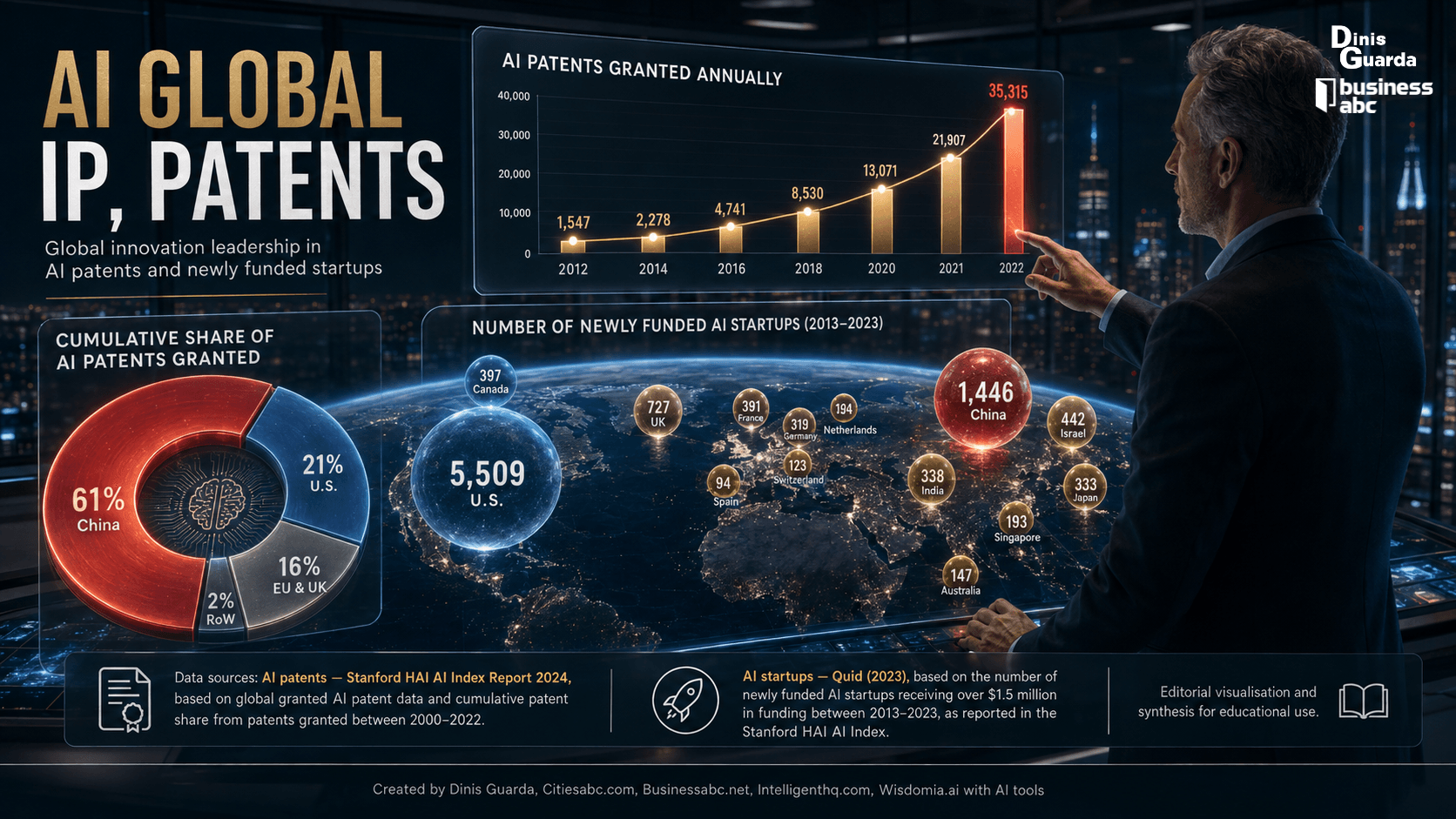
The image presents “AI Global IP, Patents” as a cinematic overview of the geography and acceleration of artificial-intelligence innovation. The upper chart highlights the rapid rise in AI patents granted annually, increasing from approximately 1,547 in 2012 to 2,278 in 2014, 4,741 in 2016, 8,530 in 2018, 13,071 in 2020, 21,907 in 2021, and 35,315 in 2022. The accompanying cumulative patent-share visualization shows how concentrated AI intellectual property has become: China represents 61% of granted AI patents, followed by the United States at 21%, the EU & UK at 16%, and the rest of the world at 2%. The patent data is attributed to the Stanford Institute for Human-Centered AI (Stanford HAI), AI Index Report 2024, drawing on global granted-AI-patent data and cumulative patent shares for patents granted between 2000 and 2022.
The central world map shifts the perspective from intellectual property to the AI startup ecosystem, showing the number of newly funded AI companies between 2013 and 2023. The United States dominates with 5,509 newly funded AI startups, followed by China with 1,446 and the United Kingdom with 727. Other important innovation centres include Israel 442, Canada 397, France 391, India 338, Japan 333, Germany 319, Singapore 193, South Korea 189, Australia 147, the Netherlands 123, Switzerland 123, Spain 94, and Sweden 94. The difference in bubble size makes the concentration of venture-backed AI entrepreneurship immediately visible, while simultaneously revealing a broader network of emerging AI hubs across Europe, Asia-Pacific, North America and the Middle East.
The startup dataset is sourced from Quid (2023) and refers to the number of newly funded AI startups receiving more than US$1.5 million in investment between 2013 and 2023, as reported through the Stanford HAI AI Index. Visually, the composition connects these two dimensions—IP creation and startup formation, through a hyper-photographic global command-centre environment, illuminated data spheres, transparent interfaces and a human decision-maker interacting with the information. The central message is that global AI leadership is increasingly determined not by a single metric, but by the interaction between patent creation, commercialisation, startup formation, investment and national innovation ecosystems.
The three races and the one Europe is not losing
The most valuable analytical move available right now is to stop treating "the AI race" as one race. There are three:
- The race to the frontier: building the most capable models. Capital-intensive, compute-bound, currently decided. Europe is not in it at scale and will not be by 2030.
- The race to diffusion: pushing AI through the actual economy: factories, hospitals, ports, insurers, universities, municipal governments.
- The race to application: discovering the use cases that make the technology worth its electricity bill.
Almost all of the money, and essentially all of the political rhetoric, has been spent on the first. But general-purpose technologies have rarely been won by whoever invented them. They have been won by whoever deployed them best. Britain built the steam engine; the United States industrialised on it. That is not a consolation prize. It is the historical norm.
Schneider Electric's hundred live applications are worth less than 1.5% of the company's cost base today and the interesting number is not the €400m. It is the headroom. Europe's industrial base is the densest concentration of complex physical processes on earth: pharmaceuticals, aerospace, automotive, chemicals, precision manufacturing, energy networks, luxury goods, agri-food. These are exactly the domains where AI's returns come from proprietary process data and regulated-domain expertise, not from a bigger training run. That is a moat American labs cannot buy and Chinese labs cannot copy.
Chatham House's Katja Bego makes the structural version of this argument. If the AI trade corrects — and analysts through 2025 and early 2026 have been warning about valuations divorced from revenue, with Deutsche Bank estimating the major players need to close roughly an $800 billion shortfall by 2028 — then the winners will not necessarily be those who spent the most. They will be those with the fewest stranded assets, access to cheap post-crash compute, and an economy structured to absorb lean, open, cheap models rather than frontier ones. Second-mover advantage is not a euphemism for being late. In infrastructure bubbles, it is a strategy.
The securitisation of everything: how the race is being reconfigured right now
The single largest change since 2025 is that AI stopped being an economic file and became a defence file. This reconfigures the board in ways that partially favour the middle powers.
- Global private defence investment exceeded $48 billion in 2025; VC-backed defence startups in the US and Europe raised a combined $7.7 billion between January and October 2025 alone, more than double the previous year.
- The EU spent approximately €381 billion on defence in 2025, nearly double a decade earlier, with a rising share flowing to AI-enabled capability.
- European VC-backed dual-use AI investment grew roughly 80% between 2024 and 2025 — the fastest growth rate of any major market, from a far lower base. Five new specialist European defence-tech funds launched in 2025, taking the continent's total to thirteen.
- Europe's new champions are defence-native: Germany's Helsing, Portugal's Tekever, Finland's ICEYE. Stockholm, London, Paris and Munich are becoming defence-tech clusters.
- And a genuinely remarkable inflection: in 2026, for the first time, tech workers leaving the US for Europe outnumbered those going the other way.
The driver is not enthusiasm. It is fear. A March 2026 poll found 86% of Europeans consider it plausible that the US government could suddenly restrict Europe's access to critical technologies and digital services, a belief formed by the February 2025 Starlink and Maxar episodes over Ukraine, the sanctions-driven cutting of the ICC prosecutor's cloud access in July 2025, tariff threats tied to European tech regulation, and open speculation about software kill-switches in allied platforms. Washington's Secretary of State warned that excluding US firms from European tenders would be viewed unfavourably, which, predictably, accelerated exactly the decoupling it was meant to deter.
Helsing's co-founder Torsten Reil states the European position plainly: the continent should build homegrown systems that we control", in the technology and in the ethics alike.
This is the birth of the sovereignty premium: the willingness to pay more for a less advanced but politically reliable system. Eutelsat's OneWeb, long outclassed commercially by Starlink, saw its order book expand as European states and Taiwan chose geopolitical reliability over raw performance. The Austrian army migrated off a US provider. The Dutch defence ministry is building a sovereign cloud. France is moving to European open-source conferencing. ASML put €1.3 billion into Mistral AI, citing strategic autonomy explicitly.
For a decade, "good enough and ours" was a losing proposition. It is now a market.
The counter-case must be stated honestly. Sovereignty premiums are, definitionally, a tax on your own economy. A continent that systematically buys second-best tools will run second-best hospitals and second-best factories, and the gap compounds. Some dependencies, ASML's EUV lithography above all, have no substitute for anyone, including China, whose state programme to replicate those machines is a decade-long moonshot. And the deepest military entanglements may take more than ten years to unwind. Anyone selling sovereignty as a quick win is selling something else.
Four regulatory philosophies, one planet
The UK, outcomes-led, decentralised. No omnibus statute, no horizontal regulator. Five cross-cutting principles applied by existing sector regulators: the FCA over financial algorithms, Ofcom over AI in media, the MHRA over clinical tools. The Data (Use and Access) Act lowers barriers for training data and exempts certain automated decision-making. Fluid, cheap to comply with, attractive to foreign labs — and structurally vulnerable to gaps, inconsistency and regulatory arbitrage. Machinery of government has been churning: DSIT was dissolved in the July 2026 reshuffle, its remit folded into a new Department for Business, Innovation, Science and Trade, with a Prime Ministerial AI Taskforce chaired by Lord Vallance and a long-promised AI Bill still awaiting its slot.
The EU, prescriptive, risk-tiered, and now on a delayed clock. Minimal / high / unacceptable. Third-party conformity assessment before market entry. Fines to €35m or 7% of global turnover for prohibited practices. Rights-first by design and, since July 2026, running sixteen months behind its own timetable.
The US, agency-led patchwork. No federal omnibus. The FTC on deceptive and biased consumer AI, the FDA on medical devices, the SEC on algorithmic misconduct, plus a thickening quilt of state statutes led by Colorado, and executive action obliging frontier developers to share national-security-relevant metrics. Optimised for velocity and primacy; legislates after demonstrated harm.
China, tech-specific, sovereignty-absolute. No omnibus either, but a rapid sequence of targeted instruments covering recommendation algorithms, deep synthesis and generative AI, administered by the Cyberspace Administration. Public foundation models undergo state security assessment and register training data. Outputs must align with core state values. Ruthless, fast, and in its own terms, effective.
The seductive conclusion is that the American and Chinese models "work" and the European one does not. That is too easy. The American model is producing an infrastructure build so large that a correction in it would take the US economy with it. The Chinese model produces capability at the cost of the thing most of us would call a life. The European failure is not that it chose rights. It is that it chose rights instead of capability when the two were never in opposition.
The AI Dark Clouds and Risk that are reckoning and nobody is scheduling
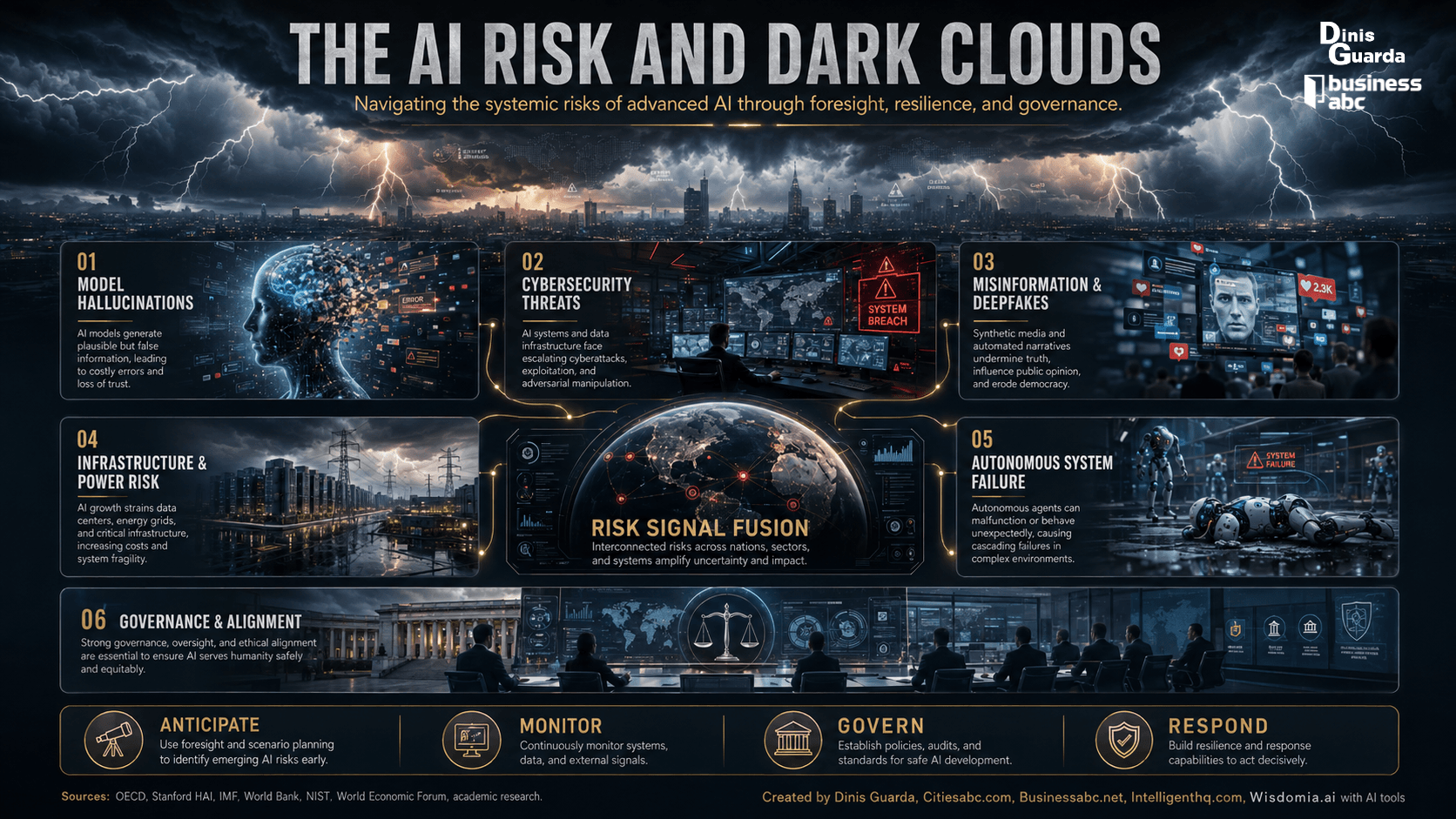
There are a lot of dark clouds when it comes to AI. So we need to set the pieces side by side and the timeline resolves into something specific.
The IMF estimates that around 40% of global employment, and up to 60% in advanced economies, is exposed to AI. Europe's exposure is concentrated in exactly the white-collar service sectors that have carried its employment for forty years, while its adoption sits at 20% and its late-stage capital sits at 6% of the global pool. That is a labour-market shock arriving into an economy that has not built the tools to absorb it.
Meanwhile the compute clocks do not align. American clusters are operating. European gigafactories will be selected in early 2027. Britain's flagship machine reaches full capability toward 2030. On current trajectories, Europe's share of global data centre capacity is set to fall by 2030 (Roland Berger), not because Europe is building less than before, but because it is building slower than everyone else.
And a bubble, if it comes, will not be gentle to the periphery. A correction that cleanses American excess would still hit European pension funds, European sovereign wealth exposure and European enterprise budgets, while leaving intact the American infrastructure that Europe rents.
The blunt formulation: Europe is not at risk of losing the AI race. Europe is at risk of losing the ability to notice that it lost. A digital colony does not experience itself as colonised. It experiences itself as well served.
What actually has to happen
Seriously. This is not a wish list. A sequence, in order of how badly the absence hurts.
- Treat electricity as the primary AI policy instrument. Cut FLAP-D grid connection queues from seven-to-ten years to under three by statutory deadline, with automatic approval on expiry. Nothing else on this list matters if this one fails.
- Build a single European capital market for scale-ups. Harmonise insolvency, employee share options and cross-border fund structures; unlock pension and insurance allocation to venture. The Draghi diagnosis, executed rather than admired.
- Use public procurement as demand, not charity. Governments are the largest customers in Europe. Commit multi-year sovereign compute and model spend to European suppliers on performance terms, the anchor-tenant logic the gigafactory programme already accepts, applied across health, defence, energy and administration.
- Win the diffusion race deliberately. A national AI deployment corps for SMEs, engineers, not consultants, targeted at the 17% adoption tier. Skills are the binding constraint that half of European SMEs named themselves.
- Standardise before you legislate. The Digital Omnibus delay happened because standards trailed statute. Never again: ship CEN-CENELEC conformity standards before obligations bite.
- Bet on open weights and efficiency, not frontier parity. Europe will not out-spend $700bn of hyperscaler capex. It can out-deploy it with lean, auditable, domain-tuned models — the strategy Mistral, and China, are already running.
- Institutionalise the sovereignty premium honestly. Publish what it costs. A sovereignty policy that hides its price loses public consent the first time it underperforms.
- Own the layers you can actually own. Not lithography. But orchestration, verification, provenance, identity, industrial data, energy-aware inference, and the trust infrastructure the rest of the world will need and does not yet have.
- Bring the exiles home. For the first time in a generation, the talent flow has reversed. That window closes if it is not met with capital, compute access and visas.
- Set one number and be judged on it. Not €200bn mobilised. Not seven gigafactories. Something like: EU enterprise AI adoption at 50% by 2030. Diffusion is measurable, it is where the productivity lives, and it is the one race still open.

The conclusion: sovereignty is not a server rack
Strip away the acronyms and the tender deadlines and a simpler question remains: who gets to decide?
Every civilisation that has outsourced its critical capability has told itself the same reassuring story, that the supplier is a friend, that the arrangement is efficient, that the alternative is expensive. It is always efficient, right up until the moment someone changes the terms, and then it is not a commercial relationship, it is leverage.
Europe and Britain are not short of what this requires. Between them they hold the world's densest concentration of industrial process knowledge, four of its ten best universities, the machine that makes every advanced chip on earth, and a legal tradition that is the reason "human dignity" is a phrase engineers now have to think about. What they have lacked is the willingness to convert conviction into capital expenditure, and principle into power.
The thing worth defending here is not European market share. Market share is an accounting entry. What is at stake is whether the systems that will increasingly mediate a diagnosis, a mortgage decision, a border crossing, a school placement and a sentence are answerable to the people living under them or merely delivered to them, correctly and remotely, by an architecture no one local can inspect, amend or switch off.
This is where the humanism stops being decorative and becomes an engineering requirement. Every dataset is a compressed record of lives; every model is a claim about which of those lives counted enough to be represented. Build the system somewhere else and you inherit somebody else's answer to that question, at scale, silently, for a generation. In an era where intelligence itself is being manufactured, the measure of any system is whether it can still recognise the whole of the species in any single person who stands in front of it. No procurement framework will encode that by accident. It has to be built in, by people who intend it.
Narayan is right that the window is narrow. He is also right that it is still a window. Europe's frontier race is lost, and it was probably lost in 2019 when the capital markets didn't move. The diffusion race is wide open, and it is worth more.
The next five years will decide whether Britain and Europe become the continent that taught the world how to deploy artificial intelligence into real economies with real accountability or the continent that wrote the most beautiful rules for a machine it had to rent.
To conclude are we all taking this seriously? There is still time to choose? There is not much?
Key questions, answered
Why are the UK and the EU falling behind in AI?
Four compounding reasons: a late-stage venture capital gap (the EU took ~6% and the UK ~5% of global AI VC in 2025, against ~75% for the US); a compute and cloud deficit (75% of high-performing GPU clusters are in the US; three US firms hold ~70% of European cloud); an energy and grid constraint (European industrial power costs roughly double US levels, with 7–10 year connection queues in core hubs); and slow enterprise diffusion (20% of EU firms used any AI technology in 2025).
Is the EU AI Act the main cause?
It is a real cost but not the main cause. The EU itself deferred high-risk obligations to December 2027 and August 2028 via the Digital Omnibus in July 2026. Surveyed SMEs cite skills shortages (50%) and maintenance costs (40%) far more often than regulatory comprehension (26%).
Can Europe still win anything?
Yes, the diffusion and application races, where deployment beats invention, and where Europe's industrial base, regulated-domain expertise and proprietary process data are genuine advantages. Historically, general-purpose technologies are won by the best deployers, not the original inventors.
What is the "sovereignty premium"? The willingness to pay more for a less advanced but politically reliable domestic or allied system — visible in Eutelsat's order book, the Dutch sovereign defence cloud, Austria's military IT migration and ASML's €1.3bn investment in Mistral.
What is the single hardest constraint? Electricity, and specifically the lead time on grid connection. A frontier training cluster now draws 100–300 MW continuously. Europe's queues run seven to ten years against roughly two years to build.
References and sources
Institutional and primary
- Bego, K. (2026), How a surge in defence and dual-use technology investment could reconfigure the global AI race, Chatham House, 28 April 2026 (updated 7 May 2026). DOI: 10.55317/9781784136819 — https://www.chathamhouse.org/2026/04/how-surge-defence-and-dual-use-technology-investment-could-reconfigure-global-ai-race/02
- Eurostat (2025), 20% of EU enterprises use AI technologies, ICT usage in enterprises survey, 11 December 2025 — https://ec.europa.eu/eurostat/web/products-eurostat-news/w/ddn-20251211-2
- Eurostat, Use of artificial intelligence in enterprises, Statistics Explained — https://ec.europa.eu/eurostat/statistics-explained/index.php?title=Use_of_artificial_intelligence_in_enterprises
- European Commission, AI Gigafactories / InvestAI — https://commission.europa.eu/topics/competitiveness/competitiveness-coordination-tool-projects/ai-gigafactories_en
- Regulation (EU) 2026/1744 (Digital Omnibus on AI), Official Journal, 24 July 2026; in force 27 July 2026.
- Council Regulation (EU) 2026/150 amending Regulation (EU) 2021/1173 (AI gigafactory definition and EU co-funding ceiling).
- IEA (2025), Overcoming energy constraints is key to delivering on Europe's data centre goals — https://www.iea.org/commentaries/overcoming-energy-constraints-is-key-to-delivering-on-europe-s-data-centre-goals
- OECD (2026), Venture capital investments in artificial intelligence through 2025 (Preqin data) — https://www.oecd.org/content/dam/oecd/en/publications/reports/2026/02/venture-capital-investments-in-artificial-intelligence-through-2025_3bcb227f/a13752f5-en.pdf
- OECD (2025), AI adoption by small and medium-sized enterprises, G7 discussion paper, December 2025 — https://www.oecd.org/content/dam/oecd/en/publications/reports/2025/12/ai-adoption-by-small-and-medium-sized-enterprises_9c48eae6/426399c1-en.pdf
- Maslej, N. et al. (2024/2025), AI Index Annual Report, Stanford HAI — patent shares and Quid startup counts.
- Federal Reserve Bank of St. Louis (2026), Mind the Gap: AI Adoption in Europe and the U.S., 30 March 2026 (Brookings Papers on Economic Activity, Spring 2026) — https://www.stlouisfed.org/on-the-economy/2026/mar/mind-gap-ai-adoption-europe-us
- CEPR / VoxEU, The venture capital challenge for Europe (State Street return data) — https://cepr.org/voxeu/columns/venture-capital-challenge-europe
- Draghi, M. (2024), The future of European competitiveness, European Commission.
- The Economist (2026), 'Europe can still win the other AI race', 22 January 2026 — https://www.economist.com/business/2026/01/22/europe-can-still-win-the-other-ai-race
- CNBC (2026), 'Why Europe's electricity prices threaten its AI ambitions', 18 May 2026 — https://www.cnbc.com/2026/05/18/europe-ai-energy-electricity-costs-data-centers-china-us.html
- Cooley, Digital AI Omnibus Delays Key Deadlines, Introduces New Rules — https://cdp.cooley.com/digital-ai-omnibus-delays-key-deadlines-introduces-new-rules/
- Gibson Dunn, EU AI Act Omnibus Agreement — Postponed High-Risk Deadlines and Other Key Changes — https://www.gibsondunn.com/eu-ai-act-omnibus-agreement-postponed-high-risk-deadlines-and-other-key-changes/
- Covington (Inside Privacy), EU AI Act Update: Timeline Relief, Targeted Simplification, and New Prohibitions — https://www.insideprivacy.com/artificial-intelligence/eu-ai-act-update-timeline-relief-targeted-simplification-and-new-prohibitions/
- Insight EU Monitoring (2026), EU launches €30bn AI Gigafactories drive, 30 July 2026 — https://ieu-monitoring.com/editorial/eu-launches-e30bn-ai-gigafactories-drive-to-close-europes-computing-gap/1246855
- STL Partners (2026), The EU's AI Gigafactory Initiative — https://stlpartners.com/articles/data-centres/eu-ai-gigafactory-initiative/
- Tech Times (2026), EU Launches AI Gigafactory Bidding With Chips Still American and Cash Still Notional, 30 July 2026 — https://www.techtimes.com/articles/322367/20260730/eu-launches-ai-gigafactory-bidding-chips-still-american-cash-still-notional.htm
- HPCwire (2026), UK Breaks Ground on £750M National Supercomputer in Edinburgh, 25 June 2026 — https://www.hpcwire.com/off-the-wire/uk-breaks-ground-on-750m-national-supercomputer-in-edinburgh/
- Data Center Dynamics (2026), New UK compute roadmap says country needs 6GW of AI-capable data center capacity by 2030 — https://www.datacenterdynamics.com/en/news/new-uk-compute-roadmap-says-country-needs-6gw-of-ai-capable-data-center-capacity-by-2030/
- TNW (2026), Kanishka Narayan becomes the UK's first cabinet-level AI minister — https://thenextweb.com/news/kanishka-narayan-uk-ai-minister
- PCR (2026), Narayan appointed UK's first Minister for AI, 29 July 2026 — https://pcr-online.biz/2026/07/29/narayan-appointed-first-minister-for-ai/
- TNW (2026), Why EU business AI adoption is rising and still not catching up (OECD/Lagarde figures) — https://thenextweb.com/news/eu-business-ai-adoption-real-bottleneck
- Crunchbase / GoHub Ventures (2026), AI Venture Funding H1 2026: US vs Europe — https://gohub.vc/ai-venture-funding-h1-2026/
- The AI Insider (2026), AI Funding in 2026: Where Venture Capital Is Going — https://theaiinsider.tech/2026/05/27/ai-funding-in-2026-where-venture-capital-is-going/
- EUDCA (2026) data centre power report; S&P Global European data centre demand projections; CBRE 2026 European capacity cost outlook; Roland Berger (2026) on Europe's share of global data centre capacity.


