
citiesabc
The Size Of The Construction, Infrastructure, Real Estate, and Property Industry
construction industry, real estate market, infrastructure development, sustainable building
26 Nov 2025

The construction, infrastructure, real estate, and property sectors are major global industries driving residential, commercial, and industrial development. They underpin economic growth, employment, and innovation, while shaping sustainable urban environments through essential transportation networks, utilities, public services, and continually evolving modern development needs.
The construction and real estate industries serve as pillars of economic development, urbanisation, and societal well-being. Globally, construction and real estate are estimated to contribute about 13% to the global GDP, a statistic that underscores their significance in economic growth and employment.
In countries like China, the U.S., and India, construction drives urban development, supports public infrastructure, and generates millions of jobs. The infrastructure sector alone in the United States is expected to see substantial growth, particularly with government initiatives focusing on sustainability and resilience against climate change.
As of 2023, the global construction market is projected to grow from approximately $15.19 trillion to nearly $15.97 trillion by 2024, reflecting steady demand driven by urbanisation, infrastructure development, and population growth.
Meanwhile, the combined global real estate and infrastructure market, encompassing residential, commercial, and industrial assets, was valued at an impressive $365.51 trillion in 2023, with projections estimating it to reach approximately $379.03 trillion in 2024. With a projected steady growth rate due to increased urbanisation, technological integration, and sustainability initiatives.
The following numbers display a snapshot of the entire industry:
Source
| Global building construction market size: Residential, commercial, and possibly some public building projects
| Year
|
Allied market research
| $5.4128 trillion | 2021 |
projected to reach $11.1219 trillion | 2031 | |
growing at a CAGR of 7.4% | 2022 to 2031 | |
Construction market size: Buildings, infrastructure and civil engineering projects, such as transportation, utilities, and other large-scale infrastructure initiatives. | ||
Research and Markets
| $15.26 trillion | 2023 |
expected to grow to $20.05 trillion at a rate of 5.61% | 2028 | |
(CAGR) of 5.28% | 2018-2023 | |
expected to grow at a CAGR of 5.94% | from 2028 | |
expected to reach $26.75 trillion | 2033 | |
Deloitte | $11.6 trillion | 2020 |
projected to reach $14.8 trillion | 2030 | |
Real Estate and Infrastructure Market Size | ||
Precedence research | $365.51 trillion | 2023 |
expected to be worth $545.09 trillion | 2034 | |
CAGR of 3.70% | 2024-2034 | |
savills | $379.7 trillion | 2022 |
The construction and real estate sectors are poised to remain major contributors to global GDP. The global construction market is projected to reach $19.52 trillion by 2027, supported by a 6.6% CAGR through the same period. Meanwhile, the real estate sector, estimated at US$634.90 trillion in 2024 (Statista), continues to expand, driven by rising demand for sustainable, smart, and tech-integrated properties.
Leading industry players such as Bechtel, Lennar, Brookfield Properties, and JLL are accelerating digital transformation across the sector.
Here are some vital macro statistics about the construction industry from reliable sources like the World Bank, the IMF, and the UN:
Economic Impact
- The global construction market value reached $15.26 trillion in 2023.
- Expected to grow to $20.05 trillion by 2028 (Research and Markets).
- In developing economies, construction contributes 3%–8% of national GDP.
Employment & Labour
- Employs approximately 220 million workers worldwide.
- Represents 7% of total global employment.
- In developing countries, the sector provides up to 7.6% of jobs.
Resource Consumption
- Accounts for 52% of global steel consumption (2022).
- Uses roughly 3 billion tons of raw materials annually.
- Responsible for around 50% of total global resource use (UNEP).
Infrastructure Investment Needs
- Global infrastructure investment requirements are estimated at $94 trillion through 2040 (Global Infrastructure Hub).
- Current trends suggest a $15 trillion investment gap relative to projected needs.
Urban Growth & Development
- 60% of global construction activity takes place in urban areas.
- The UN projects 68% of the world’s population will live in cities by 2050, significantly increasing construction demand.
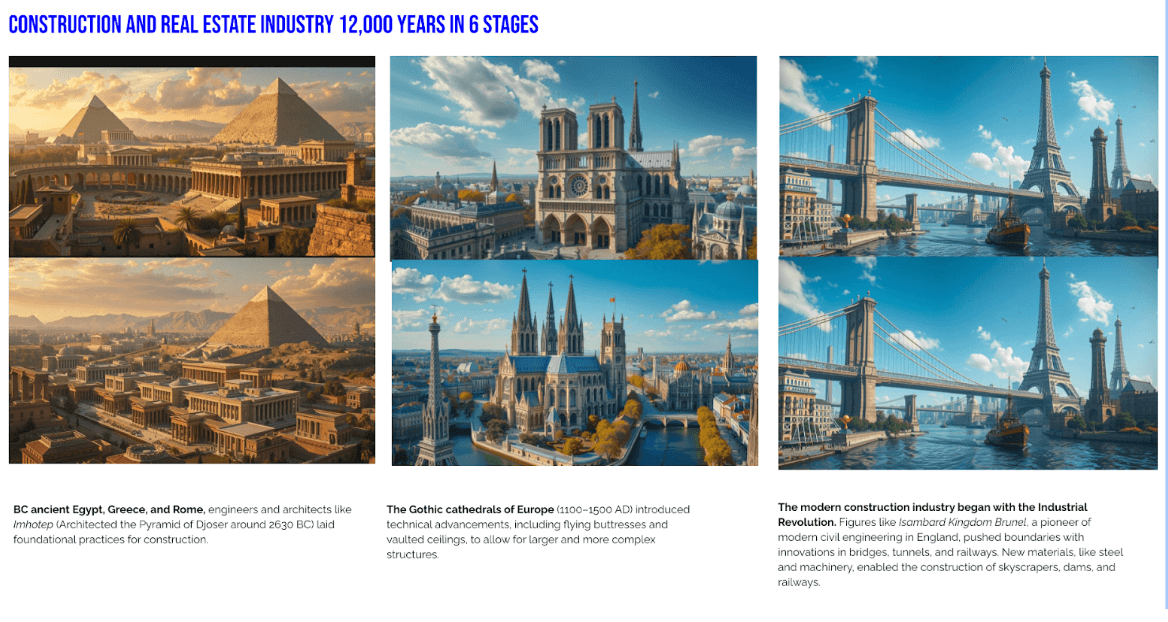
These statistics and numbers shared show how the construction, infrastructure, and real estate industries are central to global economic development.
These sectors are all experiencing unique growth drivers and challenges, such as rising material costs, labour shortages, and the need for sustainable practices, with technological advancements playing a key role in enabling efficient project management and reducing operational costs.
As the industry integrates digital transformations and adopts advanced technologies, including BIM, Digital Twins, artificial intelligence (AI), blockchain, and the Internet of Things (IoT), it has magnified the industry’s role and potential. These technologies improve project efficiency, optimise resource allocation, and enhance data transparency.
For instance, AI-powered project management software enables predictive maintenance and risk management, while blockchain enhances data integrity and security in property transactions. Smart infrastructure with IoT allows for real-time monitoring, predictive analytics, and operational efficiency, benefiting both the construction process and the final occupants of developed properties.
In real estate, digitisation and analytics allow investors and developers to make data-driven decisions, optimise portfolios, and improve tenant experiences through smart property management.
Sustainability is a significant driving force, with governments and companies focusing on eco-friendly building materials, energy-efficient designs, and carbon footprint reduction. Companies like Bouygues Construction and China Communications Construction Company (CCCC) have incorporated green practices and sustainable models, recognising their importance in modern developments.
Opportunities and challenges shaping the future of construction and real estate
Opportunities
- Urbanisation and Population Growth- The United Nations projects that by 2050, over 68% of the world’s population will live in urban areas, creating a massive demand for residential, commercial, and infrastructure development. This urban shift presents vast opportunities for real estate developers and construction companies to innovate and build smart, sustainable cities. High-density housing, mixed-use developments, and efficient transport infrastructure are expected to become critical areas of investment.
- Technology Integration- The integration of AI, blockchain, and IoT represents a paradigm shift. AI-driven construction management tools optimise project schedules, mitigate risks, and improve safety. For instance, predictive analytics help construction firms reduce project delays by identifying potential risks early. Blockchain enhances transparency and security in property transactions, reducing fraud and enabling smart contract applications. IoT enables real-time monitoring, which ensures operational efficiency and improved facility management in smart buildings.
- Green and Sustainable Construction- As environmental consciousness grows, sustainable construction practices are becoming increasingly valuable. Sustainable materials, renewable energy solutions, and green certifications like LEED are incentivised by governments and preferred by consumers. Real estate companies that incorporate sustainability not only appeal to eco-conscious buyers but also contribute to long-term environmental goals. Sustainable building design, energy-efficient appliances, and green roofs are becoming standard in urban development, with significant incentives for companies that meet these standards.
- Infrastructure Resilience- With climate change threatening infrastructure resilience, governments and private developers are investing in resilient infrastructure. This involves designing buildings and infrastructure that can withstand extreme weather events and natural disasters. Resilient infrastructure not only reduces economic losses but also ensures public safety and continuity of essential services.
Challenges
- High Cost of Technology and Training- While technology offers considerable benefits, the cost of adopting advanced solutions like AI, blockchain, and IoT remains high. Small and mid-sized construction firms may struggle to meet these financial requirements, resulting in a technology divide within the industry. Training workers and adapting to new workflows are also considerable investments, especially in regions where digital skills are limited.
- Regulatory Hurdles and Compliance- Regulatory compliance in construction and real estate is complex, as it varies by region and project type. For example, sustainable building standards require adherence to environmental regulations, which can be costly and require specialised expertise. Data privacy and security regulations, especially in IoT-enabled smart buildings, add another layer of compliance that companies must manage. Governments are increasingly mandating transparent, ethical AI applications, which may complicate deployment if organisations are unprepared to meet these standards.
- Supply Chain Constraints- The construction industry’s reliance on global supply chains exposes it to material shortages, delays, and increased costs. The COVID-19 pandemic highlighted these vulnerabilities, with many construction projects facing delays due to disrupted supply chains. Blockchain’s transparency can help mitigate some of these challenges, allowing for better tracking of materials from their source to the construction site. However, widespread adoption of blockchain solutions in supply chains remains limited.
- Environmental and Social Pressures- This is attributed to building and construction activities. Increasing pressure from governments and consumers to reduce this impact requires companies to adopt sustainable practices. However, implementing sustainable solutions often incurs additional costs and time, presenting a challenge for firms focused on quick project turnarounds and cost minimisation.
Conclusion
The construction, infrastructure, real estate, and property industries play a vital role in shaping economies, societies, and urban landscapes worldwide. With advancements in technology, a growing emphasis on sustainability, and continued urban expansion, these industries stand at the forefront of a transformative period. The integration of AI, blockchain, and IoT presents both opportunities and challenges, requiring companies to balance innovation with regulatory compliance and financial considerations.
As the industry adapts, stakeholders must focus on building resilient, sustainable, and smart infrastructure that meets the demands of future urbanisation and environmental goals. Companies investing in these changes early are well-positioned to lead in a competitive global market. The success of these industries will depend not only on their capacity to innovate but also on their commitment to ethical, sustainable practices that align with the evolving needs of society and the environment.


