
citiesabc, first_page
The Top 50 AI Creator Economy Platforms: A Global Atlas of Companies and Leaders
12 Nov 2026

Executive takeaway.
Fifty companies now form the working infrastructure of the AI creator economy.
They fall into seven layers, from marketplaces to AI-native creation tools.
At least six of the fifty have changed owners since 2023, and two in 2026.
This atlas profiles each company, its headquarters and its leadership as last publicly reported.
Why Mapping the fifty AI Creator platforms is critical
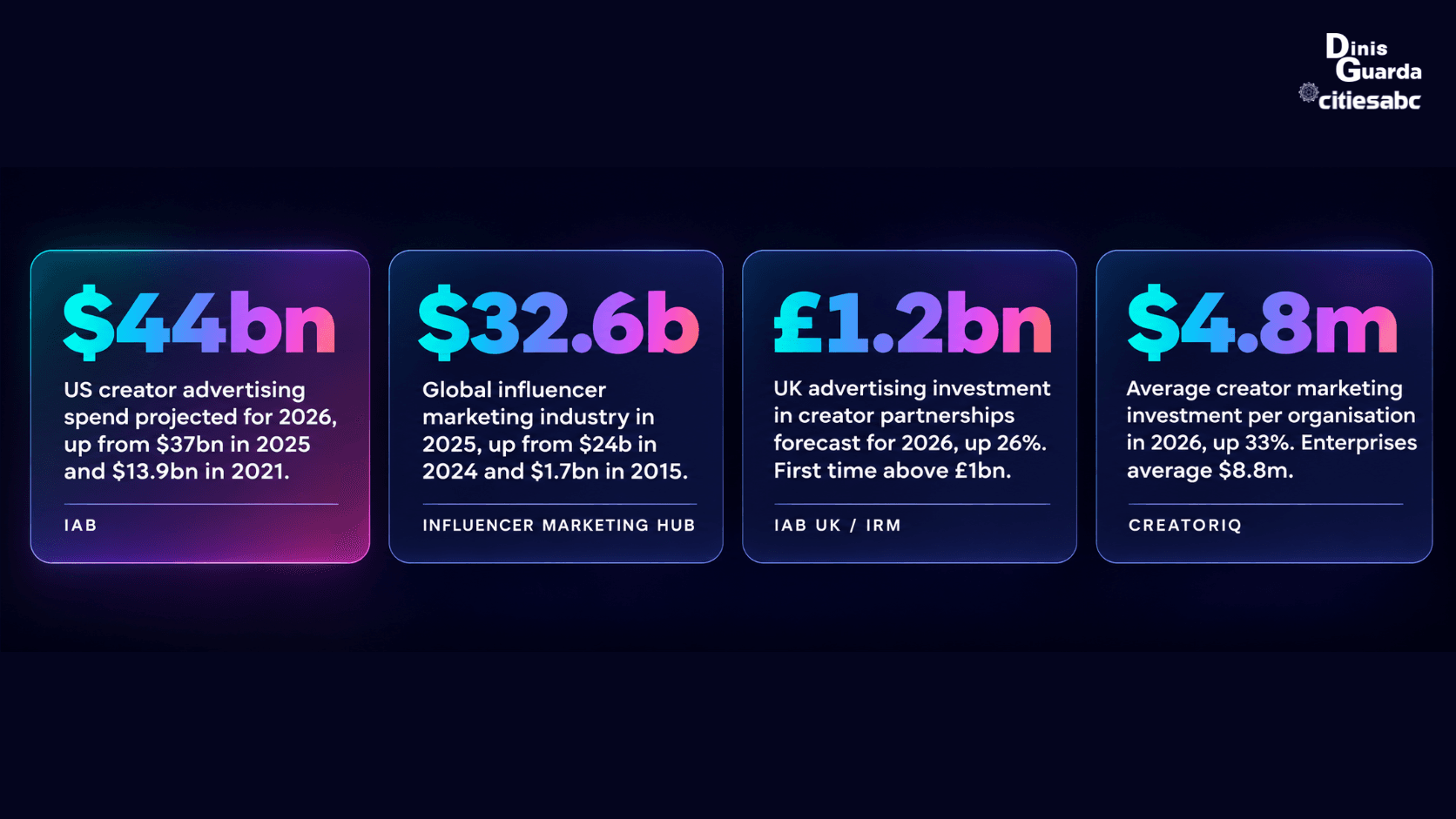
In the revolutionary age of AI, we are redefining what it means to have a job. And the jobs left to redesign are the ones where humans refuse to think like employees and must keep reinventing themselves as ID, IP creators, and entrepreneurs.
AI is automating tasks; it is erasing entire conceptions of social mechanics, work, hierarchy, financial economic identity and IP. But it is also offering us possibilities that never existed in history.
In every previous industrial revolution, humans have lost roles and gained new ones. It is painful, but it created new possibilities never seen before in human history. But this time, the shift is radically deeper:
- Work is dematerialising. 9-to-5 jobs will all disappear.
- Employment is decaying as a dominant life structure and becoming a fluid lifestyle.
- Career paths are being replaced by new, redesigned life skill stacks
- Authority is dissolving into networked creation and authority
- Capital is shifting from institutions → individuals and new opportunities to use super intelligence
That brings us to the AI Creator economy. This is an industry that is becoming real. And this happens when it can be mapped.
To truly map the trajectory of this industry, it is essential to look at the broader Creator Economy (the complete ecosystem including platform revenues, subscriptions, tipping, and e-commerce infrastructure) alongside pure Influencer Marketing Spend (the direct portion paid by brands for sponsored content).
The transition from 2026 to 2030 marks the industry’s evolution from an experimental marketing channel into an institutionalised, multi-hundred-billion-dollar global media powerhouse.
Global Overview: 2026 vs 2030
The overall creator industry is sustaining massive compound annual growth rates (CAGR) of 23% to 26%.
- 2026 Global Value: The total creator economy market sits at roughly $323.5 billion, while direct global brand spend on influencer marketing platforms makes up roughly $36.4 billion to $45.2 billion of that total.
- 2030 Global Projected Value: The broader creator economy is projected to hit $820.8 billion, putting it on a clear path to cross the $1 trillion milestone by the early 2030s.
| Metric | 2026 Estimated | 2030 Projected | Growth Trend |
| Global Creator Economy | $323.5 Billion | $820.8 Billion | ~26% CAGR |
| Global Influencer Spend | $36.4B – $45.2B | $85.0B – $95.0B | Transitioning to performance-driven data |
Regional Breakdown
The distribution of capital reflects regional strengths, with North America dominating corporate ad spend and Asia leading in social commerce.
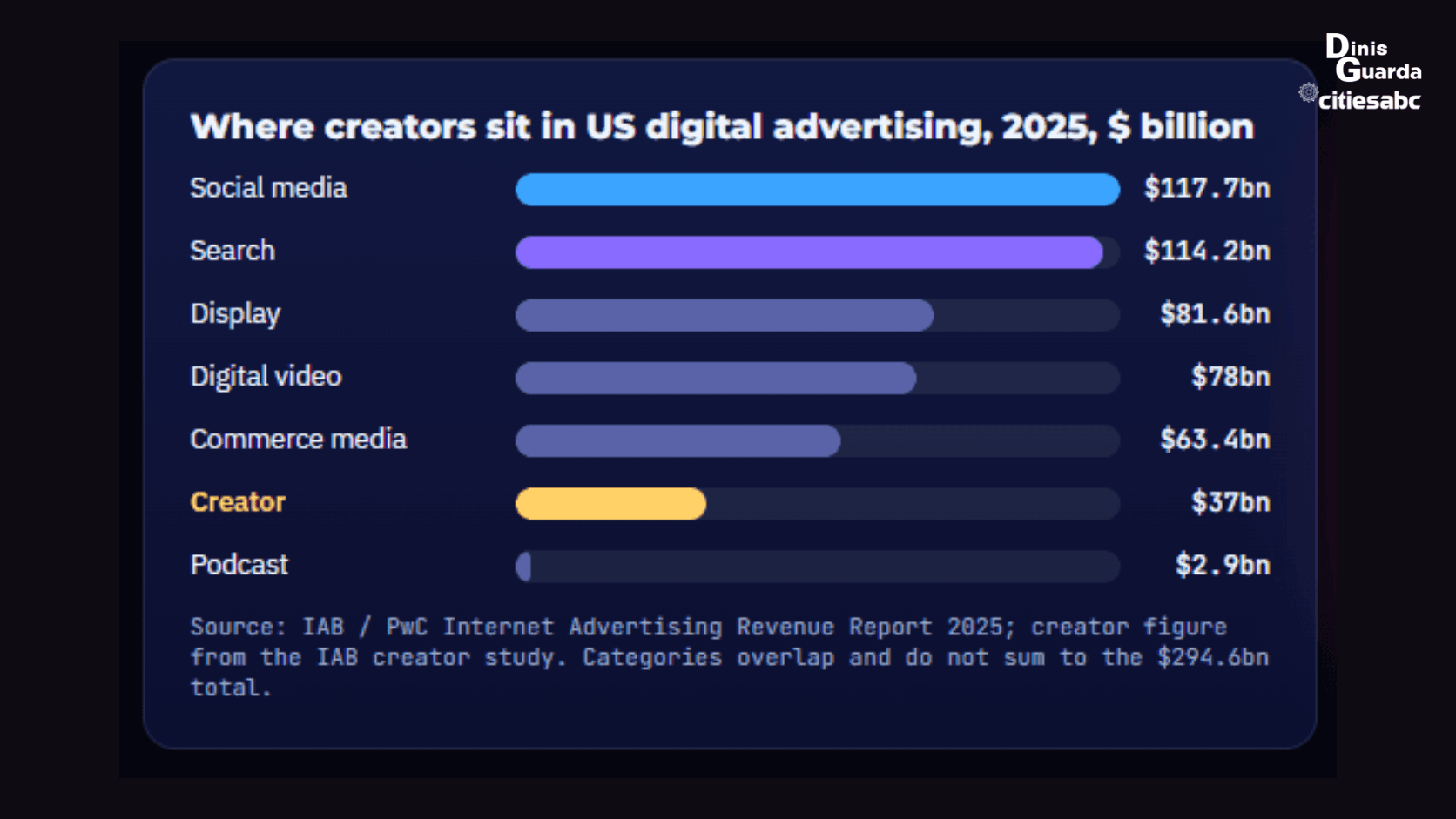
1. North America (United States)
The US remains the single largest financial engine for corporate brand integrations. The regional ecosystem is highly mature, with sophisticated attribution software and agency models.
- The Share: North America accounts for 31% to 34% of the global market.
- 2026 Numbers: Pure US brand spending on influencers hits $12.17 billion (with a broader definition of creator-marketing spend reaching $21.1 billion).
- 2030 Outlook: Driven by massive Fortune 500 adoption (where the average large company already spends $4.7 million annually on creators), US spend is expected to grow steadily, shifting heavily toward hyper-focused micro and nano-influencer networks to cut down on traditional ad waste.
2. Asia-Pacific (APAC)
Asia-Pacific is the absolute rocket ship of the creator world, expanding at the highest CAGR of any region (over 33%).
- The Share: The region captures roughly 22% to 27% of global value, heavily anchored by China, Southeast Asia, and India.
- 2026 Numbers: APAC contributes $14.2 billion to global influencer spending.
- The Social Commerce Difference: Unlike the West, where creator spend is largely top-of-funnel brand awareness, APAC has perfected creator-led shopping. Platforms like Douyin, Taobao Live, and booming TikTok Shop GMV mean APAC creators act as direct sales registers.
- 2030 Outlook: Because of seamless API integration between social apps and e-commerce platforms, APAC is projected to close the gap with North America, accounting for a massive chunk of the expected $820B global pie.
3. Europe
Europe features a highly fragmented but stable market, bounded by strict regional compliance laws.
- The Share: Europe accounts for about 27% of the global market value, with the UK, Germany, and France as the core regional hubs.
- 2026 Numbers: European creators generate roughly 12% to 15% of the world's sponsored content, with a heavy focus on localised, multilingual campaigns.
- 2030 Outlook: Growth in Europe is dictated by systemic structural shifts. A wave of mergers and acquisitions (M&A) is pulling fragmented boutique European talent agencies into massive, centralised media groups. This corporate structure will allow European creator networks to capture risk-averse institutional money by 2030.
Key Dynamics Driving 2026 ➔ 2030
- Budget Reallocation: Influencer budgets are ballooning because money is being actively cannibalised from traditional digital ad channels. Brands are realising that paying Meta or Google to host banner ads yields lower returns than paying a human creator to organically integrate a product.
- The Rise of Smaller Tiers: Micro-influencers (10k–50k followers) hold the largest market share (nearly 40%). Brands find that smaller tiers offer the perfect balance of content quality and affordability over expensive mega-celebrities. Nano-influencers (1k–10k) are projected to grow the fastest through 2030.
- AI & Transparency Infrastructure: The massive leap toward 2030 relies on software. The rise of AI-driven creator matching, automated fraud detection (filtering bot followers), and real-time revenue-tracking tools makes it easy for brands to justify pouring hundreds of millions into the space
Behind every viral video and brand deal sits an extensive, invisible infrastructure of specialised companies. These businesses handle the logistics, data, contract law, and financial engineering required to scale the creator economy into a predictable business model.
The 4 Invisible Layers of the Creator Economy
While consumer brands like Nike or Sephora work with household-name influencers, the actual machinery running these campaigns belongs to four distinct categories of B2B companies:
1. Data-Driven Discovery & Attribution Platforms
Advertisers can no longer rely on intuition or "follower counts" to distribute millions of dollars. A layer of highly sophisticated software companies analyses vast pools of social data.
- What they do: They track audience demographics, predict engagement rates, filter out fake followers (bots), and crucially, provide conversion tracking to prove an influencer actually drove sales.
- Why it matters: They turn influencer marketing from a guessing game into a performance-based science, matching the analytical rigour of Google or Meta ads.
2. Specialised Talent Aggregators & Agencies
Managing thousands of independent contractors is an operational nightmare for a traditional brand's marketing team.
- What they do: Multi-channel networks (MCNs) and boutique creator management firms act as modern-day talent agencies. They aggregate thousands of creators under single banners, standardising communication and delivery.
- Why it matters: They give major corporate executives a "single throat to choke," transforming fragmented, unpredictable individuals into a compliant and scalable media supply chain.
3. Fintech & Financial Infrastructure
Creators face unique financial hurdles: irregular income, complex tax situations, and a need for upfront capital to produce high-quality content.
- What they do: Specialised financial institutions offer custom banking, automated invoicing, instant-payout mechanisms, and capital loans secured against future ad revenue or catalogue value.
- Why it matters: This financial scaffolding keeps the creators liquid and operational, ensuring the talent doesn't go bankrupt between corporate payment cycles (which often take 60 to 90 days).
4. Compliance, Legal & Rights Management
With heavy regulations surrounding hidden sponsorships, product claims, and intellectual property, the legal risks of influencer marketing are immense.
- What they do: Enterprise software platforms automate contract generation, verify Federal Trade Commission (FTC) compliance, handle international tax withholding, and manage the digital rights of the content produced.
- Why it matters: They insulate Fortune 500 companies from lawsuits and regulatory fines, making it safe for risk-averse brands to deploy massive budgets.
The Macro Shift: "Media Buying" vs. “Creator Buying”
Historically, companies spent their ad budgets buying ad space around content—like a commercial break during a TV show or a banner ad next to a news article.
Now, the creator is the network, the production studio, and the ad space all at once. The $44 billion projection for 2026 signifies that corporate America recognises this. But because executives cannot manage millions of disparate internet personalities individually, they are routing their capital through this newly constructed B2B ecosystem. The invisible layer is the bridge making the entire system functional.
The creator economy has reached that point: US advertisers are projected to spend $44 billion on creators in 2026, and behind that spending sits a layer of companies most executives could not name.
Those companies decide which creators a brand finds, whether an audience is judged authentic, how a recommendation is attributed to a sale, where a newsletter lives and what voice narrates a video. They are the operating system of a market that the companion article, The AI Creator Economy: Context, Platforms and the Architecture of Trust, describes in full.
Our research identified 50 creator and influencer platforms. This atlas captures the campaign side of the market and represents the tools creators use to own their audiences. It contained no AI-native creation companies, which now carry the sector's largest valuations.
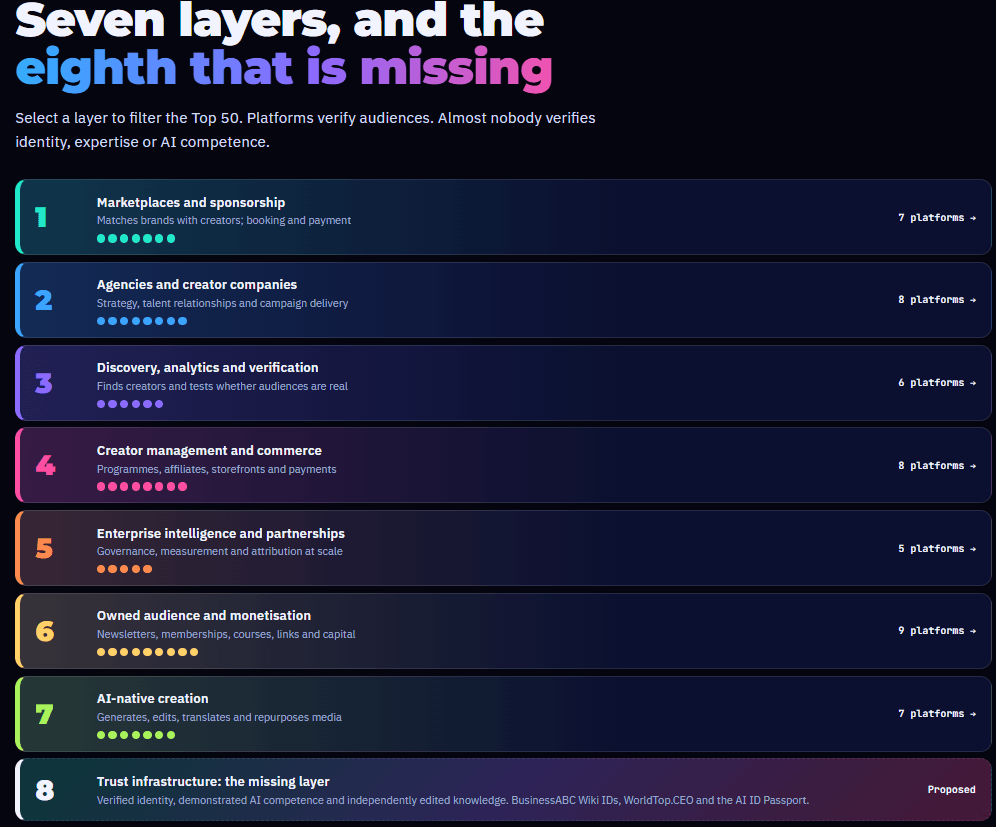
The fifty are presented in seven layers. Within each layer, the order is editorial, not a ranking of quality. A self-serve marketplace for small brands and an enterprise suite for global beauty groups are not competitors, and no league table should pretend that they are.
Methodology and editorial standards
Selection. Companies were selected for relevance to five criteria: role in the creator value chain, international footprint, visible use of AI in product or operations, and diversity of business model. Mass distribution platforms such as YouTube, TikTok and Instagram are excluded by design. They are the environment in which the fifty operate, not candidates for this kind of partnership.
Sources. Profiles draw on company announcements, trade press and industry research published to November 2026. Sources for transactions, funding and leadership changes are listed at the end.
Leadership. Names are given as last publicly reported. An asterisk (*) marks leadership confirmed against a 2025 or 2026 source during this research. All other names come from the earlier public record and must be re-verified against current official sources before any outreach, profile or publication. Leadership changes frequently, and two of the original fifty platforms changed ownership during 2026.
Independence. These are research profiles, not endorsements. No company paid for inclusion, and none has reviewed its entry.
Layer 1: Creator marketplaces and sponsorship platforms
Marketplaces answer the first question any brand asks: who can I work with, and what will it cost? Their strength is speed and transparency. Their weakness is that a transaction is not a relationship. AI is changing this layer fastest, turning creator selection and pricing into something closer to programmatic media buying.
| # | Platform | Headquarters | Leadership (last publicly reported) |
|---|---|---|---|
| 1 | Collabstr | Vancouver, Canada | Kyle Dulay and Clayton Rannard, co-founders |
| 2 | Afluencer | United States | Part of Influencer Hero since July 2026; leadership to verify |
| 3 | TRIBE | Melbourne, Australia | Jules Lund, founder; current chief executive to verify |
| 4 | indaHash | Warsaw, Poland | Barbara Sołtysińska, co-founder and CEO |
| 5 | #paid | Toronto, Canada | Bryan Gold, co-founder and CEO |
| 6 | Agentio | New York, United States | Arthur Leopold, co-founder and CEO* |
| 7 | Passionfroot | Berlin, Germany | Jennifer Phan, co-founder and CEO |
1. Collabstr is a self-serve marketplace on which brands browse creators by niche, price and platform and book them directly. It publishes a widely cited annual report on influencer pricing.
2. Afluencer connects smaller brands with emerging creators. In July 2026, it was acquired by Influencer Hero, an all-in-one platform for direct-to-consumer brands, bringing more than 17,000 registered members, including 3,500 brands.
3. TRIBE was founded in 2015 by Australian broadcaster Jules Lund as a marketplace where creators submit content for brands to buy, later expanding to the United Kingdom and United States.
4. indaHash runs technology-enabled influencer campaigns across many markets from Warsaw, an example of Central Europe's role in the sector.
5. #paid matches brands with creators through a managed marketplace and has been a consistent advocate for creators as long-term partners.
6. Agentio is the clearest example of AI entering this layer. Founded in 2023 by former Cameo president Arthur Leopold and former Spotify engineer Jonathan Meyers, it lets brands buy creator sponsorships with the controls of digital media. It raised $40 million at a $340 million valuation in November 2025.
7. Passionfroot gives creators a storefront for sponsorships and helps business-to-business brands find newsletter, podcast and LinkedIn creators.
Layer 2: Agencies and creator companies
Agencies turned influencer marketing into a professional discipline. They are also where consolidation has been most dramatic: three of the eight companies below now belong to a holding company or consultancy. Their value lies in strategy, talent relationships and delivery at scale, which is why the largest buyers of marketing services wanted them in-house.
| # | Platform | Headquarters | Leadership (last publicly reported) |
|---|---|---|---|
| 8 | Open Influence | Los Angeles, United States | Eric Dahan, co-founder and CEO* |
| 9 | The Goat Agency | London, United Kingdom | Alex Burgess, Global President*; part of WPP Media |
| 10 | Whalar | London, United Kingdom | Neil Waller* and James Street, co-founders; part of Accenture Song |
| 11 | Viral Nation | Toronto, Canada | Joe Gagliese and Mat Micheli, co-founders |
| 12 | Billion Dollar Boy | London, United Kingdom | Edward East, co-founder and Group CEO |
| 13 | Influential | Las Vegas, United States | Ryan Detert, CEO*; part of Publicis Groupe |
| 14 | AnyMind Group | Tokyo, Japan | Kosuke Sogo, co-founder and CEO |
| 15 | Gushcloud International | Singapore | Althea Lim, co-founder and Group CEO |
8. Open Influence, established in 2013, is one of the longest-standing independent influencer agencies, running campaigns for enterprise brands in the United States, Europe and Asia.
9. The Goat Agency was founded in London in 2015 and acquired by WPP in 2023. It describes itself as part of WPP Media with more than 650 specialists in 37 markets.
10. Whalar built a reputation for premium creator storytelling. In June 2026, Accenture Song acquired the agency from Whalar Group in what co-founder Neil Waller called the largest transaction in the creator economy.
11. Viral Nation combines an agency, a talent business and proprietary technology, including AI tools for brand-safety screening of creators.
12. Billion Dollar Boy is a London creator agency that in 2026 made its first acquisition, the business-to-business specialist Creator Authority, reported by Dealroom.
13. Influential was acquired by Publicis Groupe in July 2024 for about $500 million and now works alongside Captiv8 and Epsilon's identity data.
14. AnyMind Group, listed in Tokyo and founded in Singapore, operates influencer, commerce and marketing technology across Asian markets.
15. Gushcloud International manages creators and produces content across Southeast Asia, with operations extending to the United States.
Layer 3: Discovery, analytics and verification
This layer exists because follower counts can be bought. Its companies index public creator profiles, analyse audiences and estimate how much of an audience is real. Europe is unusually strong here, and the layer is the closest existing relative of the trust infrastructure our initiative proposes: it verifies audiences, where we propose to verify identity and competence/
| # | Platform | Headquarters | Leadership (last publicly reported) |
|---|---|---|---|
| 16 | Modash | Tallinn, Estonia | Avery Schrader, co-founder and CEO |
| 17 | Heepsy | Bilbao, Spain | To verify |
| 18 | Influencity | Madrid, Spain | Daniel Sánchez, CEO |
| 19 | HypeAuditor | Indianapolis, United States | Alexander Frolov, co-founder and CEO |
| 20 | Kolsquare | Paris, France | Quentin Bordage, founder and CEO*; part of team.blue |
| 21 | Favikon | Paris, France | Jérémy Boissinot, founder and CEO |
16. Modash lets brands search a very large index of public creator profiles and monitor campaigns without requiring creators to sign up.
17. Heepsy specialises in finding micro-influencers and analysing their audiences, serving smaller brands that cannot justify enterprise software.
18. Influencity provides influencer relationship management, campaign organisation and performance analysis from Madrid.
19. HypeAuditor is known for audience-quality scoring and fraud detection, and has become a reference for creator verification.
20. Kolsquare is the European consolidator. It joined team.blue in October 2024, bought Woomio and Inflead in 2025 and acquired Storyclash in January 2026. A certified B Corporation, it promotes what it calls responsible influence.
21. Favikon uses AI to rank and analyse creators, with particular depth in LinkedIn and professional creators.
Layer 4: Creator management and commerce
Once a brand works with hundreds of creators, spreadsheets fail. This layer supplies the system of record: recruitment, contracts, product seeding, affiliate links, storefronts and payments. It connects influence to revenue, and it's where the largest technology acquisitions have taken place.
| # | Platform | Headquarters | Leadership (last publicly reported) |
|---|---|---|---|
| 22 | Aspire | Austin, United States | Anand Kishore, co-founder and CEO* |
| 23 | Upfluence | New York, United States | Kevin Creusy and Vivien Garnès, co-founders and co-CEOs* |
| 24 | GRIN | Sacramento, United States | Ryan Debenham, CEO* |
| 25 | Later | Boston, United States | Scott Sutton, CEO* |
| 26 | Captiv8 | San Francisco, United States | Krishna Subramanian, co-founder and CEO*; part of Publicis Groupe |
| 27 | Linqia | San Francisco, United States | Nader Alizadeh, co-founder and CEO |
| 28 | LTK | Dallas, United States | Amber Venz Box and Baxter Box, co-founders |
| 29 | ShopMy | New York, United States | Harry Rein, co-founder and CEO |
22. Aspire serves e-commerce brands running influencer, affiliate and user-generated content programmes, and launched creator storefronts in April 2026.
23. Upfluence was founded in Lyon and built for e-commerce. It can identify the creators already present in a brand's customer base. Its co-chief executive told Net Influencer that it entered 2026 without external investment.
24. GRIN named the creator management category. Ryan Debenham became chief executive in January 2025, succeeding co-founder Brandon Brown, and in January 2026 the company opened self-serve access with an AI assistant.
25. Later combines social media management with influencer marketing after the merger of Mavrck and Later, and bought Mavely for $250 million in January 2025 to add affiliate commerce.
26. Captiv8 was acquired by Publicis Groupe in May 2025, bringing a network it puts at 15 million creators and a social commerce suite.
27. Linqia pairs enterprise influencer software with managed services for large consumer brands.
28. LTK, founded in 2011, pioneered creator-driven shopping and remains one of the largest creator commerce networks.
29. ShopMy gives creators storefronts and brands a way to track the sales they drive. It raised $70 million at a $1.5 billion valuation in October 2025.
Layer 5: Enterprise Creator intelligence
At enterprise scale, the questions change from "which creator?" to "which markets, at what cost, with what governance, and compared with which competitors?". The five companies here sell measurement, benchmarking, brand safety and attribution to organisations that run creator programmes in many countries at once.
| # | Platform | Headquarters | Leadership (last publicly reported) |
|---|---|---|---|
| 30 | CreatorIQ | Los Angeles, United States | Chris Harrington, CEO* |
| 31 | Traackr | San Francisco, United States | Pierre-Loïc Assayag, co-founder and CEO* |
| 32 | impact.com | Santa Barbara, United States | David A. Yovanno, CEO |
| 33 | Sprout Social | Chicago, United States | Ryan Barretto, CEO |
| 34 | Meltwater | San Francisco, United States | John Box, CEO |
30. CreatorIQ describes itself as the operating system for creator-led growth and serves more than 1,300 brands and agencies. Its annual research is among the most useful in the industry, including the finding that the top 10% of creators received 62% of payments in 2025.
31. Traackr provides influencer intelligence and spend benchmarking to global brands in beauty, fashion and consumer electronics, and introduced an AI strategist in September 2026.
32. impact.com manages affiliates, creators and business partnerships in one system, with attribution at its core.
33. Sprout Social, listed on Nasdaq, added influencer marketing to its social media management suite through the acquisition of Tagger in 2023.
34. Meltwater is a media and social intelligence group whose influencer marketing product derives from Klear, acquired in 2021.
Layer 6: Owned audience and monetisation
This is the layer that serves the creator rather than the brand. Its products let an individual hold a subscriber list, charge for membership, sell a course, route traffic and raise capital. In the four-stage journey I describe in my Wisdomia research, these companies move a creator from Attention and Trust to Monetise and Ownership Ecosystem. For a media group reducing its dependence on search, they are also potential infrastructure
| # | Platform | Headquarters | Leadership (last publicly reported) |
|---|---|---|---|
| 35 | beehiiv | New York, United States | Tyler Denk, co-founder and CEO |
| 36 | Substack | San Francisco, United States | Chris Best, co-founder and CEO |
| 37 | Patreon | San Francisco, United States | Jack Conte, co-founder and CEO |
| 38 | Kajabi | Irvine, United States | Ahad Khan, CEO |
| 39 | Kit | Boise, United States | Nathan Barry, founder and CEO |
| 40 | Linktree | Melbourne, Australia | Alex Zaccaria, co-founder and CEO |
| 41 | Stan | United States | John Hu, co-founder and CEO |
| 42 | Whop | New York, United States | Steven Schwartz, co-founder and CEO |
| 43 | Spotter | Los Angeles, United States | Aaron DeBevoise, founder and CEO |
35. beehiiv is newsletter software that charges a flat fee and takes no share of paid subscriptions. Its advertising network pays publishers more than $1 million a month, and it added podcasting in 2026.
36. Substack combines publishing, paid subscriptions and a discovery network. It has reported more than five million paid subscriptions and was valued at $1.1 billion in 2025.
37. Patreon pioneered creator membership in 2013 and remains the reference for recurring fan support.
38. Kajabi lets experts sell courses, coaching and communities from one system.
39. Kit, formerly ConvertKit, is email marketing built for creators and has remained founder-led and independent.
40. Linktree created the link-in-bio category and sits at the junction between social profiles and owned destinations.
41. Stan offers creators a single storefront for digital products, bookings and courses.
42. Whop is a marketplace for digital products, communities and software sold by creators.
43. Spotter provides capital to YouTube creators by licensing their back catalogues and has added AI tools for planning content.
Layer 7: AI-native creation tools
The seventh layer barely existed when most creator-economy maps were drawn. Its companies generate and transform media: voice, presenter video, editing, clipping and design. They have given every creator the capacity of a studio, and they are the reason provenance and disclosure are now legal questions.
| # | Platform | Headquarters | Leadership (last publicly reported) |
|---|---|---|---|
| 44 | ElevenLabs | London, United Kingdom | Mati Staniszewski, co-founder and CEO* |
| 45 | Synthesia | London, United Kingdom | Victor Riparbelli, co-founder and CEO |
| 46 | HeyGen | Los Angeles, United States | Joshua Xu, co-founder and CEO |
| 47 | Descript | San Francisco, United States | Laura Burkhauser, CEO |
| 48 | Runway | New York, United States | Cristóbal Valenzuela, co-founder and CEO |
| 49 | OpusClip | Palo Alto, United States | Young Zhao, co-founder and CEO |
| 50 | Canva | Sydney, Australia | Melanie Perkins, co-founder and CEO |
44. ElevenLabs builds voice AI for speech, dubbing and conversational agents. It raised $500 million at an $11 billion valuation in February 2026, and a September 2026 employee tender was reported at $22 billion.
45. Synthesia turns scripts into presenter-led video with AI avatars and is widely used for corporate training and communications.
46. HeyGen offers AI avatars and video translation aimed at creators and smaller businesses.
47. Descript edits audio and video through the transcript, removing much of the technical barrier to podcast and video production.
48. Runway develops generative video models used by filmmakers and advertisers.
49. OpusClip uses AI to cut long recordings into short clips with captions.
50. Canva brought design to a mass audience and has embedded generative AI across its suite.
What the fifty teach us
Seen together, the fifty reveal seven patterns that no single profile shows.
1. Ownership is concentrating. Six of the fifty have changed owners since 2023: The Goat Agency to WPP, Influential and Captiv8 to Publicis, Kolsquare to team.blue, Whalar to Accenture Song and Afluencer to Influencer Hero. Quartermast recorded 70 creator-economy transactions in the first half of 2026 alone. Any partnership strategy must ask who owns the partner and whose clients it will prioritise.
2. AI has moved from feature to colleague. In 2024, platforms advertised AI-assisted search. In 2026, they ship named assistants and strategists that draft briefs, vet creators, and recommend spend. Yet only a quarter of marketers report using AI for influencer marketing. The gap between capability and competence is the market for education.
3. Attribution is the prize. The highest prices have been paid for companies that connect a creator's content to a sale: Mavely, Captiv8's commerce suite, ShopMy's valuation. Influence that cannot be measured is being discounted.
4. Europe verifies; America scales. The United States supplies 30 of the fifty and most of the capital. Europe supplies a disproportionate share of the verification and responsible-influence companies, and the regulation that now binds everyone.
5. Creators are becoming companies. Layer 6 and the new institutional funds treat the creator as a founder with a balance sheet. This is the A.V.A.S.C. mindset I described in The New AI ID IP Entrepreneurial Creator Gig Mindset Game: agency, velocity, anti-fragility, sovereignty and creation, expressed as corporate structure.
6. Independence has become scarce, and therefore valuable. As agencies and platforms join holding companies, brands and creators need neutral sources of knowledge, identity and education.
7. One layer is missing. Platforms verify audiences. None of the fifty verifies who a professional is, what they know about AI, or what has been independently established about their company.
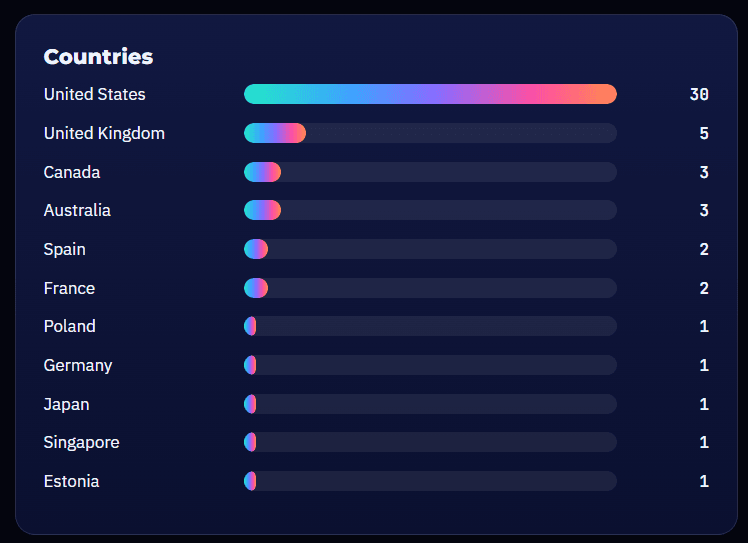
| Country | Platforms | Examples |
|---|---|---|
| United States | 30 | CreatorIQ, GRIN, Later, beehiiv, Patreon, Runway |
| United Kingdom | 5 | The Goat Agency, Whalar, Billion Dollar Boy, ElevenLabs, Synthesia |
| Canada | 3 | Collabstr, #paid, Viral Nation |
| Australia | 3 | TRIBE, Linktree, Canva |
| France | 2 | Kolsquare, Favikon |
| Spain | 2 | Heepsy, Influencity |
| Estonia, Germany, Japan, Poland, Singapore | 1 each | Modash, Passionfroot, AnyMind Group, indaHash, Gushcloud |
AI for Thought. Wisdom for All.
The companies named in this atlas are independent organisations identified for research and potential outreach. Their inclusion does not imply endorsement, participation or an existing partnership. Leadership, ownership and financial details are given as last publicly reported and should be verified against current official sources.
Research and references
- Interactive Advertising Bureau, 2025 Creator Economy Ad Spend & Strategy Report, November 2025.
- Quartermast Advisors, H1 2026 Creator Economy M&A Report, as reported by Net Influencer, July 2026.
- IPS News, Influencer Hero acquires Afluencer, July 2026.
- Pulse 2.0, Agentio: $40 Million Series B at $340 Million Valuation, November 2025.
- WPP Media, WPP Acquires Data-Driven Influencer Marketing Agency Goat, March 2023; The Goat Agency, SoundCloud appoints Goat and Bryce Adams joins as US Influencer Lead, 2026.
- Manatt, The Next Phase of the Creator Economy: Accenture/Whalar and Compound Deals, 2026.
- Dealroom, Billion Dollar Boy's first acquisition, 2026.
- MarTech, Publicis Groupe buys Captiv8, May 2025.
- Kolsquare, Kolsquare welcomes Storyclash, January 2026.
- Net Influencer, Upfluence's Co-CEO Says Influencer Marketing's Revenue Era Has Arrived, 2026.
- Business Wire, GRIN Announces President Ryan Debenham as its New CEO, January 2025.
- Summit Partners, Later Acquires Mavely for $250 Million, January 2025.
- ContentGrip, Notable influencer marketing funding rounds and acquisitions of 2026 (ShopMy funding).
- CreatorIQ, State of Creator Compensation, January 2026.
- Net Influencer, Traackr AI strategist launch, 2026.
- eMarketer, Beehiiv doubles ad sales team as newsletter monetisation heats up, 2026.
- eWEEK, ElevenLabs Raises $500M at $11B Valuation, February 2026; Sacra, September 2026.
- Dinis Guarda, AI Creator Economy Part 1 and Part 2, Wisdomia; The New AI ID IP Entrepreneurial Creator Gig Mindset Game, CitiesABC.
- Ztudium, Operation Phoenix: Global Creator Partnerships, AI Authority & Commercial Growth Strategy, internal roadmap, November 2026; Ztudium / BusinessABC Academy, AI ID Passport.
Share

Dinis Guarda
Dinis Guarda is an author, entrepreneur, founder CEO of ztudium, Businessabc, citiesabc.com and Wisdomia.ai. Dinis is an AI leader, researcher and creator who has been building proprietary solutions based on technologies like digital twins, 3D, spatial computing, AR/VR/MR. Dinis is also an author of multiple books, including "4IR AI Blockchain Fintech IoT Reinventing a Nation" and others. Dinis has been collaborating with the likes of UN / UNITAR, UNESCO, European Space Agency, IBM, Siemens, Mastercard, and governments like USAID, and Malaysia Government to mention a few. He has been a guest lecturer at business schools such as Copenhagen Business School. Dinis is ranked as one of the most influential people and thought leaders in Thinkers360 / Rise Global’s The Artificial Intelligence Power 100, Top 10 Thought leaders in AI, smart cities, metaverse, blockchain, fintech.


