
business resources
Top 5 Prop Trading Firms
05 Dec 2025

Every trader wants to grow. They spend years building up skills but typically with smaller accounts, and when it is time to make bigger bets, there is always an immovable wall called capital. Larger accounts generate higher returns, yet very few traders can access the kind of funding that unlocks serious income.
But lately, this dilemma of having skills but missing the funds to generate meaningful income has become less of a problem. And this is thanks to proprietary trading firms. Even better, these firms go beyond solving the capital problem. They also provide structure and discipline, offer professional-grade tools at no extra cost, and most importantly, provide a focused learning environment.
However, there is a challenge. How do you know what prop firm is the right partner? And given that the prop model is now quite popular (interest in prop firms has jumped by over 600% between 2021 and 2025), how do you know that a particular firm is a good-faith business? These and many more questions should concern anyone new to this side of trading. Thankfully, you will find answers in this article, but most crucially, you will know what firms are worth considering.
Understanding Prop Trading Firms
Proprietary trading firms, which traders often shorten to prop trading firms or prop firms, are businesses that offer their money for skilled traders to use. The operative word here is skilled. And that means you must demonstrate that you can turn a profit before the firm hands you an account. However, you will learn that some companies prefer not to take traders through a traditional evaluation process.
If you study it carefully, the relationship between prop firms and traders is in actual sense, a partnership. The company contributes money and support, which often includes trading tools and an enabling environment. In return, the trader follows the firm’s risk and strategy rules. Then, proceeds from profitable trades are shared according to a predetermined formula.
Prop Models
As the prop firm business has grown over time, so has the process of onboarding new traders advanced. Be that as it may, prop firms typically accept new traders using the evaluation path or the instant funding path. These are the two primary prop models.
The Evaluation Path
This model is a favorite among prop firms that want to validate your skills first before they engage you any further. The path follows a structured – often multistage – process that may resemble a job interview.
First, you may have to pay an evaluation fee before the firm provisions an account for you. This account provides an environment where you can set up trades but using dummy funds, which is why traders call it a simulated environment. You get to show what you can achieve in the real setup but without risking actual money.
But do not take this simulated trading lightly because it counts for a lot more. For starters, the simulated account allows the prop firm to prove two things: that you can hit specified profit targets within a set time, and that you can follow risk rules.
If you pass, you graduate to a funded account with the firm’s real capital. You then trade live, keep a split of the profits, and the firm assumes the financial risk.
However, some firms may take prospective traders through several evaluation stages. But the overarching goal is the same, which can be summed up this way: can you manage risk consistently and demonstrate profitability under pressure?
Read More: sway markets
The Instant Funding Path
Some call this the “start now” path because it is more direct. As the name suggests, you can begin trading a live account much faster. But there are some caveats.
For instance, many instant funding prop firms ask for a subscription, which can be costlier than taking evaluations. And just like the evaluation path, you have to hit certain profit targets. But the main difference comes from the risk rules. Instant funding props firms allow a little more room for maneuver for the trader when it comes to risk management.
As you can already tell, the goal for firms that choose this path is to find out if you can perform and be profitable in real-market conditions from day one. Of course, there are guardrails but these are more flexible than in the evaluation path.
The table below summarizes the key differences between the prop models:
| Evaluation Path | Instant Funding Path | |
| Start | After passing a simulated challenge | Almost immediately |
| Upfront cost | Typically lower one-time fee | Typically higher fee/subscription |
| Primary test | Discipline under stringent risk limits | Profitability in a live-like environment |
| Risk rules | Very tight (daily & overall loss limits) | Often wider (overall loss limit = starting balance) |
What Features Can You Use to Identify Quality Prop Firms?
As stated earlier, the prop firm business has proliferated – some estimates put the number at over 2,000 firms globally as of October 2025. This tells you that traders have a tough job choosing the most fitting prop trading partner. But that shouldn’t be a big deal if you know what features to look out for. Some of the key ones include:
Payout Reliability
We already know that traders engage prop firms so that they can increase their income from trading activities. As such, how reliable a firm is when it comes to paying your share of the profits is the bedrock of the entire relationship.
This feature is the number one metric because you invest in the relationship through effort, skill, and risk (of the evaluation or subscription fee). And the firm’s payout is your return. So, a firm that is vague, slow, or inconsistent with payments is fundamentally broken.
Rule Transparency
Once you trust that a firm will pay, you need to have absolute clarity on how to succeed under their rules. You must know every condition to win. Because your entire strategy must operate within the firm’s framework, the rules must be clear. Otherwise, vague, hidden, or constantly shifting rules will create stress and unfair failure.
Longevity
It’s true that prop trading as we know it today has a brief history. Nonetheless, many firms have operated successfully over this period. In this regard, it is prudent to look past the immediate offer and consider the firm’s foundation. Simply put, longevity is about the firm’s ability to weather tough cycles because it has already operated through several market conditions.
This factor is critical because financial markets are dynamic. They go through volatile crashes, quiet periods, bull runs, and unexpected global events. As such, a firm that has existed through multiple cycles has proven that its business model is sustainable.
Support
This factor concerns the actual reality of trading. A good firm will always hand-hold their traders through issues whenever they arise. It could be a platform glitch, a misunderstood rule, or a withdrawal question, the firm should be on hand to support you and resolve the issue as quickly as possible.
At a Glance: The Top 5 Prop Firms
| Best For | Max Allocation | Profit Split | Quick Verdict | |
| OneFunded | Best Overall | Up to $100,000 | Up to 90% | A trader-focused firm with unlimited trading time and a clear, pressure-free evaluation process. |
| FTMO | Reliability & Track Record | Up to $200,000 | Up to 90% | Mature, well-documented process with fast payouts and strong market reputation. |
| FundedNext | Community & Fast Payouts | Up to $200,000 | Up to 95% | High payouts, fast disbursements and a vibrant community. |
| TopStep | Futures Traders & Education | Up to $150,000 | Up to 90% | Twelve years specializing in futures with proprietary TopStepX platform and comprehensive coaching via Coach T. |
| The Funded Trader | High Capital Allocation | Up to $2.5 million | Up to 95% | Offers the largest capital allocations and highest leverage for aggressive, risk-tolerant trading styles. |
The Top 5 Prop Trading Firms
Our researchers scoured the internet and other resources to isolate the companies that align with our criteria of quality prop firms. Out of the thousands of the available options, we found these five to tick all the right boxes. But while some are ideal for traders of all types, some are suitable for specific needs.
1. OneFunded
OneFunded is our best overall choice. This prop firm is operated by Brynex Tech Limited, a London-based company. According to their website, OneFunded is the brainchild of traders who wanted to build the kind of firm they wished had existed when they first started trading. The firm emphasizes clear rules, timely payouts, and reliable customer support, which it says are the foundation of its trader-focused platform. OneFunded operates on simulated trading conditions and offers multiple challenge tiers from $2,000 to $100,000 account sizes with entry fees starting at $23.
Key Specs:
- Three types of challenges – 1-Step, 2-Step, and 1F Limited – with account sizes ranging from $2,000 to $100,000.
- Entry fees depend on challenge type and account size: $29–$395 for 1-Step challenges; $23–$361 for 2-Step challenges; and $25–$135 for 1F Limited
- Profit target: 10% for 1-Step challenges; 8% (Phase 1) / 5% (Phase 2) for 2-Step challenges; and 7% (Phase 1) / 4% (Phase 2) for 1F Limited.
- Minimum trading days: 5 days (1-Step), 3 days (2-Step), and 2 days (1F Limited)
- Traders keep up to 90% of the profits
- There are no deadlines on the trading periods (unlimited)
- 100% refundable fees
- First payout available after 14 days; subsequent payouts every 14 days
Why It’s Number 1:
Many factors make OneFunded the best overall pick but the highlight is the fact that you have an unlimited trading period. This means traders do not experience the psychological pressure that comes with tight deadlines, which often causes trader failure. Most competitors impose 30–90 day constraints that force rushed decision-making.
Also, out of 131 reviews on Trustpilot, OneFunded has an average of 4.4 out of 5 stars – 57% 5-star, 29% 4-star. The firm has replied to 100% of negative reviews, typically within 1 week, which shows accountability.
2. FTMO
FTMO was founded in 2015, which makes it the second oldest prop firms in our list. This firm boasts one of the best structured onboarding processes in the business – traders go through four evaluation stages. All these stages are collapsed into a two-step evaluation process – FTMO Challenge and Verification. Passing the two stages leads you to an FTMO Account; this a demo account with up to $200,000 in dummy funds. Traders using this account can earn up to 90% of simulated profits, have access to FTMO Premium Program, and can use all trading tools and services.
Key Specs:
- Account sizes range from $10,000 to $200,000
- Profit splits up to 90%
- Refundable challenge entry fees (€89 for $10K account, scaling up for larger sizes)
- A 14-day free trial available for testing the platform
- 10% profit target, unlimited trading period, $500 maximum daily loss, $1,000 maximum loss, and a 4-day minimum trading requirement for Phase 1
- 5% profit target, simplified rules, and same loss limits remain for Phase 2
- Top performers can pursue employment with Quantlane, FTMO’s professional trading arm.
- Trading platforms include MetaTrader 4, MetaTrader 5, cTrader with Copy and Automate features, and DXtrade.
- Profit payouts are typically processed within 1-3 days and withdrawals are available starting day 4 post-funding. Payouts are available every 14 days (depending on account type).
Why It’s Top Tier:
FTMO is now 10 years old and serves more than 3.5 million customers across over 140 countries. And the fact that FTMO acquired Oanda – a well-established online multi-asset trading group founded in 1996 – on December 2, 2025, adds to its quality. Also, the firm states that it has paid out more than $500 million in rewards to traders, which demonstrates reliable payouts. Our researchers found that many traders rank FTMO above several well-known competitors, and even Redditors seem to be in consensus that FTMO is top-tier.
3. FundedNext
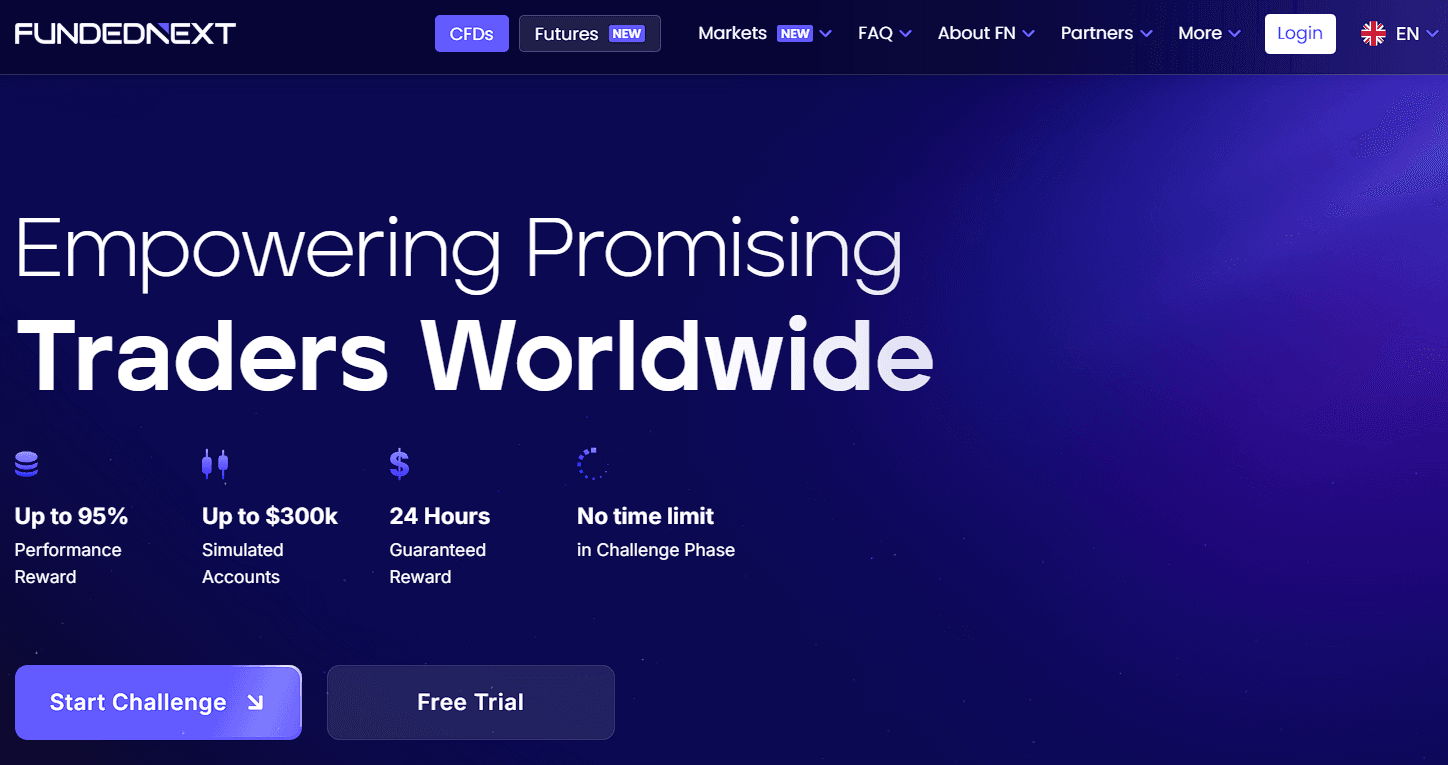
FundedNext says on its website that its mission is to change the lives of 50 million traders around the world through cutting-edge strategies, innovative technologies, and exceptional support. To this end, the firm focuses on pushing boundaries and setting the highest benchmarks in creating value for customers, people, and stakeholders. And this mission has won it several awards and recognitions, including 2025 Best Prop Trading Firm Africa, 2024 Best Trading Experience Award, and Best Prop Trading Firm of The Year 2025.
Key Specs:
- Two-step evaluation with account sizes ranging from $6K to $200K
- Stellar Instant: a new instant funding model for faster account activation for immediate trading.
- You can choose to trade CFDs via FundedNext CFDs or futures via FundedNext Futures.
- Traders get access to FNmarkets, a regulated online broker that partners with FundedNext to provide real-market trading access.
- 14 day free trial with account balance options ranging from $6,000 to $200,000
- Up to 95% profit split in live accounts after passing evaluation
- 15% performance reward from challenge phase (evaluation phase)
- Guaranteed 24-hour payouts (or $1,000 bonus if delayed)
- Average disbursement time: 5 hours
- News trading allowed for additional trading opportunities
- No time limit in Challenge Phase – unlimited trading period during evaluation
Why It’s Top Tier:
One of FundedNext’s most outstanding features is the community. Traders enjoy massive community support through discord community access, Facebook group (FundedNext community), and global events and trader meetups in Philippines, Thailand, and Nigeria. And based on about 51,000 reviews on Trustpilot, where the firm averages 4.5 stars, traders consistently receive payouts in hours, not days. Add to that industry-leading 95% profit splits, a 15% profit share from evaluation phase itself, and news trading is allowed, which most firms restrict.
4. TopStep
TopStep is the oldest prop firm on this list – it has been operating since 2012. It is also known among traders as the go-to firm for futures trading. This is because the company’s entire product list involves CME and NYMEX-listed futures; this includes equity futures, foreign exchange futures, and agricultural futures.
Key Specs:
- Trading Combine is the firm’s standout feature. It is a structured evaluation program where traders prove discipline and profitability in a simulated futures environment before earning funding.
- Traders can only trade futures contracts listed on CME, COMEX, NYMEX, and CBOT
- Fast funding path: You can qualify for a funded account in as little as 2 days
- Account sizes can go up to $150k, and each has clear profit targets and loss limits
- Traders use TopStepX – a proprietary trading platform – for commission-free trading, built-in trade copier, and exclusive indicators like The Tilt.
- Payouts are deducted instantly from accounts, with daily payout processing
- Traders only need 5 winning days of +$150 to qualify for a payout
- Ability to earn and take payouts from up to 5 Express Funded Accounts simultaneously.
- Access to a wide variety of educational content via Coach T, educational courses, daily livestreams and market insights via TopStepTV, and trader certificates sharable via LinkedIn.
Why It’s Top Tier:
TopStep goes many steps further ahead of just providing trading capital. One can confidently say that the firm is a school because of robust coaching resources. This includes the Coach T service that offers personalized performance tips and the news and insights from TopStepTV. If that is not enough, the TopStepX – built specifically for prop traders – takes things to the next level. Add to the credibility that the company has earned over 12 years of operation.
5. The Funded Trader

When talking among themselves in forums, traders often refer to The Funded Trader (TFT) as the “high-allocation giant.” This is in reference to the firm’s “Knight” and “Royal” challenges and humongous (by traditional standards) capital allocations. You can trade up to $600,000 on a TFT account – this is a simulated environment in which the trader may earn real-money remuneration.
Key Specs:
- One-step evaluation, fast payouts, and allocations of up to $2.5M for Knight and Knight Pro tiers.
- Profit splits of up to 95% for the VIP program
- Balance-based daily drawdown (e.g., 3%) and maximum drawdown (e.g., 8%).
- Payouts are available as early as 7 days after funding, with “anytime payouts” in Knight Pro.
- You can trade instruments across several markets – forex, commodities, indices, and crypto.
- Entry fees range from $489 to $578 depending on challenge type and account size.
- Mandatory ID verification before payouts.
Why It’s Top Tier:
TFT tops this list as the firm with the most challenges. The Knight Pro challenge, for instance, allocates traders up to $2.5 million in capital – this is industry-leading. This tier also has one-step evaluation, allows instant payouts, and pays out up to 95% of proceeds from profitable trades. The trading rules are also trader-friendly; for instance, the Royal Challenge allows weekend holding. Other tiers allow expert advisors (EAs) and news trading.
How to Choose the Best Prop Firm for Your Trading Style
So now you know what a quality prop firm looks like, and you also have five best options to choose from. The next thing to consider can be summed up by this question: How do you pick the most ideal prop firm for the best relationship? Here are a few ideas:
Match Your Strategy to Their Rules
This must always be your starting point. Why so? The most reputable prop firm in the world is a poor choice if its rules invalidate your style of trading. The idea here is that your trading style is your edge, and the firm’s rules are the playing field. As such, you must ensure the field doesn’t neutralize your edge.
How do you go about this? For starters, break down your strategy into core elements. That is, ask yourself questions like: How long do I hold positions? What instruments do I mainly trade? What do my setups look like? This approach will help you learn what type of trader you are – you could be a scalper, a day trader, or a swing trader. You will also be able to know your favorite trading instruments, and whether you like trading around scheduled news events or you rely on overnight positions.
Once you achieve clarity, scrutinize the firm’s rules for conflicts with your elements. You must get this factor right the first time because it creates a foundation of confidence. It means every trade you place will be within a framework designed for your success, not against it.
Assess Your Risk Tolerance
As a trader, you have a certain level where you operate comfortably. But the firm, as we have learned, has guidelines that its traders must operate within. If these two aren’t aligned, even a perfectly matched strategy can fail. The goal, therefore, is to choose a company whose limits sit comfortably within your own, so you’re trading from a place of confidence, not fear or constraint.
Calculate the Total Cost of Entry
Trading is to a trader what a 9-5 job is to an employee or what a business is to an entrepreneur. The point here is that you must understand the full commitment required to begin, as well as the ongoing costs of operating. A transparent firm will make this easy to calculate.
The idea here is that your “fee” or “challenge cost” is rarely the only expense. Your goal is to understand the total financial outlay required to realistically reach your first payout, and to weigh that against the value the firm provides.
To that end, break down the costs into categories: initial evaluation or subscription fee; the reset or retry fee; platform and data fees; and finally, the profit split structure. Then, you can create a simple scenario of two firms you are considering. For each, estimate the total cost if it takes you two attempts to pass their evaluation and one month to earn your first payout. So, if Firm A includes a $250 challenge fee plus $150 reset fee and a $0 platform fees, the total cost will come to $400 before first payout. And if Firm B has a $99 challenge fee and a $99 reset fee and a $50/month platform fee, the figure will be $248. Suddenly, you learn that the cheaper challenge isn’t always the less expensive path.
The point is that prop trading is an investment, and like any other business venture, the goal is to earn better returns. And a top-tier firm must be transparent about all fees before you pay because that way, you can proceed with clear expectations.
Verify Reputation and Stability
You are not ready to engage a firm before you do a thorough background check. This is where you take the firm’s own marketing and promises, and measure them against the actual experiences of other traders over time. The question you must answer here is: Does this firm operate with integrity and resilience in the real world?
To do this, begin with seeking proof of payouts. You could make use of forums on platforms like Reddit and sites like Trustpilot to see what others are saying about this particular topic. Then, extend the investigation to how the firm handles issues. For example, does it respond to unfavorable reviews on Trustpilot? What is the resolution tone? Does the firm respond transparently about the problem?
You can also supplement that knowledge with reviews like this one. For example, we will tell you that we conducted a support test, which we did, and found that a certain firm responded within good time and with clarity. We can give you the example of OneFunded, our best overall pick for this review, where our queries were handled within 24 hours.
FAQs
1. What’s the main difference between the Evaluation and Instant Funding models?
The Evaluation model requires you to prove your skill in a simulated account and within specific guidelines before receiving real capital. On the contrary, Instant Funding model provides immediate access to a live-like account for a higher upfront cost, with generally more flexible risk rules.
2. Are prop firm challenges worth the fee?
They can be, but only if you treat the fee as an investment in a serious opportunity. Its value depends entirely on choosing a reputable firm whose rules match your trading style, allowing you to potentially access far more capital than you have personally.
3. Can I use any trading strategy with a prop firm?
No. You must carefully check the firm’s rules. Strategies like swing trading, news trading, or using Expert Advisors (EAs) are often restricted. Your strategy must operate within their specific drawdown, holding period, and instrument rules.
4. How soon can I get my first payout?
After passing an evaluation, there is typically a minimum waiting period before your first payout request. For instant funding, you must usually hit a first profit target. Subsequent payouts are then processed on a regular schedule.
5. Is my personal money at risk in the funded account?
No. Your maximum financial risk is typically limited to the one-time evaluation or subscription fee. The trading capital in the funded account belongs to the firm. You cannot lose more than your fee, and your personal savings are not liable for trading losses.


