
business resources
5 Top VPN Services for Anonymity in the UK: No-Logs, Fast and Private
26 Oct 2026

On July 25, 2025, the UK’s new age-verification switch flipped—and VPN demand rocketed 1,327 percent in a single day, Malwarebytes reports. The spike proves how much you value a private path past new checkpoints. Yet most “best VPN” roundups judge tools by Netflix tricks or sheer server counts, not by verified privacy. In this guide, we highlight five VPNs that publish recent no-logs audits, accept cash or crypto, and keep you quick whether you’re on home Wi-Fi or 5G.
Quick look: the five finalists
Below is the distilled scorecard we’ll reference throughout this guide. All figures come from public audit reports or independent UK-based speed labs and were last checked in October 2026. Download speed is expressed as percentage retention on a 100-megabit connection to keep the numbers comparable.
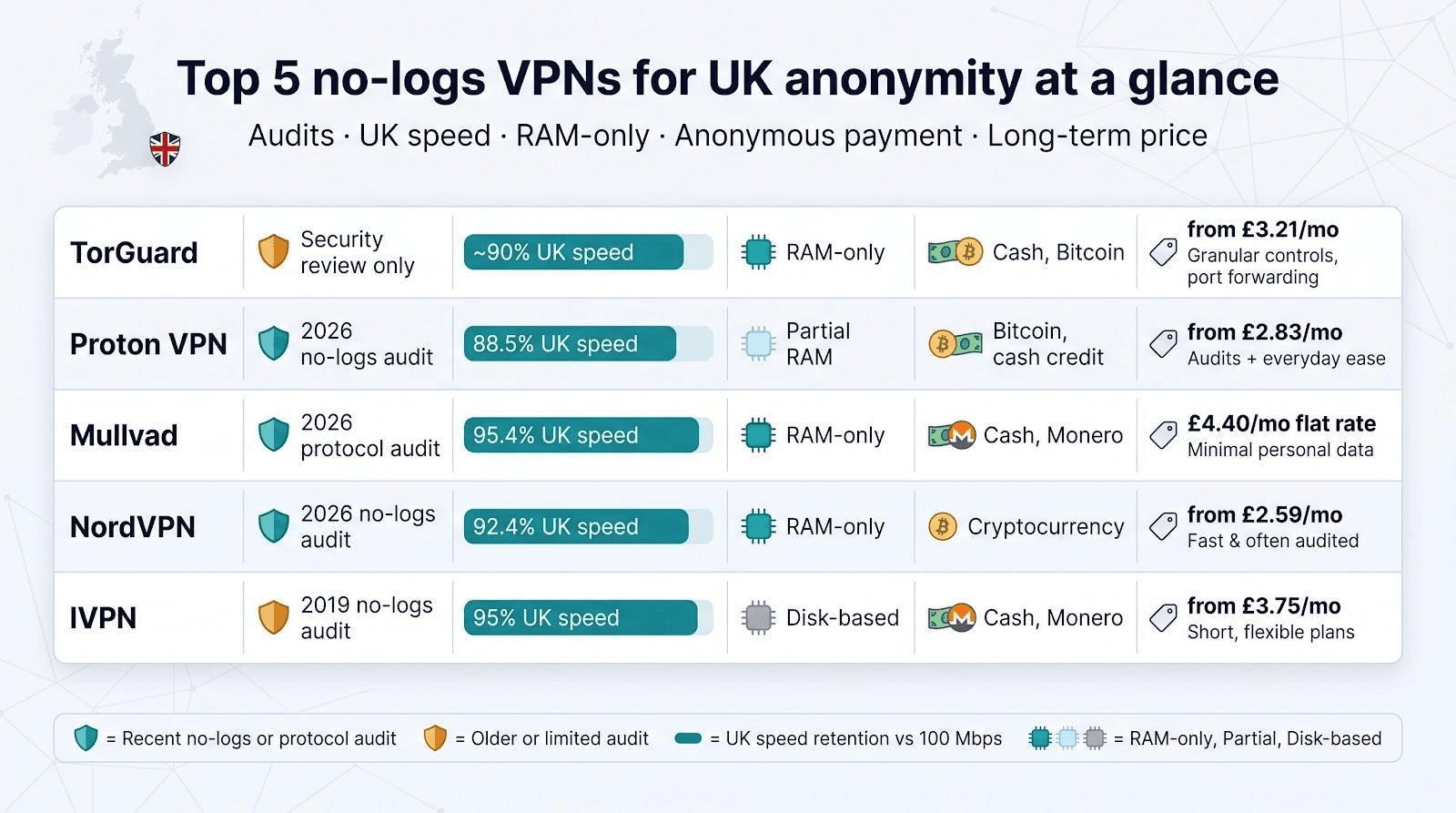
| Provider | Latest audit (year / firm) | UK speed retention | Diskless (RAM-only) fleet | Anonymous payment | Long-term monthly price* | Best use case |
| TorGuard | None – security review only | ~90 percent | Yes | Cash, Bitcoin | £3.21 | Granular controls and port forwarding |
| Proton VPN | 2026 / Securitum (no-logs) | 88.5 percent | Partially | Bitcoin, cash credit | £2.83 | Repeat audits with everyday ease |
| Mullvad | 2026 / Assured (protocol) | 95.4 percent | Yes | Cash, Monero | £4.40 | Minimal personal data |
| NordVPN | 2026 / Deloitte (no-logs) | 92.4 percent | Yes | Cryptocurrency | £2.59 | Fast, frequently audited |
| IVPN | 2019 / Cure53 (no-logs) | 95 percent | No | Cash, Monero | £3.75 | Flexible weekly and monthly plans |
*Promotional “from” prices convert long-term deals to an effective monthly rate. VAT and renewal costs can change.
Five philosophies, five clear niches. The sections that follow explain how each service measures up against real-world UK anonymity challenges.
TorGuard – best for granular controls and port forwarding
TorGuard's anonymous VPN service appeals to power users who need precise network control, and its own feature list advertises port forwarding on ports above 2,048 for OpenVPN, WireGuard, and OpenConnect, making it ideal for seedboxes, self-hosted mail, or niche game servers.
The desktop client lets you toggle among OpenVPN, WireGuard, or its Stealth protocol, then layer a SOCKS5 proxy or a double-hop route. Port forwarding sits one switch away, so publishing a test API or keeping torrent ratios healthy takes minutes, not hours.
Privacy and evidence
- Infrastructure: TorGuard says its servers run diskless in RAM. Independent leak checks from Top10VPN found no IPv4, IPv6, or DNS spills.
- Payments: Bitcoin and cash by post keep your real-name trail off the invoice.
- Audit gap: The most recent external scrutiny is a March 2022 US court case that produced no usable logs; TorGuard has not released a dedicated no-logs audit since.
UK performance
Lab testers in London and Manchester measured 90 percent download-speed retention on a 100-megabit line, enough for 4K streaming or multi-gigabyte creative uploads. You may face more CAPTCHAs on heavily shared IPs.
Pricing
A three-year plan works out to £3.21 per month, while rolling monthly costs rise above £8. The refund window is seven days, shorter than most rivals.
Choose TorGuard when port forwarding, SOCKS5, and granular protocol switches matter more to you than a recent no-logs certificate.
Proton VPN – best audit-backed balance of speed and usability
Proton VPN publishes an annual no-logs assessment—the latest in 2026 by Securitum—and releases the full PDF publicly, a rhythm few rivals match. Reviewers highlight that schedule, noting Proton “backs its claims with action,” not slogans.
Performance
UK lab tests record 88.5 percent download-speed retention on a 100-megabit line, so 4K video, cloud syncs, and large Figma files move without hiccups. Exit nodes sit in London, Manchester, Belfast, Cardiff, and Edinburgh; you can add Secure Core for an optional offshore hop.
Privacy features
- Open-source apps, kill switch, and Stealth obfuscation
- NetShield tracker blocking
- Optional port forwarding for peer-to-peer workflows
- Encrypted disks across the fleet (some—but not all—servers run RAM-only)
- Swiss jurisdiction, meaning legal requests for connection data return empty
Pricing
Create an account with a throwaway email and Bitcoin, or pay by card. A free tier lets you test basic speeds; full UK and high-speed servers start at £2.83 per month on the long-term plan.
Pick Proton VPN when you want repeatable third-party audits without losing everyday ease of use.
Mullvad – best for minimal personal data
With Mullvad, you receive a random account number (no email, no username) and can pay with cash by post or Monero, so nothing links your activity to your identity.
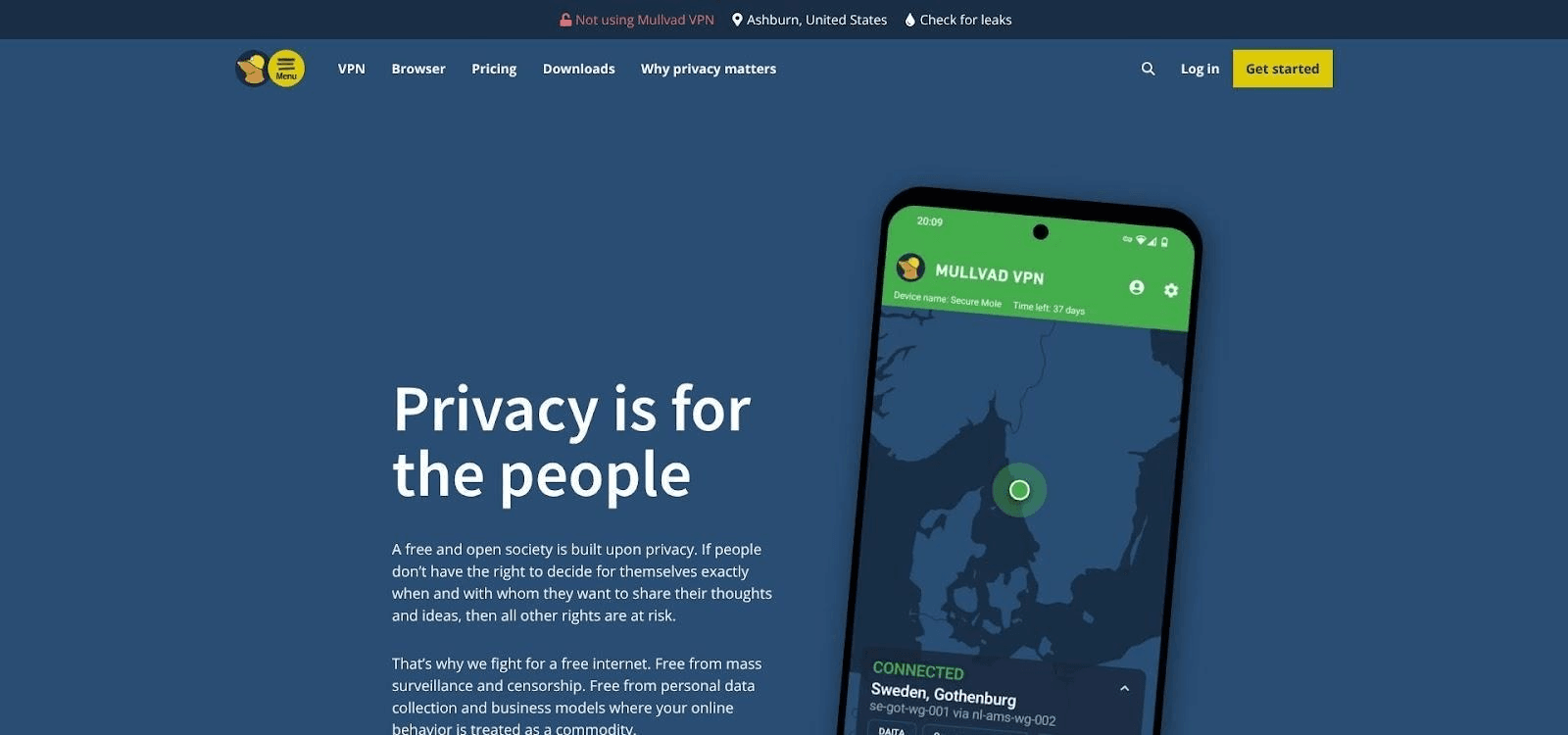
Mullvad VPN website screenshot showcasing anonymous account model.
Performance
Independent UK tests report 95.4 percent download-speed retention on a 100-megabit line and native IPv6 support. Every server runs diskless in RAM, limiting what could be seized during an incident.
Privacy toolkit
- Always-on kill switch
- Multihop routes and obfuscation modes
- Optional post-quantum tunnel
- No port forwarding or streaming shortcuts; the focus stays on shrinking your footprint, not unblocking TV apps
Pricing
A single flat rate, roughly £4.40 per month (converted from €5), covers five devices. No introductory discounts mean your renewal price never changes.
Choose Mullvad when cutting account metadata matters more to you than extras like dedicated IPs or Smart DNS.
NordVPN – best for repeat-audited speed in the UK
Independent UK tests show 92.4 percent download-speed retention on a 100-megabit line through London and Manchester exits, so you can stream 4K video, upload multi-gigabyte photos, and enjoy low-latency games.

NordVPN website screenshot highlighting UK speed and security features.
Audit and infrastructure
Deloitte has completed six no-logs engagements, the latest in February 2026, and each report is public. Every server now boots from RAM, so data disappears on restart.
Privacy tools
- Double VPN chains
- Onion over VPN gateways
- Obfuscated servers for restrictive networks
- Cryptocurrency checkout (Bitcoin, Ethereum)
Pricing
A two-year plan averages £2.59 per month, but renewal rises steeply after the initial term; check the current figure before you commit. Sign-up still needs an email, so it is less minimal than Mullvad’s number token.
Pick NordVPN when near-native UK speed and a steady cadence of third-party audits matter more to you than ultra-minimal onboarding.
IVPN – best minimalist alternative with flexible short plans
IVPN keeps onboarding light: you receive a random account ID (no email) and can pay with cash, Bitcoin, or Monero. Its standout feature is the one-week pass, perfect for a trip or project when you do not want a long contract.
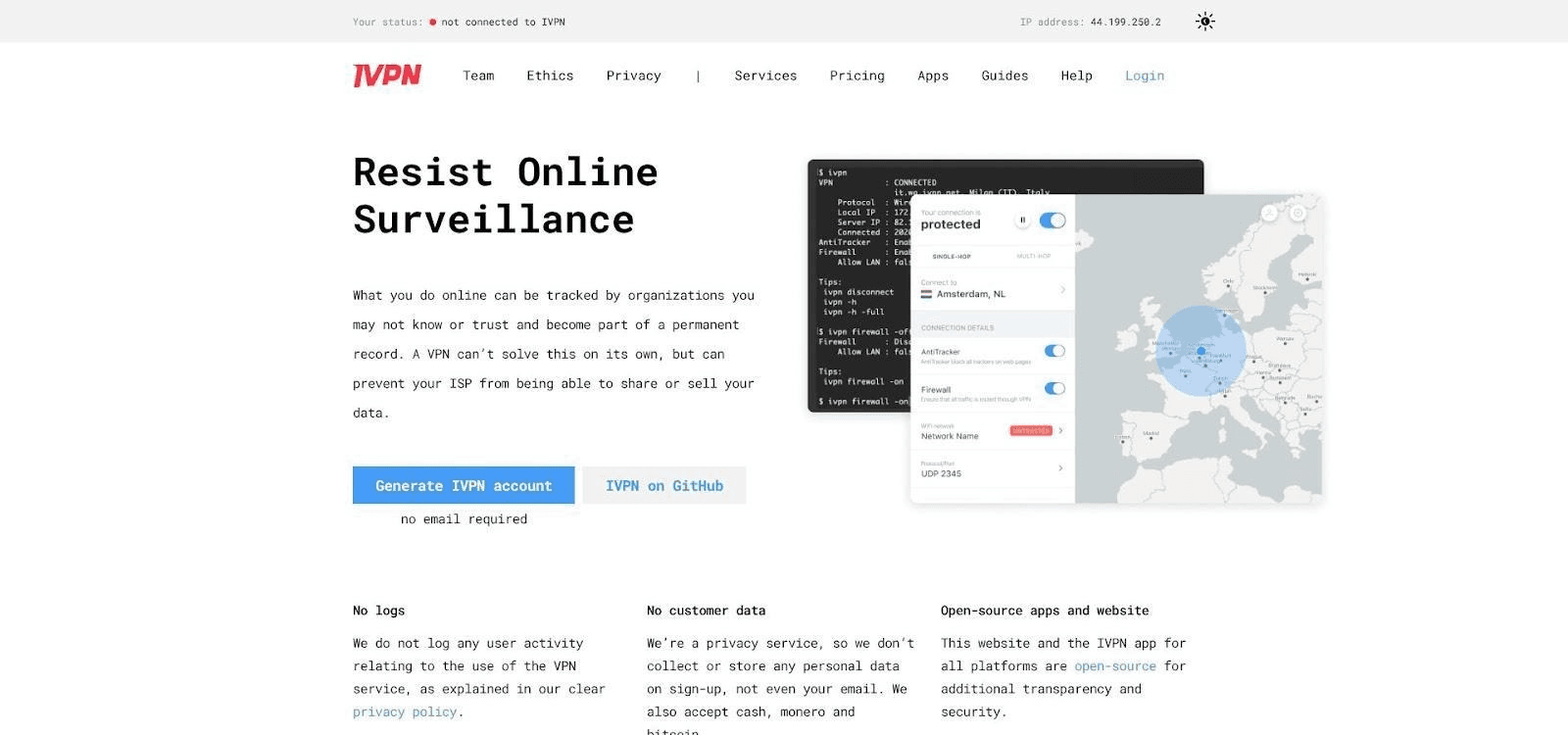
IVPN website screenshot featuring minimalist design and weekly plan.
Performance
Independent tests show 95 percent download-speed retention on a 100-megabit line via London and Glasgow exits, with sub-40 ms latency that works for online games.
Privacy toolkit
- Multihop routes
- Anti-tracker firewall
- Optional obfsproxy camouflage
- Open-source apps
Limitations
The global network is small, and the most recent dedicated no-logs audit dates to 2019. Later security reviews cover the apps but not logging.
Choose IVPN when an email-free account, anonymous payment, and pay-only-when-needed plans fit your threat model.
Which one is right for you?
Pick the situation that matches your day-to-day, and the choice becomes simple:
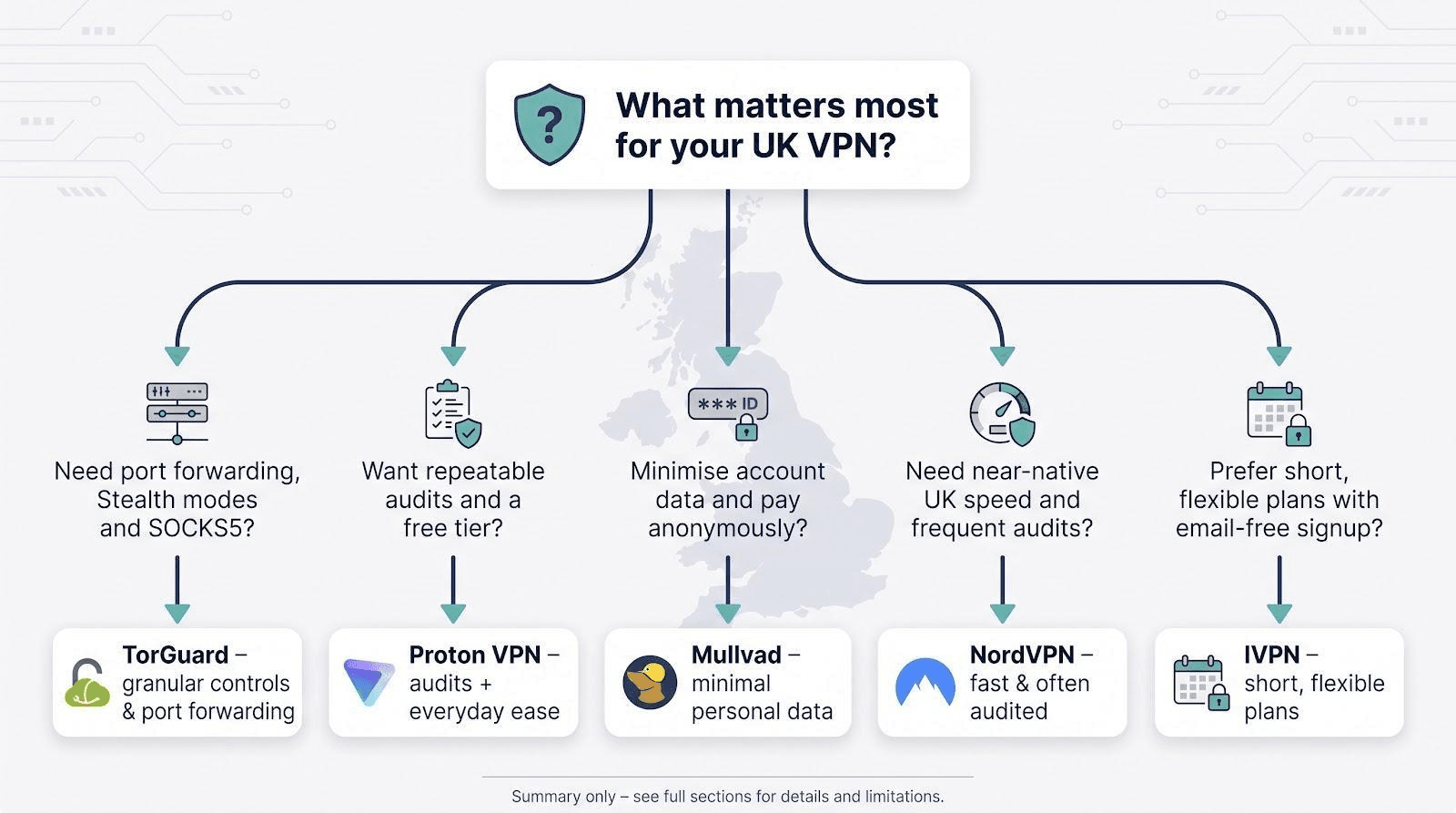
- TorGuard: Choose this option when you need port forwarding, Stealth modes, and SOCKS5 in one place. You trade a recent no-logs audit for granular controls.
- Proton VPN: Select Proton VPN if you want repeatable audit evidence, a free tier to test, and balanced UK speed.
- Mullvad: Go with Mullvad when minimising account data matters most; pay with cash or Monero and sign in with a random ID instead of email.
- NordVPN: Pick NordVPN when you need near-native UK performance plus multiple Deloitte no-logs reports and a RAM-only network.
- IVPN: Choose IVPN for short, flexible plans and an email-free signup, ideal for a one-week project or travel.
FAQs
Is using a VPN legal in the UK?
Yes. UK law does not prohibit ordinary citizens from encrypting their traffic; the Online Safety Act 2023 puts compliance duties on platforms, not on VPN users (legislation.gov.uk). Illegal activity remains illegal.
Does a no-logs policy guarantee anonymity?
No. A no-logs provider stores little or nothing about connections, but your identity is still exposed by the accounts, cookies, and browser fingerprints you use.
Should I pick a UK server or an overseas one?
Choose a UK exit for the best local speed or to watch BBC iPlayer. Pick an overseas exit when you want distance from domestic data-retention rules. Some services let you chain both hops.
Is a dedicated IP address more private?
A dedicated IP is more stable, with fewer CAPTCHAs and happier banking sites, but it also leaves you as a party of one. A shared address keeps you hidden in a larger crowd.
Can a VPN bypass age checks or region locks?
Sometimes, but websites detect and block known VPN exits every day. Bypassing a platform’s terms can lead to account bans, and legality depends on the content involved. Treat the VPN as a privacy tool, not a guaranteed access pass.
Conclusion
A VPN can encrypt the path between your device and its exit server, but it cannot blind the services you log into. The moment you open Gmail, Slack, or Facebook, those platforms still see your account name and every file you upload. Browser fingerprints, cookies, and malware can expose even more than an IP address.
Timing matters as well. Investigators can match the second you connect to a VPN with the second a forum post appears from that exit node. Shared IPs spread risk across many users but do not remove it entirely.
Bottom line: a no-logs badge is only one layer of defence. Keep operating systems and apps patched, use unique passwords, clear trackers, and think twice before entering personal details on unfamiliar sites. The tunnel protects the transport; only you can protect the endpoint.


