
citiesabc
Vue.js for Modern Frontend Development: What Businesses Should Know
07 Sept 2026

Choosing a frontend framework shapes how a product performs, how quickly a team can ship features, and how much a business spends maintaining its digital presence over time. Among the available options, Vue.js has moved from a niche favorite to a serious contender for companies building web applications, dashboards, and customer-facing platforms. According to a Statista survey of over 49,000 software developers worldwide, Vue.js was used by 17.6 percent of respondents, placing it behind larger names like React and Angular but still ahead of several established frameworks, a sign that its adoption has grown well beyond a small circle of early users. Its appeal lies in a combination of approachable syntax, solid performance, and a structure that suits both small projects and larger systems. For businesses weighing their frontend options, understanding what Vue.js actually offers, and where it fits best, matters more than following trends. This article breaks down what Vue.js is, why it has gained traction, and what companies should consider before adopting it.
What Is Vue.js and Why It Matters for Businesses
Vue.js is a JavaScript framework used to build user interfaces and single-page applications. It was designed to be adopted gradually, meaning teams can introduce it into an existing project without rewriting everything from scratch. This progressive nature sets it apart from frameworks that demand a full commitment from day one.
For businesses, this flexibility translates into lower risk. A company can start using Vue.js for a single component or feature, then expand its use as confidence and internal expertise grow. Many organizations without in-house experience choose to hire dedicated Vue.js developers at this stage, since bringing in specialists early helps establish good architectural habits before a project scales. Its component-based structure also means interfaces are built from reusable, self-contained pieces, which simplifies both development and long-term maintenance.
Key Benefits of Vue.js for Modern Web Development
Vue.js brings together several qualities that make it attractive for teams building modern web applications. Its lightweight core keeps applications fast, while its templating system remains readable even for developers who are new to the framework. Rendering is handled efficiently through a virtual DOM, which updates only the parts of a page that actually change rather than reloading entire sections.
The ecosystem around Vue.js has also matured considerably. Official libraries for routing, state management, and testing are maintained alongside the core framework, reducing the guesswork involved in selecting third-party tools.
Faster Development Cycles with Vue.js
Vue's straightforward syntax and reusable component structure allow developers to build and test features quickly. Teams often find that onboarding new developers takes less time compared to more complex frameworks, since Vue's documentation is clear and its learning curve is gentler. This shorter ramp-up period means projects can move from concept to working product faster, which matters for businesses operating on tight timelines.
Cost-Effective Frontend Solutions for Businesses
Because Vue.js requires less boilerplate code and fewer external dependencies than some alternatives, development and maintenance costs tend to be lower. Companies that hire dedicated frontend developers familiar with Vue.js often see reduced project timelines, since the framework's structure limits the amount of custom tooling needed to get a project running. Long-term maintenance also becomes simpler, as Vue's consistent patterns make it easier for new team members to pick up existing codebases.
Vue.js vs. Other Frontend Frameworks (React, Angular)
Businesses frequently compare Vue.js against React and Angular before making a decision. Each framework has its own strengths, and the right choice depends on project requirements, team experience, and long-term goals.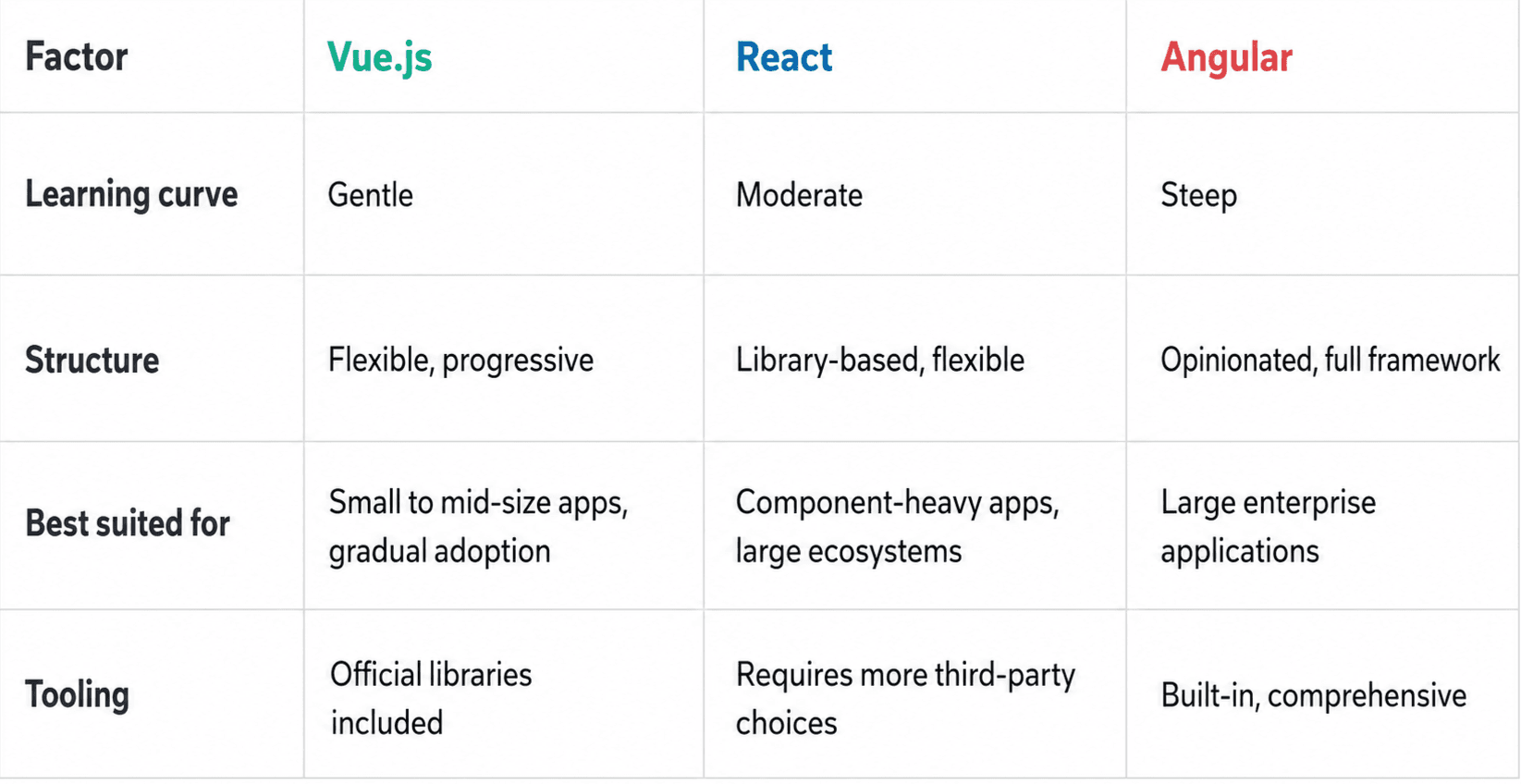 React offers a large ecosystem and strong community backing, making it a common choice for companies already invested in JavaScript-heavy workflows. Angular, backed by Google, provides a complete framework with strict conventions, which some enterprises prefer for large-scale applications with many contributors. Vue.js sits between these two, offering the flexibility of React with some of the structure found in Angular, without the steep learning curve of either.
Business Use Cases for Vue.js Applications
Vue.js has been adopted across a range of applications, from small internal tools to customer-facing platforms.

These use cases reflect Vue's versatility. It performs well in projects where interactivity, speed, and maintainability all carry weight in the final outcome.
Scalability and Performance of Vue.js for Enterprise Projects
A common question among larger organizations is whether Vue.js can support enterprise-level demands. The framework was built with scalability in mind, and its ecosystem includes tools such as Vuex and Pinia for state management, which help maintain order as applications grow in complexity.
Vue's component-based structure also supports code splitting, allowing large applications to load only the parts needed for a given page rather than the entire codebase at once. This keeps performance steady even as the application expands. Enterprises considering Vue.js should evaluate their specific technical requirements, but the framework has demonstrated that it can support applications with many contributors, frequent updates, and complex data flows.
How to Choose the Right Vue.js Development Team
Selecting the right team for a Vue.js project affects both the quality of the final product and how smoothly development proceeds. Businesses should look for developers who understand not just Vue's syntax, but its broader ecosystem, including state management libraries and testing frameworks.
When assessing candidates or outsourcing partners, a few practical factors are worth checking before committing:
- Previous experience with projects of similar scale and complexity
- Familiarity with Vue's official tooling, such as Vue Router and Pinia
- A track record of clear communication and documentation practices
Outsourcing to a specialized team can work well for businesses that lack in-house Vue.js expertise, provided the vendor demonstrates a solid understanding of both the framework and the business's specific goals. Taking time to vet technical skill alongside communication style tends to produce better long-term outcomes than choosing based on cost alone.
Conclusion
Vue.js has established itself as a practical, flexible option for businesses building modern frontend applications. Its gradual adoption model, efficient rendering, and mature ecosystem make it suitable for projects ranging from small internal tools to large enterprise systems. When compared against React and Angular, Vue.js offers a balance of simplicity and capability that appeals to teams looking for faster development cycles without sacrificing long-term maintainability.
For businesses weighing their frontend options, the decision ultimately comes down to project scope, team expertise, and long-term goals. Vue.js provides a solid foundation for companies that want a framework capable of growing alongside their needs, whether that means starting small or scaling toward enterprise-level demands.


