


citiesabc, first_page
What Should You Do 90, 60, 30 and 7 Days Before Moving?
26 Aug 2026

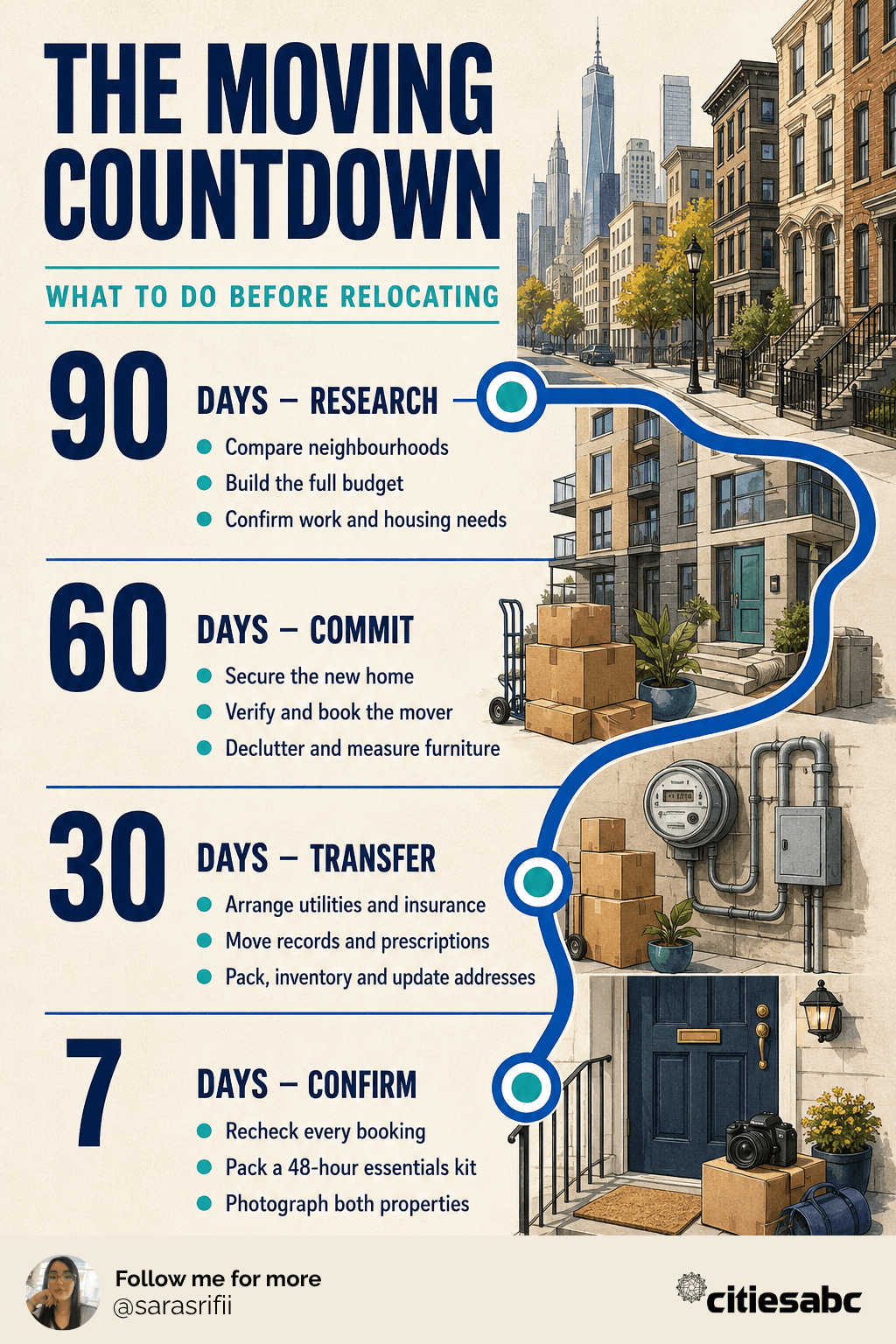
Moving to a new city becomes easier when decisions are made in the right order. Ninety days before the move, the priority is research and budgeting. By 60 days, housing and moving arrangements should be taking shape. At 30 days, attention shifts to services, records and packing. The final week is about confirmation, not major decisions.
This moving timeline organises the process into four practical stages. Exact deadlines vary by lease, destination and local rules, so verify requirements with the relevant authorities and service providers.
Key takeaways
- At 90 days, compare neighbourhoods, costs and employment arrangements.
- At 60 days, secure housing and verify the moving company.
- At 30 days, arrange utilities, records, insurance and address changes.
- At seven days, confirm every booking and prepare essential belongings.
- Keep identification, medication, valuables and important documents with you.
90 days before moving: make the major decisions
Three months before the move, focus on questions that could change whether, where or when you relocate.
Research the destination
Compare specific neighbourhoods rather than relying on citywide averages. Consider:
- Rent and local taxes
- Commute times and transport
- Healthcare and schools
- Safety and environmental risks
- Grocery and essential-service access
- Walkability, noise and parking
- Internet availability
- Lifestyle and community
If the destination remains uncertain, Citiesabc’s guide to choosing which city to move to provides a broader comparison framework.
Build the relocation budget
Estimate both moving expenses and the cost of establishing life in the new city. Include deposits, travel, movers, temporary accommodation, utility activation and replacement furniture.
Then calculate the financial reserve needed after arrival. The Citiesabc guide to how much money to save before moving explains how to combine moving costs, setup expenses and an emergency buffer.
Confirm work and housing requirements

If relocating for employment, obtain written confirmation of the salary, start date, work location and any relocation support.
If renting, learn which documents, deposits and income checks landlords typically require. Do not send money until the property and landlord or agent have been verified.
60 days before moving: secure the move
By the two-month point, planning should become contractual.
Confirm the new home

Read the entire lease or purchase agreement. Check:
- Move-in date
- Deposit and payment terms
- Included utilities
- Parking and pet rules
- Early-termination conditions
- Building access requirements
- Existing property damage
Request a live video tour if an in-person visit is impossible. Avoid untraceable payments or pressure to transfer money immediately.
Choose and verify a mover
Obtain more than one written estimate. For an interstate US move, confirm the company’s registration and complaint information through the Federal Motor Carrier Safety Administration.
Determine whether the company is the actual mover or a broker that will assign the job elsewhere. Review valuation coverage, delivery windows, storage charges and cancellation terms before signing.
FMCSA advises customers to receive and review documents including the written estimate, order for service, bill of lading and shipment inventory.
Reduce what must be moved
Sort possessions into four groups:
- Keep
- Sell
- Donate
- Recycle or dispose
Removing unnecessary items can reduce packing time, transport volume and unloading costs. Measure large furniture against doors, stairways and lifts at the new property.
30 days before moving: transfer everyday life
With one month remaining, organise the systems that must continue working after the address changes.
Arrange essential services
Schedule activation or transfer of:
- Electricity and gas
- Water
- Internet
- Waste collection
- Parking permits
- Home or renter’s insurance
Do not assume every provider can activate service immediately. Remote workers should confirm internet availability and prepare a temporary backup connection.
Organise healthcare, school and pet records
Request necessary medical, dental, school and veterinary records. Refill essential medication and check whether existing health insurance covers the destination.
Update pet identification and research any vaccination, registration or transport requirements that apply.
Start structured packing

Pack storage areas, books, seasonal clothing and rarely used kitchenware first. Label boxes by destination room and record high-value items with photographs and serial numbers.
Keep a separate digital or printed inventory. Citiesabc’s complete relocation checklist covers the documents, services and arrival checks that should accompany this timeline.
Begin address updates
USPS recommends allowing up to two weeks for mail forwarding to begin, even though it may start sooner. Mail forwarding does not update records held by banks, insurers or government agencies.
Prepare a list covering:
- Employer and payroll
- Banks and card providers
- Insurance companies
- Tax authorities
- Driving licence and vehicle registration
- Voter registration
- Healthcare providers
- Schools and subscriptions
Seven days before moving: confirm and protect
The final week should be used to verify existing arrangements rather than introduce new ones.
Reconfirm every booking
Contact the mover, landlord, building manager and utility providers. Confirm:
- Arrival and delivery windows
- Addresses and contact numbers
- Freight-lift reservations
- Loading or parking access
- Required insurance certificates
- Payment method and remaining balance
- Key collection arrangements
If any agreement changes, request written confirmation.
Prepare the essentials kit
Pack enough for at least the first 24–48 hours:
- Identification and housing documents
- Medication
- Chargers
- Clothing and toiletries
- Bedding and towels
- Water and simple food
- Basic cleaning supplies
- Pet or childcare items
- Keys and emergency contacts
Carry valuables, financial records and irreplaceable possessions personally rather than placing them in the moving vehicle.
Prepare both properties
At the old home, finish cleaning, photograph its condition and record utility readings where relevant.
At the new home, confirm access and arrange an inspection before unloading. Photograph existing damage and test locks, water, electricity, smoke alarms, heating or cooling.
A simple way to remember the timeline
| Time remaining | Main objective | Essential outcome |
|---|---|---|
| 90 days | Research | The city, budget and timing are viable |
| 60 days | Commit | Housing and moving arrangements are verified |
| 30 days | Transfer | Services, records and packing are underway |
| 7 days | Confirm | Every booking and essential item is ready |
What should you avoid leaving until the final week?
Do not wait until seven days before moving to:
- Choose an unfamiliar neighbourhood
- Sign an unverified lease
- Hire the first available mover
- Research licence-transfer requirements
- Arrange specialist transport
- Save for deposits and setup costs
- Resolve insurance gaps
These decisions can involve waiting periods, limited availability or financial consequences that cannot be fixed quickly.
Final thoughts
A successful move is not created by completing every task early. It comes from handling each decision when there is still enough time to correct a problem.
Use the 90-day stage to reduce uncertainty, the 60-day stage to secure arrangements, the 30-day stage to transfer essential services and the final week to confirm execution. After arriving, Citiesabc’s guide to building a social life in a new city can help turn the destination into a community.


