
Businesses
How Do You Build a Startup Cash Flow Forecast?
26 Aug 2026

A startup cash flow forecast estimates when money will enter and leave the company and whether enough cash will remain to meet payroll, suppliers, taxes and other commitments.
It is different from a profit forecast. A startup may record revenue before collecting payment, purchase inventory before making a sale or buy equipment that affects cash immediately but is expensed over several years.
This guide explains how to build a practical startup cash flow forecast using payment timing, operating assumptions and scenario planning.
Key takeaways
- Begin with the actual unrestricted cash available.
- Forecast the timing of payments, not only sales and expenses.
- Use weekly forecasting for short-term control and monthly forecasting for longer-term planning.
- Separate operating, investing and financing cash movements.
- Include taxes, payment delays, inventory and one-time costs.
- Create base and downside scenarios.
- Compare actual cash movements with the forecast regularly.
- Use the forecast to decide when to hire, reduce spending or raise capital.
What is a startup cash flow forecast?
A startup cash flow forecast projects the company’s cash balance across future periods.
The basic calculation is:
Closing cash = opening cash + cash received − cash paid
The closing balance from one period becomes the opening balance for the next.
- A forecast should answer four practical questions:
- How much cash is available now?
- When is cash expected to arrive?
- When must payments be made?
- When could the balance become dangerously low?
A cash forecast is one component of a broader financial model. Businessabc’s guide to startup financial modelling explains how cash connects with revenue, burn, runway and unit economics.
Cash flow is not the same as profit
Profit measures revenue and expenses under accounting rules. Cash flow records actual movements of money.
Suppose a startup completes a $30,000 project in January but allows the customer to pay in March:
- January may record $30,000 in revenue.
- January cash receipts remain zero.
- March receives the $30,000, assuming payment arrives on time.
The company may appear profitable in January while lacking the cash required to pay that month’s salaries.
Other timing differences can come from:
- Annual subscriptions paid in advance
- Customer deposits
- Supplier credit
- Inventory purchases
- Loan repayments
- Capital expenditure
- Sales taxes
- Deferred revenue
- Late customer payments
A credible forecast models these movements separately.
What should the forecast contain?
A simple startup cash flow forecast can be organised into the following sections:
| Section | Typical entries |
|---|---|
| Opening cash | Bank balances available for operations |
| Customer receipts | Subscriptions, invoices, sales and deposits |
| Other operating inflows | Refunds, grants or tax credits |
| Direct costs | Materials, fulfilment, cloud usage and transaction fees |
| Operating expenses | Payroll, rent, marketing, software and insurance |
| Working capital | Receivables, inventory and supplier payments |
| Investing cash flow | Equipment and other long-term assets |
| Financing cash flow | Equity, loans, repayments and interest |
| Closing cash | Cash remaining after all movements |
Do not include an investment round until it has completed or model it separately as a financing assumption. A verbal commitment does not pay payroll.
Step 1: Choose the forecast period
Startups normally need two complementary views.
A 13-week weekly forecast
A weekly forecast is useful for immediate cash management. It can show whether payroll, tax or supplier payments create a shortfall on a particular date.
A 12-to-24-month monthly forecast
A monthly model supports decisions about hiring, marketing, product development and fundraising.
The short-term forecast should be detailed and evidence-based. The longer the time horizon, the less precise the forecast should pretend to be.
Step 2: Establish the opening cash balance
Begin with cash that is:
- Currently held in company accounts
- Available for ordinary operating expenses
- Not legally restricted
- Not reserved for a specific unavailable purpose
- Reconcile the opening figure with bank records. Exclude undrawn loan facilities, unpaid customer invoices and funding that has not closed.
If the starting balance is wrong, every later balance will also be wrong.
Step 3: Forecast customer receipts
Build cash receipts from the company’s operating drivers rather than applying an arbitrary growth percentage.
Subscription startup
Estimate:
- Existing paying customers
- New customers
- Churn
- Monthly and annual plans
- Trial conversion
- Failed payments
- Collection timing
Annual subscriptions may provide cash before the associated revenue is recognised.
Service business
Estimate:
- Contracts or projects
- Deposit percentage
- Delivery milestones
- Invoice dates
- Payment terms
- Expected late payments
A signed contract is not the same as cash received.
Ecommerce startup
Estimate:
- Orders
- Average order value
- Refunds and chargebacks
- Payment-processor timing
- Marketplace reserves
- Sales taxes collected
Use evidence from actual payment behaviour whenever it is available.
Step 4: Forecast cash outflows
List every payment according to when money is expected to leave the bank account.
Direct operating costs
- Materials
- Manufacturing
- Shipping
- Fulfilment
- Payment-processing fees
- Usage-based technology
- Customer delivery labour
Operating expenses
- Payroll
- Employer taxes and benefits
- Rent
- Software
- Legal and accounting
- Insurance
- Marketing
- Travel
- Contractor payments
Irregular payments
- Annual licences
- Tax settlements
- Equipment purchases
- Deposits
- Recruitment fees
- Product launches
- Debt repayments
Annual totals can hide a serious monthly shortfall. Place each payment in the period when it is actually due.
Step 5: Model working capital
Working capital explains why growth can consume cash.
Accounts receivable
If customers pay 30 or 60 days after invoicing, sales growth creates receivables before producing cash.
Inventory
Product businesses may pay manufacturers months before collecting customer revenue. Include deposits, production balances, freight, duties and storage.
Accounts payable
Supplier terms can delay cash outflows. Do not assume these terms will continue if the startup pays late or increases orders rapidly.
A startup can grow revenue and still experience a cash crisis when inventory and receivables expand faster than available funding.
Step 6: Separate financing from operations
Show fundraising and borrowing below operating cash flow so that the business’s underlying cash generation remains visible.
Financing entries may include:
- Founder contributions
- Equity investment
- Convertible instruments
- Grants
- Loan proceeds
- Interest
- Principal repayments
This prevents new funding from making weak operating performance look stronger than it is.
Step 7: Calculate closing cash and runway
For each period:
Net cash flow = total cash inflows − total cash outflows
Closing cash = opening cash + net cash flow
The model should identify the lowest projected cash balance—not only the balance at the end of the year.
Runway can be estimated using:
Runway = unrestricted cash ÷ average monthly net burn
However, when expenditure or revenue changes significantly, the projected cash balance is more useful than one average runway figure.
A simple cash flow forecast example
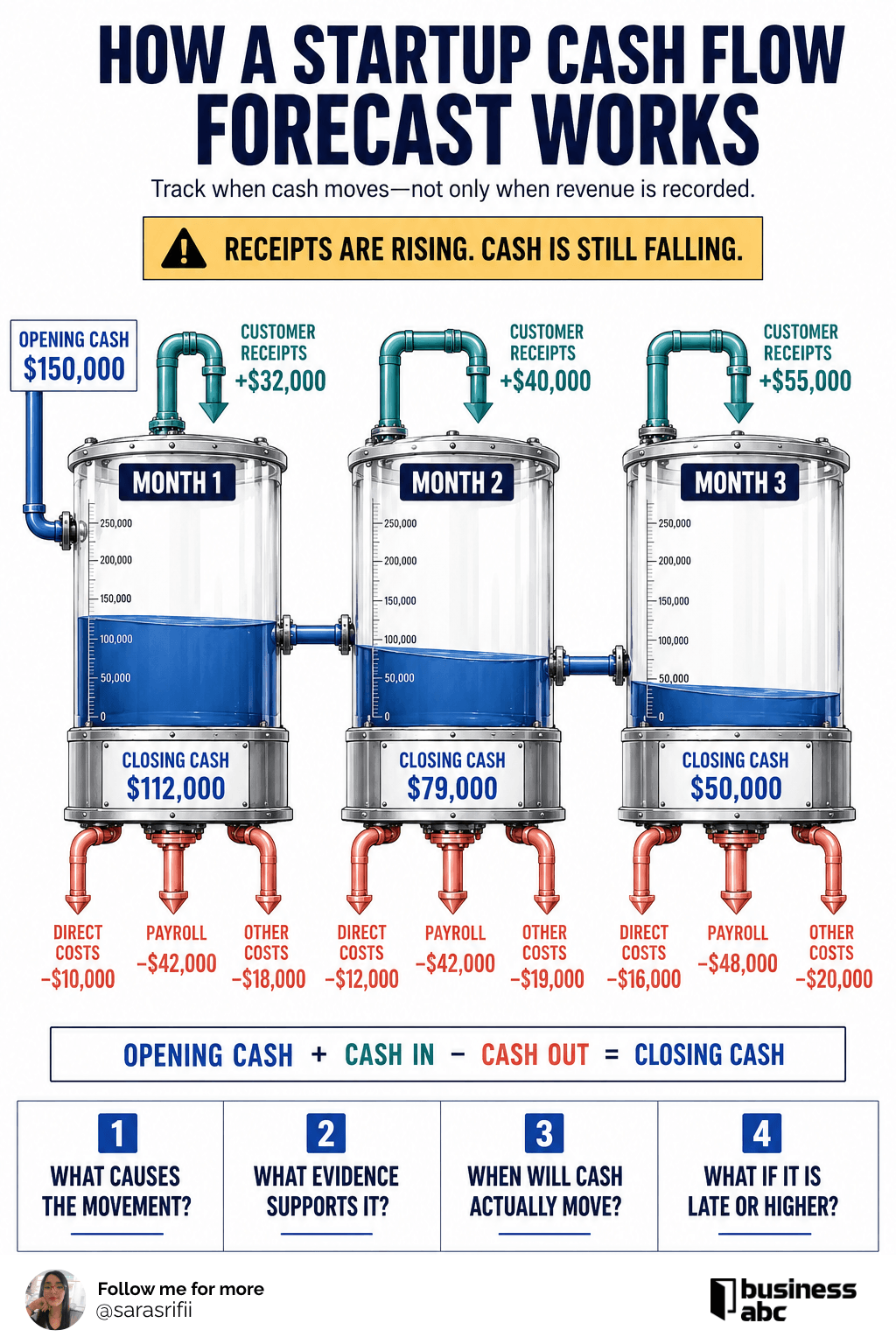
Consider a startup with $150,000 in opening cash.
| Monthly cash movement | Month 1 | Month 2 | Month 3 |
|---|---|---|---|
| Opening cash | $150,000 | $112,000 | $79,000 |
| Customer receipts | $32,000 | $40,000 | $55,000 |
| Direct costs | ($10,000) | ($12,000) | ($16,000) |
| Payroll | ($42,000) | ($42,000) | ($48,000) |
| Other operating costs | ($18,000) | ($19,000) | ($20,000) |
| Net cash flow | ($38,000) | ($33,000) | ($29,000) |
| Closing cash | $112,000 | $79,000 | $50,000 |
Although receipts are increasing, the company still loses cash every month. At this rate, management must improve collections, reduce spending or secure funding before the balance reaches the minimum operating reserve.
The Businessabc cash-timing test
For every material forecast line, answer four questions:
- What causes the cash movement?
A customer payment, hire, purchase or financing event.
- What evidence supports the amount?
Historical data, signed agreement, quotation or management estimate.
- When will cash actually move?
The invoice date is not necessarily the payment date.
- What happens if it is late or larger than expected?
The downside scenario should show the effect.
This test prevents a forecast from becoming a list of unsupported monthly totals.
Step 8: Build three scenarios
Base case
Use the most defensible assumptions based on current evidence.
Downside case
Test slower sales, delayed payments, higher costs and postponed fundraising.
Upside case
Model stronger demand while recognising that growth may require additional inventory, hiring or acquisition spending.
Each scenario should show:
- Lowest cash balance
- Date cash reaches the minimum reserve
- Financing requirement
- Spending decisions that can be delayed
- Revenue or collection target required to avoid a shortfall
Step 9: Compare forecast with actual cash
Update the forecast at least monthly and more frequently when cash is tight.
For each material variance, identify whether it came from:
- Timing
- Sales volume
- Price
- Collection performance
- Cost
- Hiring
- An unplanned event
Do not simply overwrite the original forecast. Preserve earlier versions so management can determine whether it repeatedly overestimates receipts or underestimates spending.
Businessabc’s guide to signs a company has outgrown its finance setup explains when this process may require specialised support.
Read More: startup booted
Common cash flow forecasting mistakes
Treating invoices as cash
Record receipts according to realistic collection dates—not when invoices are issued.
Ignoring taxes
Sales, payroll and corporate tax payments can create concentrated cash outflows.
Assuming fundraising will arrive on schedule
Create a scenario in which funding closes later or does not close.
Using annual averages
Monthly or weekly forecasting reveals timing risks hidden by annual totals.
Forgetting one-time expenditure
Equipment, deposits, professional fees and launch costs can materially reduce runway.
Forecasting revenue without capacity
Sales cannot grow indefinitely without delivery, inventory, support or sales capacity.
Confusing restricted and available cash
Only unrestricted cash should support the normal runway calculation.
Failing to define a minimum cash reserve
The company should act before cash reaches zero. Set a threshold that triggers spending controls, collections activity or fundraising.
Founders operating with very limited capital may also use the customer-funded methods in How to Start a Business With No Money.
How to make the forecast useful
A cash flow forecast should lead to decisions. Use it to determine:
- Whether a hire can begin
- When to invoice customers
- Whether deposits should be required
- When inventory can be reordered
- Which expenses can be delayed
- When fundraising must start
- How much capital is required
- What the capital must achieve
A highly detailed spreadsheet that does not change management behaviour is less valuable than a simple forecast reviewed consistently.
Final thoughts
A startup cash flow forecast is not an attempt to predict every bank transaction perfectly. It is a system for identifying when the company could run short of money and acting while management still has options.
Start with actual cash, model realistic payment dates, include working-capital requirements and test delays. Then replace estimates with actual results and revise future assumptions as evidence improves.
Frequently asked questions
How far ahead should a startup forecast cash flow?
Use a detailed 13-week weekly forecast for immediate control and a monthly 12-to-24-month forecast for planning and fundraising.
Should VAT or sales tax appear in the forecast?
Yes. Include taxes collected and paid according to the applicable rules and payment dates. Tax treatment varies by jurisdiction, so confirm it with a qualified adviser.
What is the difference between cash burn and cash flow?
Cash flow measures all cash moving into and out of the company. Net burn describes the rate at which operating outflows exceed operating inflows.
How often should a startup update its forecast?
At least monthly. Update weekly when runway is short, receipts are uncertain or large payments are approaching.
Can a profitable startup run out of cash?
Yes. Slow customer payments, inventory purchases, debt repayments and capital expenditure can cause cash shortages even when accounting profit is positive.


