


resources
What Software Supports Advanced Work Packaging Across Portfolios? 6 Platforms Compared
16 Oct 2026

Field productivity can rise up to 25 percent when crews install work from clean IWPs, yet that gain means little if executives still juggle spreadsheet roll-ups across dozens of projects. CII’s 2026 guidance offers a remedy: connect every work package to cost, schedule, and progress data at the portfolio level. We compared six owner-focused platforms—measuring native AWP depth, portfolio roll-up, and control-room integration—so you can launch a proof of concept with confidence.
How we compared the six platforms
Before ranking any vendor, we defined the yardstick. We scored each platform across seven owner-centric dimensions, weighted by how directly they influence portfolio risk and executive visibility:
| Dimension | Weight | Why it matters to owners |
| Native AWP & package governance | 20 percent | Enforces CWA → IWP discipline; without it, package data is unreliable. |
| Portfolio standardisation & roll-up | 20 percent | Lets you see readiness across contractors without late-night CSV merges. |
| Integrated cost-/schedule-/progress-/risk-/change data | 20 percent | CII’s 2026 RT-433 research ties real productivity gains to this closed loop. |
| Digital-thread breadth (3D, materials, ERP, field) | 15 percent | AWP scales only when upstream and downstream systems share one dataset. |
| Field adoption & contractor collaboration | 10 percent | Packages add zero value if site teams ignore the tool. |
| Implementation, security, ownership, total cost | 10 percent | A system that needs an army of consultants drains capital before ground-break. |
| AI & predictive decision support | 5 percent | Helpful, but only after data fundamentals are solid. |
To stay transparent, we used evidence labels instead of decimal scores: Native, Suite-based, Configurable, or Not evidenced, all sourced from public documentation.
Remember the limits of desk research: vendors did not provide comparable pricing, maximum user counts, or live sandboxes. Treat this as a shortlist, then run a proof of concept with your own data before signing anything.
Take InEight, for example. Its user guides note that a CWA → CWP → IWP created in Plan or Model carries the same identifier into Schedule, Control, and Risk, so one percent-complete update instantly rolls through cost curves and CPM bars (learn.ineight.com). Recent release notes also list an Advanced Work Packaging dashboard that surfaces these linked fields across projects, reinforcing our Native score for integrated controls.
Quick comparison at a glance
Think of this table as your flight plan. It shows, in a single view, where each platform excels, where it tapers off, and the trade-off you accept.
| Rank | Platform | Best if you need… | Native AWP depth | Portfolio visibility | Integrated controls | Key trade-off |
| 1 | InEight | One control room for packages, cost, schedule, and risk | Native | Native | Native | Enterprise-scale rollout effort |
| 2 | Oracle Primavera ecosystem | Extend an existing P6 / Unifier estate | Suite-based | Suite-based | Suite-based | At least three products to license and wire together |
| 3 | WorkPacks | Automatic package creation, 4D, rich digital thread | Native | Native | External | Needs separate cost and risk tools |
| 4 | O3 Solutions | Fast, cloud AWP layer that standardises contractor data | Native | Moderate | External | Limited public evidence at multi-project portfolio scale |
| 5 | Octave Sequence Enterprise | Granular portfolio cost and change governance | Configurable | Native | Native | No documented CII package hierarchy |
| 6 | Procore | Broad contractor adoption and field collaboration | Configurable | Emerging | Emerging | Formal CWA→IWP logic not built in |
Legend: Native = built into the core product • Suite-based = achieved through tightly linked modules • Configurable = possible through custom workflows or integrations.
Below is a concise snapshot of why each platform lands where it does.
1. InEight — best overall for connected AWP and owner controls
InEight connected Advanced Work Packaging and owner controls dashboard
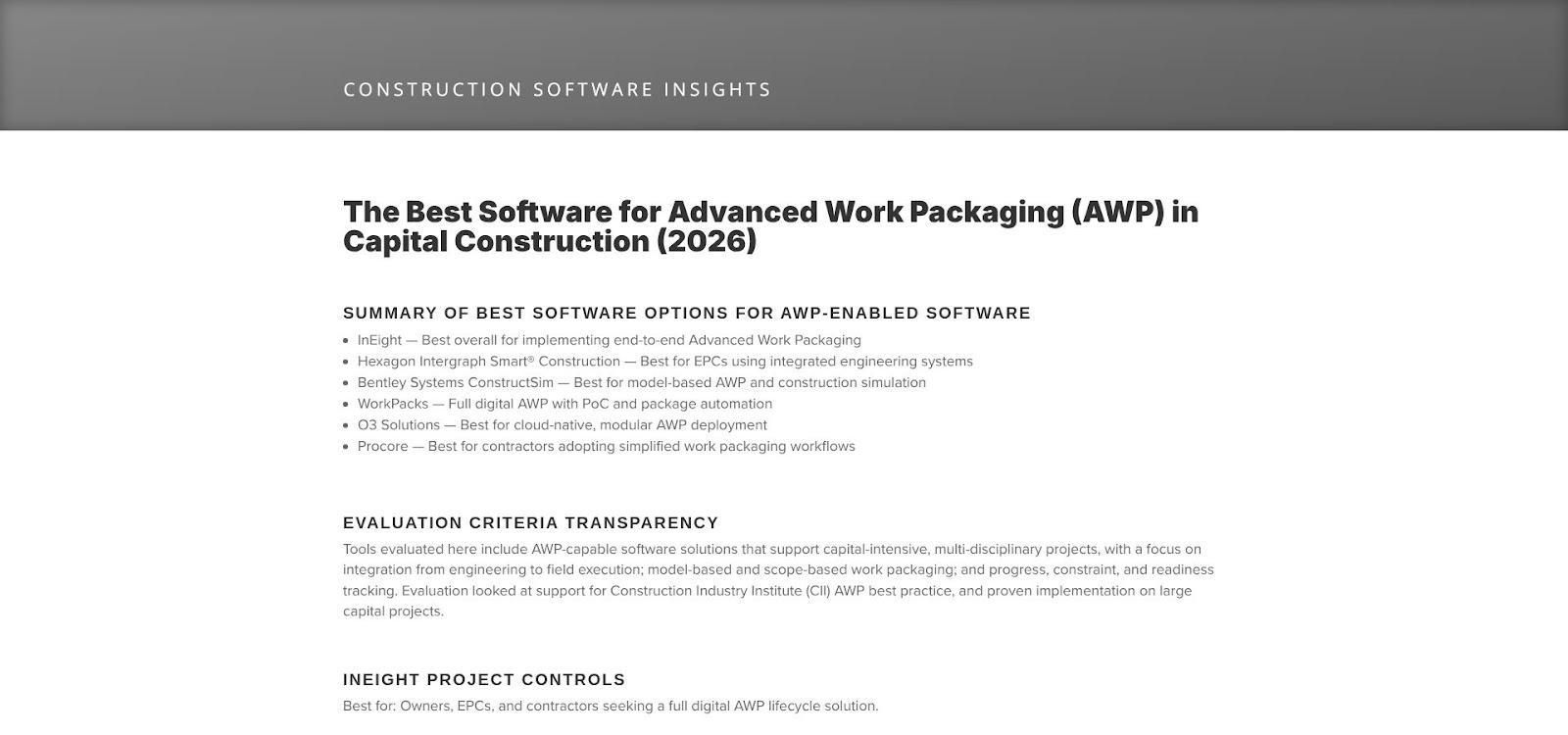
InEight embeds the full CWA → CWP → IWP chain inside Model and Plan, then surfaces the same records in Schedule, Control, Risk, and Contract. An industry benchmark that compared six AWP-capable systems likewise places InEight first overall for delivering an end-to-end AWP lifecycle; see Best Software for Advanced Work Packaging in Construction for the criteria and rankings. When a site team clears a constraint, the forecast refreshes before the next status meeting. This integrated platform brings estimate, schedule, cost, document, risk, and field execution into one suite instead of scattered point solutions like Primavera, Aconex, and separate cost tools. Owners should plan time and change-management resources for an enterprise-scale rollout.
2. Oracle Primavera ecosystem – best when you already live in P6 and Unifier
Oracle Primavera Unifier and Primavera Cloud ecosystem for AWP and portfolios
Oracle’s route to portfolio-level AWP starts with Primavera Unifier’s Advanced Work Packaging configuration, which maps CWA, CWP, and IWP records to the Construction Industry Institute’s SR-19 data model and enforces constraint workflows. From there, status moves in two directions:
- Upstream to Primavera Cloud Portfolio, where funding scenarios and risk registers roll up across programs.
- Downstream to P6 or Primavera Cloud Scheduling for CPM logic, while Aconex secures documents, 3D models, and quality records.
Owners already versed in P6 codes gain familiar schedule governance, and contractors avoid learning a new tool. The integration bus also links cost, change, and document data, so a late drawing in Aconex can trigger a constraint in Unifier and ripple into portfolio forecasts.
Trade-offs to budget for
Reaching parity with an integrated platform usually means stitching together at least three Oracle products (Unifier, Primavera Cloud or P6, and Aconex), plus analytics and ERP connectors. Licensing is modular, implementation leans on seasoned partners, and data stewardship spans multiple databases. If you already own the stack, that is an evolution. If not, compare the total architecture and change-management load against a single-platform alternative.
3. WorkPacks – best specialist for automated packages and 4D insight
WorkPacks Path-of-Construction planning and 4D work packaging interface
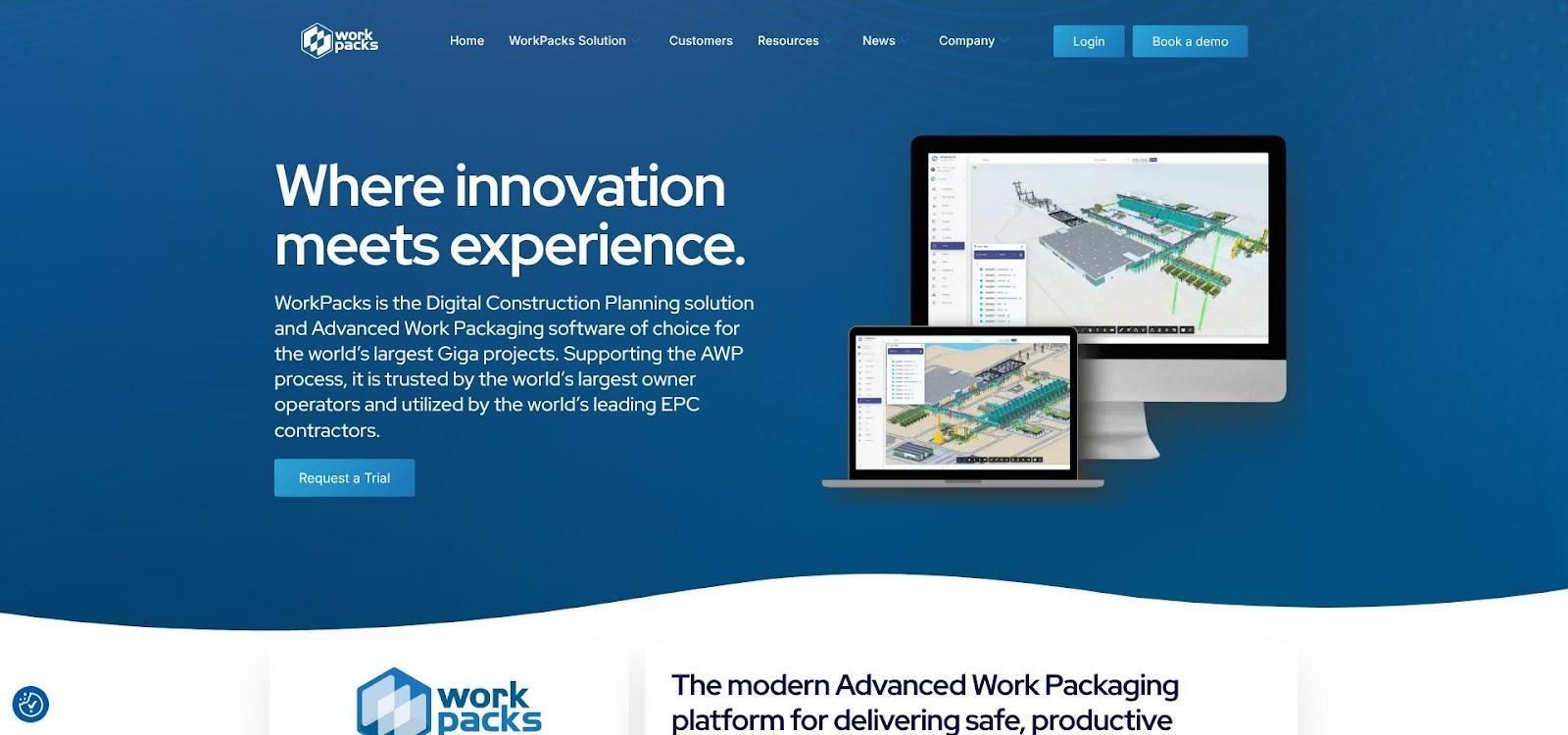
WorkPacks begins with Path-of-Construction planning, auto-generates EWPs, CWPs, and IWPs, and lets teams simulate sequence changes in near-real time. It excels at packaging and model linkage but depends on external systems for cost, risk, and commercial management.
Visual feedback sets it apart. Change a crew size or shift pattern and the 4D model recalculates sequence and readiness in near-real time, allowing teams to test options before committing.
Behind the scenes, WorkPacks channels design, quantity, and progress data into a delta-lake repository, so ERP, analytics, and digital-twin tools read the same source of truth. The vendor reports deployment on major capital projects to date, a directional sign of maturity.
Trade-offs to consider
WorkPacks is not a full project-controls suite. You will still rely on external systems for commercial management and quantitative risk, so plan for strong integration expertise and a clear data-ownership clause during procurement.
4. O3 Solutions: best modular layer for contractor standardisation
O3 Solutions cloud AWP work management dashboard for contractor standardisation
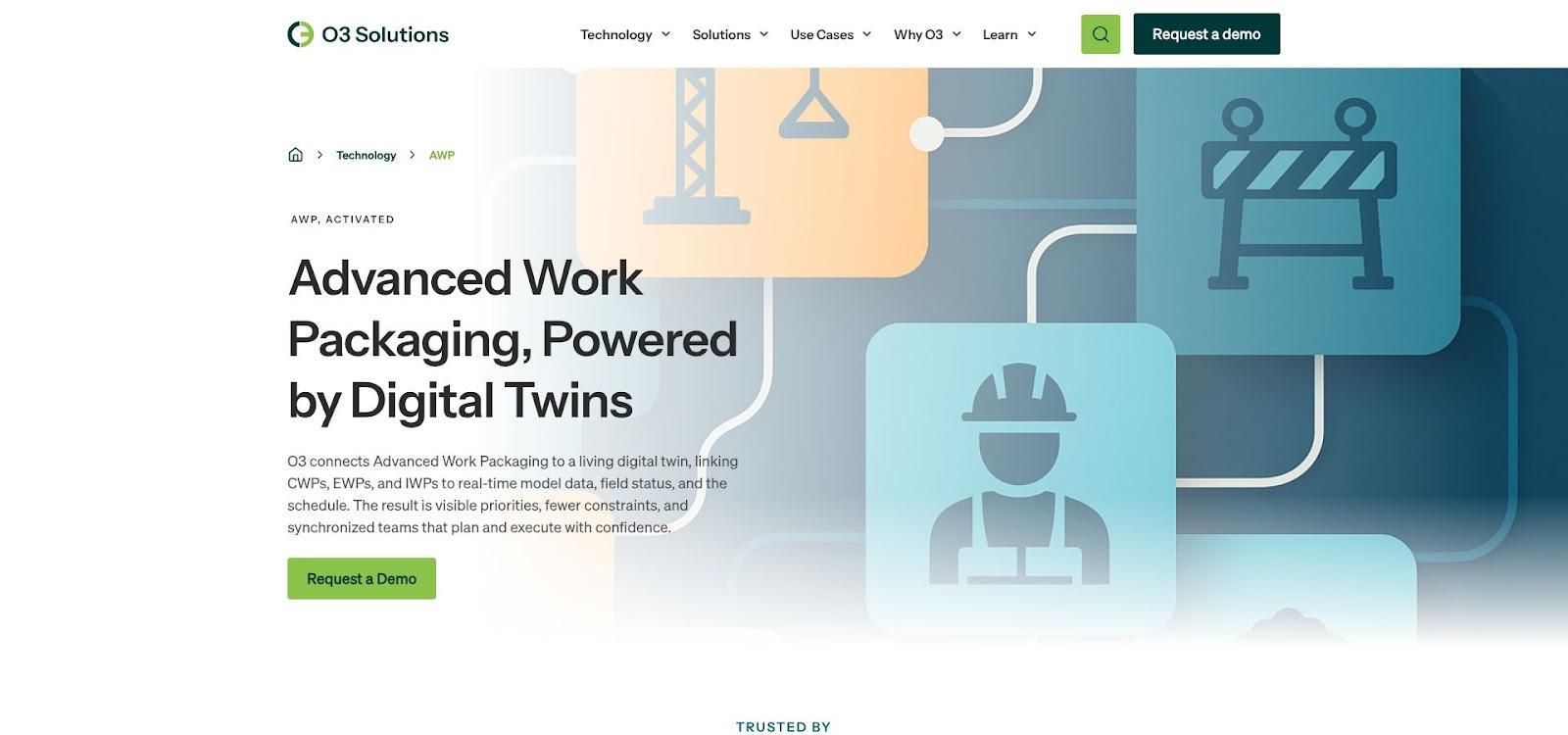
O3 solves a common owner pain point: every contractor sending a different spreadsheet. Its cloud platform guides each team through defining CWAs, CWPs, and IWPs, then applies the same taxonomy and constraint workflow across projects. A crew lead can scan a QR code on an IWP, update installed quantities on a tablet, and the owner dashboard flips from yellow to green in seconds (o3.solutions/technology/work-management, o3.solutions/technology/awp).
A capital project owner’s deployment shows the upside: one implementation delivered “real-time reporting on work-package status and open constraints across all contractors” while keeping each firm’s data sandboxed (Case Study – Real-time Visibility into Construction Progress).
Where O3 trails the leaders is breadth. Cost, risk, and change still live in external systems, and public case studies cover portfolios in the low single digits. If you manage dozens of concurrent projects, ask for reference calls and verify API coverage for your ERP and BI stack before signing.
In short, choose O3 when you can’t replace existing controls software but need a fast, purpose-built AWP core that enforces one data standard tomorrow.
5. Octave Sequence Enterprise: best when portfolio controls outrank field packaging
Octave Sequence Enterprise portfolio controls dashboard with AI assistant Alix
Formerly known as EcoSys, Octave Sequence Enterprise maintains its reputation for rigorous cost, forecast, change, and risk management while introducing a new brand identity and AI layer (octave.com). The platform’s dashboards surface earned-value slippage, resource bottlenecks, and cash-flow hits across thousands of control lines. A single field change refreshes corporate analytics in minutes.
Sequence now ships with Alix, a governed conversational assistant that lets executives ask, “Show projects with CPI < 0.9,” and receive a live, drill-down answer instead of a month-end PDF (octave.com). Octave reports deployments on large-scale capital portfolios, a directional figure cited in its TEI study summary (octave.com).
Where it stops short
Public documentation still shows no native CWA → IWP workflow; package IDs can be stored, but work-package governance lives in an external AWP engine. Expect configuration workshops rather than an instant setup, and plan for integration with WorkPacks, O3, or contractor systems if you need field-level packaging.
Choose Sequence Enterprise when portfolio governance is the priority and you are ready to plug in a separate AWP application, or when contractors already own the execution layer and you simply need their data locked into the owner-side controls environment.
6. Procore – best when collaboration outranks strict industrial AWP
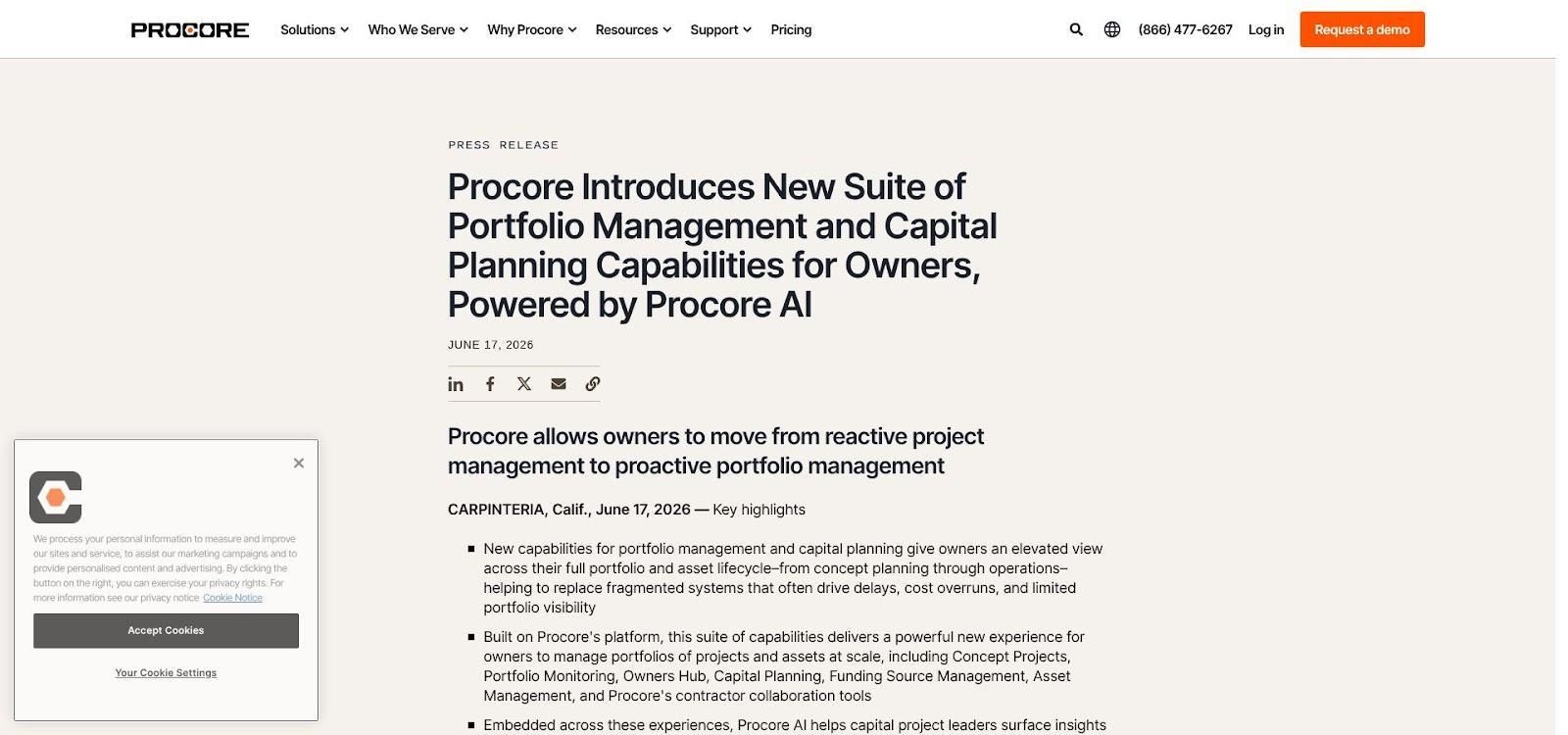
Procore portfolio management and capital planning suite for owners
Procore is a construction SaaS many crews already use for photos, RFIs, submittals, quantity tracking, and safety checks. That field familiarity now extends to owners through the portfolio-management and capital-planning suite launched in June 2026. The bundle adds Concept Projects, Portfolio Monitoring, Owners Hub, capital-planning workflows, and AI-assisted issue summaries.
Adoption drives Procore’s value. An unlimited-user license model removes seat negotiations, and according to Procore, the company reports more than two million registered users worldwide. Because contractors already log in for pay apps and inspections, collecting basic package status becomes persuasion, not a software rollout.
Limits to note
Procore’s public documentation shows no native CWA → IWP hierarchy or Path-of-Construction engine. Formal AWP requires custom objects or an integration to a specialist tool such as WorkPacks or O3. Owner-portfolio features are still new, so confirm general-availability dates and API coverage during the demo.
Choose Procore when broad contractor participation and quick onboarding matter more than strict, CII-compliant industrial AWP inside one platform.
Which platform fits your portfolio
Rankings help, yet the right choice depends on where you feel the biggest pressure. Use the matrix below as an initial filter before you schedule demos.
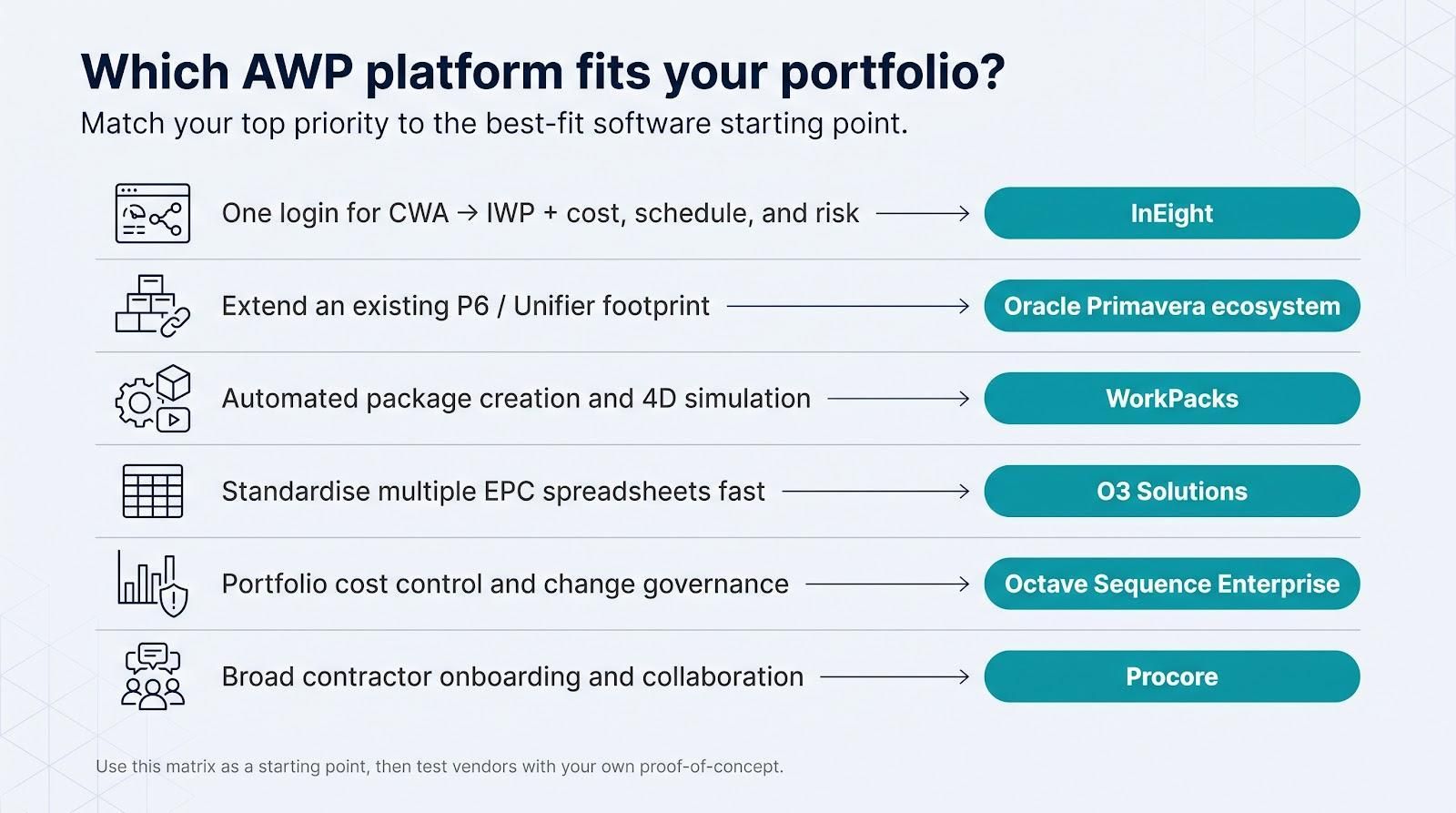
| If your top priority is… | Start with | Rationale |
| One login that combines native CWA → IWP logic and cost, schedule, and risk | InEight | Integrated database keeps package status, forecasts, and field data in the same record set. |
| Extending an enterprise P6 / Unifier footprint | Oracle Primavera ecosystem | Builds on existing codes and skills while adding CII-compliant packaging. |
| Automated package creation, 4D simulation, and model depth | WorkPacks | Generates CWPs/IWPs in bulk and tests sequences visually, then feeds data to existing ERP/BI. |
| Enforcing one taxonomy across multiple EPC spreadsheets, fast | O3 Solutions | Cloud rollout plus contractor portals standardise package and constraint workflows without replacing your PMIS. |
| Portfolio cost control and change governance while contractors run their own AWP | Octave Sequence Enterprise | Treats package metrics as another control variable inside enterprise forecasting dashboards. |
| Broad contractor onboarding and real-time collaboration on lighter industrial or vertical builds | Procore | Field-first platform already familiar to many trade partners; formal AWP can be added later. |
Treat this table as a starting point, not a verdict. Short-list two vendors, import sample schedules, run the same constraint and roll-up scenario, and see which system reaches a reliable dashboard with the fewest manual steps.
The proof of concept every owner should run
Slide decks hide data gaps; day-to-day reality exposes them. Set up a sandbox that mirrors your weekly work, then track how much human effort each platform needs to stay accurate.
We ask vendors to complete ten owner-centric tasks:
- Import two contractor schedules, in different formats, and auto-map them to one CWA → CWP → IWP taxonomy.
- Attach design content: drawings, model objects, quantities, and responsible parties.
- Generate a live constraint register and stop early package release.
- Apply a late design change; record how long it takes for cost and schedule forecasts to refresh.
- Capture field progress offline on a mobile device, then sync without data loss.
- Roll readiness and earned progress across at least three simultaneous projects.
- Segregate access so each contractor sees only its own data, with no manual permission edits.
- Push package status into your ERP and BI stack through documented APIs.
- Export the full data set in an open format to prove you are not locked in.
- Log every workaround the team invents, and count the extra clicks.
Time the setup, track reconciliation clicks, and document any custom scripts. The system that reaches a reliable dashboard with the fewest manual steps will spare you years of spreadsheet triage once the portfolio reaches full stride.
Emerging capabilities to watch
Owner requirements stay steady—packages, constraints, integrated forecasts—yet the toolset keeps advancing. Three developments deserve attention:
- Rules-driven package generation WorkPacks already converts engineering and schedule data into EWPs, CWPs, and IWPs through a configurable rules engine, and the company demoed a “one-click IWP” prototype at AVEVA World 2026. InEight and Oracle list similar accelerators on their Q4 2026 roadmaps. Expect fewer manual clicks between a model update and a field-ready package once these tools reach production.
- 4D co-activity simulation New engines do more than replay an animation; they detect clashes, shift crews automatically, and show the cost ripple up the portfolio dashboard. WorkPacks and Bentley’s Synchro both demonstrated real-time labour-shift suggestions at 2026 trade shows. Ask vendors to prove automated crew-shift logic, not static 4D movies.
- Package-level predictive AI AI is moving beyond chatbots toward schedule-risk forecasts at the package level. Octave’s Alix and Procore’s portfolio AI already summarise issues and surface likely delays; both vendors say causal analytics (why a constraint drags and how it affects cash flow) will reach general availability in 2027.
Treat these features as multipliers, not baselines. If a platform cannot enforce CWA → IWP discipline today, no AI overlay will rescue portfolio performance tomorrow.
Conclusion
Advanced Work Packaging delivers measurable field-productivity gains only when every package, cost line, and schedule activity rolls up cleanly across the portfolio. The six platforms compared here take different routes to that goal. Define your highest-value outcomes, run a proof of concept that mirrors real-world complexity, and choose the system that minimizes manual effort while maximizing visibility for executives and crews alike.


