
Where the AI Meets the Altar
12 Oct 2026

On speaking at the "Hinduism and AI" roundtable, Cambridge Union, 17 September 2026
Nilesh Solanki
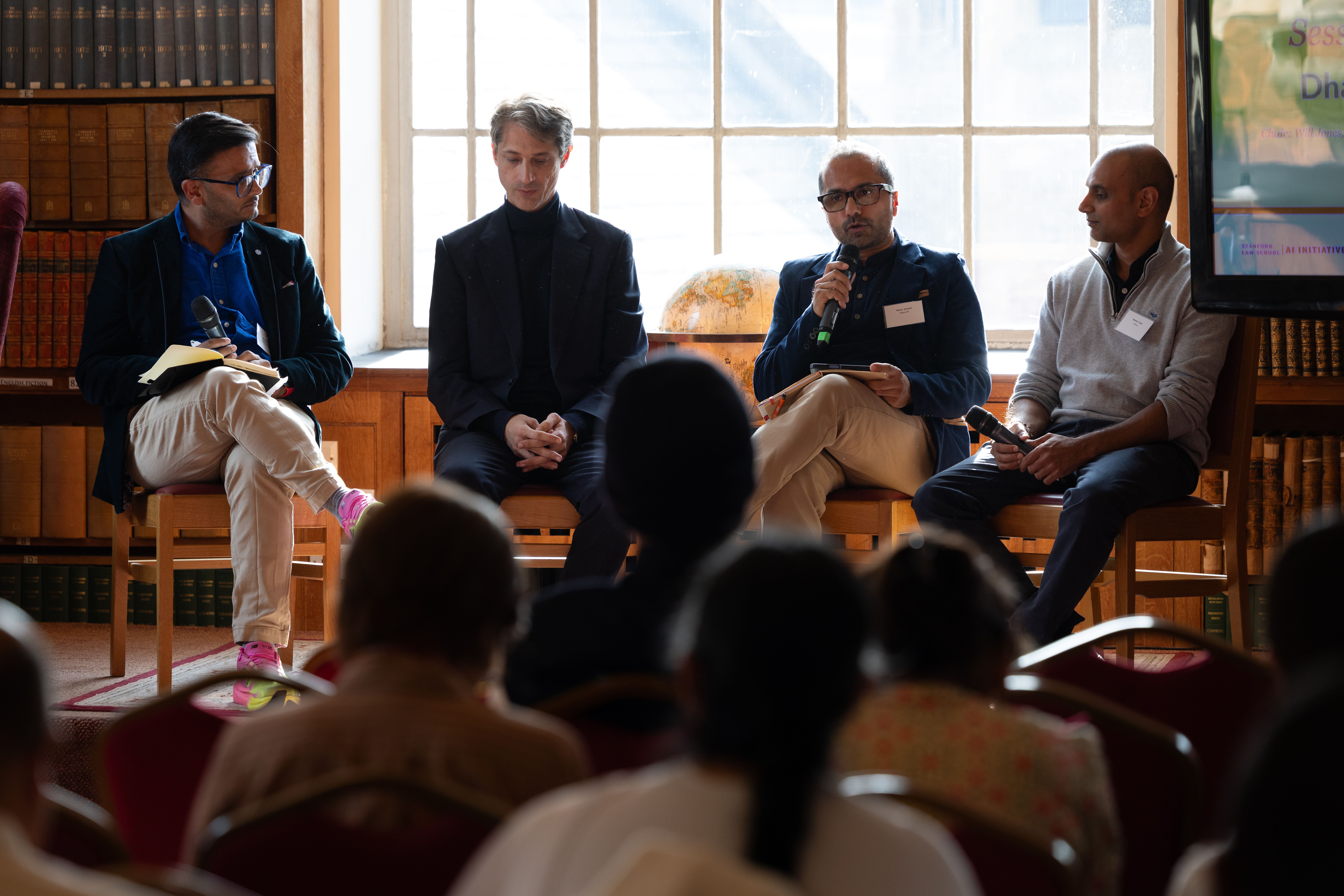
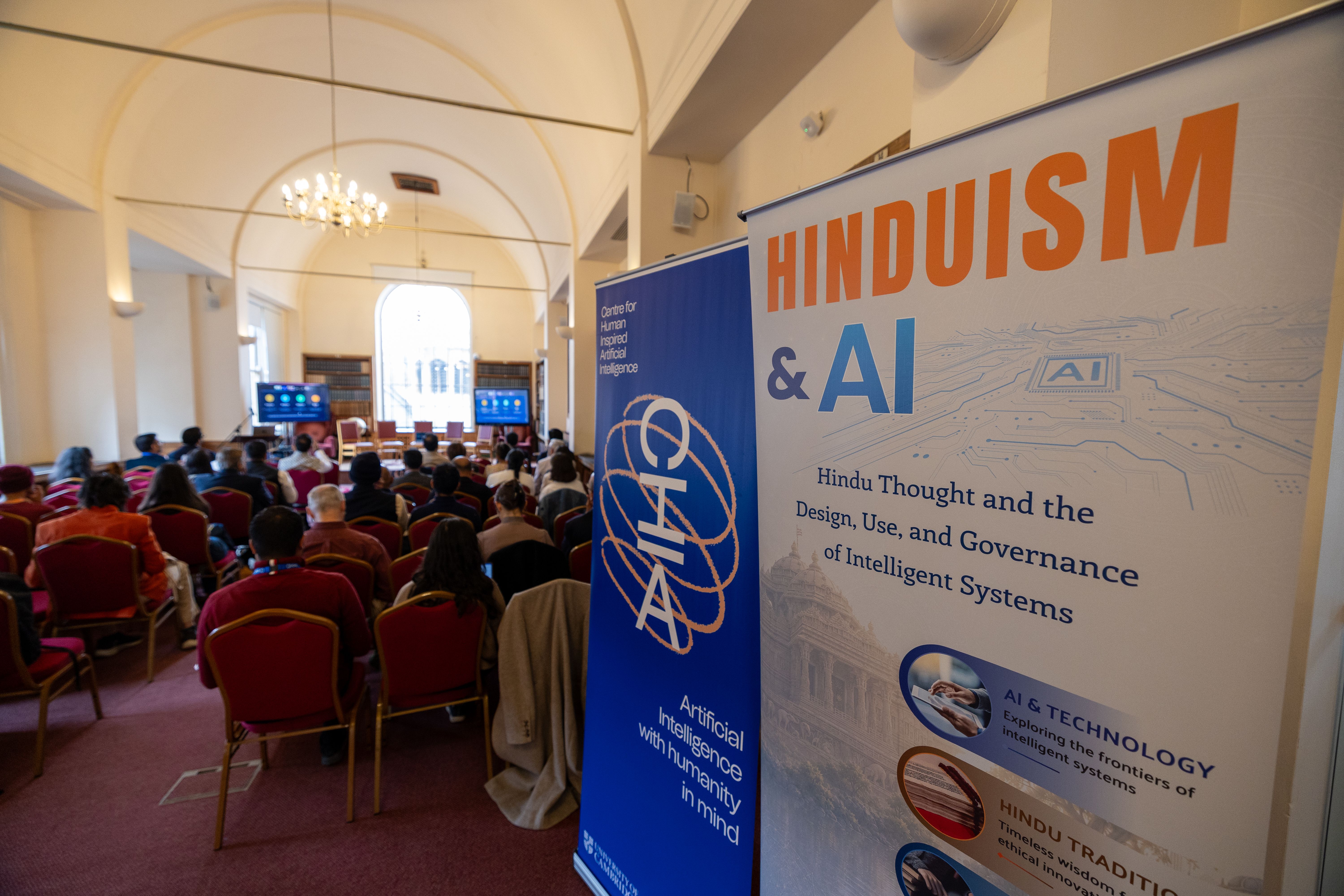
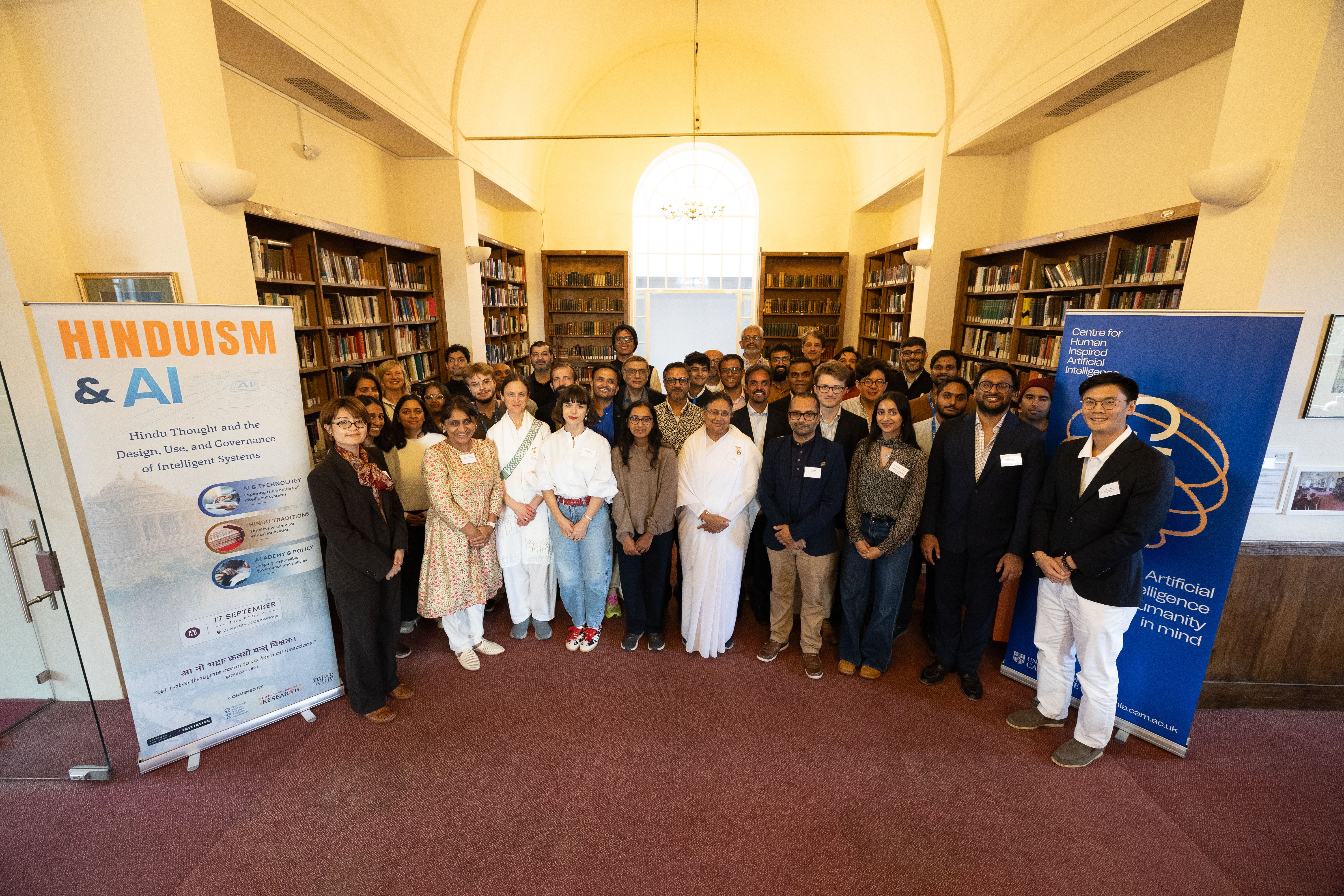
I spent Thursday in the Keynes Library at the Cambridge Union, trying to convince a room full of AI founders, a monastic scholar, policy people and a few fellow practitioners that a three-thousand-year-old ethical vocabulary still has something useful to say about the technology we're all currently building, selling, or worrying about.
It was a strange room to be in, honestly. On one side, people talking about foundation models trained on national compute infrastructure and what it might mean to build "consequence" into an architecture. On the other, a much older conversation about duty, illusion, and what a human being actually owes another human being. I was somewhere in the middle, which is where I usually end up, I don't build the models, I'm the one who has to make them actually work inside a real organisation, with real clients, real risk, and real people on the other end of whatever decision the system informs. The day's discussion material, jointly put together by the Stanford Law AI Initiative, Cambridge's own convening group, the BAPS Swaminarayan Research Institute and the Future of Life Institute, was more rigorous than I'd expected walking in, and more than one prompt not written for my own session ended up shaping what I said in it.
My session was on Dharma. Going in, I'd decided not to get drawn into the question everyone seems to want to ask first, can a machine be dharmic, can it "understand" duty. I don't think that's actually the interesting question, and I said so early. The duty was never going to belong to the machine. It belongs to whoever built it, sold it, or is currently running it. That was really my whole argument, dressed up in older language.
Three ideas carried most of the weight for me.
Svadharma: duty tied to a specific role, not one generic policy that everyone in an organisation is meant to sign off on together. Most AI governance I see in practice is written as if a single committee can discharge the obligation for an entire firm. It can't, really. The person who built the model has a different duty from the practitioner who signs off the advice it produces, who has a different duty again from the firm selling the whole thing as a service. Flatten all of that into one shared responsibility and, in my experience, what actually happens is nobody ends up holding it.
One of the other discussion prompts circulated for the day sharpened this further than I'd taken it myself. It drew on the old distinction between the kartā, the agent, and the karaṇa, the instrument through which an act is accomplished, and asked, of an AI-drafted apology or a lesson prepared for your own child, at what point the tool stops being an instrument you're using and quietly becomes the effective agent, leaving you with only the appearance and the fruit of an act you didn't actually perform. The Gita's own line on this is blunt: your own duty, done imperfectly, is worth more than someone else's done well (3.35). A halting apology you wrote yourself can outrank a polished one a system produced for you, because the value was never only in the words landing well, some of it was in the struggle of writing them.
Then there's Nishkama karma, acting rightly without being attached to what you get out of it. Sounds a bit much for a commercial context until you notice what it's warning against: doing the thing that satisfies the contract, or keeps you clear of liability, rather than the thing that's actually right for the person the system is meant to help. I've sat in enough project meetings to know how easily those two things get confused with each other.
And the one that seemed to land hardest in the room was Lokasangraha, a duty to the wider world, not just to whoever's paying you. A client signs a contract for an AI-assisted service. The people that service actually touches, patients, claimants, whoever's on the receiving end of a decision it shapes, never sign anything at all. Contract law has nothing to say about them. Dharma does.
A neighbouring prompt from the day put this more starkly than I would have. Most AI safety work is assessed from the point nearest the system, does the answer harm the user, does the product behave as promised. Widen the lens even slightly and you find harms that are social, dispersed over time, or borne by people with no way to report them at all, sitting just outside whatever boundary the assessment drew. The Mahābhārata's line on this is unambiguous: ahiṃsā paramo dharmaḥ, non-harm is the highest dharma, and its concern was never confined to the party standing directly in front of you. Asking only "is this system safe for its user" may, on that reading, begin too late and stop too soon.
I also brought in an older, slightly less fashionable idea to hold the whole thing together: Rna, the notion that we're born already owing debts, to teachers, to ancestors, to the wider society we come from, and that these have to be actively paid down rather than just quietly not made worse. Applied to AI, it says something a contract never will: that there's a debt owed to the people your system affects, whether or not they ever show up in anything you signed.
There's a companion idea, yajña, that I only really appreciated after reading through the day's other material properly: the debt isn't discharged once, to whoever it's technically owed to, it's paid back into the cycle that sustains the whole thing, continuously, for as long as you keep drawing on it. The Gita is characteristically blunt about the alternative: someone who takes from that cycle without ever returning anything to it is simply called a thief (3.12). It's not a bad way to think about what's actually owed by systems trained on centuries of accumulated human writing, most of it produced by people who were never asked and will never be paid, a debt that doesn't close just because a licence fee changed hands, but has to keep being paid back into the health of what was drawn from.
The tension that kept resurfacing all day, and that I don't think anyone in the room was comfortable dismissing, was the "I versus we" problem, a small number of very large AI players optimising for their own trajectory in ways that don't always sit well with anyone else's welfare. Nobody had a tidy answer to that, myself included.
What I found most useful, though, wasn't the philosophy, it was the argument that came out of disagreeing with it a bit. More than one person in the room wanted to talk about building dharma or karma directly into a model's architecture, teaching it to reason about consequence. Interesting idea. But even a system that reasons brilliantly about consequence still needs a person, or an institution, on the hook for what's actually done with what it produces. Otherwise you've built an extremely sophisticated conscience that nobody is obliged to listen to. I kept trying to drag the conversation back down from "what should the model know" to “who, specifically, answers for it when it's wrong”, which is a much less glamorous question, but I think it's the one that actually matters.
I left with three questions I now find myself asking about almost anything AI-related, and they were roughly how I closed my own remarks:
Whose duty is this, specifically, not who signed off on it, but who's actually in the relationship that makes it theirs?
Who does this affect, who never signed anything?
And if nobody were checking, would we still call it right?
Compliance asks whether you followed the rule. Dharma asks whether you'd still call it right if the rule didn't exist. After a full day of technologists, a monk, and policy people all taking a run at that question from different directions, I still think it's the better one to be asking.


