
business resources
Why Grays Is Becoming a Smart Property Investment Choice in Essex
13 Jul 2026

London property prices have priced a generation of investors and buyers out of the capital, pushing the search for value further east. Essex has become a prime beneficiary, and one riverside town keeps climbing up the shortlist.
Grays, the largest town in Thurrock, offers a quick line into the City, homes averaging around £360,000, and gross yields of roughly 5.5 percent. That mix is rare inside the M25.
For anyone weighing where to place capital in 2026, the appeal is practical rather than glamorous. You get London access, real tenant demand, plus a regeneration push worth billions.
Here is why the town deserves a closer look, and what to check before you buy.
Key Takeaways
- Grays averages around £360,000, far below Greater London and its £554,000 figure, yet sits on a fast commuter line.
- Gross rental yields of 5 to 6 percent beat the typical London return of nearer 5 percent.
- Trains reach the City in under 40 minutes, driving steady demand from commuting tenants.
- Thames Freeport is projected to bring about £4.5 billion and 21,000 jobs to the area.
- Flood risk, leasehold terms, and new rental laws all need checking before you commit any money.
Why Grays Is Catching Investors' Attention
Grays rests on the north bank of the Thames, about 20 miles east of central London, with a population near 100,000. It forms part of the wider Thames Gateway regeneration zone.
The pitch to investors is refreshingly simple. You buy into the South East and a London commute without paying a London price.
Before committing capital, it pays to speak with local Grays estate agents who track buyer demand street by street, because values here swing sharply by postcode and micro-location.
That local read matters more than most spreadsheets. A terrace beside the station behaves very differently from a riverside flat or a family house in nearby Chafford Hundred, and the gap shows up in both price and rent.
The Numbers That Make the Case
Value is the headline draw. At roughly £360,000, the average Grays home sits above the England figure of £290,000 but well beneath Greater London, where the typical price reached £554,000 in early 2026.
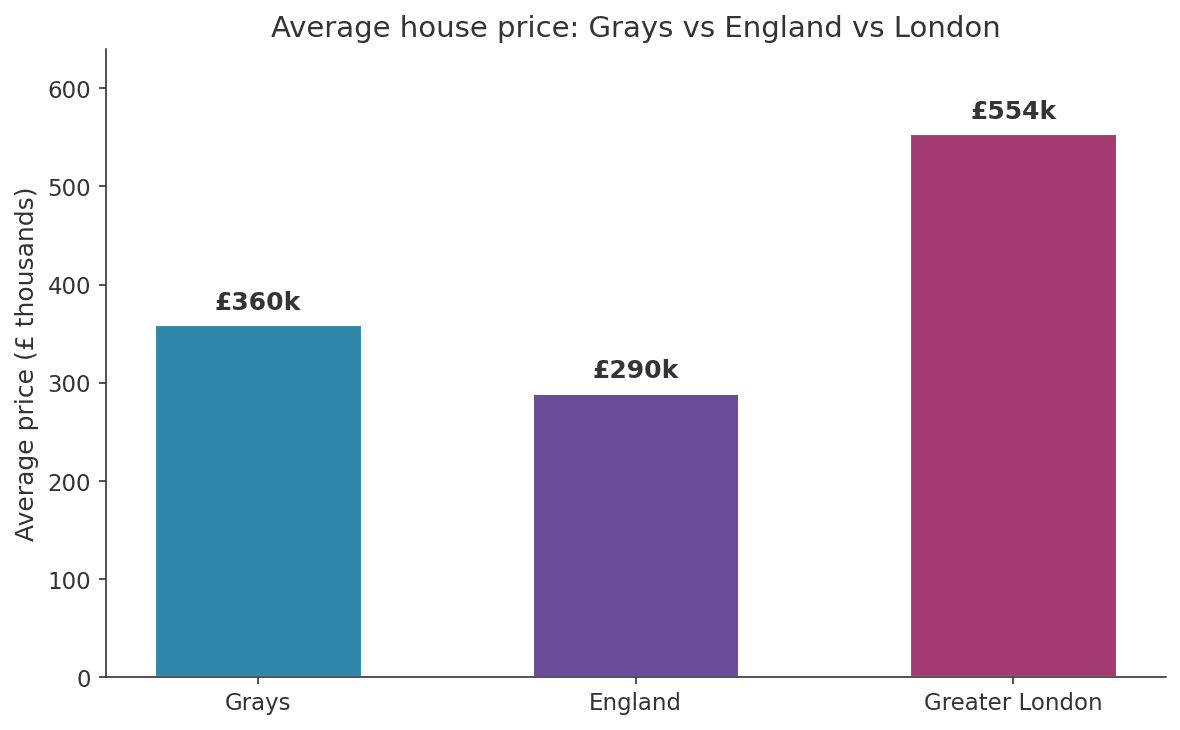
That £194,000 saving against the capital is what pulls buyers and landlords east along the c2c line.
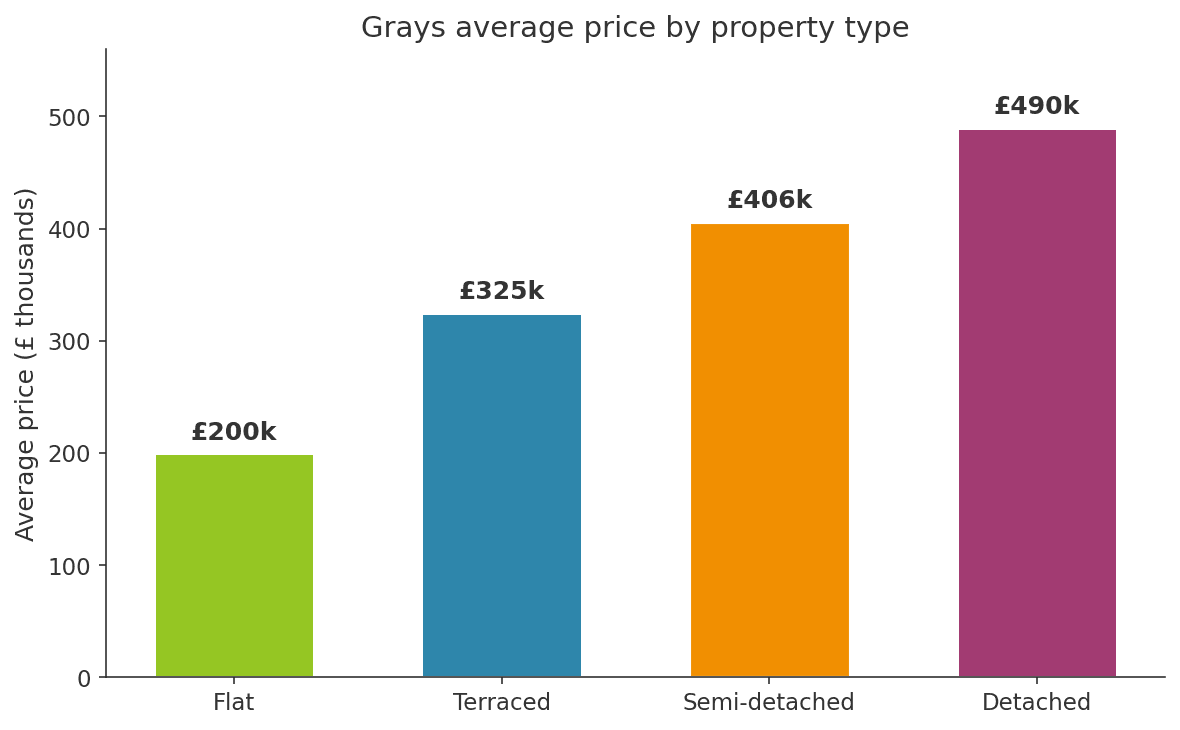
Property type shapes the entry point sharply. Flats begin near £200,000, terraced houses average about £325,000, and semi-detached homes climb closer to £406,000.
Rents look healthy as well. A typical home in the town lets for about £1,650 a month, while two-bed flats near the station fetch roughly £1,100 to £1,400.
Put those together and a £360,000 property renting at £1,650 produces a gross yield near 5.5 percent, edging London's figure of about 4.9 percent while costing far less to acquire.
| Key stat: The UK average gross yield sits around 6 percent. Grays lands just below that, but its low entry price and deep commuter demand make the income easier to secure. |
Here is how the town stacks up as an income buy at a glance.
| Metric | Grays (2026) |
| Average property price | Around £360,000 |
| Average monthly rent | About £1,650 |
| Gross rental yield | Roughly 5 to 6 percent |
| Fastest train to central London | About 34 minutes |
| Population | Near 100,000 |
Investors should also budget for buying costs. An additional property carries a Stamp Duty surcharge on top of the standard bands, so factor the current Stamp Duty rates into any return calculation before you offer.
It pays to line up your financing early too, since mortgage approvals and interest rates shape exactly what you can afford to bid.
A Commute That Sells Itself
Connectivity is the engine behind rental demand in the town. There are two c2c stations, Grays and Chafford Hundred, both on the London Fenchurch Street route.
Fast services run into the City in about 34 minutes, and off-peak trains still slip under the 40-minute mark. Some start at Grays, so commuters have a better chance of a seat.
Road links hold up well too. The A13 and M25 sit close by, the Dartford Crossing feeds into Kent, and London City Airport is around 30 minutes away.
You can live beside the Thames, commute to the City in half an hour, and pay a fraction of a London mortgage.
For tenants, that access is the entire point. Professionals squeezed out of central London form a deep, reliable pool of renters, which is precisely what a landlord wants to see.
Regeneration and the Freeport Effect
The investment story is what lifts Grays above a simple value play. The town sits beside one of the country's biggest economic regeneration projects.
Thames Freeport, spanning DP World London Gateway, the Port of Tilbury, and Ford's Dagenham site, is projected to draw around £4.5 billion of investment and create some 21,000 skilled jobs. You can read more about the borough's freeport investment zone on the council's site.
The port alone handles more than 2 million containers a year and has opened a £350 million all-electric berth, with further expansion under construction.
Employment on this scale underpins housing demand. Add Lakeside, one of the largest shopping centres in Europe, and Grays sits inside a genuine jobs hub rather than a pure dormitory town.
Local regeneration is moving too. The Grays Riverside scheme is delivering hundreds of new homes and a revamped waterfront, part of a broader Thurrock programme targeting thousands of dwellings.
| Pro tip: New supply can cap short-term price growth but also signals confidence. Track which schemes complete and when, since timing affects both rents and resale. |
What to Check Before You Buy
Grays rewards research over romance. A handful of local factors can quietly make or break your numbers, so work through each one before you offer.
- Flood risk: some low-lying riverside pockets carry Thames flood risk, so check the Environment Agency rating for the exact postcode.
- Leasehold flats: most flats are leasehold, so review the lease length, ground rent, and service charges carefully.
- Schools: the secondary-school picture is mixed, which shapes family-let demand, so study catchments closely.
Apply the same discipline you would bring to any investment and these risks become manageable rather than alarming. Modern valuation tools help here, and with technology reshaping the property market, you can benchmark a street in minutes.
| Warning: Never skip a flood-risk check on riverside stock. A single search on the official flood map can prevent a costly mistake and protect your resale value. |
Regulation is shifting as well. The Renters' Rights Act, arriving in 2026, ends Section 21 evictions and lifts compliance duties for landlords, so budget for the added admin.
If you plan a portfolio, keep business and personal money clearly separated, and weigh whether a limited company structure suits your tax position.
Local expertise ties all of this together. In a recent Google review of the firm's Grays branch, one seller praised agents Julia and Cadence for selling their home while keeping the process moving to completion.
They kept me fully up to date, replying to queries within minutes. (Google review, Grays branch)
Watch: “Grays Walk: Town Centre [4K]” https://www.youtube.com/watch?v=5wrOp3PqK7I
A short walking tour of the town centre gives a quick feel for the high street, station, and riverside setting.
Frequently Asked Questions
Is Grays a good place to invest in property?
For value-focused buyers, it stacks up well. You get a sub-40-minute City commute, entry prices far under the capital, and solid income, backed by billions in regeneration spending that supports both rents and long-term growth.
How much does the average home cost?
Land Registry figures put the typical property at about £360,000 during 2026. That average hides wide road-by-road variation, so compare recent sold prices on the specific street before you settle on an offer.
How long is the journey to London?
Direct c2c services run into Fenchurch Street in roughly 34 minutes at their quickest, and comfortably below 40 minutes off-peak. Two local stations plus the A13 and the M25 give tenants both rail and road choices.
What rental yield can I expect?
In central parts of the town, gross returns often land in the mid-single digits, around 5.5 percent, depending on the property and its exact spot. That beats most London postcodes while tying up far less money.
What are the main risks of buying here?
Watch for riverside flood exposure, leasehold charges on apartments, and an uneven secondary-school map. Incoming tenancy reform also lifts landlord obligations, so price that extra compliance into your plan from day one.
The Bottom Line for Investors
Grays will not suit every investor, and it makes no claim to be prime London. What it offers is a rare blend of affordability, genuine commuter demand, and a regeneration pipeline measured in billions.
Get the postcode, property type, and financing right, and the town can deliver steady income now with room to grow as the Freeport matures. Local knowledge and patient due diligence turn a promising area into a sound purchase.
References
HM Land Registry and Rightmove, House Prices in Grays, 2026: https://www.rightmove.co.uk/house-prices/grays.html
GOV.UK and ONS, UK House Price Index England: January 2026: https://www.gov.uk/government/statistics/uk-house-price-index-for-january-2026/uk-house-price-index-england-january-2026
Thames Freeport, About Thames Freeport, 2026: https://thamesfreeport.com/about-thames-freeport/
Thurrock Council, What is a Freeport?, 2026: https://www.thurrock.gov.uk/investment-and-growth-in-thurrock/what-is-freeport
Office for National Statistics, Private rent and house prices UK, March 2026: https://www.ons.gov.uk/economy/inflationandpriceindices/bulletins/privaterentandhousepricesuk/march2026
Fact Check: All statistics and data points in this article were verified against original sources as of 10 July 2026. Sources are listed in the References section.


