
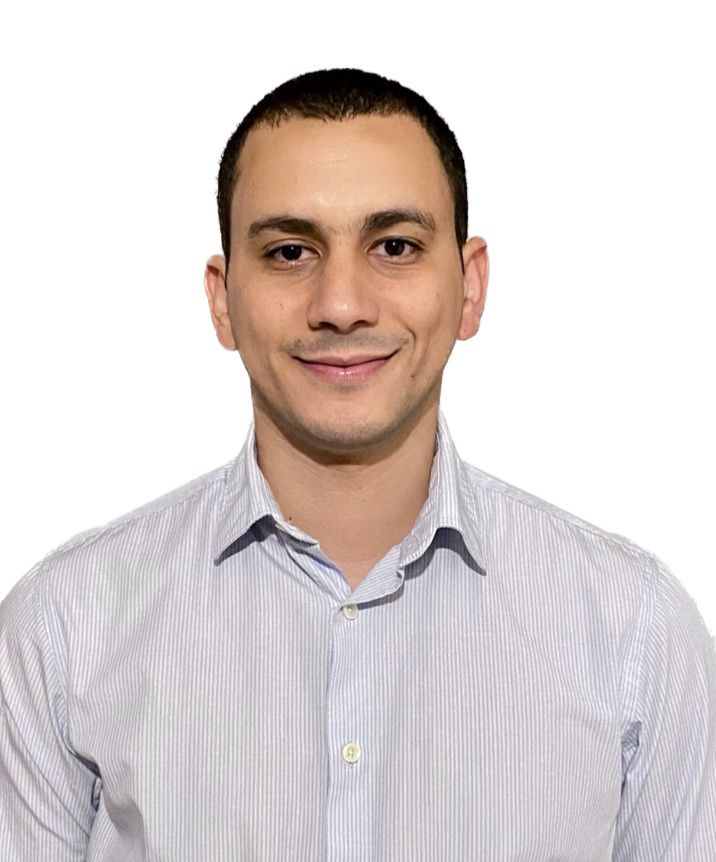
Ahmed Aboudonia

Summary
Ahmed Aboudonia is a robotics and control researcher whose work focuses on the intersection of control theory, mathematical optimisation, and machine learning. His research goal is to design adaptive, learning-enabled, and data-driven control frameworks for uncertain and complex systems, with practical impact on autonomous systems, sustainable energy systems, and trustworthy societal systems.
Since February 2025, he has been a Postdoctoral Researcher at the University of Illinois Urbana-Champaign (UIUC) in the United States, where he develops adaptive learning-based and data-driven control methods for robotic platforms. His technical expertise includes control theory, mathematical optimisation, machine learning, data science, Python, MATLAB, and applied robotics.
Before joining UIUC, Ahmed spent nearly seven years at ETH Zürich (2018–2025) as a Scientific Assistant. During this period, he led major research projects in adaptive control and data-driven control systems. He collaborated with Swiss Federal Railways (SBB) to design control architectures for railway rolling stock and with Swiss Research Laboratories (Empa) to develop data-driven algorithms for building energy management. This technology was later adopted by Viboo and has demonstrated up to 40% energy savings in European buildings. His work at ETH also covered microgrids, energy systems, and machine learning-based optimisation.
Earlier in his career, Ahmed was a Research Assistant at Sapienza University of Rome, working on humanoid robot gait generation and obstacle avoidance using model predictive control and mathematical optimisation. At The German University in Cairo, he proposed robust control algorithms for unmanned aerial vehicles. He also conducted research at the German Aerospace Center (DLR) on disturbance estimation for helicopters and completed machine learning research at TU Darmstadt on human activity recognition. He gained early industry exposure through an internship at Siemens.
Ahmed holds a PhD in Automatic Control from ETH Zürich (2018–2023), a Master’s degree in Control Engineering from Sapienza University of Rome, and both a Master’s and Bachelor’s degree in Mechatronics Engineering from The German University in Cairo. He has authored more than 15 peer-reviewed publications in IEEE, Elsevier, Springer, and PMLR, covering predictive control, machine learning for control, building energy optimisation, UAV control, and humanoid robotics.
His academic excellence has been recognised through multiple scholarships and awards, including DAAD Scholarship, Sapienza Excellence Awards, and several GUC fellowships and honours.
Biography
Ahmed Aboudonia is a researcher in robotics and control whose work focuses on the combination of control theory, mathematical optimisation and machine learning. His research aims to design adaptive, learning-based and data-driven control systems for uncertain and complex engineering problems. His long-term objective is to improve the reliability of autonomous systems, support sustainable energy systems and strengthen the trustworthiness of large-scale societal systems.
His academic and research journey began at The German University in Cairo, where he completed his Bachelor’s degree in Mechatronics Engineering from 2009 to 2014. During this period, he ranked among the top students of his cohort and received several academic fellowships and awards, including the GUC Bachelor Program Fellowship, GUC Excellence Award, GUC Bachelor Thesis Scholarship and GUC Master Program Fellowship. In 2011, he gained early industrial experience through an internship at Siemens in Cairo, where he supported service and sales engineering teams. In 2012, he joined Technische Universität Darmstadt as a research intern and developed machine learning algorithms for human activity recognition using Java. In 2013, he was a visiting researcher at the German Aerospace Center, where he worked on disturbance and state estimation techniques for helicopter systems using Simulink.
In 2014, he enrolled in the Master’s programme in Mechatronics Engineering at The German University in Cairo and completed it in 2015. During this time, he also worked as a research and teaching assistant, proposing robust control algorithms for unmanned aerial vehicles operating in windy environments. His academic performance earned him the DAAD Scholarship for ranking among the top students in his undergraduate year. In 2015, he joined Sapienza University of Rome to pursue a second Master’s degree in Control Engineering, which he completed in 2018. While at Sapienza, he served as a research assistant from 2017 to 2018, developing mathematical optimisation tools for humanoid robot gait generation in MATLAB and obstacle avoidance algorithms in C++. He received several Sapienza awards for academic excellence, including the Sapienza Award for International Students, Sapienza Excellence Award and Sapienza Honors Award.
In 2018, Ahmed began his doctoral studies in Automatic Control at ETH Zürich. From 2018 to 2025, he worked as a scientific assistant at ETH Zürich, where he conducted extensive research in adaptive control, data-driven control and machine learning for engineering systems. He led a major research project in collaboration with Swiss Federal Railways to develop data-driven control architectures for railway rolling stock. He also worked closely with Swiss Research Laboratories (Empa) on the development of data-driven control algorithms for building energy management. The technology resulting from this work was later adopted by Viboo and has been shown to deliver up to 40 percent energy savings in European buildings. His work at ETH also included research on microgrids, energy systems and large-scale distributed control.
He completed his PhD in 2023 with a research focus on predictive control, machine learning integration and adaptive control frameworks. Throughout his doctoral and postdoctoral research, he authored a large number of peer-reviewed publications with leading scientific publishers such as IEEE, Elsevier, Springer, PMLR and SAGE. His published work covers areas including building energy optimisation, model predictive control, data-driven control, distributed control of large-scale systems, humanoid robotics, quadrotor control, disturbance observer design and learning-based control.
In February 2025, Ahmed joined the University of Illinois Urbana-Champaign as a postdoctoral researcher in robotics and control. At UIUC, he continues to develop adaptive, learning-based and data-driven control approaches for robotic platforms. His work combines theoretical foundations with practical implementation using tools such as Python, MATLAB and advanced optimisation methods. He continues to collaborate across disciplines in robotics, energy systems and intelligent infrastructure.
Across his career, Ahmed Aboudonia has built a strong record of academic contribution, industrial collaboration and applied research impact. His work connects theory with real-world systems and contributes directly to improved performance, efficiency and reliability in robotics, energy and autonomous systems.
Vision
Ahmed Aboudonia’s vision is to advance the development of intelligent control systems that can adapt, learn, and operate reliably in uncertain and complex environments. He aims to integrate control theory, mathematical optimisation and machine learning into practical engineering solutions that improve the performance of autonomous machines, reduce energy consumption in large-scale systems, and strengthen the stability of critical infrastructure. His long-term goal is to support the creation of autonomous technologies that are safe, efficient and trustworthy, while enabling sustainable energy systems and resilient societal networks. Through research, collaboration and education, he seeks to translate scientific progress into real-world impact that benefits industry and society.
Recognition and Awards
Ahmed Aboudonia has received multiple academic awards and scholarships in recognition of his strong academic performance and research potential. He was awarded the Alalfi Foundation Scholarship for outstanding academic achievements in Egypt and the DAAD Scholarship for ranking among the top twenty students in his first undergraduate year. At The German University in Cairo, he received the GUC Bachelor Program Fellowship, GUC Bachelor Thesis Scholarship, GUC Excellence Award, and GUC Master Program Fellowship for maintaining top rankings throughout his studies. At Sapienza University of Rome, he earned the Sapienza Award for International Students, Sapienza Excellence Award, and Sapienza Honors Award for outstanding performance during his graduate studies.
References
- Ahmed Aboudonia | NCCR Automation
- Ahmed Aboudonia - University of Illinois Urbana-Champaign | LinkedIn
- Ahmed Aboudonia | Google Scholar
- Ahmed ABOUDONIA | PostDoc Position | ResearchGate
- Postdocs | Mechanical Science & Engineering | Illinois - MechSE | University of Illinois Urbana-Champaign
Discover up-to-date information on Business, Industry Leaders and Influencers, Organizations, Education, and Investors – connecting you to the knowledge you need.
