
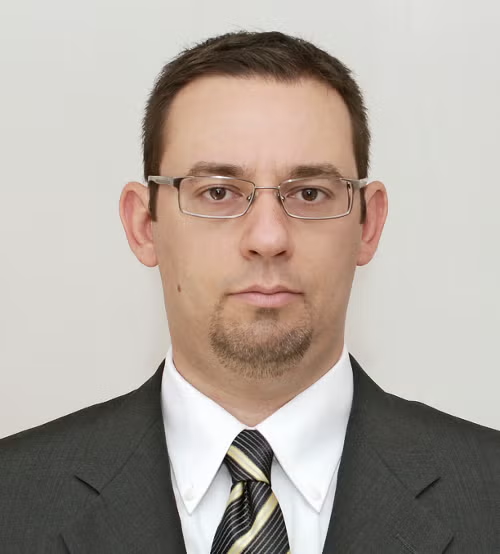
Matteo Mariantoni

Summary
Matteo Mariantoni is an Associate Professor at the Institute for Quantum Computing and the Department of Physics and Astronomy at the University of Waterloo, where he has been based since 2013. He leads the Laboratory for Digital Quantum Matter and is also a faculty member of the Institute for Quantum Computing. His work focuses on quantum computing systems, particularly those based on superconducting quantum circuits.
Mariantoni has a strong research background in superconducting qubits and circuit quantum electrodynamics. His expertise includes low-level microwave detection, pulsing techniques, and the measurement of very weak quantum signals generated by superconducting qubits coupled to on-chip resonators. His research interests cover quantum computing, quantum error correction, digital quantum emulations, superconducting quantum circuits, and broader quantum science. His work combines experimental research with selected theoretical studies.
He completed his PhD in Physics in 2009 at the Technical University of Munich, while working at the Walther-Meissner Institute for Low Temperature Research. His doctoral thesis focused on superconducting circuit quantum electrodynamics and examined light–matter interaction through vacuum fluctuation measurements, multi-resonator circuit QED systems, and two-photon interactions. He also holds a Master of Science degree in Physics from Chalmers University of Technology in Sweden and received engineering training through Politecnico di Milano.
After his doctorate, Mariantoni joined the California NanoSystems Institute at the University of California, Santa Barbara, as an Elings Prize Fellow, working in the group of John Martinis. During this period, his work on a single-chip quantum memory and processor using a quantum von Neumann architecture was recognised by Physics World as one of the top ten breakthroughs of 2011.
At the University of Waterloo, his team has fabricated advanced superconducting resonators and transmon qubits with high coherence and gate fidelities above 99.9 per cent. In 2015, his group developed the quantum socket, a vertical wiring and packaging method for scalable quantum computing. His work also includes reducing wiring complexity in large qubit systems.
Mariantoni has received several honours, including the Alfred P. Sloan Research Fellowship and the Ontario Early Researcher Award. He actively teaches electricity and magnetism courses and has published widely in leading scientific journals on superconducting quantum circuits and quantum computing technologies.
Biography
Matteo Mariantoni is a physicist and quantum computing researcher whose work focuses on superconducting quantum circuits and circuit quantum electrodynamics. He is an Associate Professor at the Institute for Quantum Computing and the Department of Physics and Astronomy at the University of Waterloo, where he has been based since 2013. He also serves as faculty at the Institute for Quantum Computing and leads the Laboratory for Digital Quantum Matter.
Mariantoni’s academic training began in Europe. He received engineering education through Politecnico di Milano in Italy and later completed a Master of Science degree in Physics at Chalmers University of Technology in Gothenburg, Sweden, in 2003. He went on to pursue doctoral studies at the Technical University of Munich while working at the Walther-Meissner Institute for Low Temperature Research. Between 2003 and 2009, he was a member of the Gross research group at the Walther-Meissner Institute. He completed his PhD in Physics in 2009. His doctoral thesis, titled New Trends in Superconducting Circuit Quantum Electrodynamics: Two Amplifiers, Two Resonators, and Two Photons, focused on the interaction between light and matter in superconducting circuit systems. In this work, he investigated vacuum fluctuations at microwave frequencies using a cross-correlation homodyne detection scheme that he developed, proposed a two-resonator circuit QED architecture coupled to a single superconducting qubit, and studied symmetry properties and two-photon interactions in flux-qubit-based circuit QED systems.
After completing his doctorate, Mariantoni moved to the United States in 2009 to join the California NanoSystems Institute at the University of California, Santa Barbara. He was awarded the Elings Prize Fellowship in Science and worked in the research group led by John M. Martinis. During this period, he contributed to the implementation of a quantum memory and processor on a single chip using a quantum von Neumann architecture. This work was recognised by Physics World as one of the top ten scientific breakthroughs of 2011.
In 2013, Mariantoni joined the University of Waterloo as an Assistant Professor in the Department of Physics and Astronomy and the Institute for Quantum Computing. In the same year, he was awarded the Alfred P. Sloan Research Fellowship, recognising his research contributions and future potential. In 2014, he received the Ontario Early Researcher Award from the Ontario Ministry of Research and Innovation, as well as a Kavli Fellowship. He was promoted to Associate Professor in 2019 and continues in this role.
At the University of Waterloo, Mariantoni established and now leads the Laboratory for Digital Quantum Matter. His research focuses on quantum computing systems based on superconducting circuits, with emphasis on practical and scalable architectures. His work includes the experimental realisation of low-level microwave detection and pulsing techniques used to measure very weak quantum signals from superconducting qubits coupled to on-chip resonators. His broader research interests include quantum computing, quantum error correction, digital quantum emulation, superconducting quantum circuits, and fundamental quantum science.
His research group has fabricated advanced superconducting devices, including on-chip resonators and frequency-tunable Xmon transmon qubits. These devices have achieved internal quality factors of around one million in the quantum regime and energy relaxation times of approximately 20 microseconds. Using these systems, his team demonstrated one-qubit gate fidelities exceeding 99.9 per cent through randomised benchmarking. In 2015, his group was the first to develop a fully vertical interconnect wiring and packaging approach for quantum processors, known as the quantum socket. This method addressed key challenges in wiring density and scalability for large quantum systems. His team also developed spatially demultiplexed qubit control schemes that, when combined with frequency-multiplexed readout, reduce the number of control wires required for large arrays of superconducting qubits.
Mariantoni has published extensively in leading scientific journals, including Nature Communications, Physical Review Letters, and Superconductor Science and Technology. His publications cover topics such as quantum simulation, superconducting qubit coherence, materials for quantum devices, and scalable wiring and packaging methods for quantum computing.
In addition to his research, Mariantoni is an active teacher. He has taught undergraduate and advanced electricity and magnetism courses at the University of Waterloo over multiple years, including PHYS 242, PHYS 342, and PHYS 442. He also contributes to the academic community through mentorship, collaboration, and service within the Institute for Quantum Computing.
Vision
Matteo Mariantoni’s vision is to help build practical and scalable quantum computing systems that can be used beyond laboratory experiments. His work focuses on understanding how quantum systems behave at a fundamental level while also developing reliable technologies that allow many qubits to work together with minimal errors. He aims to reduce technical barriers such as wiring, control, and measurement complexity, which limit large quantum processors today. By improving superconducting circuits, materials, and system architecture, his goal is to support the long-term development of useful quantum computers for science, industry, and society.
Recognition and Awards
Matteo Mariantoni has received several recognised awards for his contributions to quantum science and superconducting quantum circuits. In 2013, he was awarded the Alfred P. Sloan Research Fellowship, which recognises early-career researchers with strong research impact and future potential. In 2014, he received the Ontario Early Researcher Award from the Ontario Ministry of Research and Innovation for supporting innovative research programmes in the province. Earlier in his career, he was awarded the Elings Prize Fellowship in Science at the California NanoSystems Institute. His research on a quantum processor was also recognised by Physics World as a top ten breakthrough of 2011.
References
- Matteo Mariantoni | Physics and Astronomy | University of Waterloo
- Matteo Mariantoni | Google Scholar
- Matteo Mariantoni | Institute for Quantum Computing | University of Waterloo
- Prof. Dr. Matteo Mariantoni - WMI: Team | Bayerische Akademie der Wissenschaften
- Quantum mechanics: Waterloo gets physical | Nature
- Scaling-Up with a Quantum Socket | APS Journals
- Matteo Mariantoni, University of Waterloo | Expertise Finder
- Matteo Mariantoni | University of Waterloo
Discover up-to-date information on Business, Industry Leaders and Influencers, Organizations, Education, and Investors – connecting you to the knowledge you need.
