
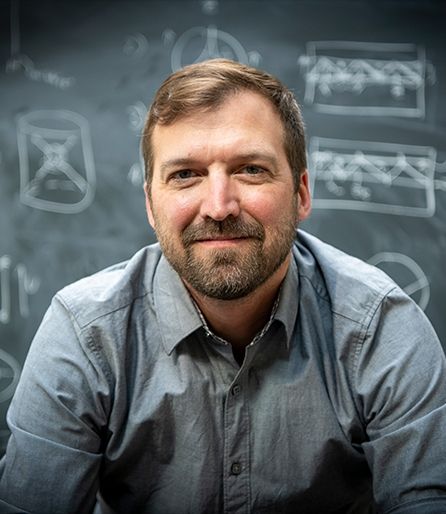
Roger Melko

Summary
Roger Melko is a Professor of Physics at the University of Waterloo, where he holds the position of Canada Research Chair in Computational Quantum Many-Body Physics. He is also Associate Faculty at the Perimeter Institute for Theoretical Physics and a Faculty Affiliate at the Vector Institute for Artificial Intelligence. His academic work sits at the intersection of condensed matter physics, quantum information science, and computational physics.
Dr Melko received his PhD in Physics in 2005 from the University of California, Santa Barbara. He also earned his MA in Physics in 2003 from the same university. Earlier, he completed an MSc in Physics in 2001 and a BSc in Physics in 2000 at the University of Waterloo. After completing his PhD, he spent two years as a Wigner Fellow at Oak Ridge National Laboratory.
His research focuses on strongly correlated many-body systems and the study of emergent phenomena in quantum matter. His main interests include quantum phase transitions, quantum criticality, entanglement in condensed matter systems, frustrated quantum magnets, unconventional quantum criticality, supersolid and superglass phases, and quantum Monte Carlo methods. He places strong emphasis on computational approaches, including the development of new algorithms and the use of machine learning to simulate quantum systems on classical computers. His work has applications in quantum materials, cold atoms in optical lattices, bosonic fluids, magnetic systems, and quantum computing.
Dr Melko is also active in quantum information science and the study of topological phases such as superconducting and spin liquid states. His contributions connect theoretical physics with modern computational techniques and artificial intelligence.
His achievements have been recognised through major international and national awards. These include the IUPAP Young Scientist Prize in Computational Physics (2012), the Canada Research Chair appointment (2013), the Herzberg Medal from the Canadian Association of Physicists (2016), the Early Researcher Award from the Ontario Ministry of Research and Innovation (2010), and the CAP/DCMMP Brockhouse Medal (2021).
Biography
Roger Melko is a condensed matter and quantum information physicist whose work focuses on understanding complex quantum systems through advanced computational methods. He is a Professor in the Department of Physics and Astronomy at the University of Waterloo, where he also holds the position of Canada Research Chair in Computational Quantum Many-Body Physics. In addition, he is Associate Faculty at the Perimeter Institute for Theoretical Physics, a Faculty Affiliate at the Vector Institute for Artificial Intelligence, and an Affiliate of the Institute for Quantum Computing. Through these roles he works closely with both theoretical physicists and computational scientists on problems connected to quantum materials, quantum computing and quantum information science.
Dr Melko completed his Bachelor of Science in Physics at the University of Waterloo in 2000, followed by a Master of Science in Physics at the same institution in 2001. He then moved to the United States where he earned his Master of Arts in Physics in 2003 and his PhD in Physics in 2005 at the University of California, Santa Barbara. After completing his doctorate, he was awarded a Wigner Fellowship at Oak Ridge National Laboratory, where he spent two years carrying out research on quantum systems and computational approaches to many-body physics. This period played an important role in shaping his later research direction.
His scientific work centres on strongly correlated many-body systems, with particular focus on emerggent phenomena, ground state phases, phase transitions, quantum criticality and quantum entanglement. He places strong emphasis on the use of computational physics as a theoretical tool and is widely known for developing advanced algorithms for studying strongly interacting systems. His research has used large-scale computer simulations to examine the low-temperature behaviour of classical and quantum magnetic materials, cold atoms in optical lattices, bosonic fluids and models relevant to quantum computing. He has made important contributions to the understanding of quantum phases such as superconducting states, spin liquids and topological phases, with special interest in microscopic models that display complex quantum behaviour in bulk systems.
Over time his work has expanded into the application of machine learning techniques for the simulation of quantum mechanical systems on classical computers. This has allowed new ways of analysing quantum data and exploring systems that are otherwise difficult to study using traditional computational methods. His research also connects directly with quantum information science, particularly in the study of entanglement and its role in quantum matter and quantum computation.
Dr Melko has been recognised for his contributions through several major awards. He received the Early Researcher Award from the Ontario Ministry of Research and Innovation in 2010. In 2012 he was awarded the Young Scientist Prize in Computational Physics by the International Union of Pure and Applied Physics. In 2013 he was appointed Canada Research Chair in Computational Quantum Many-Body Physics. In 2016 he received the Herzberg Medal from the Canadian Association of Physicists for achievement by an early-career physicist. In 2021 he was awarded the CAP/DCMMP Brockhouse Medal.
Alongside his research, he is an active teacher at the University of Waterloo. In recent years he has taught courses including Machine Learning in Physics, Statistical Physics, Quantum Many-Body Physics and Special Topics in Physics. His teaching reflects the close link between modern computational methods and theoretical physics, helping to train students in both physical theory and advanced computing.
His work has also reached a wider audience through media coverage, including reports on new theoretical approaches to high-temperature superconductivity and research into the behaviour of virtual electrons. Through his combined efforts in research, teaching and collaboration across institutions, Roger Melko continues to contribute to the development of modern quantum science and computational physics.
Vision
Roger Melko’s vision is to deepen understanding of quantum matter by combining physics, computation and data-driven methods. He aims to develop reliable computational tools that allow scientists to study complex quantum systems that cannot be solved using traditional techniques. His work seeks to uncover how quantum phases, entanglement and critical behaviour emerge from microscopic models, and how these discoveries can support the development of quantum technologies. He is committed to training the next generation of scientists in both theoretical physics and modern computational methods, ensuring that progress in quantum science remains grounded in solid physical understanding and practical application.
Recognition and Awards
Roger Melko has received wide recognition for his contributions to computational physics and quantum science. In 2010 he was awarded the Early Researcher Award by the Ontario Ministry of Research and Innovation. In 2012 he received the Young Scientist Prize in Computational Physics from the International Union of Pure and Applied Physics. In 2013 he was appointed Canada Research Chair in Computational Quantum Many-Body Physics. In 2016 he was awarded the Herzberg Medal by the Canadian Association of Physicists for achievement by an early-career physicist. In 2021 he received the CAP/DCMMP Brockhouse Medal, one of Canada’s leading honours in condensed matter and materials physics.
References
- Roger Melko | Physics and Astronomy | University of Waterloo
- Roger G. Melko | Google Scholar
- Roger Melko | Creative Destruction Lab
- Roger Melko | Perimeter Institute
- Roger Melko | Institute for Quantum Computing | University of Waterloo
- Roger Melko: Roger G. Melko | GitHub
- Roger G. Melko | Vector Institute for Artificial Intelligence
- Roger Melko, Perimeter Institute and University of Waterloo | Agile Ticketing
- Canada Research Chair - Roger Melko | Chaires de recherche du Canada
- Dr. Roger Melko - University of Waterloo | McMaster University
Discover up-to-date information on Business, Industry Leaders and Influencers, Organizations, Education, and Investors – connecting you to the knowledge you need.
