
AI Business Adoption - What are the biggest challenges?
26 May 2026

Executive Summary
The discourse surrounding Artificial Intelligence (AI) has fundamentally shifted. For the past decade, the global narrative has been dominated by an elite technological arms race: which tech giant or superpower could build the largest large language model, compute the fastest, or claim supremacy in general intelligence? However, as we navigate Q1 2026, the paradigm has changed.
The next phase of AI competition is not about who builds AI first; it is about who adopts it most effectively. AI has evolved from an experimental sandbox asset into an inescapable infrastructure of the global workforce, currently utilised by 17.8% of the global working-age population.
Despite this rapid proliferation, enterprise integration is hitting a critical wall. While global corporate adoption curves have reached an unprecedented 96%, businesses are discovering that "using" AI tools is vastly different from embedding them into a cohesive ecosystem. This comprehensive analysis explores the dynamics of the global AI adoption landscape, dissects the friction points holding businesses back, specifically the paramount challenge of measuring and proving business value and outlines a strategic blueprint for organisations to transition from superficial implementation to a holistic, "AI-first" business model.
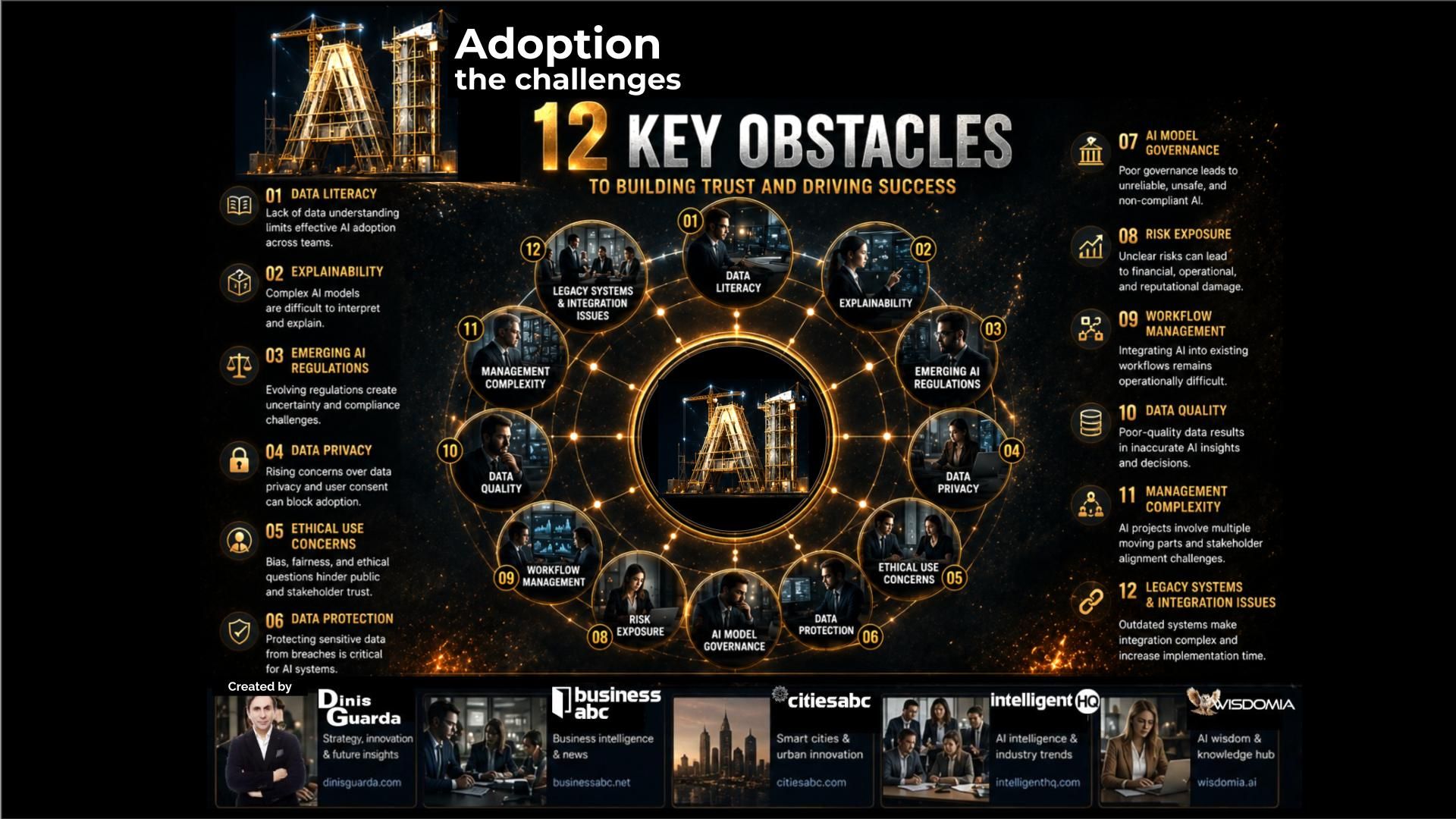
1. The Global AI Adoption Landscape: A Macro View
The geopolitical and macroeconomic map of AI is being redrawn by pragmatism rather than pure invention. Data from Q1 2026 indicates that geographical proximity to Silicon Valley or major tech hubs no longer guarantees leadership in AI deployment. Instead, agility, national strategy, and cultural readiness are dictating the new global hierarchy.
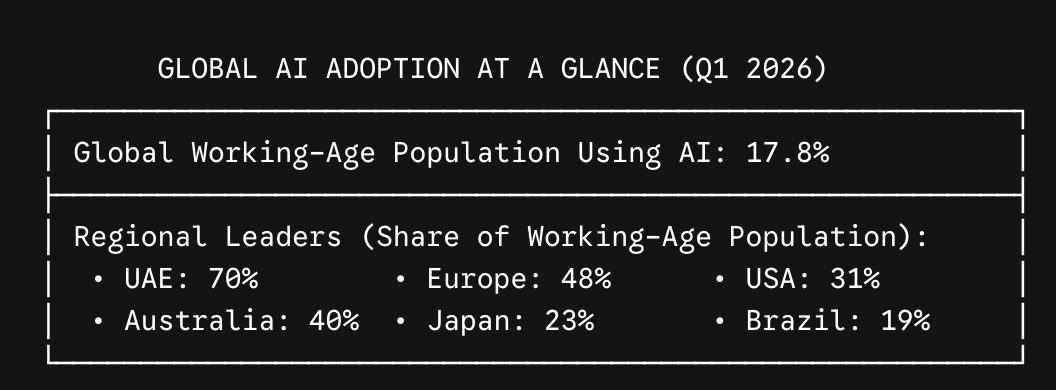
GLOBAL AI ADOPTION AT A GLANCE (Q1 2026)
The Surprising AI Adoption Hegemony of the UAE
The United Arab Emirates (UAE) stands as the global leader in AI adoption, with an astonishing 70% of its working-age population regularly using AI tools. This surpasses traditional tech epicentres like the United States (31%) and major European nations.
The UAE’s top ranking is not accidental; it is the result of a deliberate, centralised national strategy that treated AI adoption as a matter of economic survival and diversification. By embedding AI literacy into education, public services, and corporate regulatory frameworks, the UAE has closed the gap between technological availability and human habituation.
Regional Variations and the Adoption Gap
Behind the UAE, a competitive cluster of nations is emerging:
- Singapore (63%) follows closely, leveraging its highly digitised infrastructure and compact economy to operationalise new technologies rapidly.
- Europe (48% average) shows strong pockets of adoption, led by countries like Norway (49%), Ireland (48%), and France (48%).
- The United Kingdom (42%) and the Netherlands (42%) represent a mature yet slightly more cautious tier of adoption.
- The United States (31%), while home to the creators of foundational models (OpenAI, Anthropic, Google, Microsoft), lags significantly behind in population-wide workplace integration. This disparity underscores a vital truth: building the best models and integrating them into everyday life are entirely decoupled capabilities.
For a broader view of how adoption varies across markets and industries, AI adoption statistics can help illustrate the pace at which businesses are integrating AI into their operations.
2. The Illusion of Ubiquity: Enterprise Adoption vs True Integration
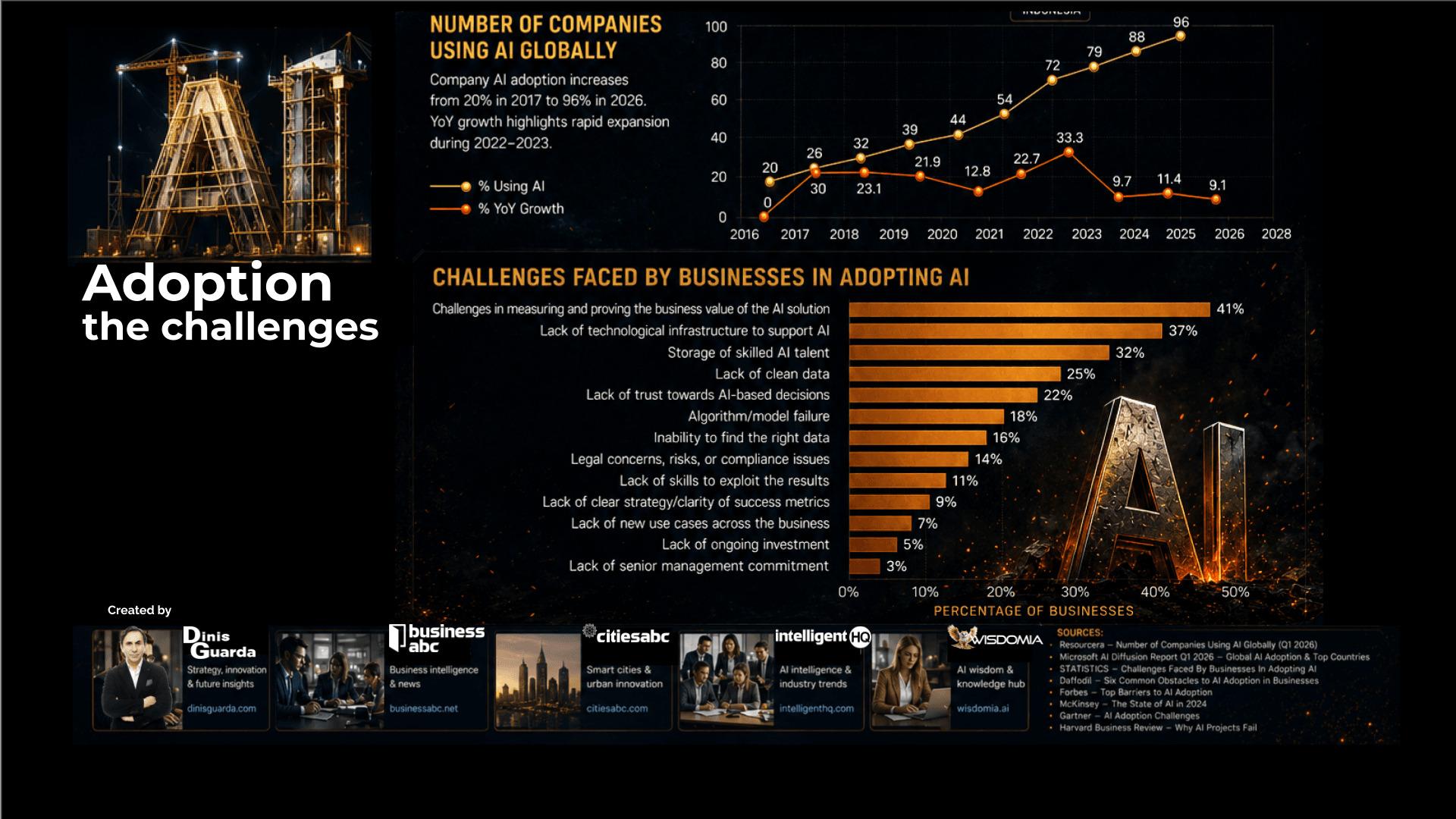
A visual analysis of corporate trends reveals an interesting paradox. The percentage of companies globally using AI has risen from a modest 20% in 2017 to near-total saturation 96% in 2026.
The Enterprise Adoption Curve (2017–2026)
The trajectory of corporate AI uptake showcases a steady climb with defining micro-epochs:
| Year | % of Companies Using AI | YoY Growth Rate | Strategic Phase |
| 2017 | 20% | — | Experimental / Proof of Concept |
| 2019 | 32% | 23.1% | Early Adopters & Specialisation |
| 2021 | 44% | 12.8% | Pandemic-Driven Automation |
| 2022 | 54% | 22.7% | Generative AI Inflexion Point |
| 2023 | 72% | 33.3% | Peak Hype & Hyper-Growth |
| 2024 | 79% | 9.7% | Stabilization & Consolidation |
| 2025 | 88% | 11.4% | Strategic Mainstreaming |
| 2026 | 96% | 9.1% (Q1) | Near-Universal Baseline Access |
The Year-over-Year (YoY) Growth Paradox
While the total number of companies incorporating AI has reached 96%, the YoY growth rate spiked dramatically between 2022 (22.7%) and 2023 (33.3%), driven by the initial shockwave of accessible Generative AI. Since that peak, YoY growth has decelerated sharply, dropping to 9.7% in 2024 and levelling out to 9.1% in early 2026.
This deceleration does not imply that interest in AI is waning; rather, it indicates that the land grab is over. Almost every company now has access to some form of AI, whether through embedded SaaS features, copilots, or API integrations.
The real problem has shifted from acquisition to activation. Businesses have purchased the licenses, but they are struggling to extract transformative economic value from them.
3. Deconstructing the Great Wall of AI Adoption: Challenges Faced by Businesses
The widespread adoption of AI has exposed structural, cultural, and operational vulnerabilities across global enterprises. Data regarding the specific hurdles organisations face show that the primary obstacles are no longer purely technical; they are deeply strategic and managerial.
Breakdown of AI Adoption Friction Points
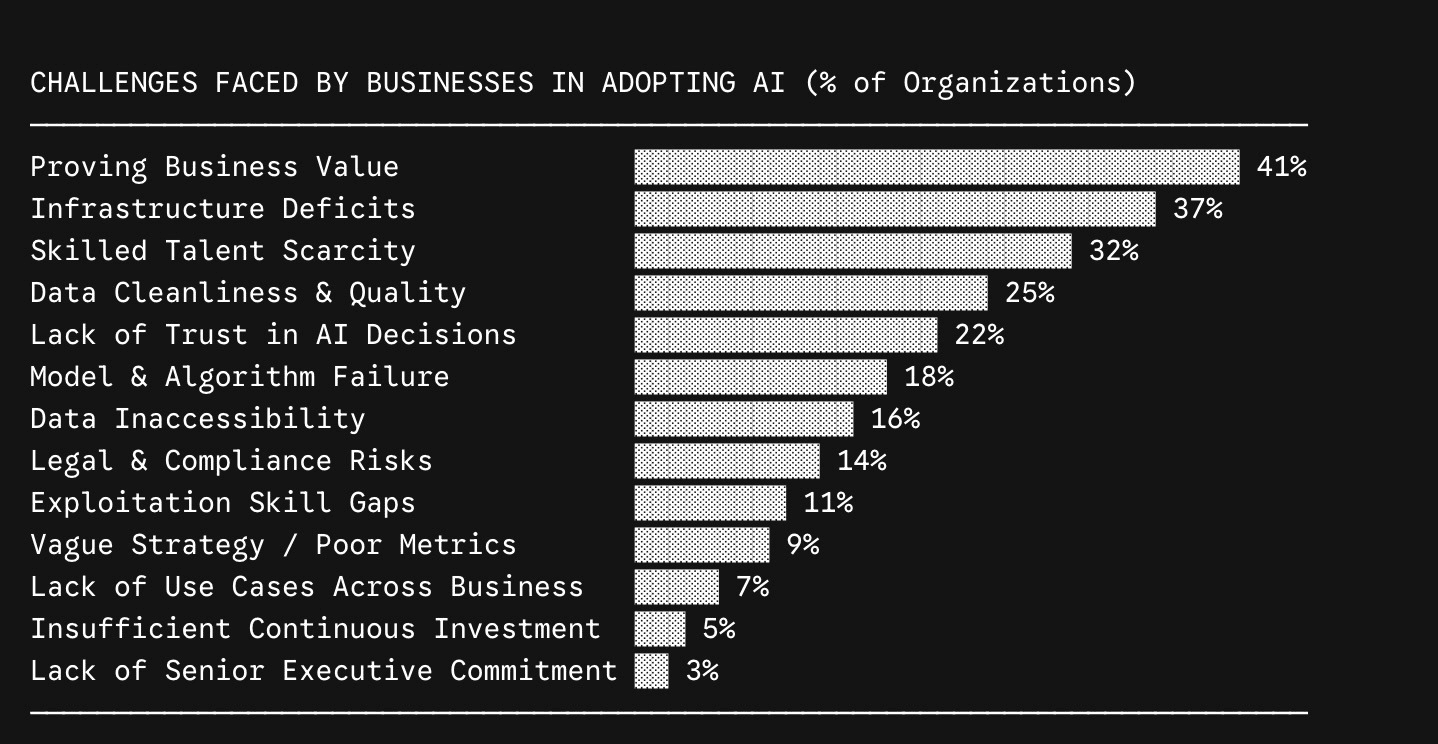
CHALLENGES FACED BY BUSINESSES IN ADOPTING AI (% of Organisations)
The Ultimate Challenge: Measuring and Proving Business Value (41%)
The single largest obstacle blocking enterprise AI deployment is the inability to measure and prove the business value of the AI solution (41%).
In the early hype phase (2022–2023), boards readily approved millions in capital expenditures driven by fear of missing out (FOMO). In 2026, CFOs are demanding tangible returns on investment (ROI).
Proving value is exceptionally difficult because AI often enhances intangible metrics: cognitive load reduction, qualitative decision support, or incremental time savings spread across thousands of distinct employee tasks. Because traditional corporate accounting is built for transactional, linear automation (e.g., replacing an old software system to save $X), it struggles to quantify the non-linear, compounding gains of an AI-augmented workforce.
The Technical Foundation: Infrastructure (37%) and Data Quality (25%)
A company's AI initiatives are only as strong as its technical foundation:
- The lack of technological infrastructure (37%) remains a major structural barrier. Legacy enterprise resource planning (ERP) systems and siloed on-premise servers are fundamentally unequipped for the real-time data pipelines and high-throughput compute required by modern AI models.
- Lack of clean data (25%) and inability to find the right data (16%) form a secondary data bottleneck. Decades of unstandardized logging, duplicate records, and unstructured internal communications mean that when a business attempts to fine-tune an AI model on its proprietary knowledge base, the output is often inaccurate, hallucinated, or irrelevant.
The Critical Human Capital Bottleneck: Talent (32%) and Exploitation Skills (11%)
The human element represents a two-sided constraint:
- On the supply side, there is a severe shortage of skilled AI talent (32%)—the engineers, data scientists, and prompt architects needed to build and customise solutions.
- On the demand side, there is a lack of skills to exploit the results (11%). This means that even when enterprise systems deliver optimised insights, the existing workforce lacks the data literacy or operational autonomy to turn those insights into real-world business actions.
Trust, Risk, and Governance
The psychological and regulatory framework around AI remains fragile. 22% of organisations cite a lack of trust towards AI-based decisions, fearing the legal or operational blowback of an incorrect autonomous choice. This is compounded by algorithm/model failure (18%) and mounting legal, risk, or compliance concerns (14%) as jurisdictions implement stricter frameworks around data privacy, copyright, and algorithmic bias.
4. The Anatomy of an AI-First Holistic Business Model
To survive an era in which AI is an inescapable element of human experience, businesses must abandon the view that AI is merely a plugin, a software upgrade, or an isolated IT project. Winning organisations are shifting to an AI-First architecture, fundamentally redesigning their core business mechanics.
Instead of treating departments as isolated pillars, modern enterprises must view their operations as a continuous, self-reinforcing loop—an organisational flywheel powered by data and machine intelligence.
THE AI-FIRST ORGANIZATIONAL FLYWHEEL 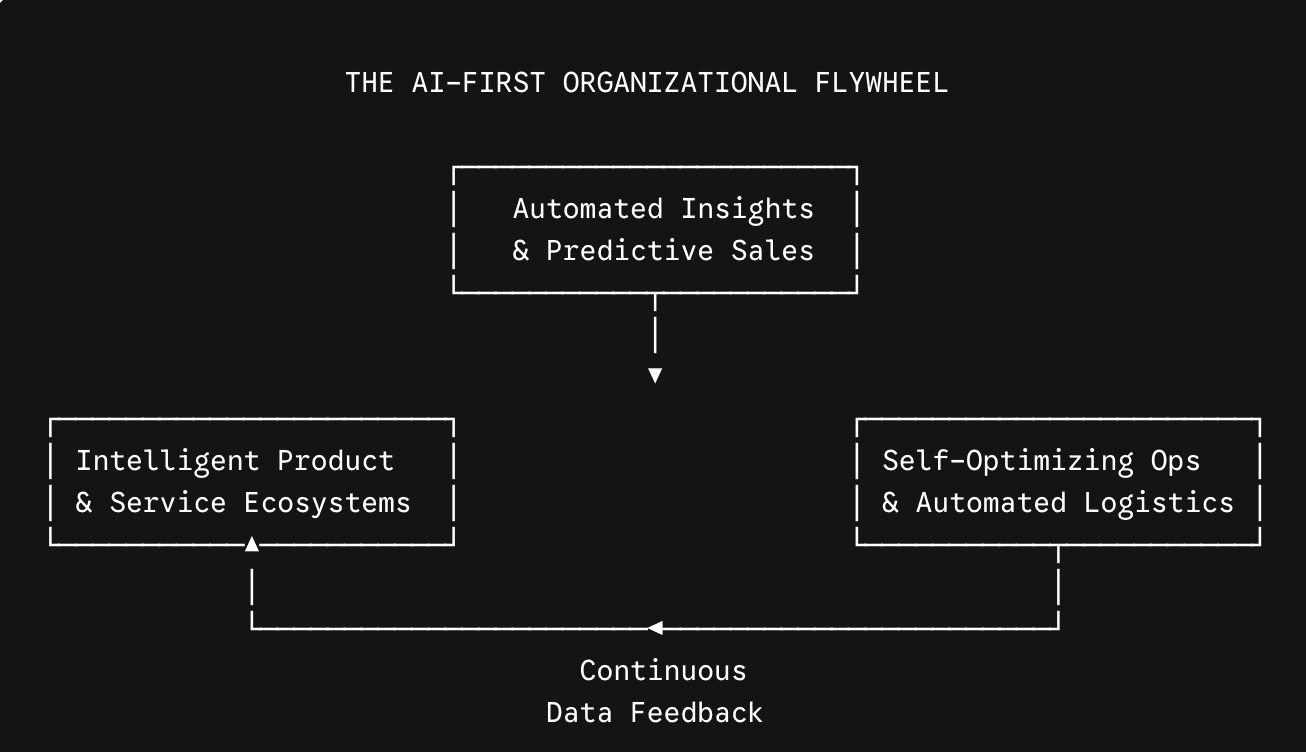
AI adoption and Redesigning the Value Chain
1. AI adoption and IT Infrastructure and Systems Engineering
The traditional IT department must change its mission from maintaining software availability to engineering enterprise intelligence networks. This requires moving away from rigid, relational databases toward dynamic, semantic knowledge graphs.
IT leaders must build modular, API-driven frameworks that enable foundational models to be easily swapped out as technology advances. This prevents the business from getting locked into an infrastructure that might become obsolete within months.
2. AI adoption and Operations and Supply Chain
In an AI-first model, operations shift from being reactive to predictive. Algorithms process vast amounts of external, unstructured data, such as geopolitical shifts, weather patterns, and macro-consumer trends, to optimise supply chains before bottlenecks occur.
Internal workflows are managed by multi-agent AI networks, in which specialised autonomous agents collaborate to handle complex, multi-step processes such as invoice reconciliation, compliance screening, and resource allocation with minimal human oversight.
3. AI adoption and Sales, Marketing, and Customer Experience
The historical boundary between marketing (acquisition) and sales (conversion) is dissolving. AI enables hyper-personalised, contextual engagement at scale.
Instead of broad demographic segmentation, businesses can dynamically generate unique marketing copy, pricing structures, and product configurations for individual buyers in real time.
Sales professionals transition from transactional relationship managers into strategic advisors, supported by real-time conversational intelligence engines that analyse client sentiment, predict objections, and surface the optimal solution during live interactions.
AI adoption and The New Role of the Human AI Professional
As tactical execution becomes increasingly automated, the premium on human labour shifts to higher-order cognitive skills. The most valuable professionals are no longer those who possess raw technical domain knowledge, but those who excel at contextual orchestration.
Crucial skills for this landscape include:
- Problem Framing and Prompt Engineering: The ability to accurately diagnose a business problem and translate it into clear instructions that guide an AI system to actionable outcomes.
- Algorithmic Auditing and Critical Evaluation: The capacity to evaluate AI-generated outputs for bias, inaccuracies, or strategic misalignment, acting as a crucial layer of human accountability.
- Interdisciplinary Synthesis: The unique human ability to connect disparate insights across culture, economics, and ethics to create entirely new business models.
5. Strategic Playbook for Executives: Overcoming the AI Adoption Chasm
To move from baseline AI use to market leadership, enterprise executives can execute a structured, five-part strategic playbook designed to address the primary adoption bottlenecks directly.
STRATEGIC AI PLAYBOOK STAGES
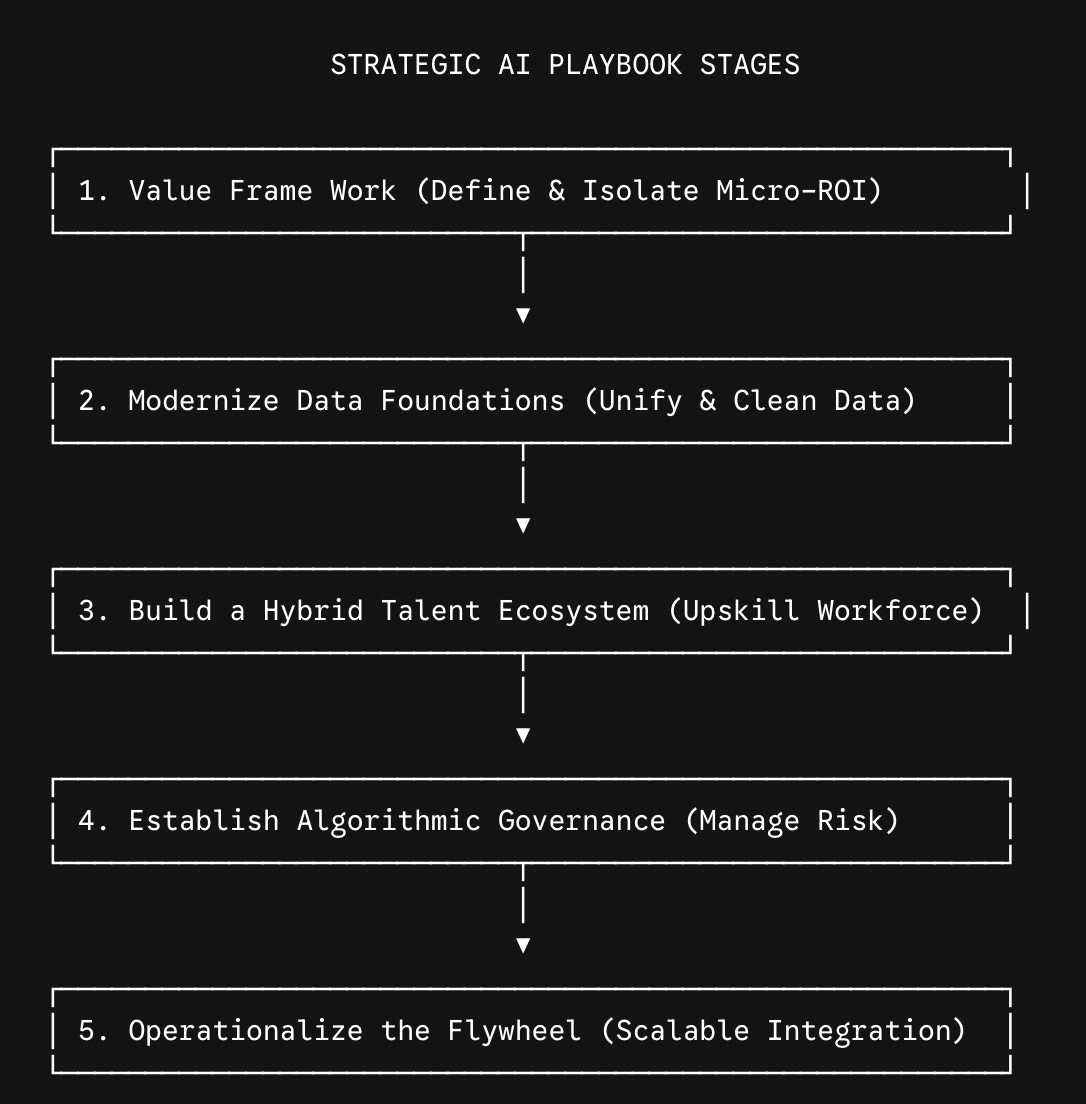
Step 1: Establish a Value Framework (Targeting the 41% Challenge)
To overcome the hurdle of proving business value, companies must abandon vague productivity metrics and adopt an Impact Isolation Framework.
- Isolate Micro-ROI: Do not try to measure the total value of AI across the whole company at once. Instead, track its financial impact within specific, high-frequency workflows, like reducing the time it takes to resolve customer service tickets or shortening sales onboarding cycles.
- Establish Value Benchmarks: Track metrics like Time-to-Value (TTV) for new product iterations or Cost-per-Optimised-Output.
- Shift from Cost-Cutting to Capacity Expansion: Evaluate AI investments not just by how many hours or heads they cut, but by the new revenue opportunities they unlock, such as a team's ability to handle double the client volume without adding headcount.
Step 2: Modernise the Data Foundation (Targeting the 37% and 25% Challenges)
Before purchasing access to advanced models, invest heavily in internal data pipelines.
- Implement a Unified Data Architecture: Break down department silos and migrate to a modern data platform capable of handling both structured data (like SQL tables) and unstructured data (like emails and PDFs).
- Enforce Strict Automated Data Governance: Use automated tools to clean, deduplicate, and catalogue internal information, ensuring your data is ready for AI systems to use reliably.
- Build Contextual Semantic Vector Databases: Convert company policies, historical project records, and proprietary data into machine-readable vector formats, allowing internal AI tools to access precise corporate knowledge instantly without hallucinations.
Step 3: Build a Hybrid Talent Ecosystem (Targeting the 32% Challenge)
Because recruiting highly specialised external AI experts is expensive and competitive, companies must build capability from within.
- Establish an Internal AI Academy: Create structured training programs focused on practical AI applications, tailored specifically to non-technical business leaders.
- Incentivise "Exploitation" Skills: Reward employees who successfully redesign their workflows with AI, turning individual efficiencies into shared institutional knowledge.
- Adopt Low-Code/No-Code AI Development: Equip everyday staff with secure internal tools that let them build their own basic automation workflows without needing a computer science degree.
Step 4: Establish Algorithmic Governance and Trust (Targeting the 22% Challenge)
Mitigate operational risks by creating clear safety frameworks that foster organisational trust.
- Implement "Human-in-the-Loop" Quality Controls: Mandate human sign-off for any AI output that directly impacts clients, compliance, or finances.
- Deploy Explainable AI (XAI) Tools: Prioritise open, transparent AI systems over closed "black box" models to ensure teams can audit and understand the logic behind automated suggestions.
- Form an AI Ethics & Compliance Board: Bring together legal, technical, and operational leaders to regularly review data privacy rules, model biases, and changing regulations.
Step 5: Scale from Task Automation to Flywheel Transformation
Transition from small, disconnected automated tasks to an integrated, autonomous enterprise model.
- Connect Disparate AI Tools: Link individual tools so that an insight generated by a marketing AI automatically triggers a creative adjustment in sales tools and updates inventory projections in operations.
- Foster an Adaptive, Iterative Corporate Culture: Encourage a mindset where business strategies are treated as hypotheses to be continuously refined by real-time data inputs.
Conclusion: The Pragmatic Mandate
The data from early 2026 makes one thing clear: technological sophistication is no longer a defence against market irrelevance. The market rewards adoption and integration far more than it rewards initial invention.
As AI becomes an implicit, foundational element of the global economy, the businesses that succeed will not necessarily be those that created the most complex models. The winners will be the organisations that demonstrated pragmatism, cultural agility, and structural boldness to rebuild their businesses around an AI-first reality completely.
The choice facing modern business leaders is simple and stark: integrate AI deeply into the fabric of your organisational model, or watch your business slowly become obsolete.
What specific area of your business model or industry sector are you looking to transform first with this AI-first approach?


