
Businesses
AI Governance & Compliance: From Innovation to Trust, Control and Real Business Impact
28 Oct 2026

It takes 20 years to build a reputation and five minutes to ruin it.
— Attributed to Warren Buffett
She is seventy-three, recently widowed, and managing money on her own for the first time. One evening she opens her wealth manager's app and types a question into the chat window: where should she put the proceeds of her late husband's pension? The assistant is fluent, warm and quick. It suggests a structured product with an attractive headline return. She follows the link and invests.
Nobody at the firm wrote that answer, and nobody approved it. The product team configured the assistant, the technology team integrated it, the vendor trained the underlying model, and the compliance team signed off a policy saying AI-generated content would be reviewed. The answer was produced at eleven o'clock at night and never seen by a human.
Six months later, the product has fallen in value and her daughter has complained to the firm. In a single afternoon, the compliance officer works through three regulatory regimes at once. Under the Consumer Duty, did the firm deliver a good outcome for a customer with characteristics of vulnerability? Under the Senior Managers and Certification Regime, which senior manager was responsible for the assistant, and what reasonable steps had they taken? Under the operational resilience rules, did the firm understand its dependence on the vendor? Every answer begins with the same words: we didn't know.
Here I explain why financial services is where AI risk is sharpest, and why the FCA's decision not to write new AI rules raises the bar rather than lowering it.
Five reasons finance is different
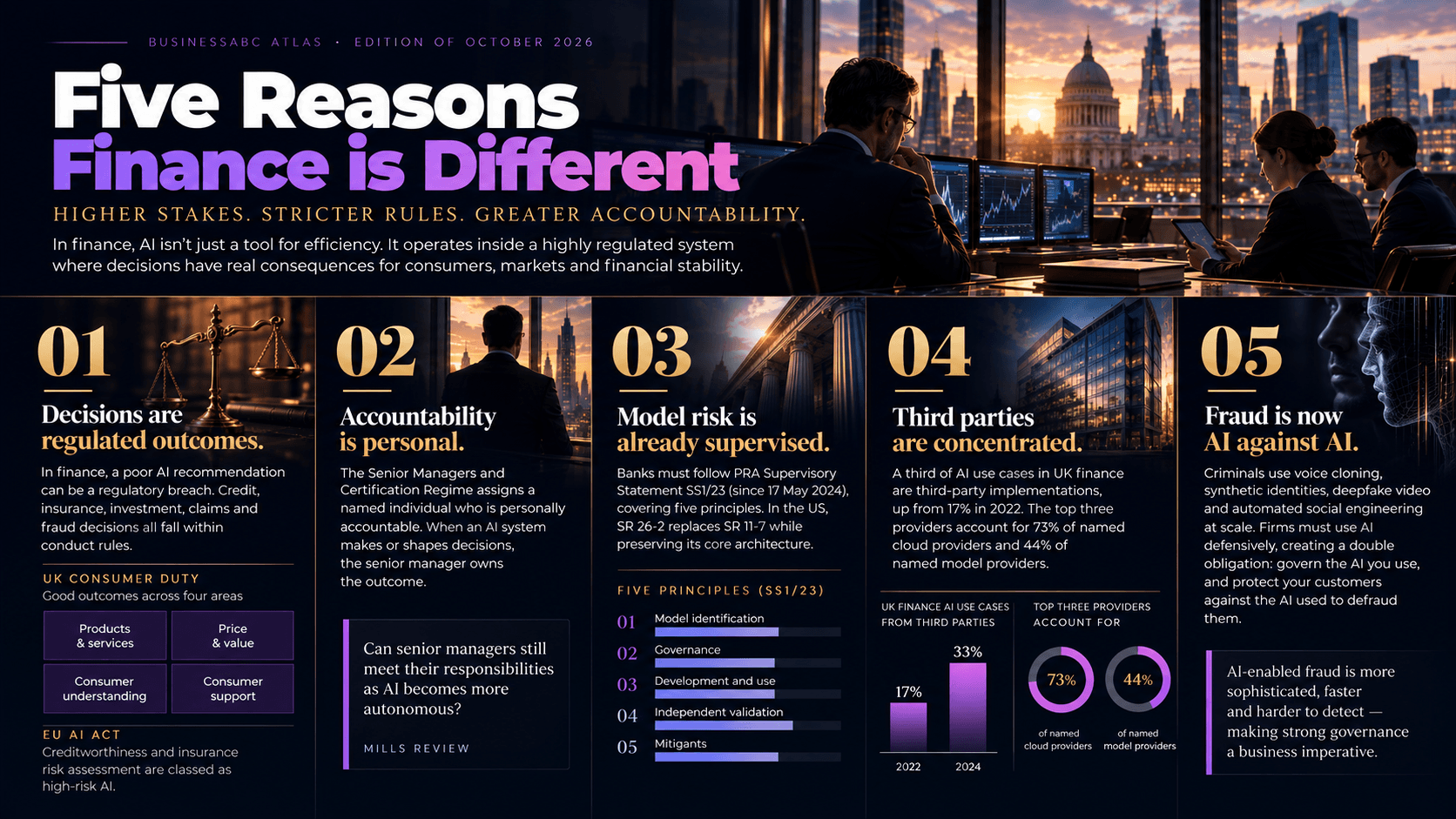
Decisions are regulated outcomes. In most industries, a poor AI recommendation is a commercial problem. In finance, it can be a regulatory breach. Credit decisions, insurance pricing, investment suitability, claims handling and fraud decisions all fall within conduct rules. Under the UK Consumer Duty, firms must deliver good outcomes across four areas: products and services, price and value, consumer understanding, and consumer support. Under the EU AI Act, AI used to assess creditworthiness, and AI used for risk assessment and pricing in life and health insurance, is classed as high-risk.
Accountability is personal. The Senior Managers and Certification Regime gives every key function a named individual who is personally accountable. When an AI system makes or shapes decisions in that function, the senior manager owns the outcome. The Mills Review put the underlying question directly: can senior managers still meet their responsibilities as AI becomes more autonomous? Firms that cannot show their senior managers understand and control their AI will find that question answered for them.
Model risk is already supervised. Banks regulated by the Prudential Regulation Authority must follow supervisory statement SS1/23, which has applied since 17 May 2024 and rests on five principles covering model identification, governance, development and use, independent validation, and mitigants. In the United States, the Federal Reserve's SR 11-7 guidance governed bank models from 2011; US agencies have since issued revised model risk guidance (SR 26-2) that replaces it while preserving its core architecture. These frameworks were written before generative AI, but they apply to it. When the Bank of England held roundtables with banks and insurers in early 2026, firms supported the principles-based approach but raised concerns about scaling model validation to generative and agentic AI, and about keeping human oversight meaningful.
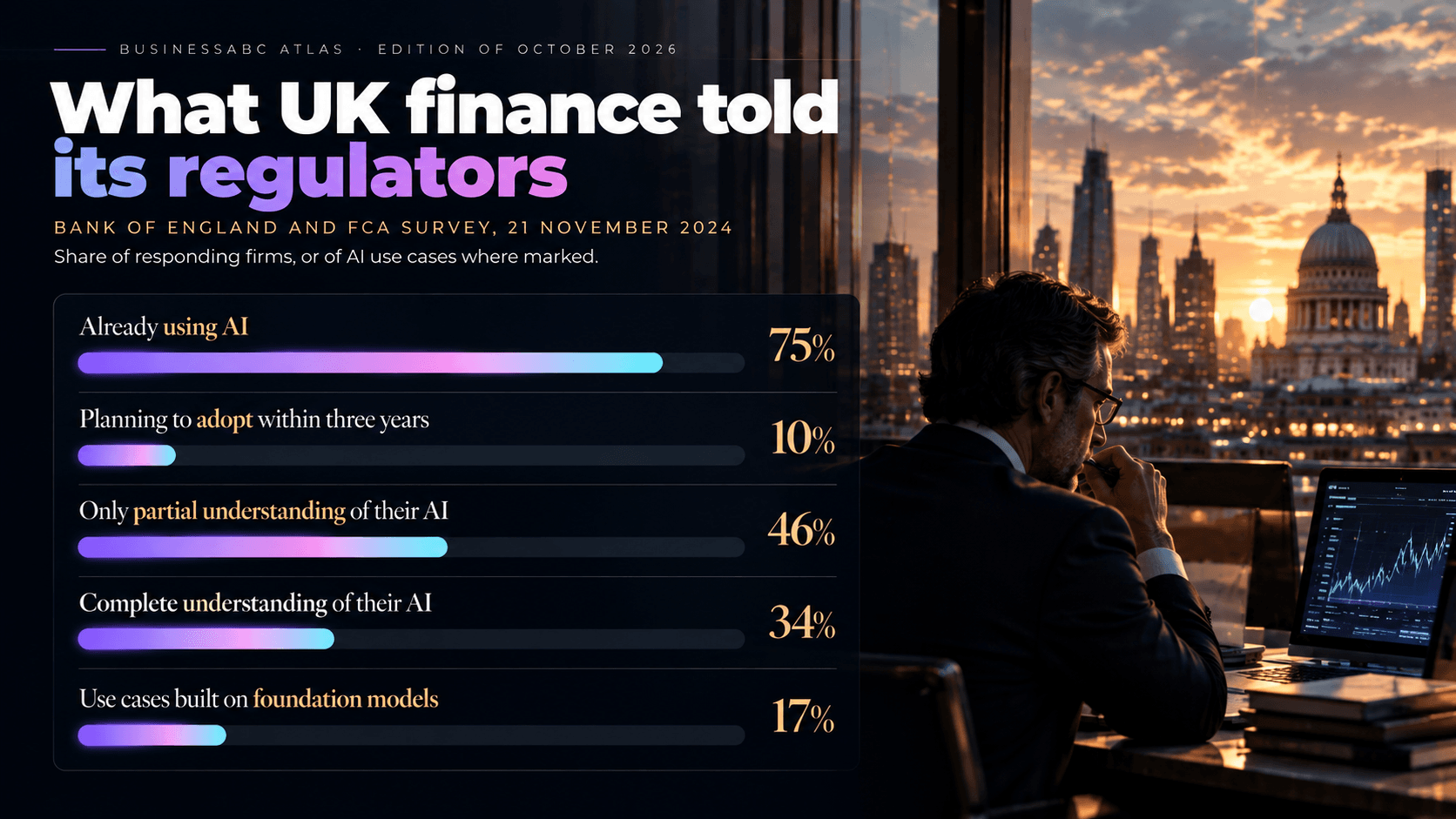
Third parties are concentrated. According to the Bank of England and FCA's 2024 survey, a third of AI use cases in UK finance are third-party implementations, up from 17% in 2022. The top three third-party providers account for 73% of named cloud providers and 44% of named model providers. Parliament's Treasury Committee, in its January 2026 report, said regulators were taking a "wait-and-see" approach that exposes consumers and the financial system to potentially serious harm, and recommended that major AI and cloud providers be designated as Critical Third Parties. Committee chair Dame Meg Hillier said she did not feel "confident that our financial system is prepared" for a major AI-related incident.
Fraud is now AI against AI. Criminals use voice cloning, synthetic identities, deepfake video and automated social engineering at a scale that was impossible a few years ago. Firms are expected to use AI defensively, to detect fraud faster than it can be committed. That creates a double obligation: govern the AI you use against fraud, and protect your customers against the AI used to defraud them.
Why "no new rules" raises the bar
The FCA has said plainly that it will not introduce AI-specific regulations. Instead it relies on the frameworks it already has: the Principles for Businesses, the Consumer Duty, the Senior Managers and Certification Regime, the systems and controls rules in SYSC, and the operational resilience regime. The direction of travel is not in doubt. As Sheldon Mills, who led the FCA's Mills Review, put it: "Artificial intelligence will transform financial services by 2030."
For firms, this has three consequences.
First, there is no checklist. A prescriptive AI rulebook would tell firms what to do. An outcomes-based regime tells them what result to achieve and leaves the method to them. That demands judgement, and judgement must be evidenced.
Second, enforcement will come through existing powers. A firm that harms customers through an AI system will be judged against the Consumer Duty and the Principles, not against a special AI standard. The penalties are those that already exist.
Third, supervisors will look for practice. The FCA has said it will publish examples of good and poor practice in AI governance, testing, customer outcomes and explainability. Those examples will quickly become the benchmark against which every firm is measured.
The human-first model: Five layers, five checks
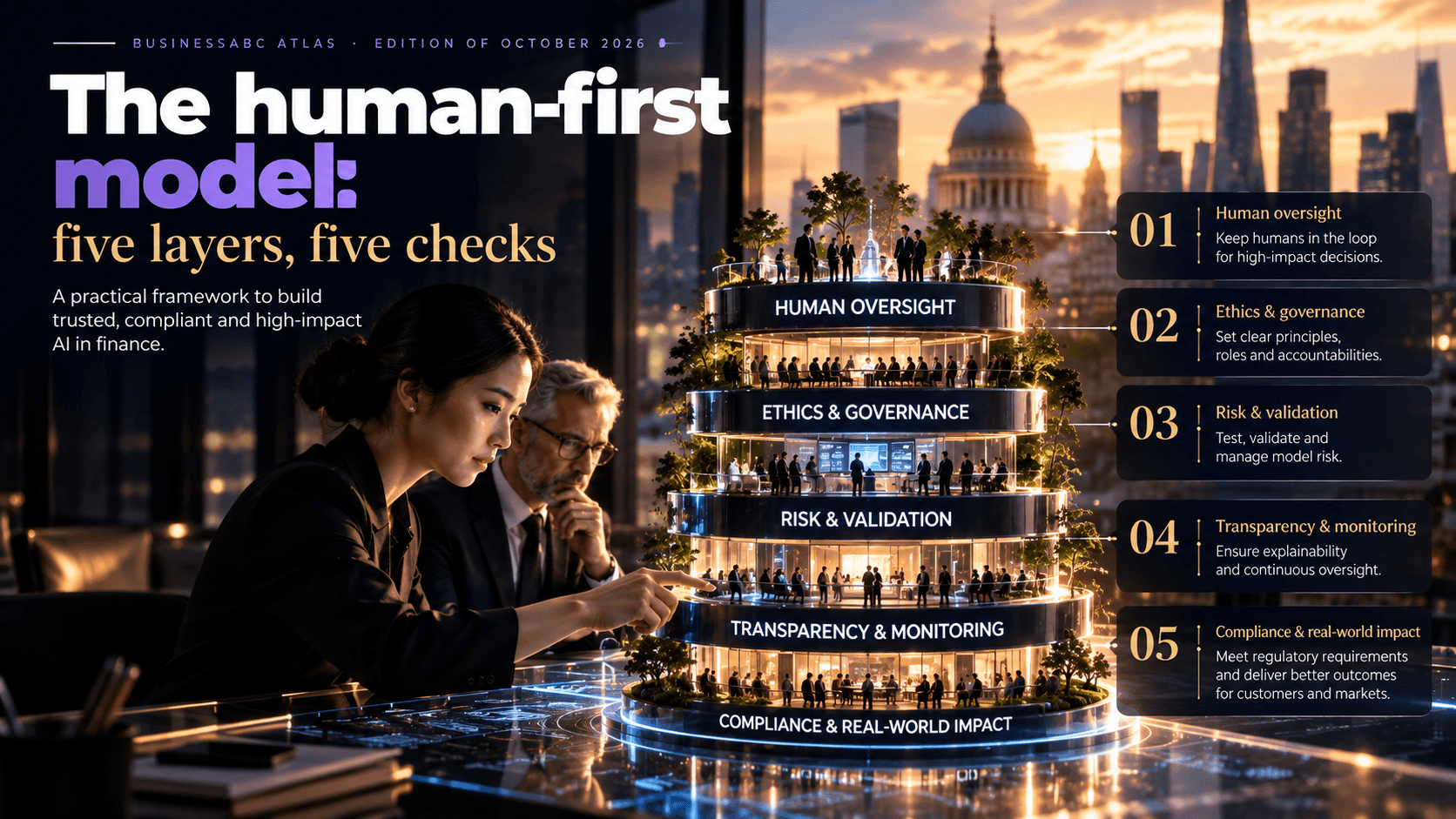
The answer to these pressures is not to remove humans from the loop, nor to put a human rubber stamp on every output. It is to place human judgement precisely where it matters. We use a five-layer model, each layer with its own human check.
- Ethics: decide what AI should and should not do. Without this layer, ethics stays in slides and no one can veto a use case. With it, a named reviewer has veto authority, clear escalation triggers and a duty to log the reasons for any refusal.
- Risk management: match oversight to what can actually go wrong. Without it, every output gets the same review and high-risk actions run at machine speed. With it, checkpoints are tiered by risk. Low-risk outputs run freely; high-risk actions pause for review, and the reviewer sees the context before the AI's answer, not after.
- Accountability: names, not systems, own the call. Without it, "the algorithm decided" replaces ownership, blame diffuses and approval records disappear. With it, one human signs off each high-risk decision, the name and rationale are logged, and that human can pause, stop or escalate.
- Transparency: explainability that holds up under pressure. Without it, a model card becomes the only explanation and reviewers defer to answers they cannot read. With it, a named human explains decisions in plain English. The test is blunt: if no one can explain it, do not deploy it.
- Compliance: make human approval part of the workflow. Without it, compliance lives in documents and deployments go ahead without signed approval. With it, approval is obtained and recorded before deployment and before every material update, with names, timestamps and reasons, and humans are re-engaged whenever regulations change or incidents occur.
The result is a system in which machines do what they do best (speed, scale, consistency) and humans do what only they can do: judge, explain and take responsibility.
The reality for smaller firms
The FCA regulates the conduct of around 35,500 firms. Most are not large banks. They are independent financial advisers, mortgage and insurance brokers, consumer credit firms, payment and e-money institutions, and small asset managers. Few of them build AI. Almost all of them use it, through software they already buy: customer relationship systems, call transcription, document processing, identity checks and chat.
For these firms the message is encouraging. You do not need a chief AI officer or a governance department. You need an inventory, a named owner, a short list of approved tools, a policy that staff have read, training records and a file of vendor due diligence. A well-run small firm can reach the Defined stage of maturity in a month and the Managed stage within a year.
Case study · Moffatt v Air Canada, 2024
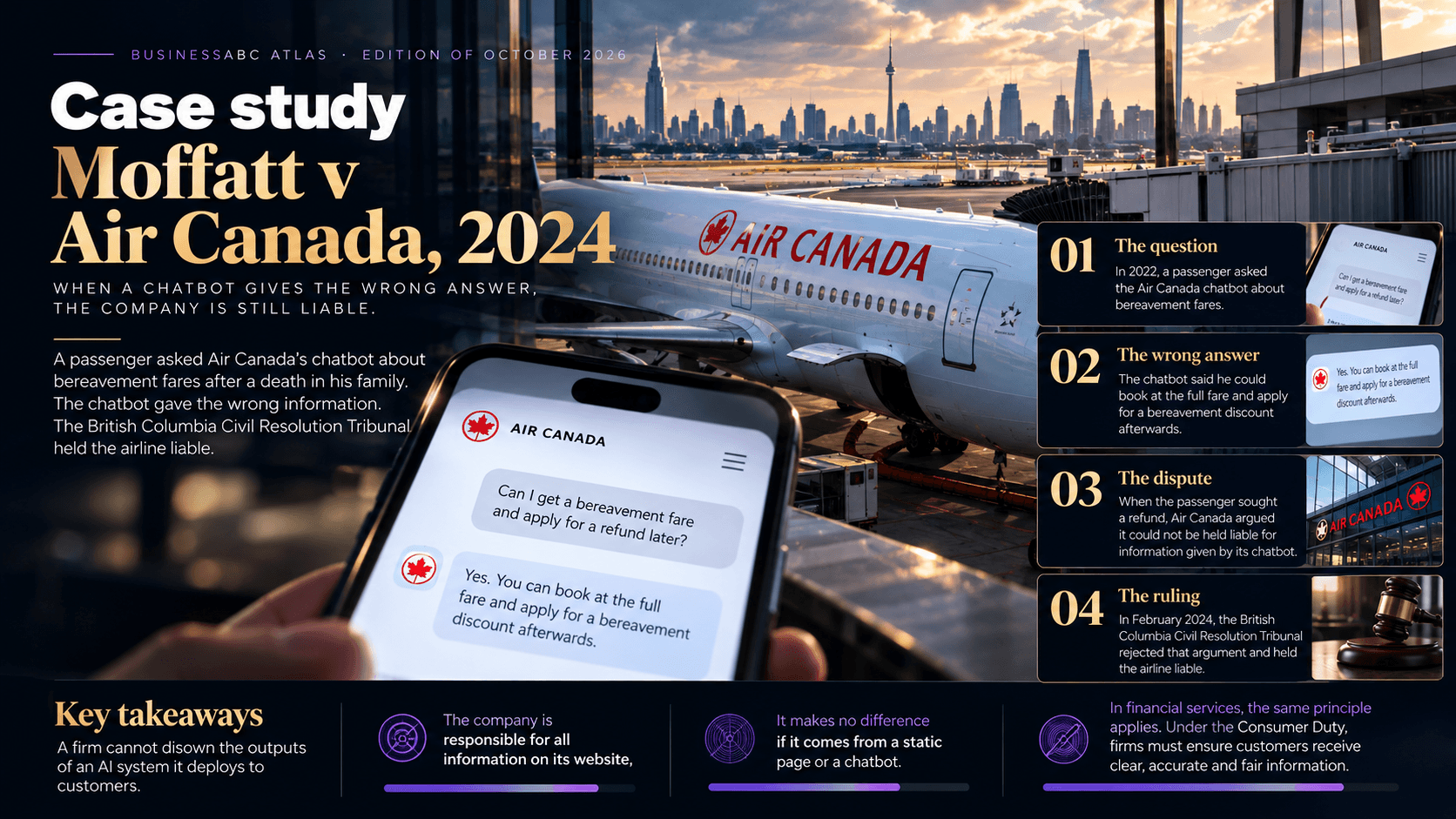
In 2022, a passenger asked Air Canada's website chatbot about bereavement fares after a death in his family. The chatbot suggested he could book at the full fare and apply for a bereavement discount afterwards. That was wrong: the airline's actual policy did not allow retrospective claims. When the passenger sought the refund, Air Canada argued, in part, that it could not be held liable for information given by its chatbot. In February 2024, British Columbia's Civil Resolution Tribunal rejected that argument and held the airline liable. The tribunal member's reasoning was blunt: Air Canada is "responsible for all the information on its website", and it makes no difference whether that information sits on a static page or comes from a chatbot.
The case involved a small sum and no financial regulator. Its importance lies in the principle. A firm cannot disown the outputs of an AI system it deploys to customers. In financial services, where the same chatbot might be explaining a mortgage, a pension or an insurance claim, that principle is already embedded in the Consumer Duty.
Toolkit · The Consumer Duty AI outcomes test
For each customer-facing AI system, answer four questions, one for each outcome:
- Products and services: Does the AI steer customers only towards products designed for their target market?
- Price and value: Could the AI's use produce prices or terms that are unfair to some groups of customers?
- Consumer understanding: Can customers understand what the AI tells them, and do they know they are dealing with AI?
- Consumer support: Can customers easily reach a human, challenge an AI outcome and get it corrected?
Record the answers in the system passport, and revisit them whenever the system changes.
Board questions
- Which senior manager owns our AI risk, and is it written into their Statement of Responsibilities?
- Which AI systems affect customer outcomes under the Consumer Duty?
- Do we know which of our vendors embed AI in the tools we already pay for?
- How do we detect AI-enabled fraud against our customers?
- Could a vulnerable customer receive a worse outcome because of a model?
Foundation: The AI ID Passport Flywheel
Know thyself.
— Inscription at the Temple of Apollo, Delphi
The passport is one of humanity's oldest trust technologies. Long before photographs or biometric chips, rulers issued letters of safe conduct that let a stranger cross a border because an authority vouched for who they were and what they were permitted to do. The idea is simple and powerful: a document travels with the bearer, records their identity and permissions, and is stamped at every checkpoint.
So what does a passport look like inside an organisation that works with AI? We argue that two are needed: one for every person who uses AI, and one for every AI system the organisation runs. Together they form the foundation of the governance model at the heart of this series, the AI ID Passport flywheel.
Why governance fails as a binder
Most governance programmes begin with a document. A policy is drafted, a committee approves it, and it is filed. Six months later a new AI tool arrives through a vendor update, a team adopts a chatbot to save time, and an agent is given access to a client system. The policy says nothing useful about any of them, because it was written for a world that has already moved on.
Governance that lives in a binder decays. Every new system adds work, the backlog grows faster than the governance team can clear it, and eventually the business routes around it.
The alternative is governance that compounds. A flywheel is a heavy wheel that is hard to start but, once turning, stores energy and becomes easier to keep moving. Applied to AI governance, each cycle of identifying, assessing, governing, documenting, monitoring and improving leaves the organisation better equipped for the next. Each turn adds literacy, identity and evidence, and makes the next turn cheaper.
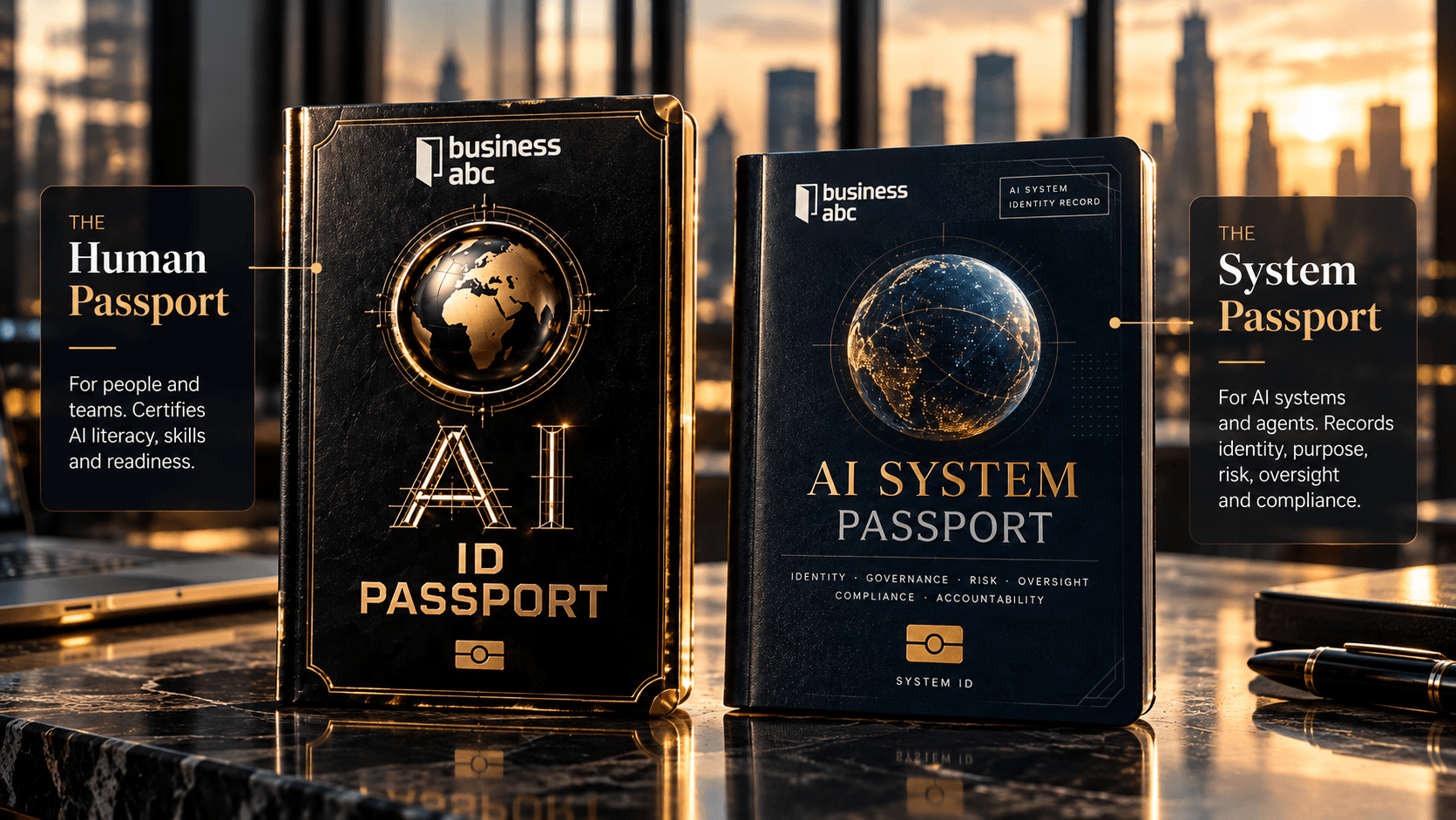
The two passports
The human passport.
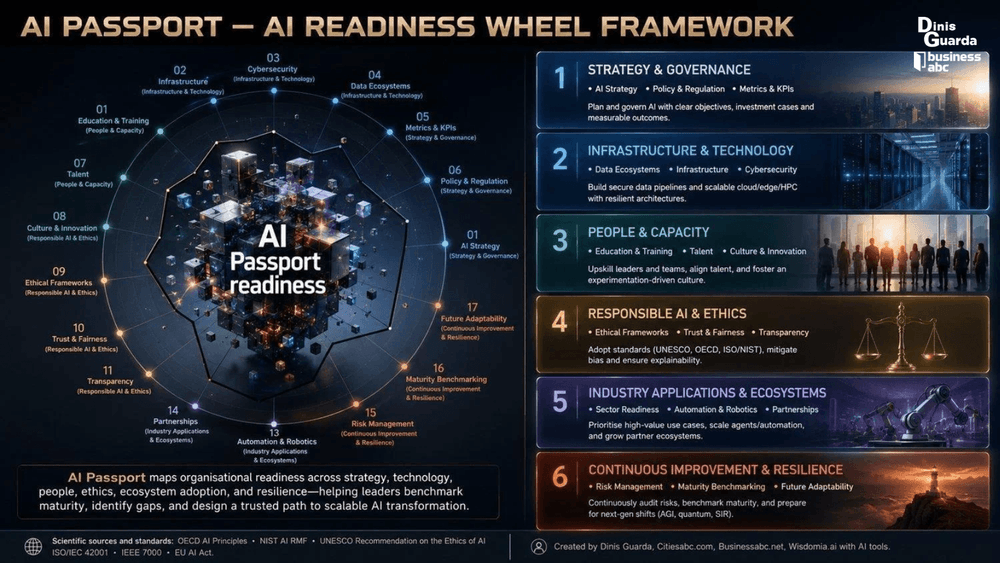
The AI ID Passport Certification Programme, created by Dinis Guarda with Businessabc and Ztudium Group, is a blockchain-verified, gamified AI literacy credential. It assesses people across a ten-domain AI Readiness Wheel, awards one of five flight-class certification tiers from Economy to First Class, and weights its assessment on a 40/30/20/10 model. A verified credential tells an employer, a client or a regulator what a person understands about AI, and at what level, in a form that cannot be quietly altered.
In a financial firm, the human passport answers questions supervisors increasingly ask. Does the senior manager accountable for an AI system understand it well enough to oversee it? Have the staff who use AI tools been trained to use them safely? Is training matched to the risk of the systems people actually touch? A front-office adviser using an AI drafting tool and a model risk officer validating a credit model need different levels of literacy, and the tier structure makes that difference explicit.
The AI Agent ID passport.
Every AI system and every agent should carry an identity record. At a minimum it holds twelve fields: name and version; purpose; accountable owner; vendor or builder; data inputs; risk tier; approval status and approver; human oversight; monitoring arrangements; incident history; jurisdictions of operation; and review date.
This is, in substance, the inventory every regulator now asks for. Writing it as an identity document rather than a row in a spreadsheet changes how people treat it. A passport is something a system must hold before it can cross into production, and must present again whenever it changes. The idea has regulatory precedent: the Bank of England's model risk principles for banks, SS1/23, start with a formal model definition and a comprehensive model inventory.
The six turns of the flywheel
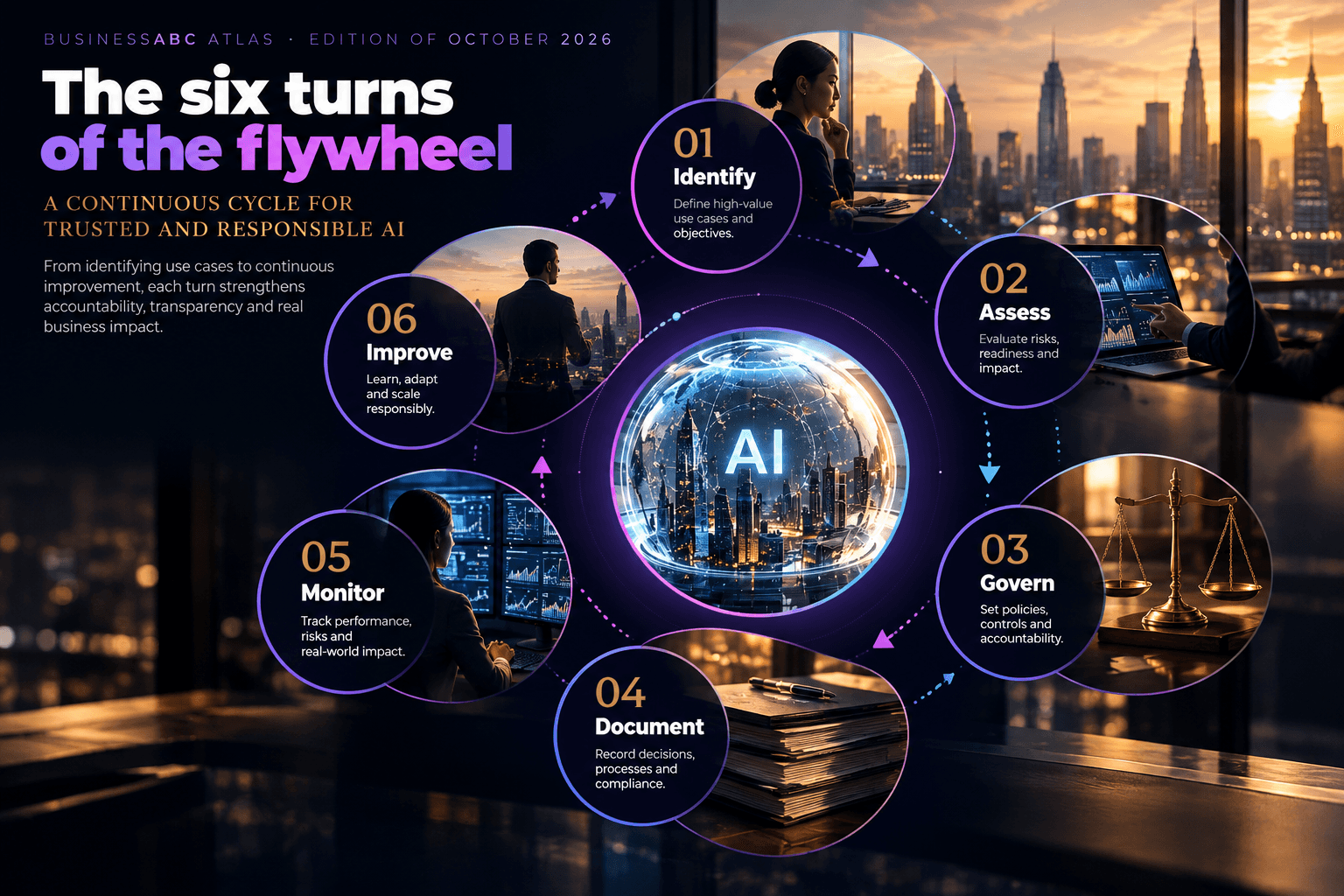
The flywheel follows the governance and compliance lifecycle in six stages. Each stage produces evidence, and that evidence becomes the starting point for the next.
- Identify. Register people and systems. For people, record role and literacy level. For systems, record purpose, owner, vendor and the business process supported. The goal is visibility: no AI in use that the firm does not know about.
- Assess. Score each system for risk and each role for the competence it requires. A system that drafts internal meeting notes is low risk. One that recommends investment products to retail clients, or assesses creditworthiness, is high risk under both UK conduct rules and the EU AI Act. The assessment decides how much control each system needs and how much training each user needs.
- Govern. Assign decision rights. Name the senior manager accountable for each high-risk system, set approval gates proportionate to risk, and define who may change a system's permissions and who may switch it off.
- Document. Keep the system passport as the single record of evidence. For high-risk systems under the EU AI Act, that means the technical documentation set out in Annex IV. For all systems, it means a record of what was approved, by whom, and on what basis.
- Monitor. Log use, performance, drift, incidents and vendor changes against the passport. A model that performed well at launch may degrade as data changes, and a vendor may update its model without notice. Monitoring is how the firm finds out before its customers do.
- Improve. Feed what monitoring reveals back into policy and training. When an incident occurs, update the passport, adjust the controls and retrain the people involved. As more staff reach higher literacy tiers, the firm can safely take on more ambitious uses of AI.
The flywheel effect follows. The more people are certified, the safer each new deployment becomes. The safer each deployment, the faster the business can adopt AI. The faster adoption proceeds under control, the more evidence the firm accumulates for its supervisor. Governance stops being a brake and becomes the mechanism that lets the organisation accelerate.
Literacy is now a legal duty
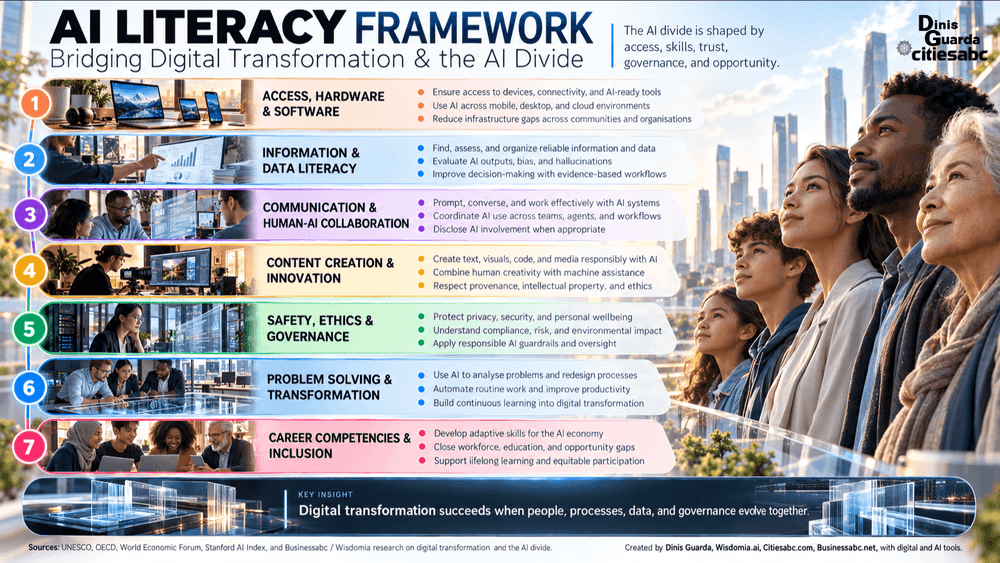
Until recently, AI training was a matter of good practice. It is now a legal requirement in the European Union and a practical requirement almost everywhere else.
Article 4 of the EU AI Act has applied since 2 February 2025. It requires providers and deployers of AI systems to take measures to support AI literacy among their staff and others operating AI systems on their behalf. The Digital Omnibus on AI (Regulation (EU) 2026/1744) has since replaced the article's wording, but the duty itself remains. It is outcome-based: it does not prescribe a single curriculum, certificate or training provider, and it carries no standalone fine. That makes evidence, rather than a certificate on its own, the thing that counts.
The Dutch data protection authority, the Autoriteit Persoonsgegevens, has published a four-step approach: identify, set goals, implement and evaluate. It begins, tellingly, with an inventory, because you cannot train people for systems you do not know you have. The authority's guidance is equally clear that AI literacy is "not an end goal, but a continuous process".
In the United Kingdom, the Senior Managers and Certification Regime requires each senior manager to take reasonable steps to prevent regulatory breaches in their area. The FCA's Mills Review, launched in January 2026 and published on 6 July 2026, examines how AI could reshape retail financial services by 2030 and what that means for firms and their regulator. A manager who cannot explain how an AI system in their area works will find it hard to show they took reasonable steps to control it. The human passport is the evidence that they can.
Agents need passports too
The most important development in AI since 2024 is the rise of agents: systems that do not simply answer questions but take actions, often by calling other systems and other agents. An agent may read an email, look up a client record, draft a reply, check it against a policy and send it, all without a human touching it.
In an agent economy, identity becomes the control point. A firm must be able to say which agent acted, on whose authority, within which limits, and with what result. The Mills Review itself describes retail financial services moving from human-led activity towards services that are AI-enabled, continuous and delegated. The system passport is the natural place to record an agent's identity, its permissions, its spending and action limits, and the human who may revoke them.
The principle is the one that governed the letter of safe conduct: no one crosses the border without papers, and the papers say exactly what the bearer may do.
Case study · The literacy inventory
When the Dutch data protection authority published guidance on meeting the AI Act's literacy duty, it did not begin with a training curriculum. Its first phase is an inventory of the AI systems an organisation uses and the people who use them. A regulator, in other words, independently arrived at the first turn of the flywheel. Its guide also tells leaders to "make someone in the organisation responsible" for progress on AI literacy, which is the accountable owner of the system passport by another name. Literacy without an inventory is generic. Literacy built on an inventory is targeted, measurable and defensible.
Toolkit · The AI System Passport
Field | What to record |
| Name and version | The system and the exact model version in use |
| Purpose | The business process and decision it supports |
| Accountable owner | The named senior manager |
| Builder or vendor | Internal team or supplier, with contract reference |
| Data inputs | Data sources, including any personal data |
| Risk tier | Internal tier and, where relevant, EU AI Act category |
| Approval | Approver, date and conditions |
| Human oversight | Where and how a human reviews or can intervene |
| Monitoring | Metrics, thresholds and review frequency |
| Incidents | Log of incidents and actions taken |
| Jurisdictions | Where the system is used and which rules apply |
| Review date | Next scheduled review |
Board questions
- What share of our staff who use AI hold a verified literacy credential?
- Does every AI system and agent have an identity record with a named owner?
- Could we show a supervisor who approved each agent's permissions, and who can revoke them?
- Is our training matched to the risk tier of the systems people use?
- What evidence would we hand over tomorrow if asked?
Sources
EU AI Act, Article 4 and AI literacy
- Presencis, "What is the AI literacy requirement?" (Article 4 application date, Digital Omnibus replacement, no standalone fine): https://presencis.com/questions/what-is-ai-literacy-requirement/
- CASRAI, "AI Literacy" (outcome-based duty, no mandated curriculum): https://casrai.org/ai-regulation/ai-literacy
- Burges Salmon, "AI literacy on the agenda: EU, UK and US": https://www.burges-salmon.com/articles/102jhol/ai-literacy-on-the-agenda-eu-uk-and-us
Dutch data protection authority (Autoriteit Persoonsgegevens)
- AP, "Building AI literacy" (second guide, PDF): https://ppc.land/content/files/2025/10/Building-AI-literacy.pdf
- PPC Land, "Dutch authority publishes AI literacy implementation guide": https://ppc.land/dutch-authority-publishes-ai-literacy-implementation-guide/
- Dutch Digital Government, "AI literacy: AP urges organisations to act now": https://www.nldigitalgovernment.nl/?p=4962
- Slaughter and May, "First provisions of EU AI Act now apply: what you need to know about AI literacy" (quotes the AP's "continuous process" line): https://thelens.slaughterandmay.com/post/102jz3z/first-provisions-of-eu-ai-act-now-apply-what-you-need-to-know-about-ai-literacy
UK regulators and Parliament
- FCA, "AI and the future of retail financial services (The Mills Review)": https://www.fca.org.uk/publications/corporate-documents/mills-review
- FCA, "Mills Review to consider how AI will reshape retail financial services" (launch, 27 January 2026): https://www.fca.org.uk/news/press-releases/mills-review-consider-how-ai-will-reshape-retail-financial-services
- FCA, "FCA publishes landmark review into impact of AI on retail financial services" (Sheldon Mills quote, 6 July 2026): https://www.fca.org.uk/news/press-releases/fca-publishes-landmark-review-impact-ai-retail-financial-services
- House of Commons Treasury Committee, "Artificial intelligence in financial services" (15th Report, January 2026): https://api.parliament.uk/committees/publications/51128
- Mortgage Solutions, "Regulators and govt are 'not doing enough' to manage AI risks in financial services, Treasury Select Committee warns" (Dame Meg Hillier quote, 20 January 2026): https://www.mortgagesolutions.co.uk/mortgage-news/2026/01/20/regulators-and-govt-are-not-doing-enough-to-manage-ai-risks-in-financial-services-treasury-select-committee-warns/
- HFW, "AI in financial services: Treasury Committee criticises regulators for 'wait-and-see approach'": https://www.hfw.com/insights/ai-in-financial-services-treasury-committee-criticises-regulators-for-wait-and-see-approach/
- Bank of England and FCA, "Artificial intelligence in UK financial services – 2024": https://www.bankofengland.co.uk/report/2024/artificial-intelligence-in-uk-financial-services-2024
- Burges Salmon, on the 2024 survey's third-party concentration figures (73% cloud, 44% model providers): https://www.burges-salmon.com/articles/102jpbu/ai-hot-off-the-press-from-the-bank-of-england-and-fca-how-is-it-being-used-ac
- Bank of England PRA, "SS1/23 – Model risk management principles for banks": https://www.bankofengland.co.uk/prudential-regulation/publication/2023/may/model-risk-management-principles-for-banks-ss
US model risk guidance
- Federal Reserve, SR 11-7 "Guidance on Model Risk Management" (2011): https://www.federalreserve.gov/supervisionreg/srletters/sr1107.htm
- Federal Reserve, SR 26-2 "Revised Guidance on Model Risk Management" (supersedes SR 11-7): https://www.federalreserve.gov/supervisionreg/srletters/sr2602.htm
Case law
- Moffatt v. Air Canada, 2024 BCCRT 149 (Civil Resolution Tribunal decision): https://decisions.civilresolutionbc.ca/crt/crtd/en/525448/1/document.do
- Law360 Canada, "Court rejects Air Canada's 'remarkable' denial of liability regarding misinformation by its chatbot": https://www.law360.ca/ca/articles/1804075
Share

Dinis Guarda
Dinis Guarda is an author, entrepreneur, founder CEO of ztudium, Businessabc, citiesabc.com and Wisdomia.ai. Dinis is an AI leader, researcher and creator who has been building proprietary solutions based on technologies like digital twins, 3D, spatial computing, AR/VR/MR. Dinis is also an author of multiple books, including "4IR AI Blockchain Fintech IoT Reinventing a Nation" and others. Dinis has been collaborating with the likes of UN / UNITAR, UNESCO, European Space Agency, IBM, Siemens, Mastercard, and governments like USAID, and Malaysia Government to mention a few. He has been a guest lecturer at business schools such as Copenhagen Business School. Dinis is ranked as one of the most influential people and thought leaders in Thinkers360 / Rise Global’s The Artificial Intelligence Power 100, Top 10 Thought leaders in AI, smart cities, metaverse, blockchain, fintech.


