
Businesses
Why do we need an AI ID Passport?
08 Oct 2026

Why did I create an AI-Certified Gamification Course Built on the AI Readiness Wheel?
World’s First · Blockchain-Verified · Gamified · Universally Scalable Businessabc.net · Citiesabc.com · Wisdomia.ai · IntelligentHQ.com
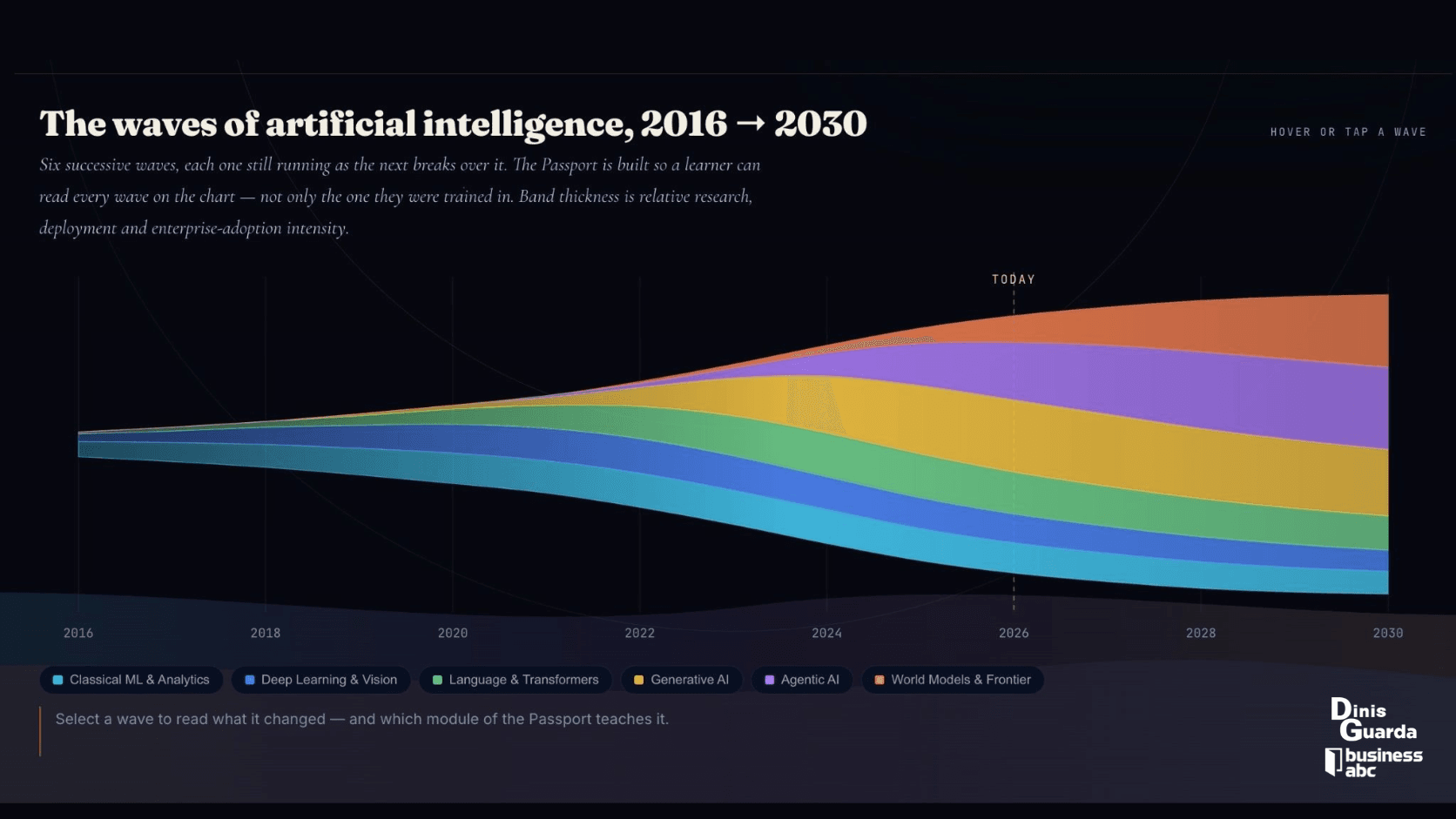
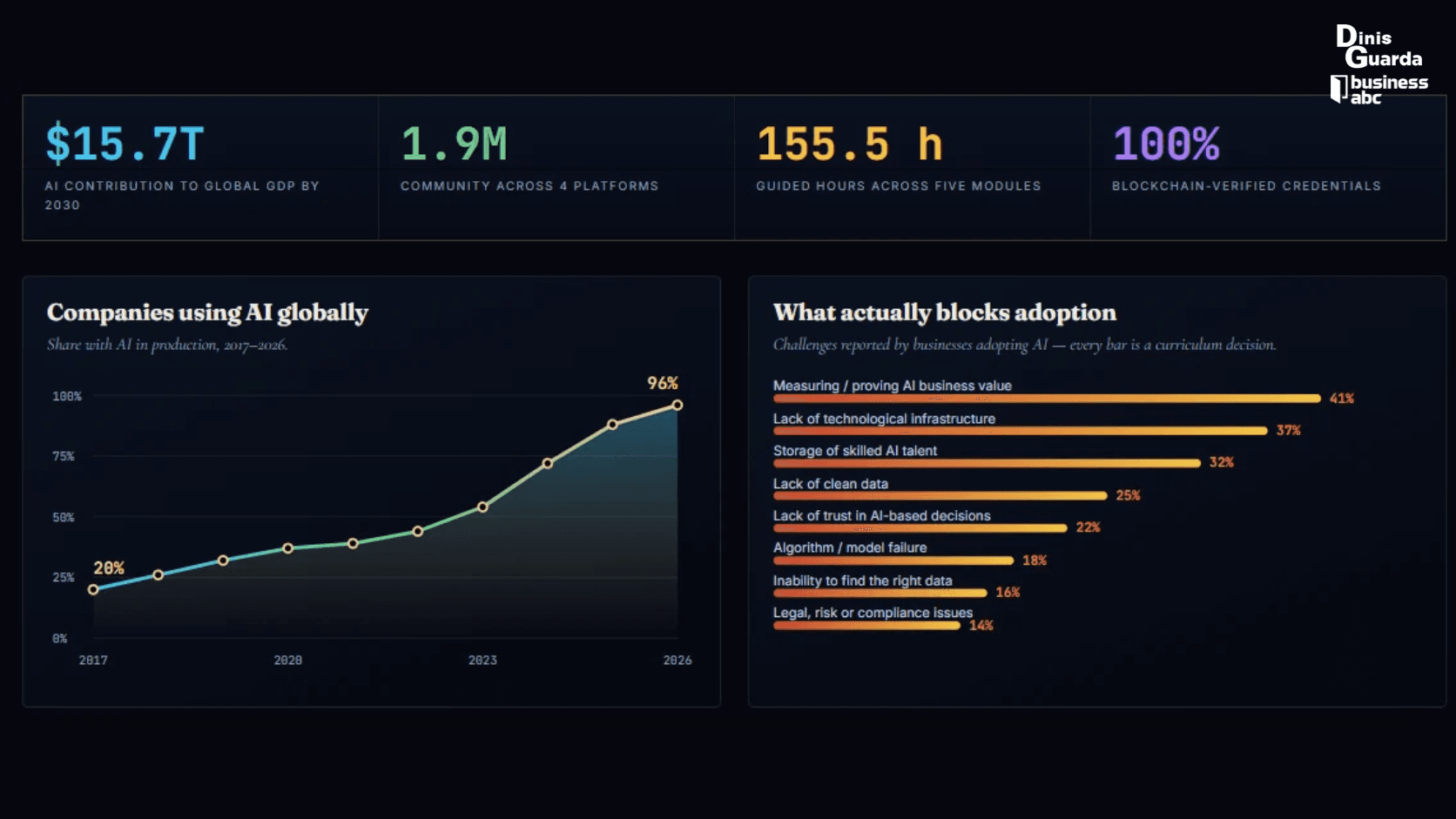
As we dive deeper into the world of AI, the need for an AI ID Passport is becoming increasingly clear. Why? Because corporate AI adoption has surged from 20% in 2017 to 96% in 2026. In the same window, 41% of businesses still cannot demonstrate the value of their purchases, and more than 70% of professionals lack a foundational understanding of AI. Ninety-seven million AI-adjacent roles are emerging against a catastrophically insufficient verified supply. The scarcity has moved: from tools to verified human capability.
Every serious institution on earth now offers an artificial intelligence certificate. Many of them carry accreditation. Almost all of them share three defects that make the certificate worth considerably less than the course behind it.
The first is that the credential is siloed. It is recognised inside the institution that issued it and rarely beyond, and it certainly does not travel cleanly across jurisdictions. The second is that it is falsifiable, a PDF, a line on a CV, a logo, none of it checkable without picking up a telephone. The World Economic Forum’s Digital Trust Initiative has named this a structural trust deficit, and it is. The third is the most consequential: almost none of these programmes measure anything. They record attendance. They issue on completion. And they therefore cannot tell you, at the end, what the learner can actually do.
The AI ID Passport was built to correct all three, and it was built around a single governing principle that inverts how certification normally works: certification follows demonstrated readiness. Never seat time. Never payment.
That principle has consequences throughout the design, and this article is an account of them.
AI ID Passport™ -The instrument first, the curriculum second
Human rights and fundamental freedoms must be respected, protected and promoted throughout the life cycle of AI systems.
— UNESCO, Recommendation on the Ethics of Artificial Intelligence
Most courses are designed curriculum-first. Someone decides what should be taught, sequences it into modules, and then bolts an assessment onto the end to check whether any of it stuck. The assessment is downstream of teaching and is usually the weakest part of the whole structure.
The AI ID Passport was designed the other way round. The measuring instrument came first, and the curriculum was built to move the needle on it.
That instrument is the AI Readiness Wheel™, a proprietary, patent-pending framework organised around ten interconnected domains, expressed across seventeen individually assessed spokes. It is the intellectual heart of the programme, and the thing every module, lab, quiz and score in the system ultimately reports into.
The AI Readiness Wheel™ ten domains are:
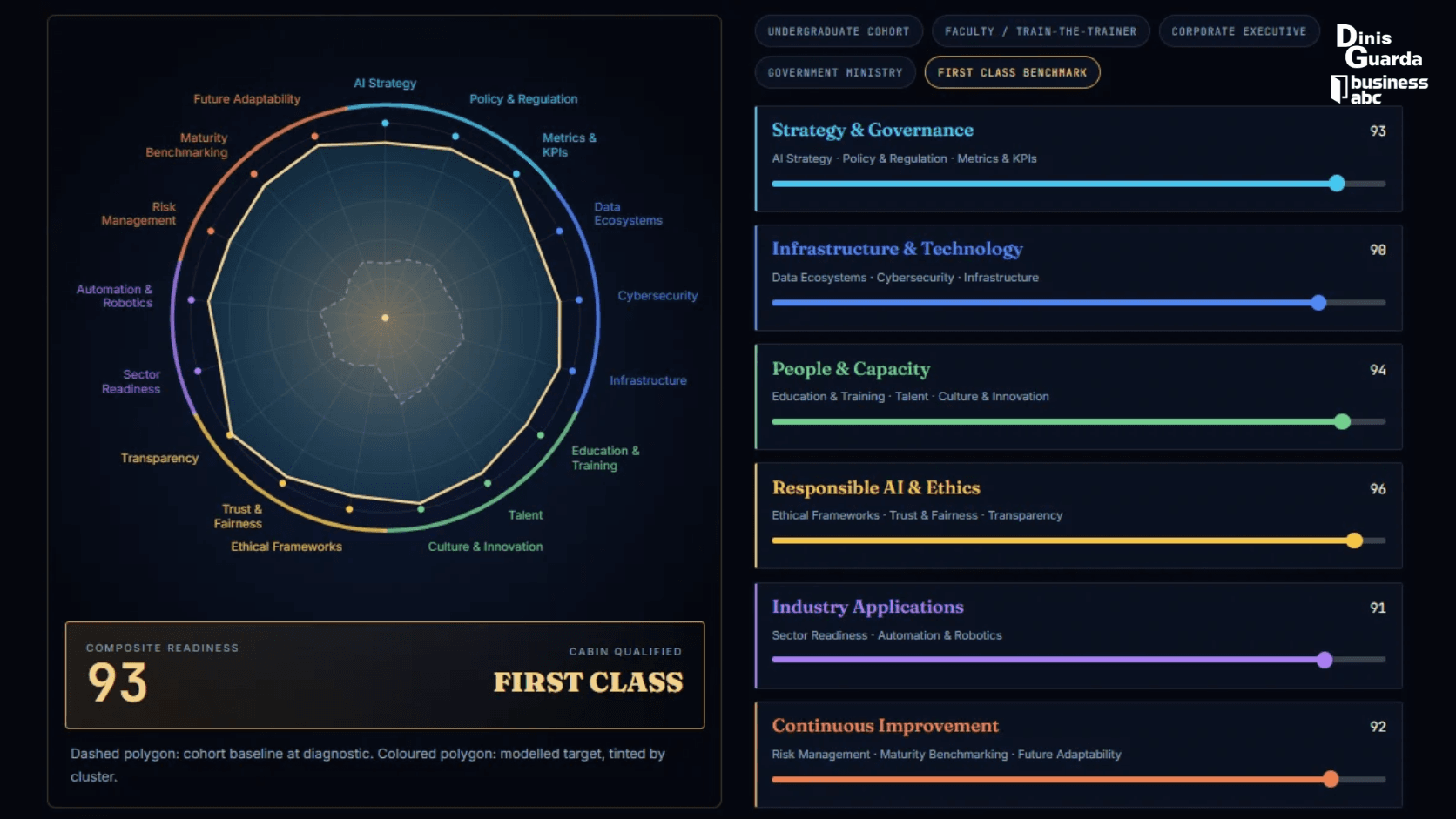
- Strategy and Governance: national and corporate AI strategy, governance structures, policy frameworks, metrics and KPIs.
- Infrastructure and Technology: cloud, edge and sovereign architecture, data ecosystems, high-performance compute, integration readiness, cybersecurity architecture.
- People and Capacity: human capital development, skill-gap analysis, workforce transformation, talent, culture of innovation.
- Responsible AI and Ethics: the UNESCO, OECD, IEEE 7000 and ISO/IEC 42001 frameworks, bias detection and mitigation, fairness by design, explainability.
- AI and Sustainability: environmental impact of AI systems, data-centre energy efficiency, the carbon footprint of large models, ESG reporting, green compute.
- AI Risks and Resilience: data ownership, cybersecurity, deepfakes, privacy, NIST AI Risk Management Framework application, incident response, business continuity.
- Industry Applications and Ecosystems: sector-specific deployment across health, finance, agriculture, manufacturing, education, government and the creative industries, including agentic AI.
- AI Trends and Society: generative AI, AGI preparedness, quantum-AI convergence, the Fifth Industrial Revolution, geopolitical dimensions.
- Regulation and Compliance: EU AI Act risk categorisation, GDPR alignment, national AI laws, legal liability in autonomous systems.
- Continuous Improvement and Resilience: maturity benchmarking, performance monitoring, adaptive learning, AGI-era transition readiness.
Read that list and notice what it is not. It is not a technical syllabus with an ethics chapter appended. Strategy, people, sustainability, risk, regulation and continuous improvement occupy six of the ten domains. The framework takes the position that AI readiness is an organisational property as much as an individual one, and that someone who can fine-tune a model but cannot classify its regulatory risk, cost its carbon footprint or explain it to a board is not, in any useful sense, ready.
Every learner is scored 360 degrees across the Wheel and rendered as a live radar chart, baseline against target, benchmarked against their cohort. The diagnostic is administered free at the very start and re-administered at the close of each subsequent stage, so progression is evidenced rather than asserted. That single design decision is what separates a readiness instrument from an attendance register, and it is why the programme can report movement rather than completion.
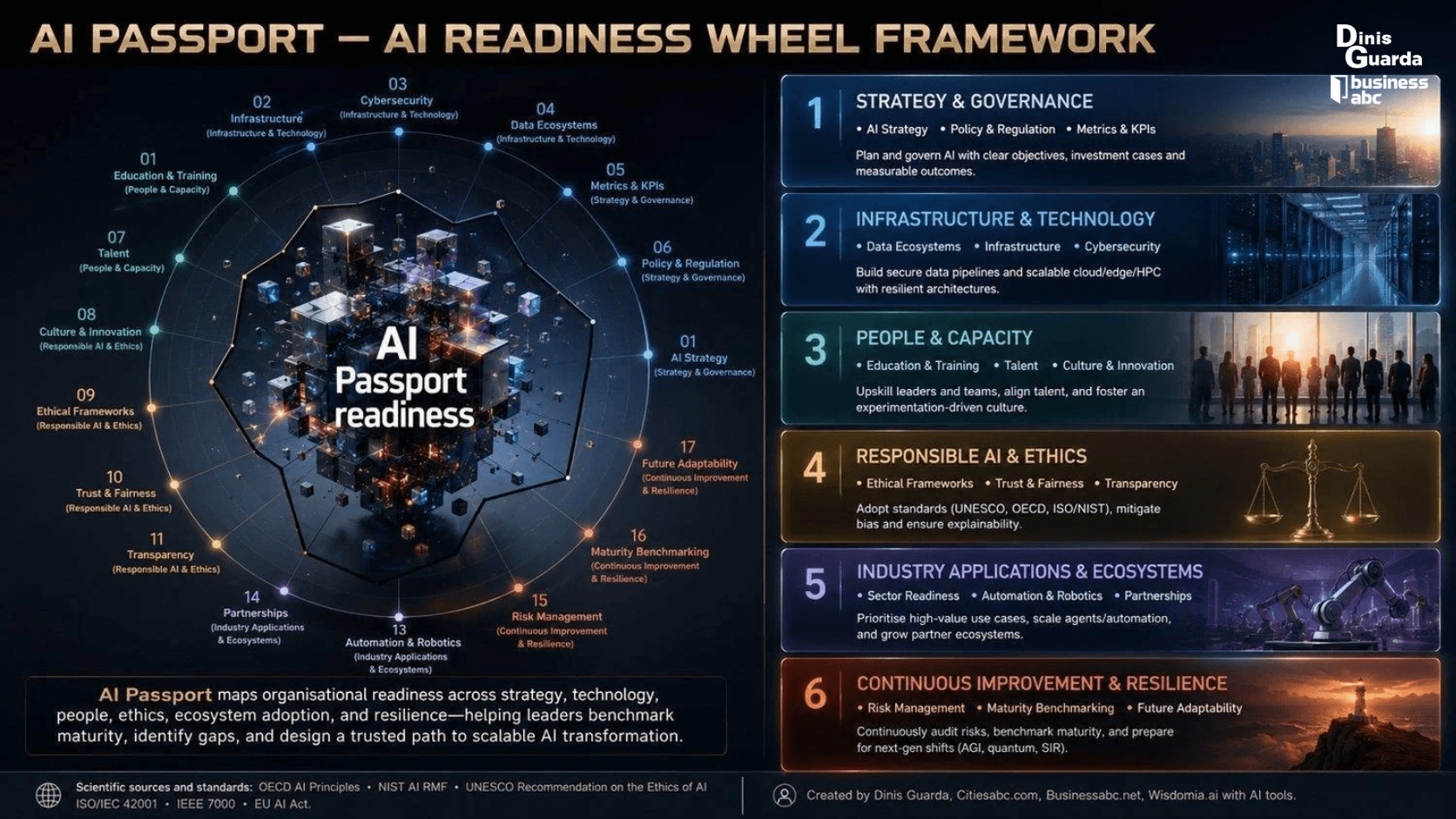
The Wheel is reinforced by a seven-dimension readiness scorecard, data foundations, technical infrastructure, organisational culture, leadership support, strategy and planning, ethical and social considerations, and talent and skills ecosystem, running to thirty-five evaluation criteria and benchmarked against the UNESCO AI Readiness Assessment Methodology. At the senior levels, learners do not study this scorecard. They administer it, in the field, to a real organisation.
Gamification is the assessment architecture, not the decoration
The word “gamification” has been devalued by a decade of badges sprinkled over otherwise unchanged e-learning. What it means in this programme is something more structural: the assessment architecture made visible and made motivating.
Three principles govern the design of the AI Readiness Wheel™.
- Mastery over performance. Points and tiers reflect genuine competency progression, not hours logged or fees paid. The system cannot be gamed, it can only be grown. This is enforced by governance and design: strict no-pay-to-pass rules, a published conflict-of-interest registry, and external moderation of capstone panels.
- Community over competition. Leaderboards celebrate cohort-level progress rather than ranking individuals against one another. Peer review amplifies collective intelligence. Mentorship is rewarded with its own recognition because the people who lift others produce value the system should be able to see.
- Infinite over finite. Drawing on James Carse’s distinction between finite and infinite games, the programme is structured so that no level is a terminus. Economy is not a consolation prize for failing to reach First Class; it is the first chapter of a First Class story. Every level unlocks possibilities rather than closing doors.
The pedagogical scaffolding beneath this is deliberate. Mihaly Csikszentmihalyi’s flow theory informs the calibration of challenge to capability at every rung, so that learners are neither bored nor overwhelmed. Joseph Campbell’s departure–initiation–return structure shapes the arc, which is why the senior capstones require a return, the learner brings something of value back to their own institution rather than simply passing an examination.
Play is the highest form of research.
— Albert Einstein
AI ID Passport™ - The flight: five cabins, one journey
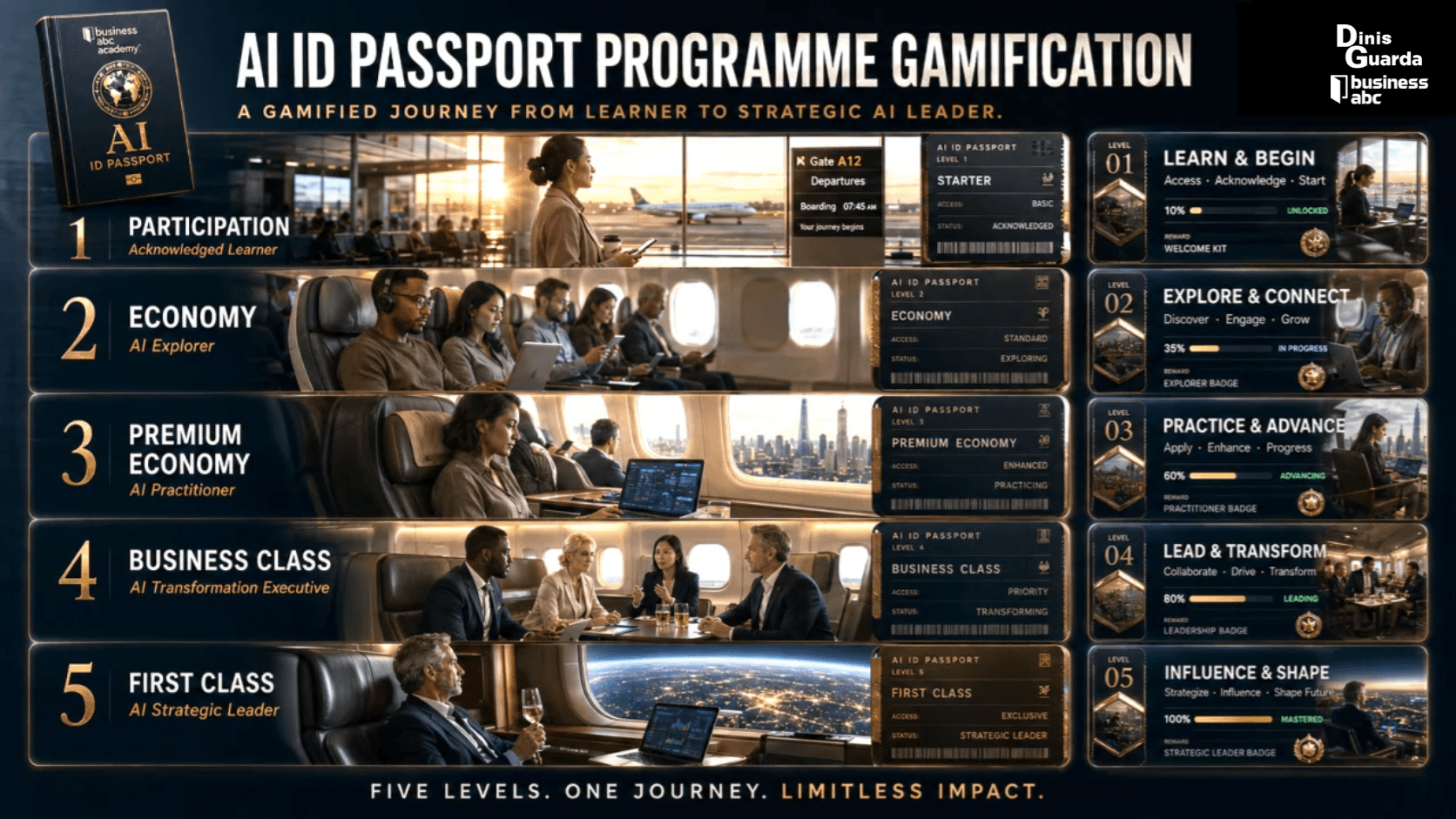
The programme is structured as a long transatlantic flight across five cabins. The metaphor is not ornamental. It encodes the central governance claim of the whole system: every learner boards, and every learner can fly First Class. There is no seat that money buys. There is only a score that competence earns.
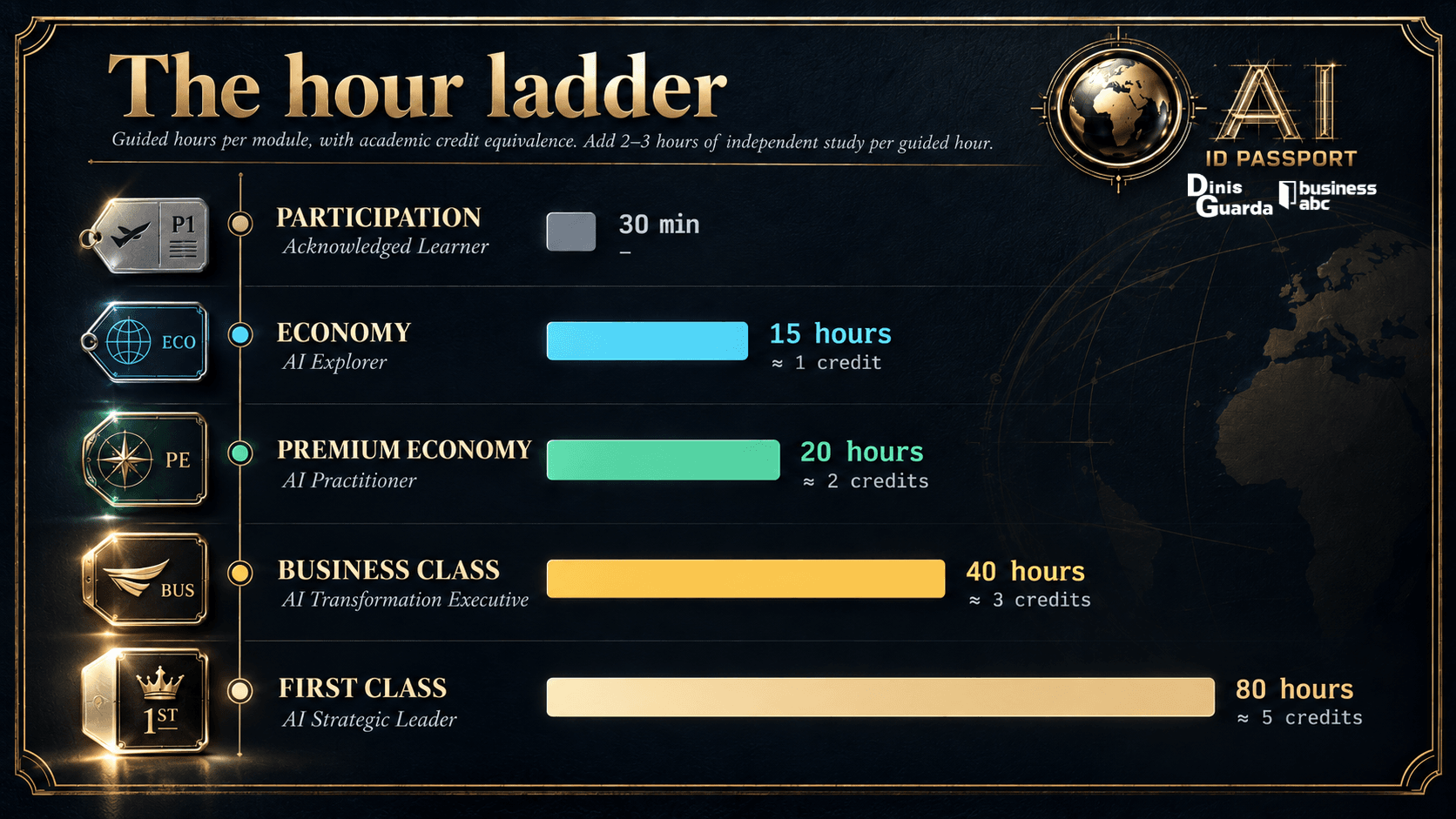
Level 01: Participation · Acknowledged Learner · 30 minutes · free.
Thirty minutes to convert a curious person into a registered, diagnosed, named learner holding a passport number and a measured map of their own gaps. This level exists because the single largest point of loss in AI education is the distance between intention and enrolment. Participation removes cost, commitment, and intimidation, and in exchange collects the one thing the system genuinely needs: a baseline. It is also the social-impact tier, offered at no charge to the Global South, K-12 teachers, and underserved and disability communities, with WCAG 2.1 AA accessibility throughout.
Level 02: Economy · AI Explorer · 15 hours · six weeks.
The level at which AI stops being magic and becomes infrastructure. Economy does not make a learner an engineer. It makes them AI-literate, AI-safe and AI-employable, able to use these systems daily with judgement, explain what they are doing to a non-technical colleague, recognise where the risk sits, and prove it. It runs from Turing to transformers through the collaborator mindset, prompt hygiene, grounding and hallucination detection, digital identity and verification, responsible AI and bias, and genuine regulatory literacy including comparative EU, US and UK frameworks. Approximately one academic credit.
Level 03: Premium Economy · AI Practitioner · 20 hours · eight weeks.
Where understanding becomes building. Machine learning in practice and the limits of accuracy; a generative AI build lab in which every learner ships a working custom application solving a real problem in their own workplace, with no prior coding experience required; a supervised sector sprint on an authentic case in business, education, healthcare, finance, cybersecurity, e-commerce or legal; a governance clinic producing a compliant dossier for the learner’s own use case; and AI risk management from data ownership through deepfakes to AI-driven cybercrime. Approximately two credits. This is the university cohort tier and the core institutional product.
Level 04: Business Class · AI Transformation Executive · 40 hours.
Here the learner moves from practitioner to the person accountable for an organisation’s AI transformation, and the unit of work changes: no longer a model or a use case, but a portfolio, a budget, a workforce and a board. Strategy and corporate governance; the readiness scorecard administered in the field; hyperautomation, agents and operating-model redesign; infrastructure and sovereign AI; the regulatory portfolio across jurisdictions; sustainability and social licence; a dedicated unit on leading people through transformation; and a transformation capstone defended to a panel. Delivered as a five-day face-to-face executive immersive with full virtual parity.
Level 05: First Class · AI Strategic Leader · 80 hours.
First Class is not a larger Business Class. It changes the object of the work from the organisation to the system: national and sector AI strategy, standards and international governance, frontier horizon including world models and AGI preparedness, AI and the future of work, responsible AI at system scale, ecosystems and AI economics, and an original published contribution, a national strategy, a policy instrument, a standards submission or substantive research. Designed for ministers, permanent secretaries, chief executives, university leadership and regulators.
One ladder, thirty minutes to eighty hours, 155.5 guided hours end to end. Progress is retained for twenty-four months, retakes are free, and the upgrade path is open at every rung.
The engine: stamps, badges, lumens
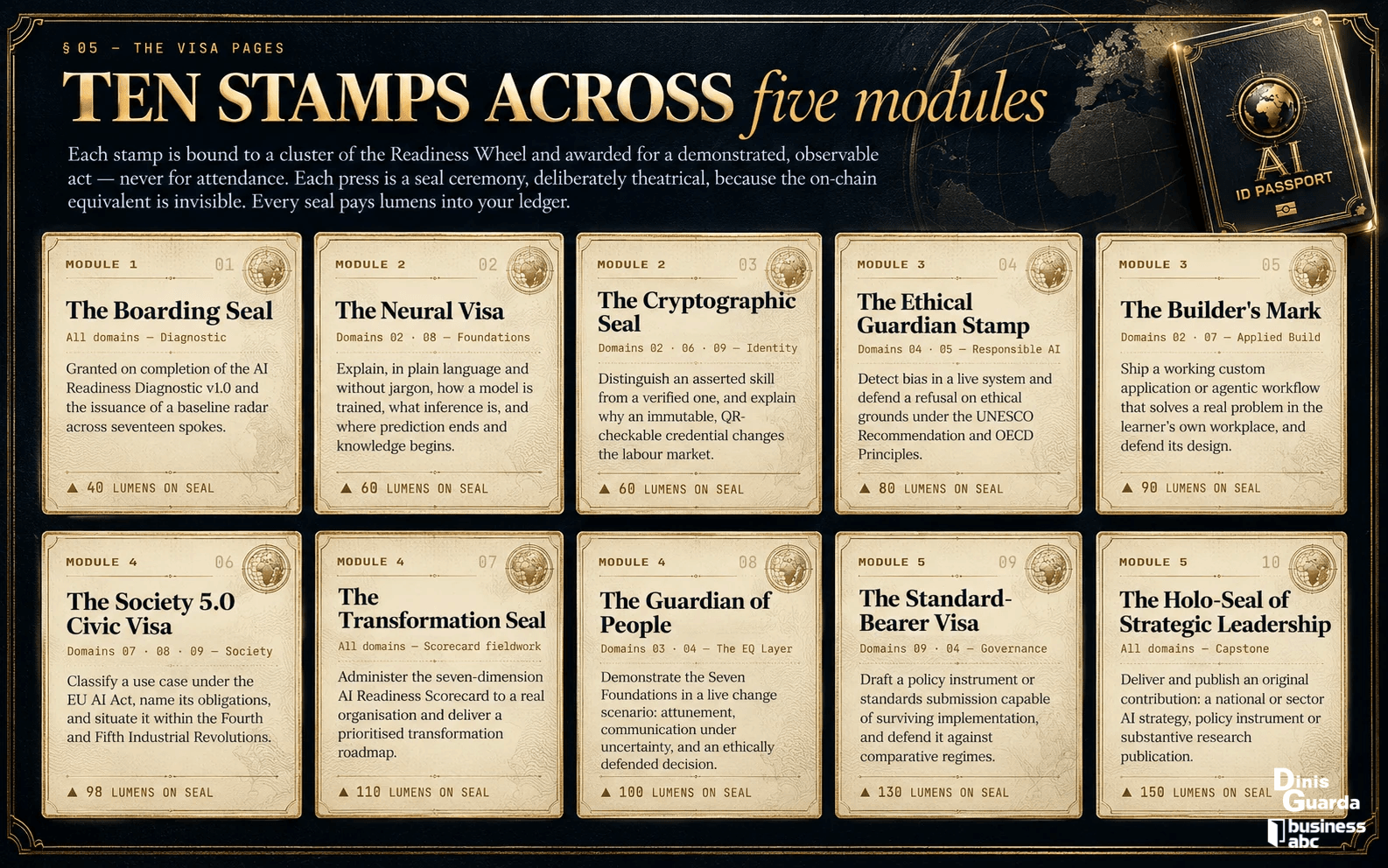
Four mechanics drive the learner forward, and each is tied to something observable.
Visa stamps. Ten across the five levels, each bound to a cluster of the Readiness Wheel and awarded for a demonstrated act rather than for attendance, explaining how a model is trained without jargon, detecting bias in a live system and defending an ethical refusal, shipping a working application, administering the scorecard to a real organisation, drafting a policy instrument that survives implementation. Stamps are sealed in the learner’s passport and written on chain at module close.
Badges. Ten Domain Mastery badges, awarded for scores of 70% or above in each Wheel domain, alongside recognition for practical application, peer excellence, community mentorship, rapid advancement, ethical guardianship, and social impact. Each is verifiable on-chain and displayable on LinkedIn, CV and ecosystem profiles.
Lumens. The programme’s engagement currency, earned for module completion, seals, assessment performance, peer reviews given and mentorship provided. Lumens determine leaderboard position and unlock cohort-level rewards. They do not and cannot purchase certification, a distinction the governance rules enforce absolutely.
Upgrade pathways. AI-powered recommendation of the next cabin based on the learner’s live radar, with progress carried forward and retakes free.
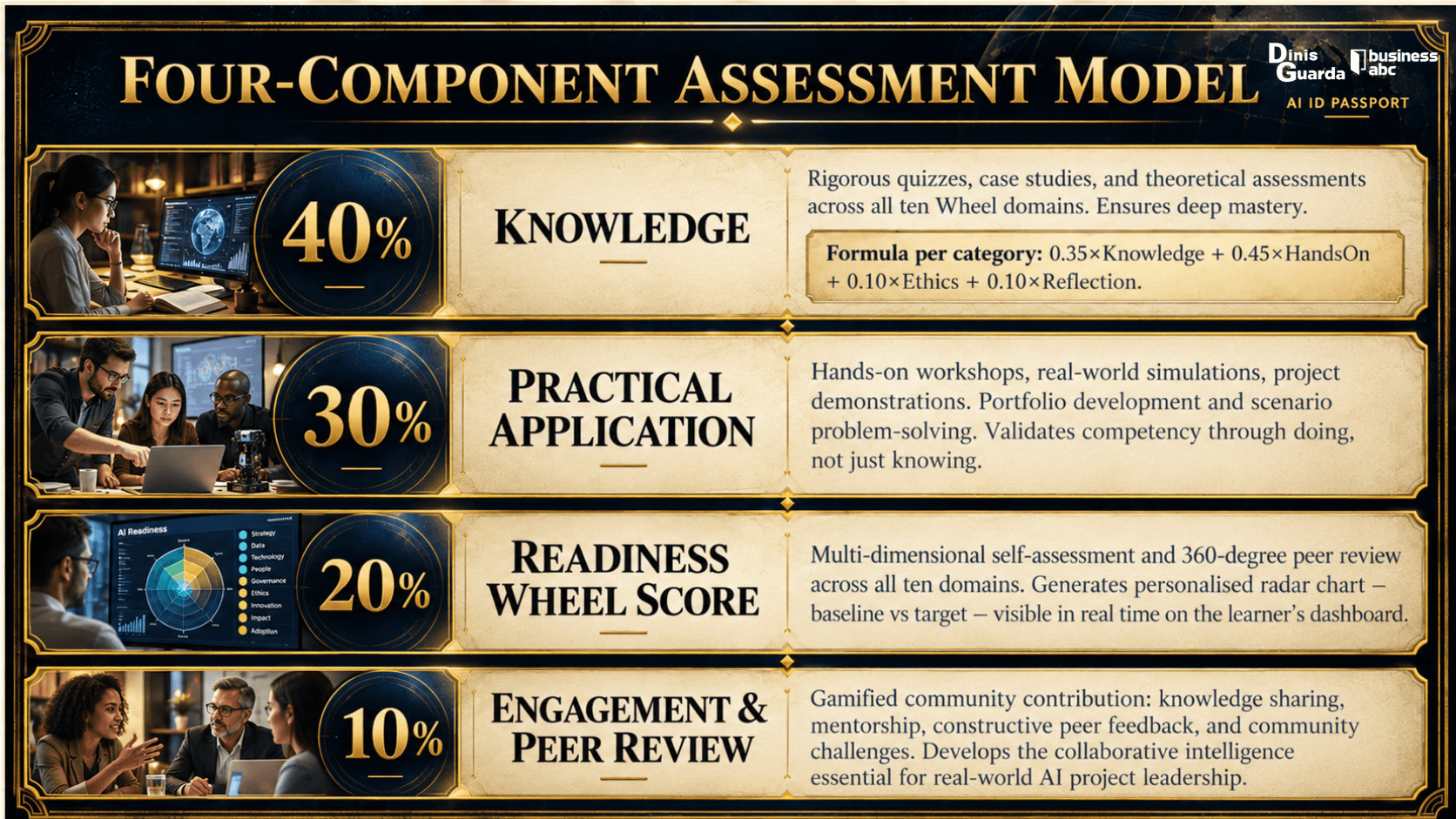
Underneath it all sits a four-component assessment model. Knowledge carries 40%, assessed through rigorous quizzes, case studies, and theoretical assessments across all 10 domains. Practical application carries 30%, assessed through workshops, simulations, portfolios, and project demonstrations. The Readiness Wheel score carries 20%, combining self-assessment with 360-degree peer review. Engagement and peer review account for the final 10 per cent, covering knowledge sharing, mentorship, and constructive feedback.
The weighting is the argument. Doing and being observed by peers together outweigh recall. Competence is validated through demonstration, which an attendance-based certificate cannot provide.
The AI critical layer nobody else teaches
Every serious institution teaches the technology. Almost none teach the human capability that determines whether the technology survives contact with a real organisation.
Look at what organisations themselves report as the obstacles to AI adoption. Measuring and proving business value leads at forty-one per cent. Lack of technological infrastructure follows at thirty-seven. A shortage of skilled talent at thirty-two. Lack of clean data at twenty-five. And a lack of trust in AI-based decisions at twenty-two per cent, with resistance to change and a lack of senior commitment recurring throughout the same data.
Read that as a practitioner. Only one of those obstacles is primarily technical. The rest are problems of people, measurement, judgement and confidence and they are where AI programmes actually die. Not in the pilot, which usually works, but in the long trough between the pilot and the value, where people decline to use the thing, or use it without trusting it, or quietly route around it.
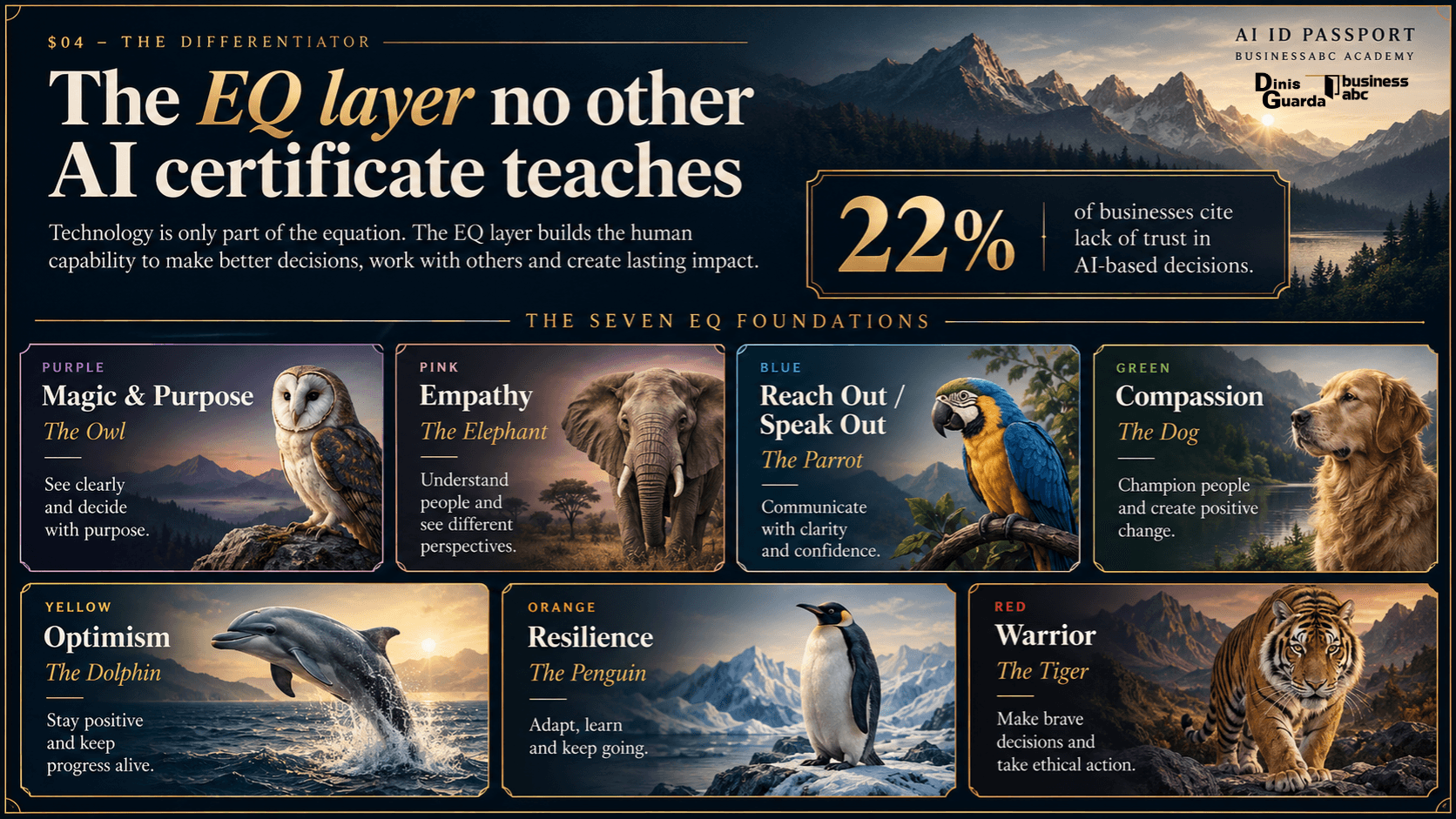
Drawing on EQ, IQ & AI, the programme embeds a seven-part emotional intelligence methodology through all five levels. Each band carries an emblem and a capacity: purpose and clarity in uncertainty; empathy and stakeholder attunement; communicating AI decisions to non-technical audiences and speaking up on risk; compassion in workforce transition and the ethics of displacement; the optimism required to sustain a programme through the trough; resilience through incident and failure; and the decisiveness to defend an ethical refusal against commercial momentum.
It appears as an introduction in Economy, as stakeholder discipline in the Premium Economy clinics, as a dedicated unit at Business Class on leading people through transformation, and at First Class as a full synthesis covering emotional intelligence in large language models, agents and the open questions surrounding artificial general intelligence.
I am aware this reads as soft next to transformer architectures and conformity assessments. The data says otherwise. The capabilities AI cannot replicate are exactly those that determine whether AI programmes succeed.
Amateurs practise until they get it right. Professionals practise until they cannot get it wrong.
— John Wooden
AI Verification: what the blockchain does and does not guarantee
Every AI ID Passport is blockchain-verified, wallet-interoperable, privacy-preserving and QR-checkable by any employer in any jurisdiction in seconds, carrying domain-level competency metadata rather than a single undifferentiated pass.
It is worth being precise about what this achieves, because the technology is routinely oversold. On-chain issuance guarantees integrity and independent verifiability, that the record has not been altered since issuance, and that it can be checked without contacting the issuer. It does not, and cannot, guarantee that the assessment behind it was rigorous.
That is why verification is paired with the scored model rather than offered in place of it. The chain makes the claim checkable; the 40/30/20/10 architecture and the no-pay-to-pass governance make the claim worth checking. Either without the other is theatre.
Dual faculty, and why it matters
Lectures are split between two kinds of teachers.
Academic professors carry the foundational theory, the mathematics and the method, the things that remain true when the tools change. Active industry executives and technology leaders carry deployment, MLOps, procurement, governance and monetisation, the things that are true this quarter and will need revisiting next.
Programmes taught only by academics produce graduates who understand AI and cannot ship it. Programmes taught only by practitioners produce graduates fluent in a toolchain that will be obsolete within eighteen months. The split is not a scheduling convenience; it is a hedge against both failure modes, and at Premium Economy and above, every lab is paired.
Cohorts are international by design, bringing together comparative regulatory frameworks, the EU AI Act set against United States and United Kingdom approaches, so that a graduate is literate in more than one jurisdiction. Mentorship matching pairs learners with higher-tier passport holders. Practitioner communities run across all four ecosystem platforms.
AI ID Passport™ - Academic credit and institutional delivery
For partner institutions, the programme maps cleanly onto standard credit frameworks. Fifteen guided hours over a month corresponds to approximately one credit. Fifty hours across a standard four-month semester, two credits. Seventy-five hours over six months, three. A full-year pathway at around 350 hours, five credits. The standard expectation of two to three hours of independent study per guided hour applies throughout.
Where delivered for credit, the component split follows academic convention: individual assignments at twenty-five per cent, midterm examination or case analysis at twenty per cent, team project with a business implementation plan at forty per cent, class participation and lab work at fifteen per cent, with integration into industry partner certification.
Institutions gain curriculum harmonisation with global standards, reduced administrative burden through automated credential management, research-grant alignment, including EU Horizon and Innovate UK, a train-the-trainer multiplier for faculty cohorts, and co-branded visibility across the ecosystem. Delivery runs online, face-to-face, and through a 3D immersive metaverse campus for learners without practical access to a physical institution.
AI ID Passport™ - The Institutional and Industry Evidence Foundation
The AI ID Passport™ is built around a growing international shift from simply adopting AI to measuring whether institutions and people are actually ready to use it responsibly and effectively.
UNESCO’s AI Readiness Assessment Methodology is now being implemented across more than 70 countries. Its assessment framework uses 195 qualitative and quantitative questions across five dimensions , legal, social and cultural, scientific and educational, economic, and technical and infrastructural, to identify strengths, capability gaps and areas requiring policy or institutional development.
The methodology is already informing real policy and capacity-building initiatives. In Colombia, the RAM process engaged more than 3,380 stakeholders, contributing to a policy implementation roadmap and informing the country’s evolving AI governance framework. In the Philippines, RAM-related follow-up training has reached more than 2,000 civil servants, connecting readiness assessment directly with institutional AI literacy and public-sector capability development.
The need for structured AI education is equally visible in the education sector. Microsoft’s 2026 research found that 92% of students and education leaders and 88% of educators had already used AI for school-related purposes. Yet 77% of students and 53% of educators had received no formal AI training, highlighting the widening gap between AI adoption and verified capability.
This is the gap the AI ID Passport™ is designed to address. Rather than treating course completion as evidence of readiness, the AI Readiness Wheel™ establishes a baseline, identifies capability gaps and enables progress to be reassessed over time.
The objective is therefore not simply to record that someone completed an AI programme, but to provide evidence of what they understand, what they can apply, where their weaknesses remain, and how their readiness develops over time.
AI ID Passport™ - Who this is for?
Company AI adoption has risen from twenty per cent in 2017 to ninety-six per cent in 2026, while forty-one per cent of businesses still cannot prove the business value of what they deployed, and more than seventy per cent of professionals lack foundational AI understanding. Ninety-seven million AI-adjacent roles are emerging, with a verified supply nowhere near enough to meet them.
For students and professionals, the Passport converts abstract knowledge into a verified, shareable credential that travels across borders and proves not only technical capability but data privacy understanding, bias awareness and responsible use, at a moment when seventy-eight per cent of Fortune 500 companies prioritise AI literacy for entry-level roles and the text CV can no longer carry that proof.
For universities, it offers an accreditation-ready curriculum, grant eligibility, a train-the-trainer multiplier, and a global credential pipeline, against the cost of inaction, now measurable in graduate employability and curriculum obsolescence.
For businesses, it eliminates guesswork in hiring, reduces onboarding friction, and mitigates the corporate risk posed by staff who do not know how to handle confidential data within AI systems.
For governments, it provides a scalable instrument for civil service capability with a measurable baseline, something most national AI strategies conspicuously lack.
In an age where technology evolves at unprecedented rates, you must not merely adopt AI, but lead your organisation through the transformation needed to realise its full potential.
Peter Diamandis’s abundance thesis holds that technology functions as a resource liberator precisely when it is distributed rather than hoarded. AI literacy is the live test of that proposition. Held by a few, AI concentrates advantage. Distributed across an institution and verified to be reliable, it becomes the largest expansion of human capability in a generation.
That is what this programme was built to do, and the Readiness Wheel is how we intend to prove it.
Five levels. One journey. Limitless impact.
The AI ID Passport is delivered by Businessabc Academy, the education arm of Ztudium Group and is distributed across Businessabc.net, Citiesabc.com, Wisdomia.ai, and IntelligentHQ.com to a community of 3.4 million. The programme is aligned to UNESCO, OECD, the EU AI Act, ISO/IEC 42001, IEEE 7000, NIST AI RMF, GDPR and WCAG 2.1 AA. Coordination: Marjorie Gutierrez with Dilip Pungliya, alongside a network of global AI business, technology and education experts.
Institutional enquiries:
- 30-minute scoping call → tailored pilot cohort proposal → MOU within 30 days.
- info@ztudium.com
Sources and further reading
- UNESCO, Recommendation on the Ethics of Artificial Intelligence (2021). Global framework for human-centred, ethical and responsible AI, covering human rights, transparency, fairness, accountability and human oversight.
UNESCO Recommendation on the Ethics of Artificial Intelligence - UNESCO, AI Competency Framework for Teachers (2024). Defines the knowledge, skills and values educators need to use and understand AI responsibly.
UNESCO AI Competency Framework for Teachers - UNESCO, AI Competency Framework for Students (2024). Organises AI literacy around a human-centred mindset, AI ethics, techniques and applications, and AI system design, with progression from understanding to application and creation.
UNESCO AI Competency Framework for Students - UNESCO, AI Readiness Assessment Methodology. Institutional and national readiness framework covering legal, social, educational, economic and technical dimensions. The article's AI Readiness Wheel explicitly positions itself against this wider readiness approach.
UNESCO AI Ethics and Governance publications and RAM resources - OECD, OECD AI Principles. Intergovernmental principles for trustworthy AI, covering human-centred values, transparency, robustness, safety and accountability. Adopted in 2019 and updated in 2024.
OECD AI Principles - OECD, Skills in the AI Age (2026). Policy research on how AI is changing labour-market requirements, skills development and workforce-transition policy.
OECD — Skills in the AI Age - European Union, Regulation (EU) 2024/1689 — Artificial Intelligence Act, Article 4. The central legal reference for AI-literacy responsibilities.
EU AI Act — Article 4: AI Literacy - ISO/IEC 42001:2023, Artificial Intelligence Management System. International management-system standard for establishing, implementing, maintaining and continuously improving responsible AI governance within organisations.
ISO/IEC 42001:2023 - NIST, Artificial Intelligence Risk Management Framework 1.0 (2023). Widely used framework for incorporating trustworthiness and risk management across the design, development, deployment and evaluation of AI systems.
NIST AI Risk Management Framework - IEEE 7000-2021, Standard Model Process for Addressing Ethical Concerns During System Design. Provides a process for incorporating human and social values into engineering and system-design decisions.
IEEE 7000-2021
Academic research on AI literacy and competency
- Long, D. & Magerko, B. (2020), “What Is AI Literacy? Competencies and Design Considerations,” CHI 2020. One of the foundational academic papers on AI literacy. It develops a framework of competencies people need to interact with and critically evaluate AI systems. DOI: 10.1145/3313831.3376727.
Read via ACM Digital Library - Ng, D. T. K., Leung, J. K. L., Chu, S. K. W. & Qiao, M. S. (2021), “Conceptualizing AI Literacy: An Exploratory Review,” Computers and Education: Artificial Intelligence, 2, 100041. Identifies four major dimensions of AI literacy: knowing and understanding AI, using and applying it, evaluating and creating with it, and addressing ethical issues. DOI: 10.1016/j.caeai.2021.100041.
Read the paper - Ng, D. T. K., Leung, J. K. L., Chu, K. W. S. & Qiao, M. S. (2021), “AI Literacy: Definition, Teaching, Evaluation and Ethical Issues.” Examines how AI literacy can be defined, taught and assessed, with particular attention to ethical understanding and competency evaluation. DOI: 10.1002/pra2.487.
Read via Wiley - Laupichler, M. C., Aster, A., Schirch, J. & Raupach, T. (2022), “Artificial Intelligence Literacy in Higher and Adult Education: A Scoping Literature Review,” Computers and Education: Artificial Intelligence, 3, 100101. Reviews 30 studies on AI literacy in higher and adult education and highlights the need for stronger training models and validated assessment instruments. DOI: 10.1016/j.caeai.2022.100101.
Read the paper
Workforce, education and business context
- Microsoft, AI in Education Report 2026. Reports that 92% of surveyed students and education leaders and 88% of educators had used AI for school-related purposes, while 77% of students and 53% of educators reported receiving no formal AI training. This supports the argument about the gap between adoption and structured capability.
Microsoft 2026 AI in Education Report overview - PwC, Sizing the Prize. Economic analysis estimating that AI could contribute up to $15.7 trillion to the global economy by 2030.
PwC — Sizing the Prize - World Economic Forum, Future of Jobs reports. Useful for the broader workforce-transformation argument, particularly around technological literacy, AI skills, reskilling and changing job requirements.
World Economic Forum — Future of Jobs
Learning and gamification foundations
- Csikszentmihalyi, M. (1990), Flow: The Psychology of Optimal Experience. Relevant to the programme's use of challenge–capability balance and progressive mastery.
- Carse, J. P. (1986), Finite and Infinite Games. Supports the programme's philosophy of continuous competency development rather than learning that ends with certification.
- Campbell, J. (1949), The Hero with a Thousand Faces. Relevant to the programme's departure–initiation–return learning structure.
Share

Dinis Guarda
Dinis Guarda is an author, entrepreneur, founder CEO of ztudium, Businessabc, citiesabc.com and Wisdomia.ai. Dinis is an AI leader, researcher and creator who has been building proprietary solutions based on technologies like digital twins, 3D, spatial computing, AR/VR/MR. Dinis is also an author of multiple books, including "4IR AI Blockchain Fintech IoT Reinventing a Nation" and others. Dinis has been collaborating with the likes of UN / UNITAR, UNESCO, European Space Agency, IBM, Siemens, Mastercard, and governments like USAID, and Malaysia Government to mention a few. He has been a guest lecturer at business schools such as Copenhagen Business School. Dinis is ranked as one of the most influential people and thought leaders in Thinkers360 / Rise Global’s The Artificial Intelligence Power 100, Top 10 Thought leaders in AI, smart cities, metaverse, blockchain, fintech.


