


business resources
AI Search Results Are a Moving Target in 2026
21 Oct 2026

Over the past year, studies tracking how AI platforms and Google's AI Overviews respond to repeated queries have reached a fairly consistent finding, which is that the brands and sources these platforms put forward for a given question often change from one run to the next. For companies whose pipelines now depend at least partly on being recommended by a chatbot, the statistics on AI answer volatility gathered so far point to a genuine measurement problem, because a result recorded one week may not hold the next.
In January, SparkToro co-founder Rand Fishkin and Patrick O'Donnell of the AI tracking firm Gumshoe published one of the more rigorous attempts to measure the problem, having volunteers run the same 12 prompts through ChatGPT, Claude and Google's AI tools close to 3,000 times. Any two responses had less than a one-in-100 chance of listing the same brands, and less than a one-in-1,000 chance of listing them in the same order. Fishkin's conclusion was that a brand's "position" in an AI answer means little, while how often it appears across many runs of a prompt can be measured with reasonable confidence.
Cited Sources Change From Month to Month
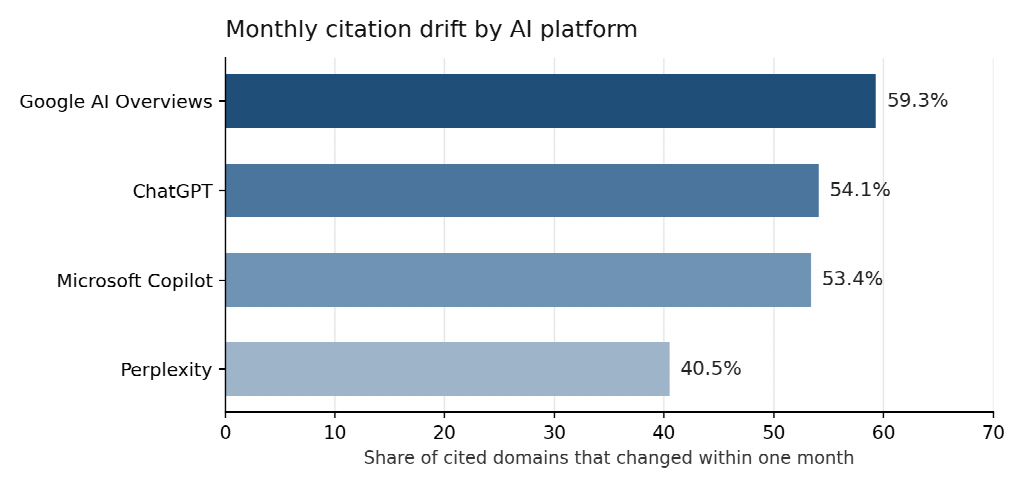
The same instability extends to the sources AI platforms cite, which decide whose content gets credited in an answer and, often, who gets the click. Profound, which tracks citations across the major platforms, found that 40 to 60 percent of the domains cited for a fixed set of queries changed within a single month, with Google's AI Overviews turning over the most and Perplexity the least, though even Perplexity replaced four in ten.
Ahrefs found a similar pattern when it followed identical queries in Google over time, with the text of an AI Overview changing in about 70 percent of its checks and close to half the citations swapped out whenever it did. A separate Ahrefs comparison of Google's two AI features showed that AI Mode and AI Overviews cited the same URLs just 13.7 percent of the time, even though in most cases they reached answers that said essentially the same thing. For publishers, that means an answer can remain stable while the sources supporting it change underneath.
Much of this variation follows from how these systems are built, since language models produce text probabilistically and the retrieval layers feeding them draw on an index that is re-crawled constantly. Combined with the model and ranking updates the platforms roll out without notice, those mechanics make some variation between one answer and the next all but certain.
How Marketing Teams Are Adjusting
For marketing teams, the first casualty has been the screenshot. A single image of ChatGPT recommending a client's product has long been a fixture of monthly reports, offered as proof that an AI search program is working, yet the SparkToro results make clear that the same prompt run a few minutes later could just as easily have left the brand out. Teams that take the channel seriously now run each prompt dozens or hundreds of times across several platforms and report the percentage of answers that include the brand. That figure still rises and falls from week to week, but over a few months it settles into a trend a CMO can actually plan around.
The citation data also says something about where the effort should go. When half the cited domains turn over in a month, a brand that relies on one strong page is betting that the page survives every reshuffle, and the numbers suggest that is a poor bet. The companies that appear consistently usually have a much wider footprint, with coverage in trade publications, listings on review sites, mentions in comparison articles and discussion on forums like Reddit. Whichever handful of pages a model happens to retrieve on a given run, a few of them are likely to bring the company up.
That breadth changes how results should be read as well. A dip in AI mentions from one month to the next may be little more than noise, and a sudden jump can fade just as quickly, so teams that react to every swing tend to end up chasing them. The steadier signal moves more slowly: whether a brand's share of answers is climbing across a full quarter, and whether the number of independent sources discussing it keeps growing. In the data gathered so far, those have been the measures that hold up from one period to the next.


