
resources
Explore Texas Maps with Cities: Your Ultimate Guide
10 Jan 2026

Contemplating a trip to Texas? Indeed, its sheer size can make pinpointing destinations quite daunting. This is precisely where detailed Texas maps—complete with city indicators—become invaluable. Whether you're meticulously planning an extensive road trip or simply aiming to explore a particular region, possessing the appropriate map unequivocally transforms the experience. In the following sections, we'll delve into how these essential navigational tools assist in visualizing Texas's diverse landscapes, locating its myriad cities, and ultimately, crafting your ideal adventure.
Key Takeaways
- Texas maps featuring cities prove exceptionally useful for comprehending the state's varied regions and intricate geography.
- These maps reveal not only prominent urban centers but also smaller towns and every community in between.
- The process of planning road trips and identifying points of interest is significantly streamlined with a comprehensive map.
- Furthermore, detailed maps facilitate a clear visualization of the state, enabling precise location of desired destinations.
- Exploring the distinct regions—such as North, East, South, and West Texas—is considerably simplified by the regional delineations offered on these maps.
Navigating Texas Regions With Maps
Understanding Texas's Diverse Geography
Texas, an undeniably vast state, presents a remarkable tapestry of terrains; it is far from monolithic. One encounters everything from expansive, flat plains and gentle rolling hills to the rugged majesty of mountains in the west. Attempting to visualize this immense diversity in one go can be overwhelming, which is precisely why segmenting it into distinct regions offers a practical approach. Consider it akin to savoring a whole pizza: it's simply more manageable—and enjoyable—to tackle it slice by slice. Maps, in essence, provide us with these digestible 'slices' of Texas.
Defining Regional Boundaries for Clarity
Over time, various attempts have been made to delineate Texas's regions, resulting in a fascinating array of interpretations. Indeed, some cartographic representations might unintentionally consolidate areas that residents perceive as distinct, or conversely, fragment locales that intuitively belong together. This can lead to considerable confusion, particularly when one map classifies, say, Houston as part of East Texas, while another situates it differently. Establishing clear boundaries, therefore, significantly aids in a universal understanding of where one distinct part of Texas concludes and another commences. This clarity, in turn, simplifies discussions and enhances exploration of the state.
The Importance of Accurate Texas Maps with Cities
Whether you're meticulous about planning an upcoming trip or merely nurturing a burgeoning curiosity about the state, possessing an accurate map is absolutely fundamental. Its utility extends far beyond simply visualizing major highways; rather, it’s about grasping how individual towns and cities organically integrate into the grander tapestry of Texas's geography. A well-designed map, which distinctly showcases cities within their respective regions, offers several key advantages:
- Perceive the intricate connectivity between various Texan locales.
- Develop a comprehensive understanding of the diverse landscapes you'll traverse.
- Precisely pinpoint specific destinations, thereby minimizing the risk of misdirection.
Maps serve as an indispensable navigational aid—a true 'cheat sheet' for the complexities of the real world. They adeptly distill the intricacies of a complex geographic area into an easily digestible format, a benefit particularly pronounced when navigating a state as immense and multifaceted as Texas. Absent these essential tools, discerning one's current position or intended destination would, unequivocally, present a considerably greater challenge.
Exploring Key Texas Cities and Their Regions
Major Urban Centers on Texas Maps
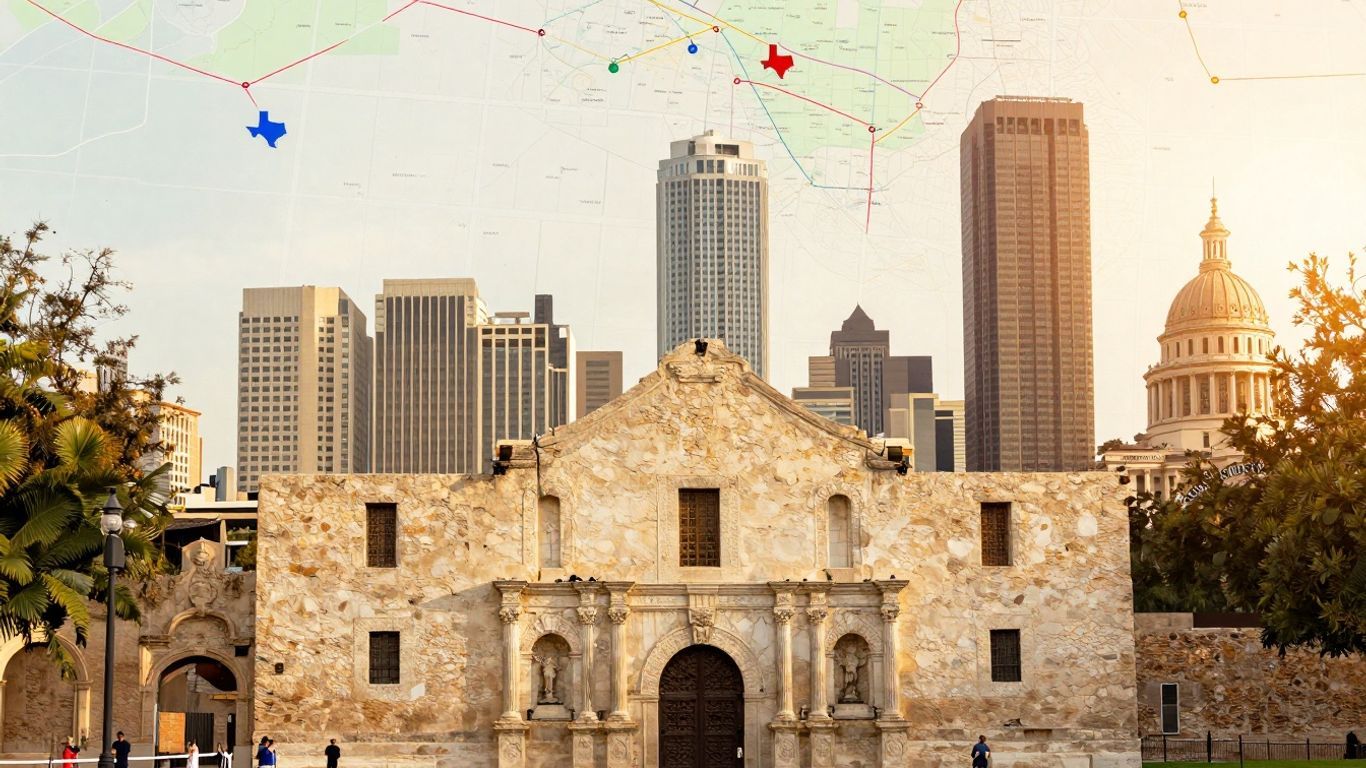
Texas, being the second-largest state in the U.S., naturally presents its major urban centers as the initial images that spring to mind for many. Cities such as Houston, Dallas, San Antonio, and Austin function as pivotal hubs of activity, each possessing a unique and unmistakable character. Houston, for example, is globally recognized for its vibrant energy industry and iconic space center, whereas Dallas stands as a formidable financial and cultural nucleus. San Antonio, steeped in history, captivates with its enduring Spanish colonial missions, while Austin has earned renown for its dynamic live music scene and burgeoning tech sector. These aren't merely arbitrary points on a map; rather, they represent vibrant epicenters of commerce, culture, and innovation—drawing individuals from across the globe.
Discovering Smaller Towns and Communities
Yet, to truly appreciate Texas is to recognize that it comprises far more than its prominent urban landscapes. Indeed, the state is generously dotted with an array of smaller towns and communities, each radiating its own unique charm and distinct character. Consider, for instance, Marfa in West Texas, celebrated for its avant-garde art scene, or Round Top in Central Texas, which garners fame for its acclaimed antique fairs. Such smaller locales frequently provide a more intimate and authentic glimpse into the fabric of Texan life. Often, one finds a quaint main street, a local diner where familiar faces greet you by name, and a rhythm of life notably more serene than the ceaseless bustle of major metropolises. Venturing into these towns, therefore, can unveil truly hidden gems and illuminate an entirely different—and equally captivating—facet of the Lone Star State.
Connecting Cities Through Regional Exploration
Upon consulting a comprehensive map of Texas that highlights its cities, an immediate pattern of interconnectedness begins to emerge. Principal highways, for example, efficiently connect the major urban centers, thereby facilitating seamless travel between them. Crucially, however, these same arterial routes often traverse or skirt numerous smaller towns and communities. It is precisely this intricate web of interconnectedness that renders regional exploration so profoundly rewarding. One can, quite literally, devise an itinerary that transitions from a vibrant, bustling metropolis to a tranquil, rural community, thereby encountering the complete spectrum of experiences Texas so generously offers. Cultivating an understanding of the intricate relationships between these cities and towns within their respective broader regions genuinely helps to paint a far clearer, more nuanced picture of the state's diverse landscape and rich culture.
Utilizing Texas Maps for Travel Planning
Embarking on a journey across Texas can certainly feel like a formidable undertaking, especially considering its immense geographical footprint. However, armed with a quality map that meticulously details its cities and towns, the entire endeavor becomes considerably more manageable. Indeed, envision it as your essential guide, unveiling the full breadth of the Lone Star State's offerings—from its vibrant, bustling metropolises to its serene, quiet country enclaves.
Planning Road Trips Across Texas
When meticulously charting a road trip, possessing a crystal-clear visualization of Texas's cities and their precise locations is, without question, paramount. This allows for effortless assessment of inter-city distances and the facile determination of the most logical, efficient route. Should your interests lie in experiencing the major urban centers, for example, you might strategically plan a route linking Dallas, Fort Worth, Houston, and San Antonio. Alternatively, if the allure of smaller towns captivates you more, a map becomes indispensable for weaving together a captivating journey through the picturesque Hill Country—perhaps pausing in delightful locales like Fredericksburg or Bandera—or for exploring the distinctive charm characteristic of East Texas towns.
Consider this straightforward approach when constructing your itinerary:
- Identify your starting and ending points: From where will your journey commence, and what is your ultimate destination?
- Pinpoint key cities or regions you want to visit: Are you, for example, venturing for authentic barbecue in Central Texas, delving into rich history in South Texas, or yearning for the expansive, open vistas of West Texas?
- Look for connecting routes: Utilize your map to discern primary highways and more intimate roads that efficiently connect your chosen stops.
- Consider overnight stays: Designate potential towns or cities where a restful overnight stop might be beneficial.
Identifying Points of Interest with City Maps
Beyond the mere logistical task of navigating from point A to point B, detailed city maps—integrated within a broader Texas map—excel at highlighting specific points of interest. Indeed, numerous maps thoughtfully denote state parks, historical markers, renowned dining establishments, or distinct local attractions. Such detailed annotations prove exceptionally advantageous for integrating spontaneous detours or meticulously planning your daily excursions within each city. It's entirely plausible, for instance, to unearth a truly hidden gem situated just a few short blocks from your intended route.
Texas, undeniably, is a state that generously rewards the spirit of exploration. Often, the most cherished discoveries are not the grand, iconic landmarks, but rather the delightful, unexpected encounters unearthed when one ventures on a slight detour. Crucially, a well-designed map empowers you to visualize and seize these invaluable possibilities.
Navigating Between Different Texas Regions
The sheer diversity of Texas naturally lends itself to being segmented into distinct regions, such as North Texas, the picturesque Hill Country, or the sun-kissed Gulf Coast. Consulting a map that clearly delineates these various areas significantly simplifies the process of understanding the evolving landscapes and cultural nuances encountered during your travels. One can readily observe the swift transitions—perhaps from the expansive plains of West Texas to the lush, piney woods of East Texas, or from the vibrant, innovative energy of Austin to the serene coastal breezes near Galveston. Such acute regional awareness, indeed, profoundly enriches your entire travel experience, enabling you to anticipate with greater insight the forthcoming scenery and distinctive local flavors.
For instance, when conceiving an itinerary that will traverse multiple regions, a map can effectively illustrate:
- Major highways that act as connectors: For example, I-35, which effectively links North Texas to South Texas, or I-10, extending across the state's southern expanse.
- The approximate boundaries of each region: Providing crucial insight into the geographical transitions you'll encounter.
- Key cities within each region: Offering essential anchor points to orient your journey.
Ultimately, by judiciously utilizing Texas maps that clearly delineate its cities, you're engaging with far more than mere lines on paper; rather, you're leveraging a comprehensive guide capable of transforming a straightforward drive into a meticulously planned and deeply enriching adventure.
The Value of Detailed Texas Maps
Visualizing State Geography
Texas, an undeniably expansive state, presents a remarkable variability in its geography as one traverses from one region to another. Consider, for a moment, the striking contrasts: from the arid, flat plains of the west to the undulating rolling hills of the central region, and then to the humid, dense piney woods in the east. A well-designed map, thoughtfully annotated with city locations, proves invaluable in discerning these myriad differences. It offers a panoramic perspective, clearly illustrating the location of mountain ranges, the course of winding rivers, and the nuanced shifts in terrain. Without a detailed map, it’s quite easy to become disoriented by the sheer scale and profound diversity that defines Texas. Visually comprehending these features in a clear layout, therefore, profoundly deepens one's appreciation for the state's exceptional natural diversity.
Locating Specific Cities and Landmarks
Certainly, while major metropolises like Houston and Dallas are widely recognized, Texas is also home to hundreds of other towns and cities, each imbued with its own distinct character. A map that meticulously illustrates these locales, alongside significant landmarks such as state parks, historical sites, or principal highways, proves immensely valuable. Its utility extends beyond mere navigation from point A to point B; crucially, it's about uncovering the myriad attractions and experiences that lie between those designated points. Imagine planning an itinerary only to discover, through your map, a charming small town or a truly unique roadside attraction situated just a brief, enticing detour away. Indeed, these comprehensive maps are instrumental in transforming what might otherwise be a straightforward drive into a genuine adventure.
Enhancing Your Texas Exploration Experience
The application of detailed Texas maps, complete with city indicators, transcends the basic function of mere point-to-point transit. Rather, it's about profoundly enriching your entire journey, imbuing it with greater meaning and insight. One can meticulously plan routes that purposefully traverse diverse geographical regions, thereby enabling a firsthand encounter with the state's wonderfully varied landscapes. Picture, if you will, charting an itinerary that commences amidst the stark beauty of the West Texas desert, gracefully winds through the picturesque Hill Country, and ultimately culminates on the vibrant Gulf Coast. A quality map renders this caliber of planning not only feasible but also significantly more enjoyable. Moreover, it fosters a deeper understanding of how various parts of Texas interrelate and what distinctly characterizes each region. Ultimately, it serves as your indispensable guide to genuinely—and intimately—discovering the Lone Star State.
The immense geographical scale and profound geographical diversity of Texas mean that attempting to comprehend the state as an undifferentiated whole can, quite frankly, be rather perplexing. While partitioning the state into more manageable sections offers a natural and intuitive path to understanding it better, the historical reality is that various groups have proposed differing methodologies for these divisions, occasionally leading to a degree of confusion.
Below is a concise overview of how maps significantly assist:
- See the Big Picture: Gain an overarching comprehension of Texas's expansive shape and considerable size.
- Discover Hidden Gems: Unearth charming smaller towns and intriguing points of interest you might otherwise miss.
- Plan Smarter Trips: Devise itineraries that guide you through a rich tapestry of diverse landscapes and captivating attractions.
- Learn About Geography: Forge connections between cities, landmarks, and the state's wonderfully varied natural environments.
Regional Breakdown of Texas Cities
Texas, an undeniably immense state, can prove rather daunting to comprehend in its entirety at first glance. Consequently, it's common practice—and quite effective—to segment it into distinct regions. Each of these Texan segments boasts its unique atmosphere, characteristic landscape, and, naturally, its own collection of cities and towns. Maps, in this context, are exceptionally beneficial for visualizing the interconnections between these regions and identifying their primary population centers.
North Texas Cities and Their Characteristics
North Texas constitutes a fairly distinct geographical area, typically situated south of the Red River and north of Central Texas. It's worth noting that while the nomenclature isn't entirely geographically precise—it doesn't encompass the state's absolute northernmost reaches—the designation has nonetheless endured. This expansive region encompasses significant urban centers such as Dallas and Fort Worth, together forming a vast, dynamic metropolitan area. However, it's not exclusively defined by bustling big-city life; one will also discover numerous smaller cities and towns dispersed across its expanse. The landscape itself is quite varied, featuring undulating rolling plains alongside considerable agricultural zones.
- Major Hubs: Dallas, Fort Worth, Arlington, Plano.
- Key Features: Characterized by large urban centers, substantial economic activity, and a diverse industrial base.
- Atmosphere: Energetic, modern, and notably business-centric.
The North Texas region, it must be said, is a dynamic area where robust economic growth converges with a rich historical legacy, thereby offering a harmonious blend of urban sophistication and comfortable suburban living.
East Texas Urban Hubs and Rural Charm
East Texas is widely recognized for its distinctive Piney Woods, which impart a noticeably different ambiance compared to other areas of the state. It is frequently characterized by a palpable Southern charm, evident in its communities and traditions. The cities within this region span a spectrum, from notable urban centers to more intimate, rural communities. Houston, though its regional classification is occasionally debated, is often situated within Southeast Texas—a sub-region integral to the broader East Texas geographical area. This entire area possesses a robust cultural identity, significantly shaped by its geographical adjacency to the American South.
- Notable Cities: Tyler, Longview, Beaumont, Nacogdoches.
- Landscape: Primarily characterized by extensive forests, numerous lakes, and gentle rolling hills.
- Culture: Marked by strong Southern influences, abundant historical sites, and, in many areas, a distinctly slower pace of life.
South Texas Cities and Cultural Richness
South Texas is a region deeply imbued with rich cultural roots, profoundly influenced by its shared border with Mexico and its extensive coastline along the Gulf of Mexico. San Antonio, a significant city in its own right, is frequently regarded as a cultural capital for this vibrant area. Here, one discovers a harmonious blend of Texan and Mexican heritage, vividly reflected in its cuisine, music, and enduring traditions. Furthermore, beyond the prominent urban centers, numerous smaller towns and communities meticulously preserve a strong, distinctive sense of local identity.
- Key Cities: San Antonio, Corpus Christi, Laredo, McAllen.
- Characteristics: Defined by a rich cultural heritage, substantial Hispanic influence, inviting coastal areas, and significant agricultural importance.
- Atmosphere: Characterized by a warm climate, a vibrant cultural tapestry, and an intriguing blend of historical legacy and modern vibrancy.
West Texas Cities and Vast Landscapes
West Texas is, for many, virtually synonymous with expansive, wide-open spaces and a notably rugged, often arid, landscape. This immense region is characterized by cities that are typically quite dispersed. El Paso, strategically positioned directly on the border, stands as a major urban hub offering a truly unique cultural amalgamation. Elsewhere, cities such as Lubbock and Amarillo function as crucial hubs for their respective surrounding areas, frequently acting as centers for flourishing agriculture, and robust oil and gas industries. Given the sheer, imposing scale of West Texas, inter-city travel often entails considerable driving distances, rendering detailed maps especially invaluable for meticulously planning journeys through this captivating region.
- Major Cities: El Paso, Lubbock, Amarillo, Midland.
- Geography: Deserts, plains, mountains, and wide-open country.
- Economy: Heavily reliant on oil, gas, agriculture, and international trade.
| City | Region | Approximate Population (2023 est.) |
|---|---|---|
| El Paso | West Texas | 678,000 |
| Lubbock | West Texas | 264,000 |
| Amarillo | West Texas | 200,000 |
| San Antonio | South Texas | 1,495,000 |
| Dallas | North Texas | 1,302,000 |
Interactive Texas Maps with Cities

Digital Tools for Exploring Texas
The days of wrestling with an unwieldy, oversized paper map sprawling across your kitchen table are largely behind us. Today, exploring the vast expanse of Texas has become significantly more streamlined, thanks to the advent of powerful digital tools. We refer, of course, to intuitive websites and mobile applications that enable you to meticulously zoom in on virtually every corner of the state—from the dynamic, bustling streets of Dallas to the tranquil, expansive ranches of the west. These platforms are ingeniously designed to pinpoint locations with absolute precision, thereby rendering the immense scale of Texas considerably less daunting. Indeed, virtually any piece of navigational information you require is readily accessible with just a few simple clicks or taps.
Finding Cities and Routes Easily
These interactive maps prove exceptionally adept for meticulous travel planning. For instance, should you need to plot a course from Amarillo to Houston? Simply input your desired origin and destination, and the map will swiftly present optimal routes, provide estimated travel times, and even highlight potential points of interest for stops en route. It's akin to having an astute, personalized tour guide—or perhaps a co-pilot—at your fingertips, directly on your screen. Specifically, you'll be able to observe:
- Principal highways and secondary roadways.
- Anticipated driving distances and estimated journey durations.
- Real-time traffic conditions (a feature available on select platforms).
- Adjacent towns and cities that could prove appealing for a visit.
Customizing Your Texas Map View
A particularly advantageous feature is the ability to customize these maps to suit your individual preferences and specific requirements. Certain sophisticated platforms, for instance, allow users to place personalized pins for desired destinations, bookmark cherished locations, or even manually trace bespoke routes. Furthermore, the flexibility to toggle between various map styles—such as detailed satellite views for observing actual terrain, or simplified road maps for unambiguous directions—enhances usability. This degree of personalization profoundly elevates the effectiveness and enjoyment inherent in planning your Texas adventure.
The immense geographical scale of Texas naturally presents a considerable challenge when attempting to grasp its intricate layout. Interactive maps, however, adeptly decompose this vastness into digestible, manageable sections, thereby empowering users to concentrate on specific areas or chosen routes without becoming overwhelmed by the granular details of the entire state. Crucially, they offer a dynamic and intuitive method for visualizing the essential connections that exist between its diverse cities and regions.
Wrapping Up Your Texas Map Exploration
Having journeyed through a comprehensive exploration of Texas, from its northernmost reaches to its southernmost tips, it's evident just how vast and multifaceted this state truly is. Indeed, it's unequivocally clear that this state is immense, encompassing a rich tapestry of diverse areas, each imbued with its unique character and atmosphere. Whether your intention is to visit its renowned cities or to uncover the charming smaller towns we've discussed, possessing a reliable map—or even an assortment of maps—proves profoundly beneficial. Such navigational tools undeniably streamline the process of identifying destinations and points of interest. Texas, undoubtedly, offers a wealth of experiences, and a deeper comprehension of its distinct regions can significantly enrich your travels within its borders. May your explorations be both fruitful and enjoyable!
Frequently Asked Questions
Why are Texas maps with cities so helpful?
Texas maps that meticulously illustrate its cities essentially function as an indispensable guide for exploring the Lone Star State! They enable you to accurately perceive the location of everything, ranging from bustling urban centers to charming, tiny villages. This clarity significantly simplifies trip planning, whether your journey entails traversing the entire state or merely visiting a new locality.
How do Texas maps help understand the state's size?
Texas is, of course, a truly vast state, characterized by significant geographical shifts from one area to the next. Maps are instrumental in segmenting this immense state into more digestible, comprehensible regions. They allow you to observe how natural features—such as mountains, expansive plains, and coastlines—distinctly shape various areas and the cities nestled within them.
What kind of cities can I find on a Texas map?
You'll encounter an impressive array of cities! These range from colossal urban centers like Houston and Dallas, which serve as pivotal hubs, to picturesque small towns offering an authentic glimpse into local life. Maps effectively highlight these distinctions, assisting you in selecting destinations that perfectly align with your preferences—be it vibrant excitement or serene tranquility.
How can maps help me plan a road trip in Texas?
Planning a road trip becomes remarkably straightforward with the aid of a comprehensive map. You can effortlessly plot your chosen route, assess the distances between cities, and pinpoint fascinating stops along the way—such as state parks or significant historical sites. This strategic planning ensures you won't overlook any hidden gems situated between your primary destinations.
Are there different ways to look at Texas regions on maps?
Indeed, there are! Various methodologies exist for segmenting Texas, with some approaches dividing the state into as few as four regions, while others expand to seven or even eleven. These diverse divisions aim to help conceptualize the state's varied landscapes and rich cultures. Maps are capable of illustrating these different regional frameworks, thereby enhancing your understanding of each specific area.
What are interactive Texas maps?
Interactive Texas maps are sophisticated digital tools readily accessible via your computer or smartphone. They empower you to seamlessly zoom in and out, efficiently search for specific cities, obtain precise directions, and occasionally even view supplementary photos or pertinent information about locations. These tools are exceptionally convenient for virtually exploring Texas directly from your screen!


