
resources
Explore the World: Interactive World Map with Cities and Key Landmarks
13 Dec 2025

So, contemplating a clearer grasp of global spatial relationships? A world map showcasing cities proves exceptionally advantageous for such endeavors. It transcends mere rote memorization of country names; rather, it offers insight into how geographical areas interconnect, where major urban centers are situated, and what captivating landmarks exist. Whether you're meticulously planning an upcoming journey, assisting with academic assignments, or simply driven by curiosity, a well-designed map has the remarkable ability to diminish the perceived vastness of our world and heighten its intrigue. Let's delve into what renders these maps so invaluable and how best to utilize them.
Key Takeaways
- A world map with cities facilitates a deeper understanding of global geography and our place within it.
- Interactive maps empower users to zoom, pan, and customize views, enabling focus on specific areas or the addition of personal annotations.
- Engaging with cities and landmarks on a map profoundly enhances the learning experience regarding diverse global locations.
- These maps serve as excellent educational instruments, ranging from foundational geography lessons to fostering global awareness.
- Their utility extends to design projects, data visualization, or simply conceptualizing one's next great adventure.
Understanding the World Map with Cities
The Importance of a World Map
A world map is far more than a mere two-dimensional representation of our planet; it stands as an indispensable instrument for comprehending our position within the global tapestry. It vividly illustrates the immense expanse of oceans, the distinctive contours of continents, and the precise locations of nations. Without such a visual aid, grasping global relationships, vast distances, and the sheer scale of our world would, quite frankly, be incredibly challenging. Indeed, one might consider it the paramount reference point for virtually everything unfolding across the globe.
Navigating Global Geography
Comprehending global geography can often appear to be a formidable undertaking, yet a world map expertly simplifies this complexity. It meticulously helps us discern how various landmasses are positioned relative to one another. One can readily trace the intricate path of a river across a continent or observe how majestic mountain ranges span vast distances. Ultimately, it is through these visual aids that we assimilate the locations, interconnections, and fundamental topography of our world.
- Continents: Identifying the major landmasses such as North America, Europe, Asia, Africa, Australia, and Antarctica.
- Oceans: Recognizing the expansive bodies of water that delineate these continents.
- Country Borders: Understanding the political divisions that constitute our global landscape.
Visualizing Countries and Continents
Engaging with a world map allows for the immediate visual apprehension of data concerning countries and continents. We can perceive the relative dimensions of nations, their unique shapes, and their proximity to one another. This visual aspect is crucial for recalling geographical placements and discerning geopolitical dynamics. For instance, visually recognizing that Russia spans across both European and Asian landmasses offers a profoundly distinct perspective compared to merely encountering its name in text.
A well-designed world map truly aids in constructing a comprehensive mental image of Earth, thereby simplifying the understanding of news reports, facilitating trip planning, or merely satisfying one's inherent curiosity about diverse parts of the world.
Interactive Features of a World Map
A truly effective world map is not merely a static image; rather, it represents a dynamic instrument that truly invites in-depth exploration. Consider, for instance, the capacity to zoom intimately to observe the intricate street layouts of a city or to recede for a broader, encompassing perspective of entire continents. Such inherent flexibility is precisely what renders these maps invaluable for both educational pursuits and strategic planning.
Zooming and Panning Capabilities
Among the most fundamental, yet pivotal, interactive features is the inherent ability to zoom and pan. Users can freely navigate the map, allowing closer inspection of areas of interest or receding for a broader panoramic view. This functionality enables detailed examination of elements like national borders or the intricate layout of major cities without being confined to a singular, fixed perspective. Indeed, it's akin to possessing a magnifying glass coupled with the freedom to traverse it across any point on the globe—a truly liberating experience.
Customization and Annotation Tools
Moving beyond mere observation, many interactive maps permit personalized modifications. This might entail drawing lines to delineate a travel itinerary, adding text labels to identify specific places, or employing shapes to highlight particular regions. These tools transform a rudimentary map into a personalized canvas for understanding and presenting information. For example, a student might leverage these features to create an engaging geography project, meticulously labeling capitals and drawing borders. Similarly, designers could utilize a blank map as a foundational layer upon which to superimpose their own bespoke graphics and data.
Highlighting Key Locations
Interactive maps frequently facilitate the precise identification of significant locations. One can click on a country to access supplementary details, or utilize markers to indicate cities, prominent landmarks, or even specific points of interest for an upcoming journey. This feature empowers users to expeditiously locate and concentrate upon the particular parts of the world that pique their interest. This represents an excellent method for visually structuring information, whether one is studying for an examination or meticulously planning a vacation. You can easily visualize all major urban centers or iconic landmarks within a particular area. For instance, imagine using this to pinpoint all the countries within South America, or perhaps to designate all the national parks you aspire to visit.
To truly interact with a map signifies more than passively observing information. It means actively engaging with data, forging connections, and constructing one's own nuanced understanding of global geography and the interrelationships between places.
Exploring Cities and Landmarks
Discovering Major Urban Centers
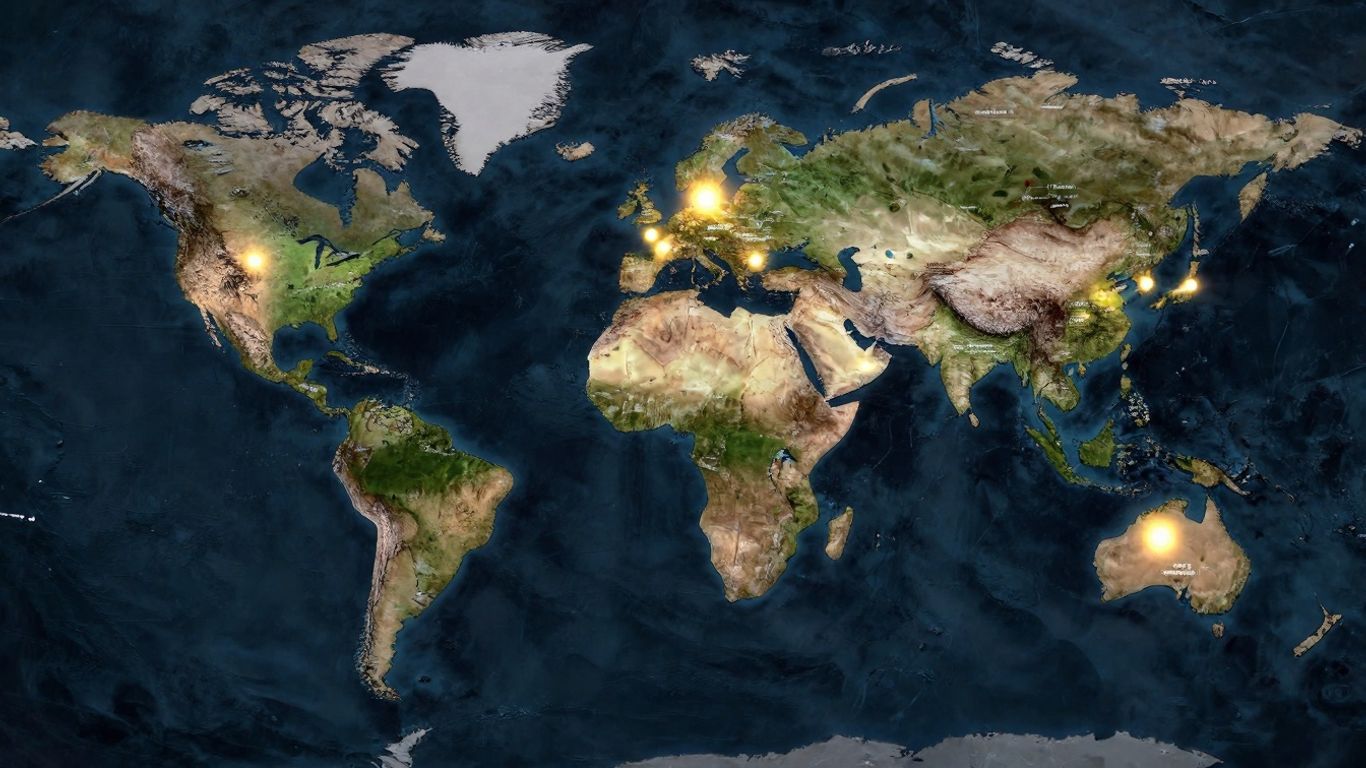
Herein lies the true commencement of exploration—unveiling the vibrant tapestry of urban centers that grace our planet. From bustling metropolises like Tokyo and New York to historic capitals such as Rome and Cairo, each city offers a unique narrative. Interactive maps allow us to pinpoint these pivotal urban hubs, providing expeditious access to their geographical coordinates and, occasionally, foundational data. One can readily ascertain Paris's proximity to Berlin, for instance, or the precise distance from London to Dublin. It's akin to possessing a comprehensive global city guide readily available at one's fingertips, poised to unveil the world's most populated and influential places.
Identifying Iconic Landmarks
Beyond the cities themselves, the world is graced with iconic landmarks that invariably capture our collective imagination. Consider, for example, the architectural marvel of the Eiffel Tower, the monumental scale of the Great Wall of China, or the ancient splendor of the pyramids of Giza. These are not merely geographical coordinates; they stand as profound symbols of history, culture, and enduring human achievement. An interactive map can effectively highlight these famous spots, frequently complemented by illustrative imagery or concise descriptions. This functionality simplifies the process of understanding what distinguishes each landmark and precisely where it is situated. Indeed, it presents a remarkable avenue for engaging with the world's most recognizable places—all from the comfort of your own setting.
Mapping Travel Routes and Destinations
For individuals imbued with a spirit of wanderlust, interactive maps are indispensable tools for planning journeys. One can meticulously delineate a prospective itinerary, interlinking cities and landmarks one aspires to visit. Envision mapping an expansive road trip across the United States, for example, or meticulously planning a multi-city European tour. These sophisticated tools can aid in visualizing distances, estimating travel times, and even suggesting captivating points of interest along the way. This effectively transforms the often-abstract concept of travel into a tangible, visually coherent plan. Moreover, you can even leverage these tools to explore virtual tours of global cities, gaining a preliminary sense of a destination before your actual visit. Why not Explore the world from home?
While planning a trip can often seem daunting, visually articulating it on a map renders the task considerably more manageable. Observing the interconnections between destinations truly aids in comprehending the scope of your prospective adventure and facilitates well-informed decisions regarding your itinerary.
Educational Applications of World Maps
World maps are far more than mere aesthetic representations of our planet; they are exceptionally valuable pedagogical instruments. Indeed, consider the alternative: how else might one gain such lucid comprehension of spatial relationships across the globe? Fundamentally, they aid us in grasping the overarching panorama of our global environment.
Geography Lessons and Worksheets
Educators frequently employ maps to illustrate the geographical placement of nations, their distinctive contours, and their interconnections. One can readily distribute outline maps, tasking students with labeling continents, oceans, or specific countries. This provides a tactile and engaging learning methodology that fosters superior retention compared to textual study alone. Furthermore, one can delineate trade routes or migration pathways, thereby enriching history lessons with compelling visual aids. This kind of active learning truly helps solidify concepts.
Learning About Countries and Capitals
Do you recall the often-arduous task of memorizing national capitals? A map, undoubtedly, renders this process considerably more accessible. One can simply indicate a country and then locate its corresponding capital city. Interactive maps prove particularly adept for this purpose, offering seamless zoom capabilities and often enabling users to click on a country for supplementary details. This effectively transforms what might otherwise be a rather dry memorization exercise into a fascinating journey of exploration.
Enhancing Global Awareness
Observing the entirety of the world's expanse helps cultivate an understanding of our collective participation in a larger global community. One can discern the vast distances separating locations, prompting reflection on international travel or the logistics of global commerce. Moreover, geographical knowledge aids in contextualizing current events—for instance, understanding a nation's position invariably facilitates a clearer comprehension of ongoing developments within that region. Ultimately, it offers a straightforward yet profound means to transcend localized perspectives.
Maps truly serve as an invaluable visual compendium of the world. They reveal not only the precise locations of places but also their intricate interrelationships—a rather remarkable insight upon deeper consideration. Though a fundamental instrument, it performs significant heavy lifting in our quest to comprehend our planet.
Here's a quick look at how maps can be used:
- Labeling Activities: Students fill in country names, capitals, or major physical features.
- Route Mapping: Tracing historical journeys, trade routes, or planning imaginary trips.
- Comparison Exercises: Comparing the size of countries or the distances between continents.
- Thematic Mapping: Showing population density, climate zones, or resource distribution.
Designing with World Maps
Creating visuals that incorporate world maps can prove to be an exceptionally potent method for disseminating information, whether one is compiling a professional presentation, developing a website, or even crafting a scholastic project. This endeavor extends beyond merely affixing a map to a page; it involves its judicious utilization to narrate a story or elucidate a complex concept.
Creating Custom Map Visuals
When the need arises for a map precisely tailored for your project, it often necessitates transcending the limitations of conventional political or physical maps. This might involve adjusting color palettes to align with brand guidelines, incorporating bespoke icons for points of interest, or even simplifying the map to emphasize a specific geographical region. The overarching goal is to integrate the map as a clear and attractive component of your overall design, rather than merely a decorative background element. You can achieve this by employing tools that allow you to fine-tune every minute detail, from the exact shade of blue for the oceans to the specific font used for country names. The right map visual can make complex data instantly understandable.
Utilizing Outline Maps for Design
Outline maps prove exceptionally advantageous for design endeavors, primarily because they furnish an unencumbered canvas. Consider them, if you will, as a blank canvas awaiting artistic expression. One can take a basic outline of continents or countries and then superimpose one's own distinct layers of information. Such additions might range from delineating custom borders for a hypothetical region to strategically placing markers for significant historical events. They prove particularly valuable when the objective is to emphasize specific areas without the inherent distraction of detailed geographical features or complex political labels. Many online tools readily permit the download of these outline maps in formats suitable for graphic design software, making them remarkably easy to integrate.
Adding Data Overlays
It is precisely here that maps truly transcend their static nature. Adding data overlays signifies integrating specific information directly onto the map's surface. Rather than merely indicating locations, one can illustrate what is occurring within those locales. Examples include population density, regional sales figures, or the propagation of a specific phenomenon. One can employ different colors, varying sizes of markers, or even heatmaps to represent this data visually. This process fundamentally transforms a static geographical representation into a dynamic instrument for comprehensive analysis and compelling storytelling. For instance, you could use a tool like Flourish to create interactive charts and maps that respond to user input, rendering your data much more engaging.
Maps inherently serve as potent instruments for visualizing spatial relationships. When data is integrated, one transcends mere geographical depiction to reveal vital context. This contextual layer empowers individuals to discern patterns and interconnections they might otherwise miss. Ultimately, it’s about rendering the invisible visible through astute design choices.
Here are some common ways to add data:
- Color-coding regions: Assign different colors to countries or states based on a specific metric (e.g., economic status, climate zone).
- Placing markers: Use icons or dots to indicate the location of cities, businesses, or events, potentially varying their size or color based on data.
- Drawing lines or routes: Show travel paths, trade routes, or the spread of something over time.
- Creating heatmaps: Visualize areas of high or low concentration for a particular data point.
Resources for World Map Exploration
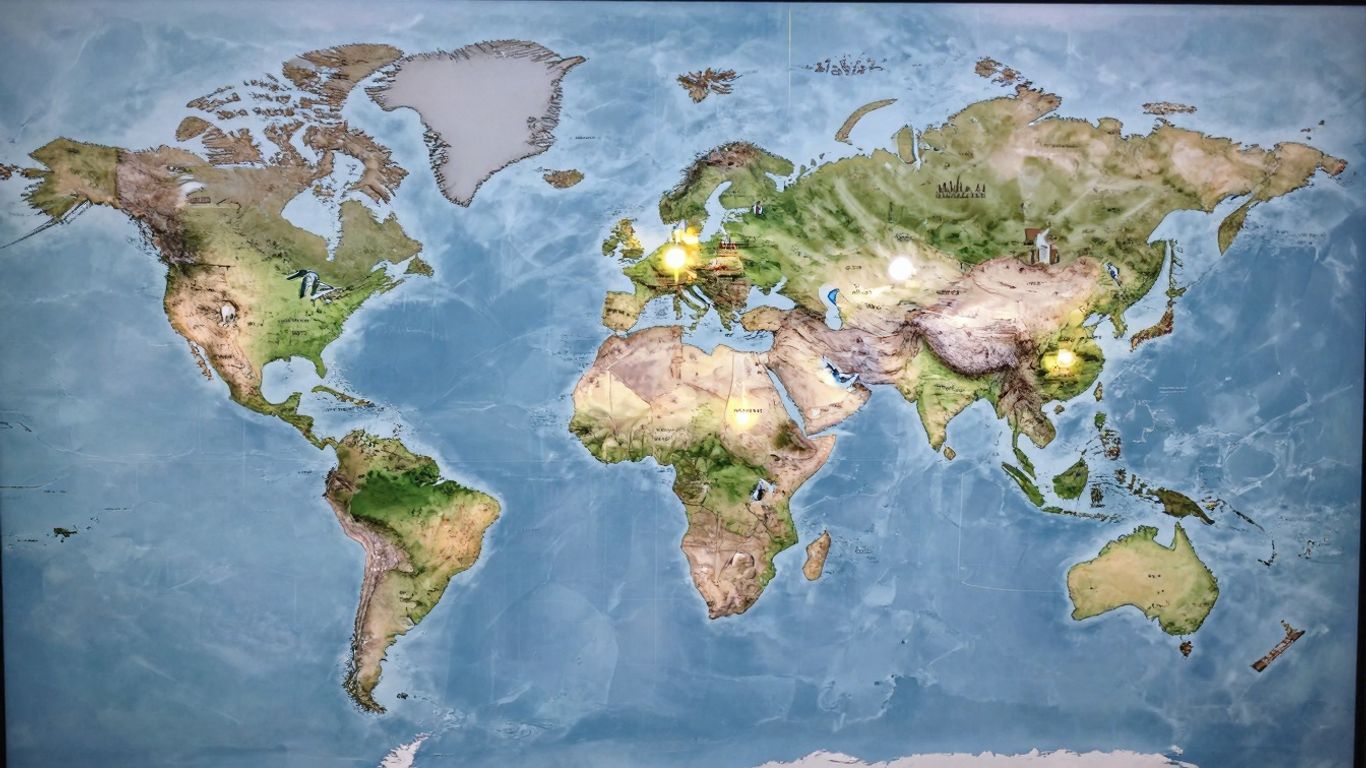
Having journeyed through the world map, perhaps virtually or even with a traditional physical rendition, you might now be contemplating avenues for additional tools or printable map resources. Discovering the requisite resources is, in fact, quite straightforward, whether your role is that of a student engaged in a project, a designer seeking a foundational image, or simply an individual with a profound curiosity about our planet.
Online Map Tools and Editors
There are a plethora of sophisticated online tools available that facilitate map manipulation directly within your web browser. Consider them akin to digital sketchpads tailored for geographical exploration. You can often zoom in extensively, pan across various continents, and even append personal annotations or delineate pathways. Some interfaces allow you to highlight countries or draw borders, proving exceptionally useful for academic assignments or itinerary planning. These interactive editors streamline the creation of custom map visuals, obviating the need for specialized software. Should you require a quick, high-resolution image for a presentation or a worksheet, one can typically capture a screenshot. For more advanced interactive map creation, specialized tools exist that allow for clickable markers and custom styling, perfect for embedding on a website.
Printable Map Options
Occasionally, the tangible utility of a physical map remains unparalleled. Many reputable websites offer printable versions of world maps. One can procure anything from rudimentary outline maps—ideal for coloring or labeling exercises—to meticulously detailed political maps illustrating national borders and principal urban centers. These prove invaluable for educational settings or for any enthusiast desiring a wall-mounted geographical reference. You can often discover maps specifically designed for children, or those that focus on particular regions or themes, such as fault lines or latitude and longitude coordinates. It is advisable to explore various online sources to ascertain the array of styles and formats on offer.
Digital Map Platforms
Beyond the scope of rudimentary online editors, a broader spectrum of digital map platforms exists. These platforms are frequently more robust, capable of managing intricate datasets. Consider services that enable the superposition of diverse informational layers onto a map, like population density, climate zones, or even historical event locations. Certain platforms are specifically engineered for developers, empowering them to construct immersive, real-world mapping experiences, often featuring advanced 3D capabilities. Such capabilities can render route planning and geographical exploration considerably more dynamic. Should your objective be to construct an interactive feature for a website or an application, these platforms furnish the essential foundational components. You can find tools that let you customize markers, add detailed pop-up information, and even set up search filters for users. For example, you might use one to show all the places you've traveled to, complete with photos and personalized notes for each spot.
Ultimately, selecting the appropriate map resource hinges entirely upon your specific objectives. Whether your need is a swift conceptual sketch via an online tool, a decorative wall poster, or an elaborate data visualization—a suitable digital or printable option invariably awaits discovery.
Your Journey Through the World Awaits
Having explored a significant portion of the globe, from vibrant urban centers to iconic landmarks, all made possible through the remarkable utility of interactive maps—it is quite astounding, isn't it, the sheer volume of information readily accessible from our screens? Whether one is meticulously planning a journey, diligently preparing for an examination, or simply harboring a profound curiosity about the wider world, these sophisticated tools render global discovery both accessible and engaging. We encourage you to continue exploring, perpetually discovering, and to recall that your next adventure—be it virtual or tangible—is merely a click away. We wish you joyous travels, both virtual and real!
Frequently Asked Questions
Why are world maps so important to learn from?
World maps serve as a comprehensive visual representation of our planet. They facilitate understanding of the geographical locations of nations and continents, along with their intricate interrelationships. This holistic view enhances our global comprehension, from significant international events to the logistical connections vital for travel or trade. They function much like an indispensable guide to the entire Earth!
What makes a world map "interactive"?
An interactive world map enables more than passive observation. Users can zoom in closely to examine specific cities or zoom out to survey the entire globe. Often, you can also append your own notes, delineate pathways to show routes, or highlight places you find particularly engaging. Consider it a dynamic digital map, inviting active engagement!
How can I use an interactive map to find cities and landmarks?
Interactive maps render the discovery of locations exceptionally straightforward. One can search for a specific city or landmark, or simply navigate extensively until a point of interest is uncovered. Many maps will reveal famous buildings, mountains, or rivers as you approach a sufficient zoom level. This offers an enjoyable method of exploration without requiring physical travel.
Are these maps useful for school?
Indeed! Interactive world maps stand as superb educational instruments. Educators can employ them to illustrate national geographies, impart knowledge about diverse cultures, or even design hypothetical journeys. Students can utilize them for academic assignments, to gather information for projects, or simply to cultivate a deeper curiosity about the world.
Is it possible to develop bespoke map designs?
Yes, many interactive map tools afford opportunities for creative customization. You can often modify color schemes, add bespoke labels for places, or even draw directly on the map to mark important spots. This capability proves invaluable for crafting maps for presentations, academic projects, or simply for generating unique visual aids.
Where might one locate reputable online world maps for exploration?
Numerous excellent resources are available online! Some websites offer free interactive maps that allow for zooming and panning. Others provide tools where you can draw and customize. Furthermore, you can also find printable maps if you prefer to have a physical copy. A simple search for "interactive world map" or "online map tool" will typically yield a wealth of options.


