
Businesses
How to Create a Business Directory Profile That Attracts Customers
17 Aug 2026

A business directory profile should do more than confirm that a company exists. It should help the right customer understand what the business offers, why it is relevant and what action to take next.
The strongest profiles combine accurate information, a specific description, credible evidence and a clear route to contact or purchase. This guide explains how to create an online business directory profile that supports visibility and customer enquiries without relying on exaggerated claims or keyword stuffing.
If the company is not yet listed, begin with Businessabc’s guide on how to list your business in an online directory.
Key takeaways
- Use the company’s real public-facing name.
- Choose the most specific relevant business category.
- Lead with the customer, problem and service.
- Replace broad claims with verifiable evidence.
- Use genuine photographs rather than misleading stock images.
- Give visitors one clear next action.
- Keep contact details, leadership and services current.
- Measure qualified enquiries—not profile views alone.
What makes a good business directory profile?
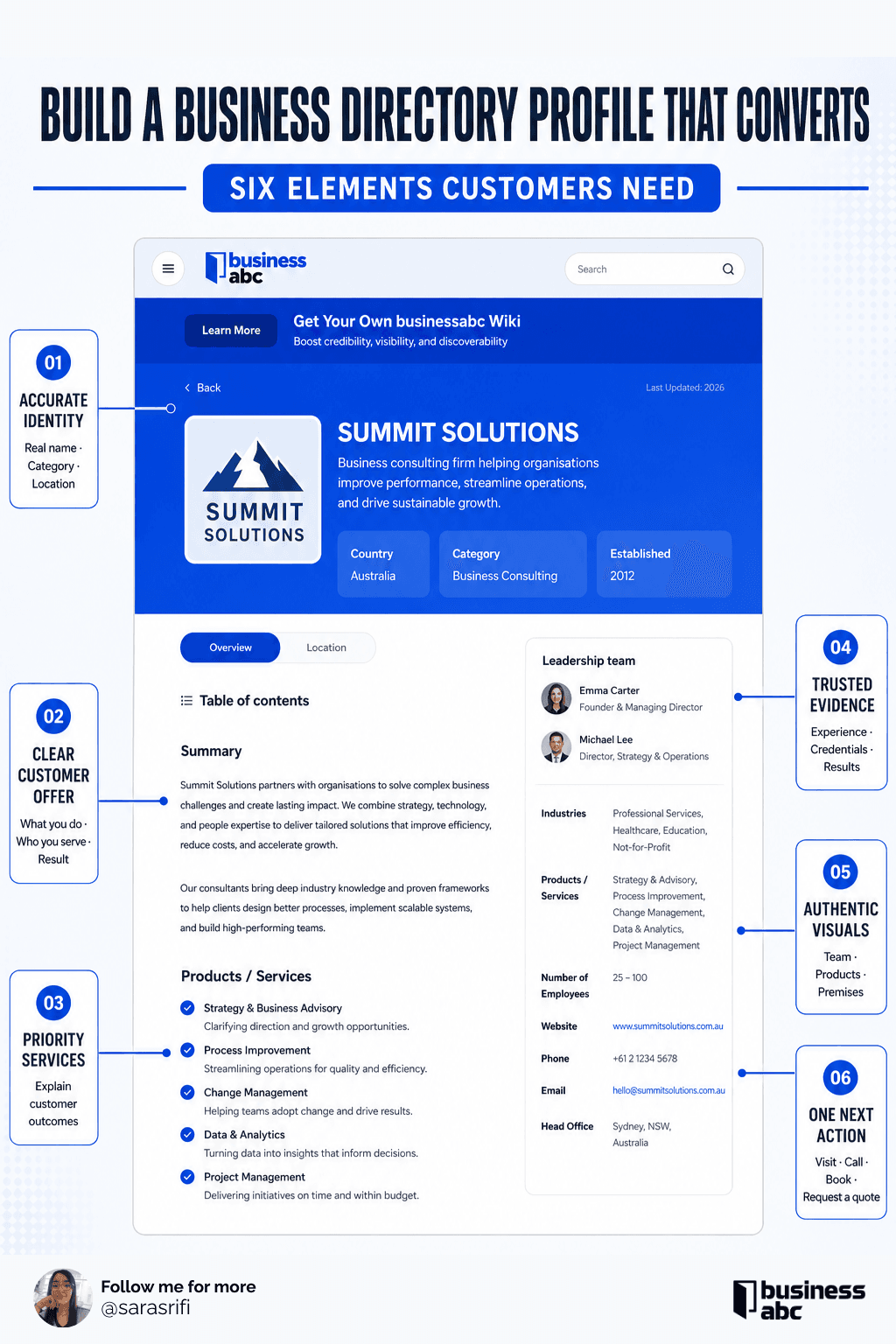
An effective profile quickly answers six questions:
- What is this company?
- What does it provide?
- Who does it serve?
- Where does it operate?
- Why should a customer trust it?
- How can someone take the next step?
A profile that forces visitors to search elsewhere for basic information is incomplete. Conversely, a long company history that does not explain the customer offer can obscure the most important details.
1. Use an accurate business name and category
Enter the name customers see on the company’s website, documents and other official channels.
Do not add promotional phrases or search keywords to the name field.
Use:
Meridian Circular Packaging
Avoid:
Meridian Circular Packaging — Best Sustainable Packaging Consultants
Choose the most specific category that accurately describes the company. “Accounting firm” is more useful than “business services” when accounting is the primary activity.
Relevant secondary categories can provide additional context, but unrelated categories may weaken the profile’s clarity.
2. Write for a specific customer
A vague description such as “We provide innovative world-class solutions” gives a prospective customer little reason to continue.
Instead, identify:
- The company type
- Target customer
- Principal service or product
- Geographic market
- Practical result
- Credible difference
Use this structure:
[Company] is a [business type] serving [customer] in [market]. It provides [products or services], helping clients achieve [practical outcome]. The company specialises in [credible differentiator].
Example
Meridian Circular Packaging is a Manchester-based packaging consultancy serving food and consumer-goods companies across the UK. It evaluates materials, redesigns packaging systems and develops implementation plans that help clients reduce waste and meet commercial requirements.
The example is specific without making unsupported claims.
3. Put the strongest information first
Directory visitors usually scan before reading closely. The opening lines should contain the information most relevant to a potential customer.
A practical order is:
- Company and business type
- Principal customer
- Main products or services
- Market or service area
- Evidence or differentiator
- Contact action
Do not begin with the founding story unless it directly explains the company’s value. History, leadership and milestones can appear later in the profile.
4. Add customer-focused products and services
Avoid publishing an unexplained list of internal product names. Describe each important service in language the customer understands.
For each service, include:
- What it is
- Who it is intended for
- What problem it addresses
- What the customer receives
- Where it is available
For example, replace “Strategic Transformation Package” with:
A six-week operational review for growing manufacturers, covering workflow analysis, cost bottlenecks and a prioritised implementation plan.
The second description gives the customer enough information to assess relevance.
5. Use evidence instead of superlatives
Claims such as “leading,” “best” and “world-class” are weak unless the company can support them.
More credible evidence may include:
- Years of operation
- Professional qualifications
- Relevant certifications
- Named markets served
- Documented project outcomes
- Patents or registered intellectual property
- Awards with dates and issuing organisations
- Published case studies
- Verified customer reviews
- Recognised partnerships
Evidence must be accurate, current and authorised for publication. Do not reveal confidential customer information merely to strengthen a directory listing.
6. Add professional and authentic visuals
Images help visitors understand whether the company is established, relevant and suitable.
Depending on the business, useful visuals include:
- Current company logo
- Workplace or premises
- Products
- Facilities or equipment
- Team and leadership
- Completed projects
- Service delivery
- Authorised event photographs
Use recent, high-resolution images with consistent lighting and presentation. Avoid stock photographs that could be mistaken for the company’s actual employees, facilities or work.
The main image should communicate the business category immediately. A restaurant might show its dining space, while a manufacturer might show its production facility or finished products.
7. Complete leadership and company details
B2B customers, partners and investors often want to understand who operates the company.
Where the directory allows it, include:
- Founding year
- Headquarters
- Markets served
- Leadership team
- Employee range
- Industry
- Products and services
- Company milestones
- Official website
- Relevant social profiles
Only publish information the business is comfortable maintaining publicly. Leadership details should be updated when roles change.
Companies can examine how structured records appear through the Businessabc Global Business Directory.
8. Make contact simple
Every directory profile should have one obvious next step.
Possible calls to action include:
- Visit the website
- Request a quotation
- Book a consultation
- View the product catalogue
- Contact the sales team
- Find a location
- Apply for membership
- Explore a case study
Ensure the website link opens correctly and sends visitors to the most relevant page. Directing every visitor to a generic homepage may create unnecessary friction.
The published telephone number and email should be monitored. A strong profile cannot generate customers if enquiries receive no response.
9. Keep information consistent
Maintain the same core information across important profiles:
- Company name
- Website
- Telephone number
- Address or headquarters
- Opening hours
- Industry
- Service area
- Operating status
Minor stylistic differences in descriptions are acceptable. Contradictory contact details or locations are not.
Assign responsibility for maintaining directory information to a specific person or team. Review priority listings after any major company change and at least once per quarter.
10. Measure whether the profile attracts customers
Profile views alone do not show commercial value.
Monitor:
- Website visits from the directory
- Contact-form submissions
- Telephone enquiries
- Quotation requests
- Booked consultations
- Newsletter registrations
- Partnership enquiries
- Qualified leads
- Customers acquired
Use tracked links or a dedicated landing page where appropriate. Ask new prospects how they discovered the company.
The objective is not to maximise clicks from everyone. It is to help suitable customers recognise the offer and take the next step.
Business directory profile template
Use this short template when preparing a company listing:
[Company name] is a [specific business type] serving [customer group] across [location or market]. The company provides [main products or services], helping customers [practical result].
It specialises in [relevant capability] and is supported by [qualification, experience, certification or other evidence]. Customers can [primary action] through [website or contact route].
Adapt the language to the company rather than publishing the template mechanically.
Common profile mistakes
Writing for search engines instead of customers
Keywords should appear naturally. Repeating services and locations makes the profile difficult to read and can reduce trust.
Making unsupported claims
Replace “industry-leading” with specific experience, qualifications or outcomes.
Listing every possible service
Prioritise the services that represent the company’s actual offer and commercial strategy.
Using outdated visuals
Old logos, former premises and discontinued products can create confusion.
Hiding the contact route
Make the desired customer action obvious and ensure someone monitors it.
Creating duplicate profiles
Search the directory first. Claim and improve the existing listing when possible.
Publishing and forgetting
An abandoned profile can continue displaying incorrect information for years.
How to improve a Businessabc profile
Businessabc combines its global business directory with profiles for companies, leaders, investors, universities and organisations.
Before creating or updating a profile, prepare:
- A concise customer-focused description
- Primary industry and category
- Products and services
- Markets served
- Current contact information
- Logo and authorised photographs
- Leadership information
- Significant milestones
- Verifiable awards or certifications
- One clear call to action
Businesses can explore the Businessabc directory and review available Businessabc membership options.
Frequently asked questions
How long should a business directory description be?
It should be long enough to explain the company, customers, services, market and differentiator without repeating the website. For many listings, two concise paragraphs are sufficient.
Should a directory profile include keywords?
Yes, when they accurately describe the business. Use the principal business type, services and locations naturally rather than repeating them.
What photographs should a company use?
Use genuine, authorised images of the logo, products, premises, team or work. Select visuals that help customers understand the business.
How often should a profile be updated?
Update it immediately after a significant change and review important profiles at least quarterly.
Can a directory profile generate customers?
It can create a credible discovery and referral route, but results depend on the directory’s relevance, profile quality, customer demand and the company’s response process.
Final takeaway
A business directory profile attracts customers when it makes the company easy to understand and easy to contact.
Use an accurate name and category, describe the offer from the customer’s perspective, support important claims with evidence and provide one clear next action. Then maintain the profile as carefully as the company website.
For the complete setup process, see How to List Your Business in an Online Directory.


