
citiesabc, first_page
Jensen Huang Urges Europe to Become an AI Producer, Not Just a Consumer, at NVIDIA GTC Berlin 2026
21 Oct 2026

At NVIDIA GTC Berlin 2026, Jensen Huang outlines Europe's opportunity to build its own AI economy, supported by nearly $10 billion in NVIDIA commitments, more than 12,000 partners and growing investment in sovereign AI infrastructure, industrial computing and open models.
NVIDIA founder and CEO Jensen Huang has called for Europe to become a producer of artificial intelligence rather than simply a consumer of AI technologies, positioning computing infrastructure, industrial expertise and sovereign AI as essential foundations for the region's future economic competitiveness.
Speaking at NVIDIA GTC Berlin 2026 on October 21, Huang outlined how European businesses, governments and technology developers could participate in the emerging AI economy by building their own computing infrastructure, developing specialised models and applying artificial intelligence across established industries.
The keynote follows NVIDIA's European technology initiatives in Paris, London, Stockholm and Dublin. According to the company, NVIDIA has committed nearly $10 billion to Europe's technology ecosystem and works with more than 12,000 partners across the region.
The announcement reflects growing efforts to strengthen Europe's AI capabilities as countries compete to develop the infrastructure, technologies and expertise required for the next generation of intelligent applications.
Jensen Huang's Vision for Europe's AI Economy
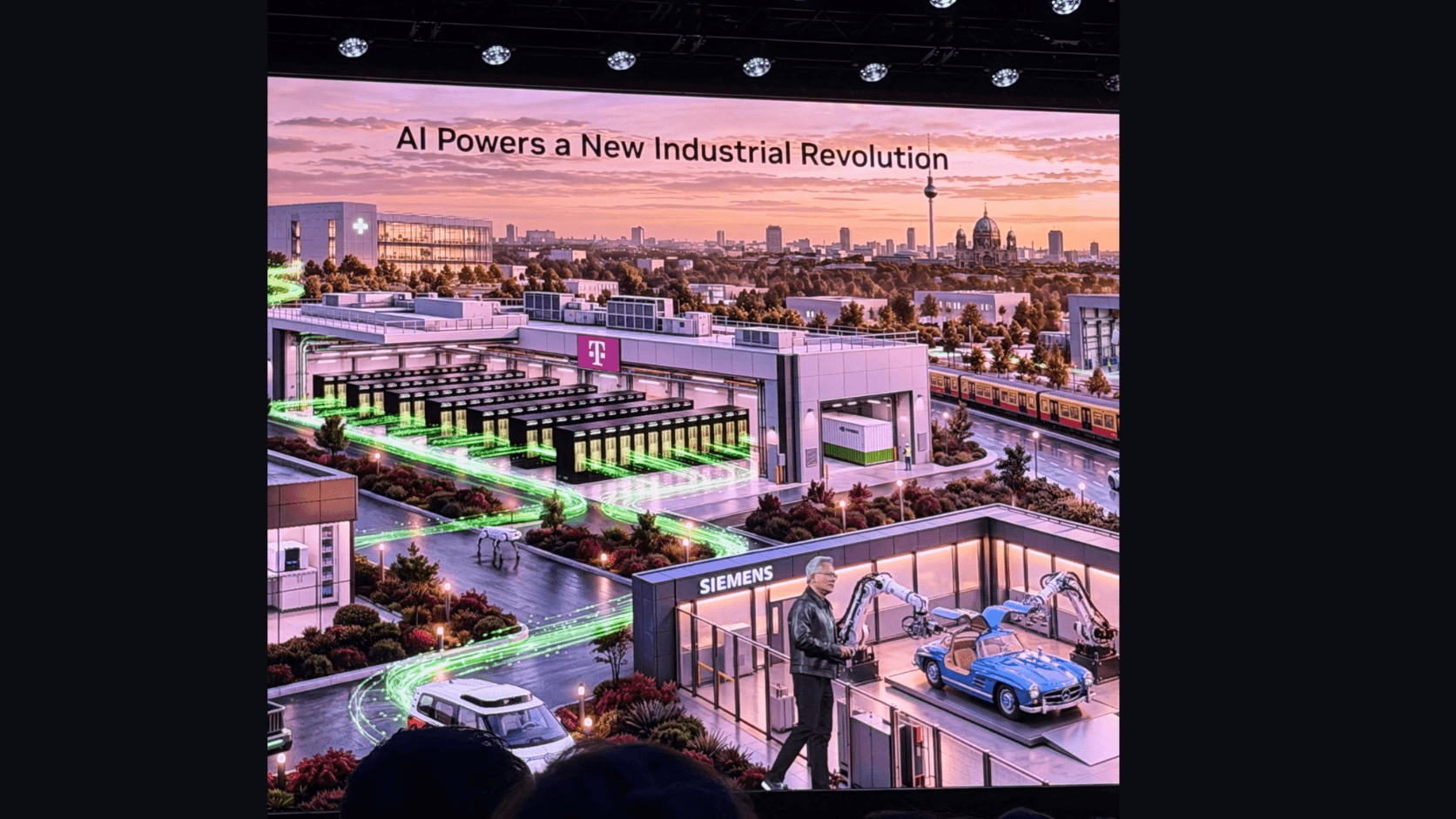
During the keynote at Berlin's Tempodrom, Huang described artificial intelligence as the beginning of a new industrial revolution.
He presented AI as a five-layer system consisting of energy, advanced computing, AI factories, models and applications. Each component plays a role in producing and delivering digital intelligence.
The framework highlights why developing competitive AI capabilities involves more than adopting existing models from international technology providers.
Countries also need access to energy infrastructure, computing resources, specialised expertise and businesses capable of turning AI technologies into products and services.
Huang argued that Europe has an opportunity to participate across these layers, particularly through its established industrial and engineering capabilities.
The message extends beyond technological ambition. Greater domestic AI production capacity could enable European organisations to develop applications adapted to their own markets, languages, industries and regulatory requirements.
However, building this capacity requires long-term investment and coordination between governments, infrastructure operators, research institutions and private enterprises.
NVIDIA's Nearly $10 Billion European Technology Commitment
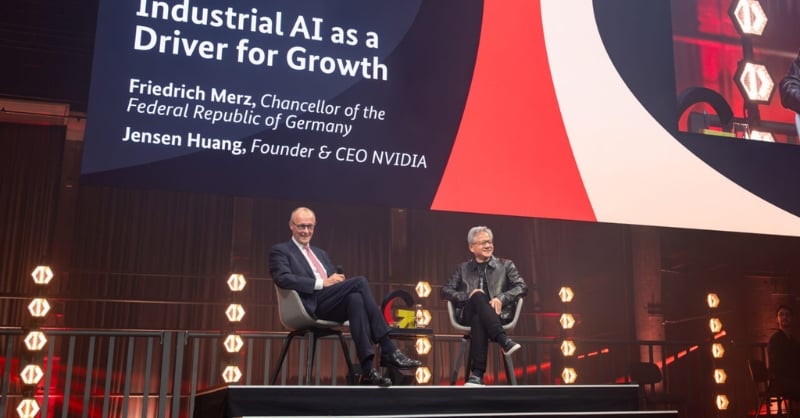
NVIDIA's European expansion includes nearly $10 billion in commitments to the technology ecosystem, according to the company.
The figure encompasses a wider programme of investments and partnerships announced across Europe, rather than a single new investment unveiled during the Berlin keynote.
NVIDIA has also identified more than 12,000 partners working across its European ecosystem, including technology companies, industrial manufacturers, cloud providers, research organisations and startups.
During his keynote, Huang highlighted collaborations with European businesses such as L'Oréal, Revolut, Spotify, Merck, Vodafone, Zara, Porsche, Nestlé and HSBC.
These companies represent sectors ranging from financial services and telecommunications to pharmaceuticals, retail and automotive manufacturing.
Their participation illustrates how artificial intelligence is expanding beyond specialist technology businesses into established industries.
For Europe, this creates opportunities to combine AI capabilities with existing economic strengths.
However, investment commitments and partnership announcements should not be interpreted as evidence that every project has reached commercial deployment or generated measurable economic returns.
Sovereign AI and the Importance of Local Infrastructure
A central theme of NVIDIA's European strategy is sovereign AI, which refers to the ability of countries and organisations to develop and operate AI systems with meaningful control over infrastructure, data and technological capabilities.
Sovereign AI can involve domestically operated computing facilities, locally developed models, data governance frameworks and specialist technical expertise.
The objective is to give governments and businesses greater control over critical AI capabilities rather than depending entirely on external providers.
NVIDIA is supporting these ambitions through accelerated computing infrastructure, AI factory technologies and open models that organisations can adapt using their own information.
During the Berlin keynote, Huang highlighted NVIDIA Nemotron, Cosmos, GR00T and other open model families designed for applications including language processing, robotics and physical AI.
These technologies provide a foundation for organisations developing specialised systems without necessarily training every model from the beginning.
Europe already has an expanding ecosystem of AI developers, with some of the region's most successful AI companies working across foundational models, industrial technologies, infrastructure and emerging applications.
Sovereign AI is therefore not solely about owning data centres. It also involves developing the skills, institutions and businesses capable of using that infrastructure productively.
Europe's Industrial Strengths Could Shape the Next AI Revolution

Europe's manufacturing and engineering capabilities could provide an important advantage in the development of industrial artificial intelligence.
Germany's automotive and advanced manufacturing sectors, France's technology and research ecosystem, and the United Kingdom's strengths in scientific computing and AI research offer different opportunities for specialised applications.
During the keynote, NVIDIA demonstrated how AI agents and simulation technologies could support industrial processes.
At Siemens' Erlangen factory, agents are being developed to assist production planning and evaluate proposed changes using digital twins before implementation.
NVIDIA also highlighted applications involving Dassault Systèmes, where engineering agents can use simulation tools to examine and refine vehicle designs.
These examples demonstrate how artificial intelligence can combine with existing industrial expertise.
Rather than replacing established engineering systems, AI technologies can support workers and organisations in analysing information, evaluating alternatives and improving operational processes.
For European cities and industrial regions, these developments could influence demand for technical skills, specialised infrastructure and investment in advanced manufacturing.
Energy, Computing Capacity and Skills Remain Challenges
Despite the potential opportunities, Europe faces significant obstacles in expanding its AI economy.
Advanced computing infrastructure requires substantial electricity capacity, cooling systems, networking equipment and capital investment.
The development of new AI factories can also involve complex planning, construction and grid-connection requirements.
These constraints are particularly relevant as increasingly sophisticated AI models and autonomous agents increase demand for computing resources.
NVIDIA's DSX infrastructure technologies aim to improve the efficiency and deployment of AI factories, but technology alone cannot resolve all physical infrastructure limitations.
The availability of specialist workers and the ability of businesses to integrate AI into their operations are equally important.
Organisations must understand which applications provide real value, how to manage potential risks and what forms of training are required, especially as AI literacy becomes an increasingly important requirement under the EU AI Act.
The development of sovereign AI capabilities will therefore depend on investment in both infrastructure and human expertise.
What Europe's AI Expansion Means for Cities and Communities
The growth of AI infrastructure could have important implications for European cities and regional economies.
New data centres, research facilities and technology campuses may attract investment, create specialised employment and support local innovation ecosystems.
Industrial regions could benefit from closer collaboration between manufacturers, universities and AI developers.
Cities may also adopt AI applications in transport management, infrastructure maintenance and public administration.
However, these opportunities need to be evaluated alongside electricity demand, land use, environmental impacts and the distribution of economic benefits.
Large computing facilities do not automatically translate into broad local employment or improved public services.
Regional authorities will need to consider whether proposed investments support long-term economic priorities and provide measurable benefits for communities.
Responsible AI development also requires attention to cybersecurity, data protection, transparency and public trust.
These considerations are especially important when AI systems are deployed within essential services or public infrastructure.
From AI Adoption to European Economic Leadership
NVIDIA GTC Berlin 2026 highlights an increasingly important distinction between adopting artificial intelligence and building an economy capable of producing it.
Europe has considerable strengths in scientific research, manufacturing, engineering and industrial technology.
The opportunity is to connect these capabilities with computing infrastructure, specialised models and emerging AI applications.
NVIDIA's expanding partnerships and investment commitments represent one contribution to this wider transformation.
Yet Europe's long-term competitiveness will depend on how effectively businesses, researchers and governments translate investment into useful technologies, skilled employment and sustainable economic growth.
The challenge is not simply to increase computing capacity, but to ensure that European organisations can develop, operate and benefit from the intelligence produced.
As the AI industry evolves, the countries and regions that connect infrastructure with industrial expertise and effective governance will be better positioned to shape its economic future.
Sources
- NVIDIA — GTC Berlin 2026: Live Updates From NVIDIA CEO Jensen Huang's Keynote (21 October 2026)
- https://blogs.nvidia.com/blog/gtc-berlin-2026-keynote/
- NVIDIA — NVIDIA Lands in Europe for GTC Berlin (October 2026)
- https://blogs.nvidia.com/gtc-berlin-2026-news/
- NVIDIA — NVIDIA CEO Drops the Blueprint for Europe's AI Boom (11 June 2025)
- https://blogs.nvidia.com/blog/gtc-paris-2025/
- Citiesabc — The Most Successful AI Companies in EU (3 March 2026)
- https://citiesabc.com/the-most-successful-ai-companies-in-eu
- Citiesabc — Why AI Literacy Is No Longer Optional: The Business Impact of the EU AI Act (7 October 2026)
- https://citiesabc.com/why-ai-literacy-is-no-longer-optional-the-business-impact-of-the-eu-ai-act
Share

Sara Srifi
Sara is a Software Engineering and Business student with a passion for astronomy, cultural studies, and human-centered storytelling. She explores the quiet intersections between science, identity, and imagination, reflecting on how space, art, and society shape the way we understand ourselves and the world around us. Her writing draws on curiosity and lived experience to bridge disciplines and spark dialogue across cultures.


