
citiesabc, first_page
Smart Farming (Part 1): Why the World's Food System Needs a Digital Nervous System
24 Mar 2026

The global food system is broken, not through lack of effort, but through a structural failure to connect knowledge, data, and resources to the 608 million farms that feed the world. The vast majority are smallholdings, worked by families operating with limited technology, uncertain markets and no financial safety net. Meanwhile, cities grow, climate pressures intensify, and an estimated 30–40% of all food produced is lost before it reaches a plate.
This article is the first in a three-part series examining the Citiesabc Impakt Smart Farming 4.0 platform, an AI-driven agricultural system built by Ztudium Group (London) that is actively transforming how farmers, cooperatives, governments and city food authorities connect. Part 1 covers the problem and the technology that addresses it. Parts 2 and 3 will explore the supply chain architecture, international evidence base, and the business and financial model for institutional co-investment.
1. The Scale of the Challenge
Farmers receive just 10–25% of the retail price of the food they grow. An estimated $120B in agricultural subsidies fails to reach its intended beneficiaries every year.
— World Bank, 2023
To understand why a digital intervention platform is necessary, it helps to look at the numbers honestly. The global food system generates approximately $5 trillion in value annually (FAO 2024), yet the people who produce that food, the 2.5 billion people directly involved in agriculture worldwide, are among the most economically excluded on the planet.
There are five compounding structural failures at the heart of this crisis, each measurable, each addressable through targeted digital infrastructure:
1.1 The Five Structural Failures in Global Agriculture
| Failure | Quantified Impact |
| Climate & Environmental Risk | Drought, floods, and soil degradation cause $29B in annual crop losses (FAO 2023); 40% of farmland faces soil degradation risk |
| Financial Exclusion | 1.4 billion smallholder adults are unbanked (World Bank 2023); informal loan rates run at 35–60% APR |
| Market Opacity | Farmers receive only 10–25% of the retail food price; post-harvest loss runs at 16–40% (ICAR Maharashtra) |
| Knowledge Gap | Smallholders operate at just 40–60% of achievable yield due to lack of agronomy advisory and pest diagnosis (CGIAR 2024) |
| Digital Invisibility | No verifiable digital identity means no subsidy access, no insurance, no carbon income , $120B in subsidies annually fails to reach intended recipients (World Bank) |
These failures are not independent , they reinforce each other. A farmer without digital identity cannot access formal credit; without credit, they cannot afford quality inputs; without quality inputs, yields stay low; low yields prevent savings; no savings means no resilience against the next climate event. The cycle repeats, generation after generation.
What breaks this cycle is not a single technology or a standalone app. It is a platform , a joined-up digital ecosystem that addresses identity, knowledge, markets, finance and traceability simultaneously. That is precisely the architecture that the Citiesabc Impakt Platform has been designed to provide.
1.2 Key Market Metrics at a Glance
SOURCES: FAO 2024 · WORLD BANK 2024 · GSMA 2023 · ITU 2023
The opportunity for digital intervention is vast, and the cost of inaction is rising:
Metric | Figure | Source | Implication |
| Farms worldwide | 608 million | FAO 2024 | ~90% are family smallholdings |
| People in agriculture | 2.5 billion | FAO 2024 | Direct food system dependents |
| Global food system value | $5.0 trillion | FAO 2024 | Enormous commercial opportunity |
| Post-harvest food loss | 30–40% | FAO 2023 | Farm to retail waste |
| Agriculture water share | 70% | UN Water | Of all global freshwater use |
| Ag share of GHG emissions | 23% | IPCC AR6 2022 | Major climate mitigation lever |
| Smallholder digital access | <20% | GSMA 2023 | With any digital services |
| Annual AgriTech gap | $300 billion | Blended Finance Taskforce | Annual investment shortfall |
2. Defining Smart Farming 4.0
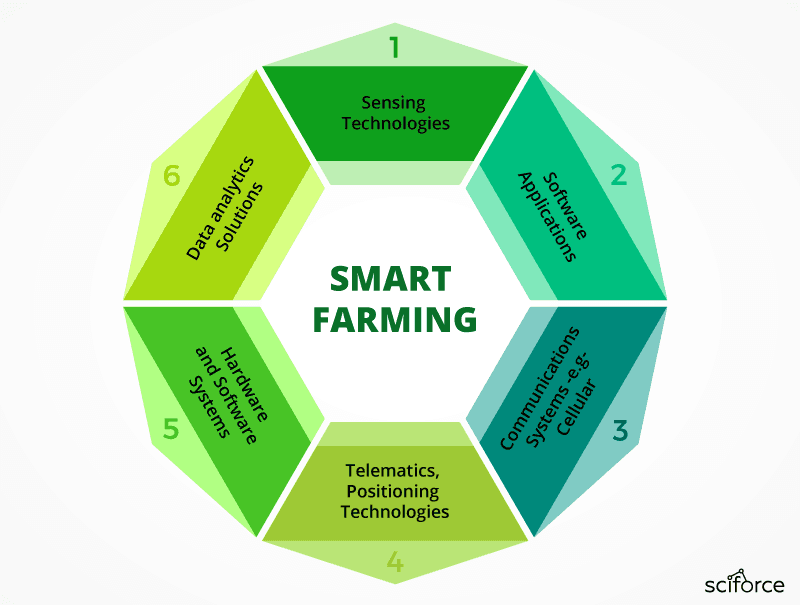
Smart Farming — sometimes called Digital Farming 4.0 — is the application of modern Information and Communication Technologies (ICT) to agricultural systems. It shifts farming from a manual, intuition-based process to a data-driven model in which decisions about planting, irrigation, pest management, and marketing are guided by real-time sensor data and AI-generated recommendations.
The concept is not limited to large industrial farms. The key finding from a decade of deployments across Asia, Africa, and Latin America is that the relative benefit of AI-assisted advisory is actually highest for the least-efficient farmers, the smallholders who currently operate furthest below their yield potential. A 23% average yield improvement (Computers and Electronics in Agriculture, meta-analysis of 147 studies, 2024) means substantially more on a 1-hectare subsistence farm than on a 1,000-hectare commercial operation.
2.1 What Does Smart Farming Look Like in Practice?
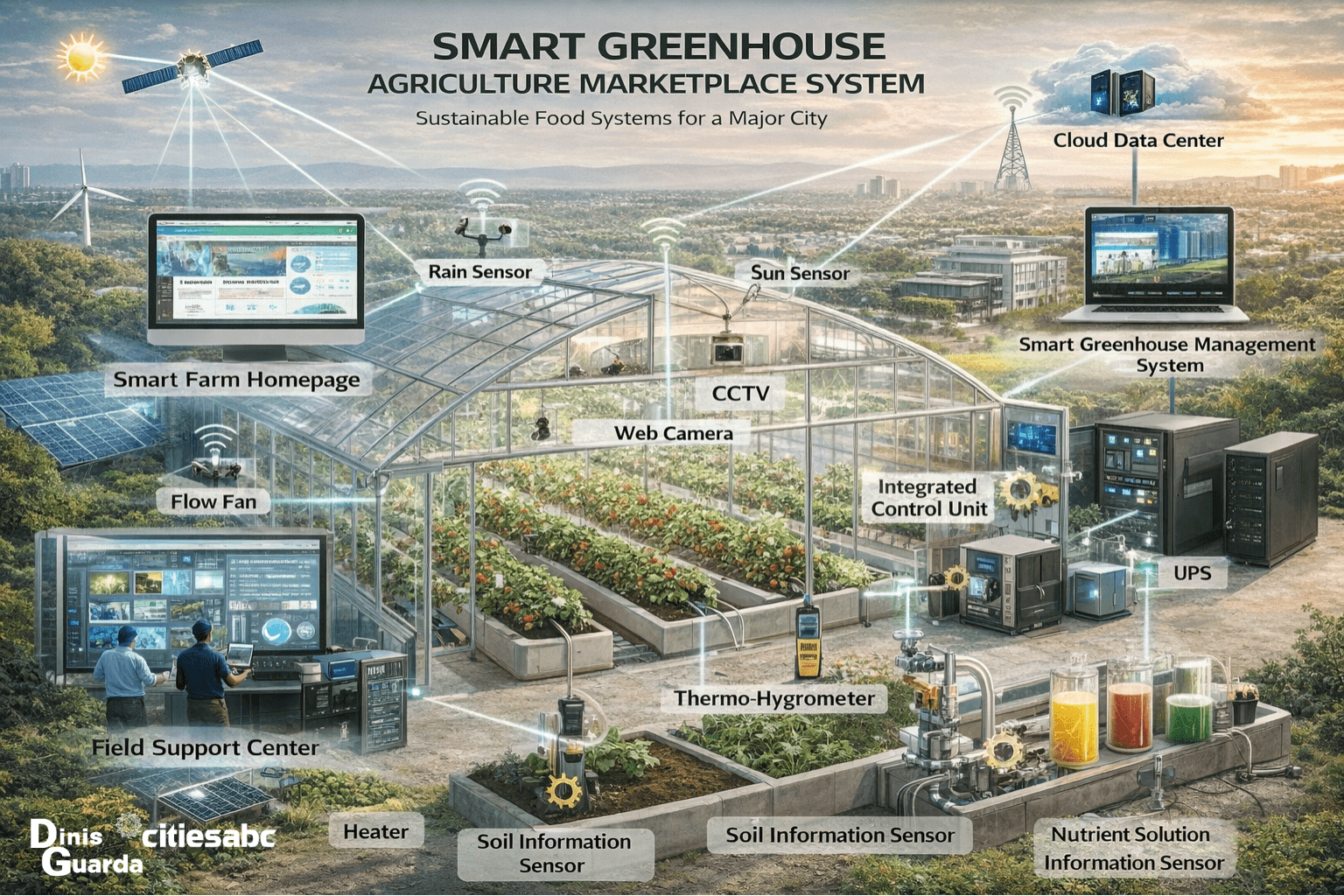
Three straightforward examples illustrate the practical impact:
- Precision Irrigation: Instead of watering on a fixed schedule, soil moisture sensors trigger irrigation only when the crop needs it, reducing water use by 30–50% while improving yields.
- AI Crop Diagnostics: Drone imagery analysed by machine learning models can detect crop stress 14 days before it becomes visible to the human eye, allowing treatment before significant yield loss occurs.
- Livestock Wearables: Biometric monitors on cattle provide continuous health data, alerting farmers to illness before symptoms appear, reducing mortality rates and veterinary costs.
The critical insight is that cooperatives act as technology intermediaries for smallholders who cannot individually afford high-end equipment. A cooperative of 5,000 farmers can collectively access drone fleets, autonomous equipment and AI dashboards, sharing costs in a model analogous to a library that members borrow from rather than own.
3. The Citiesabc Impakt Technology Architecture
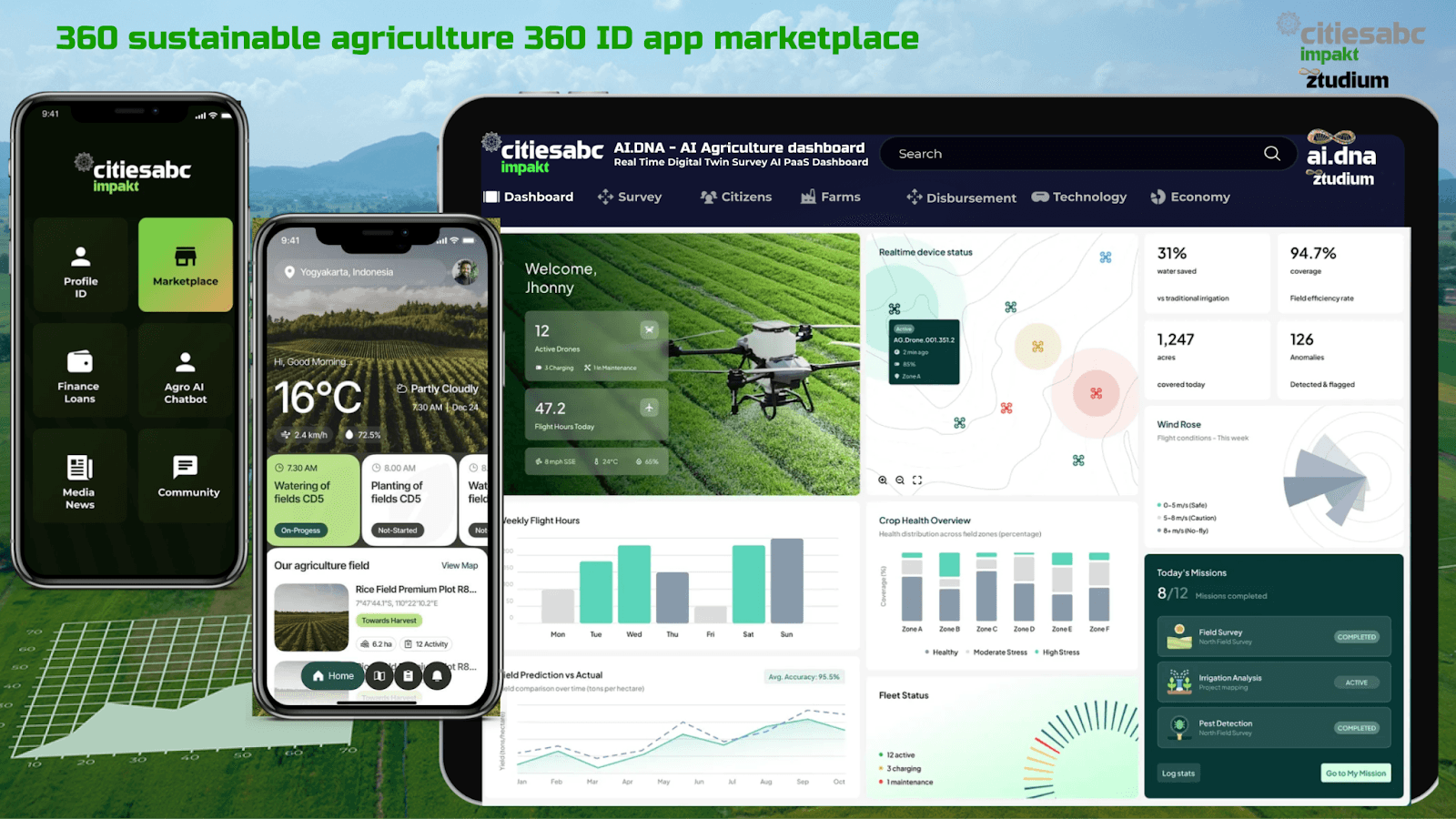
The Citiesabc Impakt Platform, developed by Ztudium Group , is built on six integrated technology layers. Each layer is independently operational and mutually reinforcing. The architecture follows an open-API, plug-and-play design to maximise interoperability with existing government agricultural systems, third-party IoT hardware, and financial infrastructure.
The architecture is offline-first: all mobile features function without connectivity, syncing on next available connection — purpose-built for the rural environments where it is most needed.
3.1 THE SIX-LAYER DIGITAL FARMING STACK
Layer 1 — AI.DNA: The Intelligence Engine
The AI.DNA layer is Ztudium's proprietary large language model and machine learning framework, purpose-built for agricultural applications. Its core capabilities include:
- Crop advisory AI delivering daily planting, pest, and input recommendations
- Computer vision crop and pest disease diagnosis at 92–97% accuracy
- Market price forecasting to advise farmers on optimal selling windows
- Yield modelling integrated with soil, weather, and historical data
- Agro-chatbot operable by voice or text, in local language, over 2G networks — no smartphone required
- Weather intelligence and soil health analytics
The chatbot's 2G capability is architecturally significant. As demonstrated by the iCow programme in Kenya (Furber et al., World Development, 2021), AI advisory delivered via SMS on basic handsets achieved a 32% income uplift for smallholders with no smartphone or internet access. The AI.DNA chatbot is designed to the same minimum viable delivery standard.
Layer 2 — BlocksDNA: Blockchain Infrastructure
BlocksDNA provides the traceability and identity backbone for the entire platform:
- iDNA Farmer Digital Identity — blockchain-verified KYC profile, portable across all services, enabling subsidy access, credit scoring, and insurance eligibility
- Carbon credit tokenisation (Verified Carbon Tokens / VCT) — satellite-verified sustainable practice data converted to tradeable digital assets
- Farm-to-city product traceability — every batch of produce carries an immutable digital record from harvest to retail shelf
- Cooperative governance and input authenticity verification
- Parametric insurance records — enabling 8-day insurance settlement vs. the previous 47-day average (ICAR Maharashtra pilot data)
The iDNA digital identity layer is the foundational commercial infrastructure of the entire platform. Without verified identity, none of the financial, insurance, or carbon income services are possible. Its design is KYC/AML compliant and aligned with World Bank digital ID standards.
Layer 3 — IoT & Sensor Network
The IoT layer provides the real-time field data that powers the platform's AI recommendations:
- Soil moisture, pH, and nutrient sensors with AI-triggered irrigation alerts
- Micro weather stations monitoring temperature, humidity, CO₂, and wind
- LoRaWAN and NB-IoT networks with 10km range, operating on sub-1W power, no 4G or internet required
- Solar-powered off-grid stations for remote deployment
- Smart irrigation controllers with automated trigger integration
LoRaWAN connectivity is the key technical enabler for rural deployment. Operating at 868/915 MHz, it provides 10km sensor range with minimal power consumption — purpose-built for areas where 45% of farming communities lack reliable broadband (ITU 2023). The Netherlands' precision agriculture systems demonstrated 30–50% water savings from sensor-triggered drip irrigation at scale; the Citiesabc Impakt IoT layer directly replicates this architecture.
Layer 4 — Drone & Satellite Layer
Aerial intelligence provides the macro-view of crop and soil health that ground sensors cannot deliver:
- Multispectral/NDVI crop health mapping — detecting plant stress 14 days before visible symptoms
- Precision spraying with AI-guided variable-rate application — reducing chemical input waste
- LiDAR soil and carbon surveys for verified carbon credit generation
- Post-disaster damage assessment — 3x faster than ground survey methods
- Seed and fertiliser aerial application
Brazil's Embrapa Agropensa programme demonstrated national satellite monitoring of 340 million hectares with AI crop yield forecasting at ±4% accuracy 8 months in advance. This is the reference architecture for the Citiesabc Impakt satellite layer, scaled for the Indonesia (36.8M ha) and India (150M ha) deployments.
Layer 5 — Digital Twin Dashboard
The GovTech Platform-as-a-Service (PaaS) command centre provides government food authorities and cooperative managers with a real-time operational picture:
- Real-time farm, district, and national food system monitoring
- Subsidy disbursement tracking and governance KPIs
- Supply chain demand forecasting for city food authorities
- ESG and carbon reporting exports compatible with World Bank, ADB, IFAD, and NDC frameworks
- Offline-capable web and mobile interface
Singapore's 30x30 Food Security Programme demonstrates the value of this layer: AI supply chain intelligence for the city-state's food system reduced logistics costs and food waste by 15–25%, while enabling management of regional supplier networks across Indonesia, Malaysia, and Thailand, identical to the multi-country supply chain intelligence model in the Citiesabc Impakt architecture.
Layer 6 — Marketplace & Financial Services
The revenue-generating layer connects all platform participants in a 360° agricultural economy:
- E-commerce marketplace for agricultural inputs and produce forward contracts
- Microloan and insurance facilitation via AI credit scoring on iDNA profiles
- Carbon credit marketplace — VCT token trading with institutional ESG buyers
- Educational content and agronomy advisory media
- Farmer ID-linked digital wallet for all financial transactions
4. Connectivity Architecture: Reaching the Unreachable
One of the most common objections to digital agricultural platforms is the connectivity challenge:
how do you deliver AI-powered advisory to farmers in areas with no reliable internet?
The Citiesabc Impakt platform was architected specifically to answer this question.
This multi-layer connectivity stack means the platform's minimum viable product , an AI voice advisory chatbot delivering crop, weather, and market recommendations, can reach any farmer in the world who has access to a basic mobile phone and a 2G signal.
Looking Ahead
This first article has established the problem, the five structural failures in the global food system, and the technology architecture designed to address them. The six-layer Citiesabc Impakt stack, from AI advisory and blockchain identity to drone intelligence and government dashboards, provides an end-to-end response to each failure category.
Part 2 will examine how this technology translates into a functioning farm-to-city supply chain: how farmers, cooperatives, logistics networks, and city food authorities connect through the platform's B2B2C2G model. It will also present six international case studies, from the Netherlands, India, Kenya, Indonesia, Singapore, and Brazil, providing the peer-reviewed and programme-evaluated evidence base for each component of the platform.
Part 3 will present the business model, financial projections, and deployment roadmap — including the blended finance architecture that makes the platform accessible to government organisations, development finance institutions, and impact investors, and the 5-year financial model projecting the platform's path from pilot to self-sustaining sovereign-scale deployment.
Key References
- FAO (2024). The State of Food and Agriculture 2024. Food and Agriculture Organization of the United Nations. Available at: https://www.fao.org/publications/fao-flagship-publications/the-state-of-food-and-agriculture/2024/en
- World Bank (2023/2024). Agriculture and Food: Building Climate-Resilient Food Systems. World Bank Group. Available at: https://www.worldbank.org/en/topic/agriculture
- GSMA (2023). The Mobile Economy 2023. GSMA Intelligence. Available at: https://www.gsma.com/mobileeconomy/
- ICAR (2023). Annual Report 2022–2023. Indian Council of Agricultural Research. Available at: https://icar.org.in/content/annual-report
- ITU (2023). Measuring Digital Development: Facts and Figures 2023. International Telecommunication Union. Available at: https://www.itu.int/en/ITU-D/Statistics/Pages/facts/default.aspx
- IPCC (2022). Climate Change 2022: Impacts, Adaptation and Vulnerability (AR6). Intergovernmental Panel on Climate Change. Available at: https://www.ipcc.ch/report/ar6/
- Furber, A. et al. (2021). Mobile advisory systems in smallholder agriculture. World Development, 147, 105600. Available at: https://doi.org/10.1016/j.worlddev.2021.105600
- Wolfert, S. et al. (2017). Big Data in Smart Farming: A review. Agricultural Systems, 153, 69–80. Available at: https://doi.org/10.1016/j.agsy.2017.01.023
- Computers and Electronics in Agriculture (2024). Meta-analysis of AI crop advisory systems: yield improvements across 147 field studies. Available at: https://www.sciencedirect.com/journal/computers-and-electronics-in-agriculture
- CGIAR (2024). Digital Innovation in Agronomy — Pathways for Scaling. CGIAR Excellence in Agronomy Initiative. Available at: https://www.cgiar.org/initiative/excellence-in-agronomy/
- Blended Finance Taskforce (2022). Better Finance Better Food. Dalberg Advisors. Available at: https://www.blendedfinance.earth/better-finance-better-food/


