
citiesabc, first_page
The Best Success Stories for Physical AI, Digital Twins, Super Factories & Smart Cities, Case Studies
22 Oct 2026

We tend to overestimate the effect of a technology in the short run and underestimate the effect in the long run.
— Roy Amara, Institute for the Future (known as Amara’s Law)
Generative AI and accelerated computing have ignited a new industrial revolution.”
— Jensen Huang, announcing the Siemens partnership (January 2026)
The debate over ‘whether Physical AI works’ has now been taken over by ‘who it works for’.
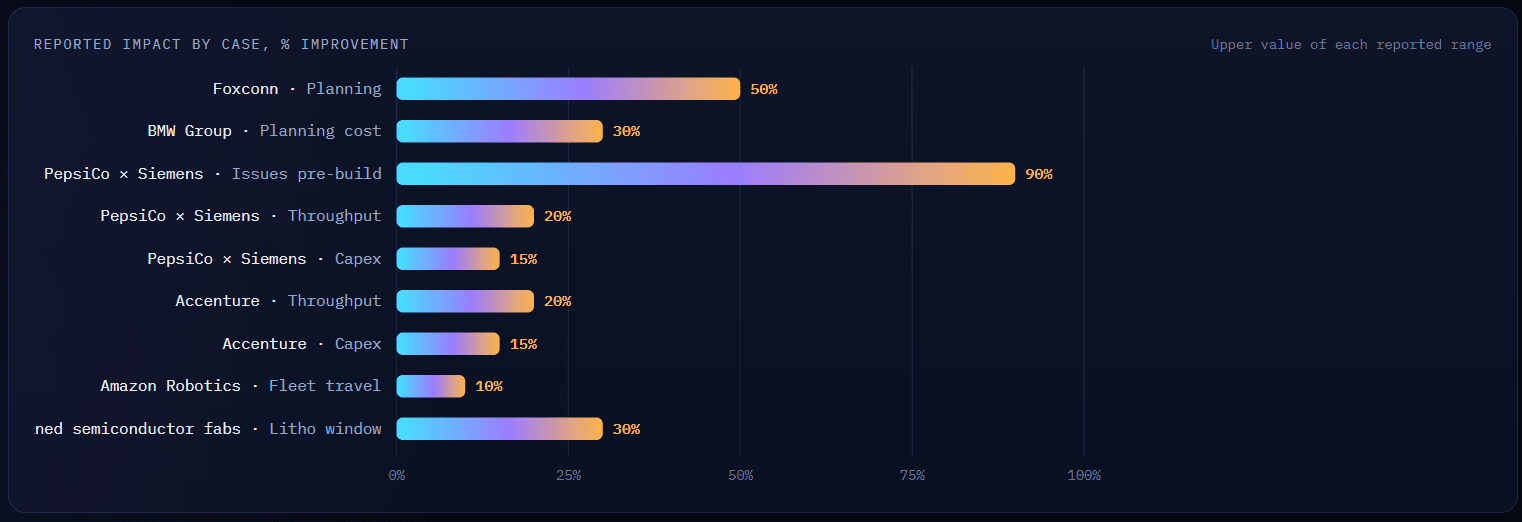
This research extends my white paper Physical AI, Digital Twins, Super Factories and Smart Cities: Can We Create an Abundance Society? It moves from argument to evidence by examining the companies already turning the thesis into production lines, capital budgets and payrolls. BMW validated an entire plant virtually before pouring concrete. Amazon runs more than a million robots. PepsiCo reports 20% more throughput and 10–15% less capex from a twin. Foxconn is using AI to build the factories that build AI.
Key Findings
- The biggest savings come before construction. Virtual planning and validation are reported to cut set-up time by about 50% (Foxconn estimate), collision-check cycles from about four weeks to about three days (BMW), and capital expenditure by 10–15% (PepsiCo/Siemens; Accenture client: 15%).
- Twins compound. The same model serves as a planning tool, robot training gym and live operating console.
- Humanoids are real but early. The Figure 02 programme at BMW Spartanburg ran for 11 months, loading about 90,000 parts. Production Atlas units are now going to Hyundai, and Tesla began slow Optimus production at Fremont this summer. All are measured in thousands of hours and thousands to tens of thousands of units, not millions.
- People do not disappear, but jobs change. Amazon reports that advanced robotics require 30% more employees in reliability, maintenance and engineering roles.
- The loop is closing. Chips make AI, AI makes better chips, and the semiconductor industry reports 30–85× speed-ups in simulation and inference.
- Evidence quality varies. Almost every figure below is vendor-reported. None has been independently audited.
Selection and Method
The cases were chosen on three criteria: they are large enough to matter, documented enough to be checked, and diverse enough to show the pattern is not peculiar to one sector. They span electronics, automotive, consumer goods, logistics, robotics, semiconductors, energy and cities.
Each case carries a deployment status tag:
- In production: running in live operations at commercial scale.
- Scaling: proven in initial deployments and being extended to more sites.
- Pilot / demonstration: limited deployment, announced programme or prototype.
Figures are reported as the companies disclosed them and are attributed in the text. Vendor-reported results should be read as indicative, not definitive. Where a result is an estimate, a projection or a proposal rather than a measured outcome, we say so.
Manufacturing and Industry
Foxconn: The factory that builds AI factories (Scaling)
Hon Hai Technology Group (Foxconn), the world's largest electronics contract manufacturer, is the clearest example of a company using AI to make the infrastructure of AI. Its Fii Omniverse Digital Twin (FODT) platform creates virtual replicas of factories producing NVIDIA GB200 Grace Blackwell systems, connected to manufacturing execution systems (MES), shop-floor control and automation systems for real-time KPI dashboards.
- Planning time. Leo Guo, general manager of Fii's Robotic Group, estimates that virtual modelling can cut time to revenue, factory set-up and planning "by about 50%". Entire production lines are assembled virtually and then duplicated between sites, as in a migration from Taiwan to Mexico.
- Thermal simulation. Using NVIDIA PhysicsNeMo trained on data from Cadence's CFD solver, Foxconn runs computational fluid dynamics simulations up to 150 times faster than conventional methods.
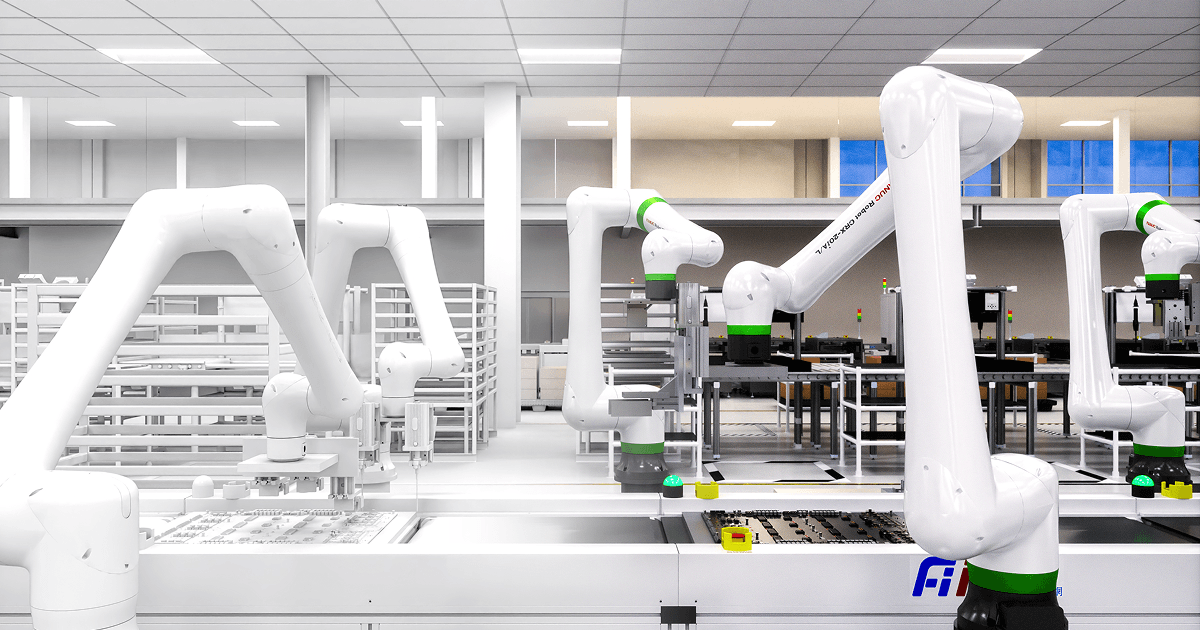
- Robotics. Screw-tightening and cable-insertion tasks are refined in Isaac Sim and Isaac Lab. FANUC robot models are integrated into the virtual lines, and humanoid development uses Isaac GR00T.
- Houston. At GTC Washington in October 2025, Foxconn announced that its 242,287 sq ft Houston facility, which makes NVIDIA AI infrastructure systems, would be among the first to deploy humanoid robots powered by Isaac GR00T N models on production lines. The facility was designed in Omniverse and its systems validated before construction using Siemens' digital twin stack.
- Humanoid investment. In 2026 Foxconn also moved from customer to backer: it is leading the roughly US$200 million PIPE in Agility Robotics' public listing (see the Top 36).
Why it matters: The twin is not a one-off planning exercise but a replicable template. A line perfected once in simulation can be copied across continents, the manufacturing equivalent of software's near-zero marginal cost.
BMW Group: The virtual factory (In production; humanoid programme completed)
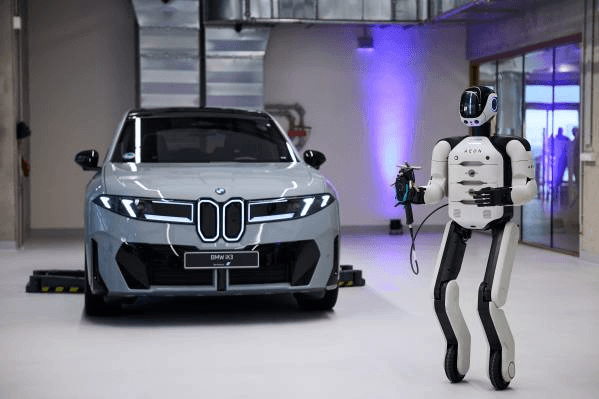
BMW was among the first automotive groups to make the twin a corporate standard. From 2020 it 3D-scanned all its vehicle and engine plants. In March 2023, at NVIDIA GTC, it announced that virtual production was under way at its future plant in Debrecen, Hungary, more than two years before series production, making Debrecen "the first facility planned and validated entirely virtually". Production board member Milan Nedeljković called real-time collaborative planning "a revolution in factory planning".
BMW reports:
- twins spanning more than 30 plants;
- collision checks cut from almost four weeks to about three days;
- projected planning-cost reductions of up to 30% (a projection, not a measured result);
- series production of the Neue Klasse iX3 at Debrecen since late 2025.
The humanoid test at Spartanburg. At its South Carolina plant, BMW became the proving ground for humanoids. A fleet of Figure AI's Figure 02 robots ran an 11-month programme with these reported results:
| Metric | Reported result |
|---|---|
| Sheet-metal parts loaded | About 90,000 |
| BMW X3 vehicles contributed to | More than 30,000 |
| Runtime logged | Over 1,250 hours |
| Placement accuracy | 99% |
| Shift length reached | Full 10-hour shifts by month ten |
The robots were retired in late 2025. Their wear data, notably thermal stress in the forearm, fed directly into the redesign of Figure 03. This is the data flywheel at company scale. Note that the digital twin programme is in production, while the humanoid deployment was a time-limited pilot.
PepsiCo × Siemens × NVIDIA (Scaling)
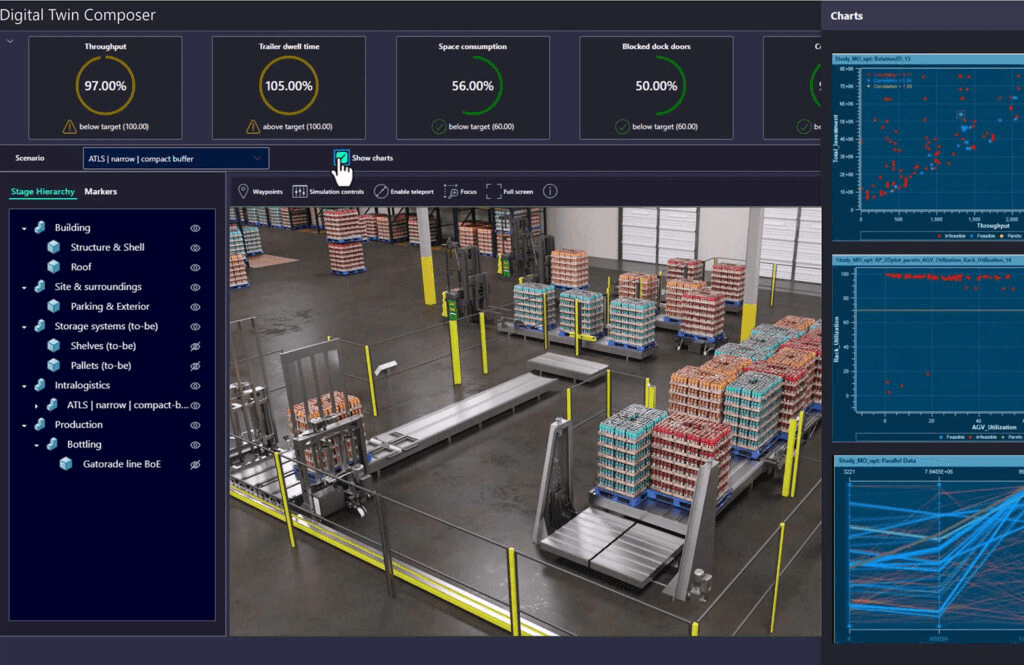
Announced at CES in January 2026, PepsiCo and Siemens built high-fidelity digital twins of selected US manufacturing and warehouse sites using Siemens' digital twin technology and NVIDIA Omniverse libraries. The reported results are among the most complete published for a consumer-goods operation:
- up to 90% of potential issues identified before physical changes were made;
- 20% throughput increase on initial deployment;
- 10–15% reduction in capital expenditure;
- nearly 100% design validation.
At the same show Siemens launched Digital Twin Composer, due on the Siemens Xcelerator Marketplace from mid-2026. It lets engineers build a 3D model of a product, process or plant and "move through time" to see the effects of weather or engineering changes. Siemens also announced nine new industrial AI copilots across Teamcenter, Polarion and Opcenter.
Siemens Electronics Factory, Erlangen (Pilot, scaling from 2026)
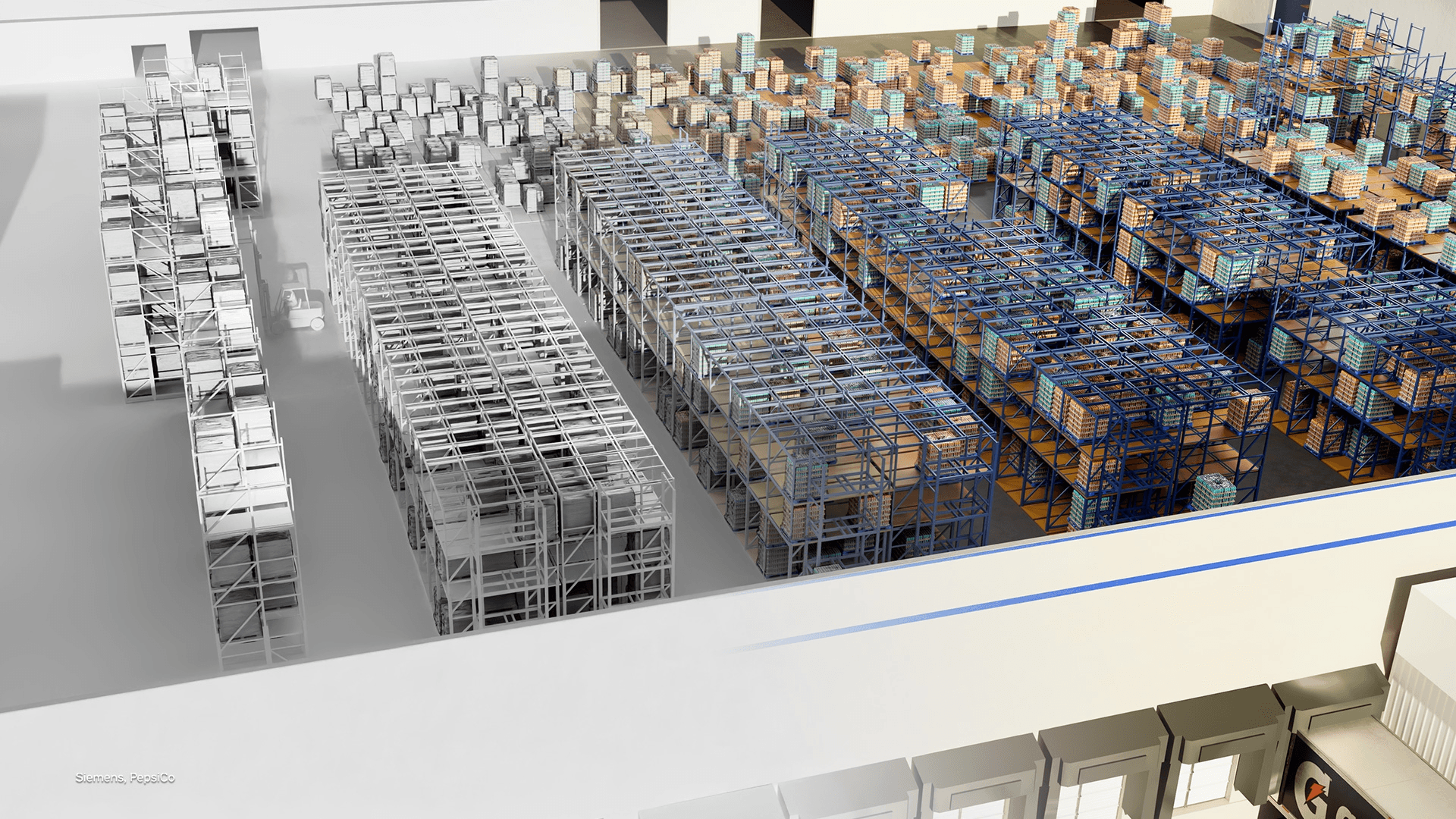
In January 2026 Siemens and NVIDIA announced their intention to build an "Industrial AI Operating System" and to create fully AI-driven, adaptive manufacturing sites, starting with the Siemens Electronics Factory in Erlangen, Germany, in 2026. NVIDIA supplies infrastructure, simulation libraries, models and blueprints, and Siemens commits hundreds of industrial AI experts. The partnership extends to AI-native electronic design automation using NVIDIA NIM and Nemotron models. Jensen Huang framed it in civilisational terms: "Generative AI and accelerated computing have ignited a new industrial revolution."
Accenture Physical AI Orchestrator (Scaling)
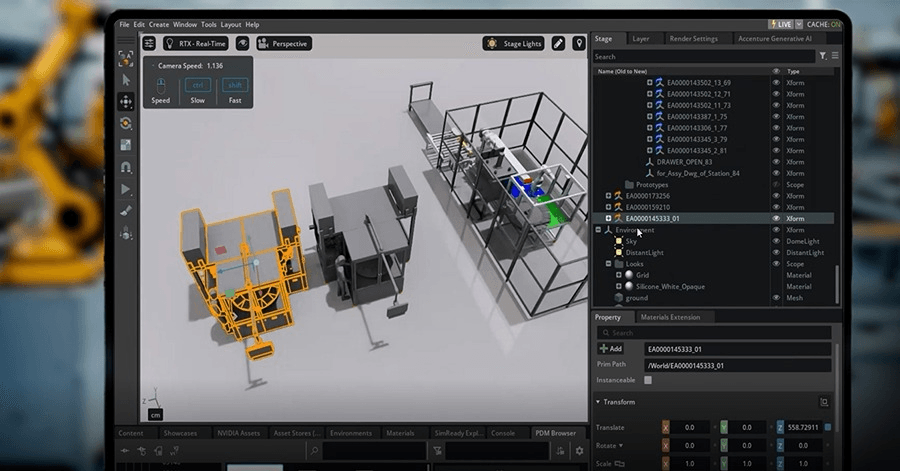
Launched on 28 October 2025 at GTC Washington, Accenture's cloud-based Physical AI Orchestrator combines the Omniverse Mega blueprint, NVIDIA Metropolis vision AI and agents from Accenture's AI Refinery. In Accenture's words, it "acts as a brain for a physical space". Reported deployments include:
- A consumer-goods manufacturer. A warehouse twin analysing worker movement, picking rates and conveyors delivered a 20% throughput improvement and 15% capital expenditure savings by avoiding trial-and-error redesign.
- Belden. A "virtual safety fence": edge AI models the movement of people, vehicles and robots, and robots stop or reroute when a person enters a zone.
- A life-sciences company. Simulation of the drying of biologics and vaccines pinpointed when, where and why deviations occurred, reducing batch variability and extending shelf life.
Accenture has also demonstrated warehouse twins with KION Group and GXO, in which robot fleets are trained end to end in a virtual sandbox before deployment.
AI-defined semiconductor fabs (Scaling)
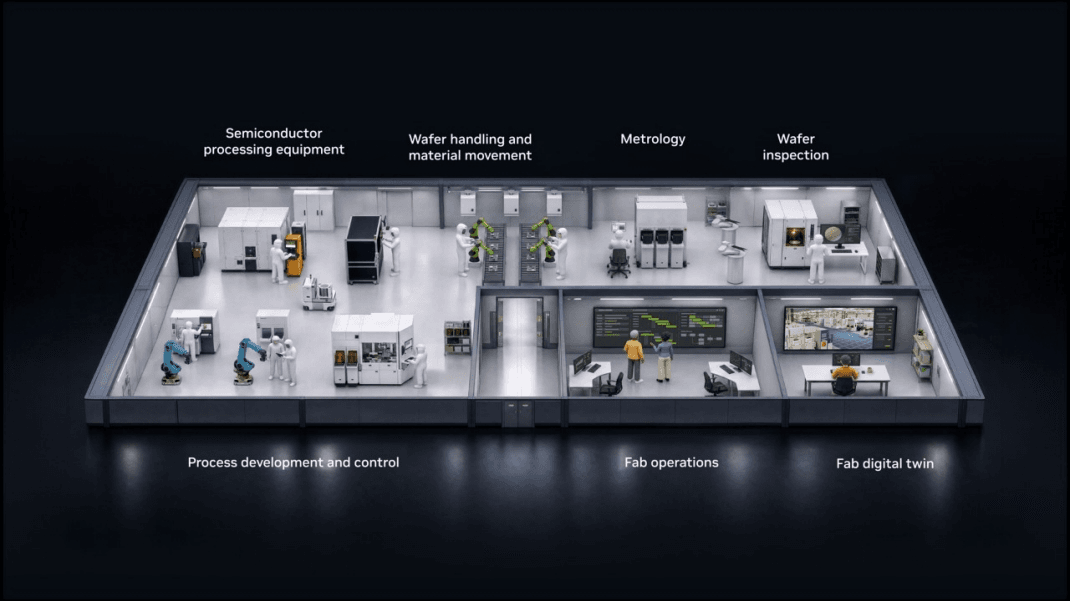
Chip fabrication is the most demanding manufacturing environment on Earth, and therefore the strongest test of the thesis. At SEMICON West on 14 October 2026, NVIDIA and semiconductor leaders announced a wave of AI and twin integrations for "AI-defined fabs":
| Company | Reported result |
|---|---|
| Lam Research | Wafer-etch modelling up to 30× faster; plasma prediction cut from days to milliseconds |
| Applied Materials | Chamber simulations up to 35× faster |
| KLA | Inspection kernels 50× faster than earlier CPU versions |
| imec | 30% improvement in lithography process window |
| Teradyne | Probe-maintenance inference about 85× faster |
| Voltai | 3D-IC electro-thermal-mechanical workflows cut from months to a day |
The semiconductor industry made the AI revolution possible. Now, AI is transforming how chips are built,
said NVIDIA's Tim Costa. The loop closes: chips make AI, AI makes better chips.
Logistics and Robotics
Amazon Robotics: one million robots (In production)
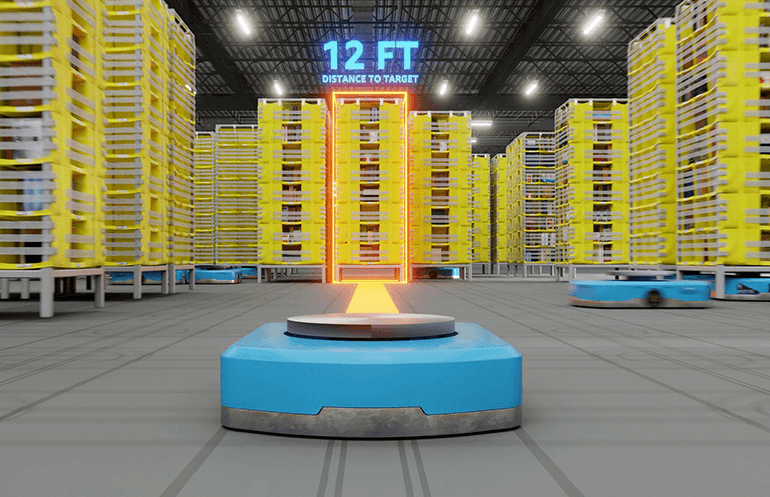
On 30 June 2025 Amazon announced that it had deployed its one-millionth robot, at a fulfilment centre in Japan, across a network of more than 300 facilities worldwide. It simultaneously launched DeepFleet, a generative foundation model for coordinating fleet movement that it says improves robot travel efficiency by 10%. Scott Dressner, vice-president of Amazon Robotics, described it as "an intelligent traffic management system".
Amazon's own disclosures add a crucial nuance for the abundance debate: advanced robotics require 30% more employees in reliability, maintenance and engineering roles. Automation changed jobs. It did not remove the need for people. Whether the net employment effect is positive remains an open question that company disclosures alone cannot settle.
Hyundai Motor Group × Boston Dynamics × Google DeepMind (Pilot; production from 2026)
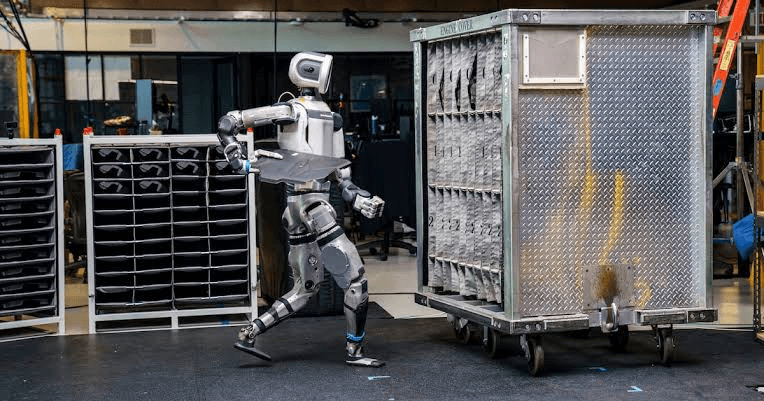
At CES on 5 January 2026, Boston Dynamics unveiled the production version of its electric Atlas humanoid:
- 56 degrees of freedom and a 2.3 m reach;
- 50 kg lift capacity;
- operation from −20°C to 40°C;
- autonomous battery swapping;
- fleet-wide skill sharing: "a task learned by one robot can be copied across the whole fleet".
All 2026 deployments were already committed, with fleets bound for Hyundai's Robotics Metaplant Application Center (RMAC) and Google DeepMind. Hyundai, Boston Dynamics' majority shareholder, plans to deploy tens of thousands of its robots. It has announced a US$26 billion US investment that includes a robotics factory with capacity for 30,000 robots a year by 2028, and will integrate Google DeepMind foundation models into Atlas. CEO Robert Playter called it "the best robot we have ever built."
Update (September 2026). Boston Dynamics opened the RMAC inside Hyundai's Georgia Metaplant on 21 September 2026. It describes the centre as a "robot behaviour factory" that pairs Atlas units with human pilots to generate training data, the first step in a plan for about 25,000 Atlas units across Hyundai and Kia plants. Other industries are due to follow from 2027.
Cities, Infrastructure and Energy
| Case | Status | What is reported |
|---|---|---|
| Virtual Singapore | In production | The reference national-scale twin, used by government agencies for planning, solar potential and accessibility analysis. |
| Helsinki open 3D city models | In production | Open data supporting energy and climate planning in districts such as Kalasatama. |
| AES and the Maximo robot | Scaling | Used Omniverse libraries and Isaac to test updates in simulation. Four robots installed 100 MW of solar panels by March 2026. |
| NVIDIA Omniverse DSX (AI factories and grid) | Scaling | Blueprint generally available since March 2026. Schneider Electric (ETAP), GE Vernova, Siemens Energy, Cadence and others model power, cooling and grid interaction before an AI factory is built. |
| ztudium Sportsdna smart-stadium solutions | Pilot / demonstration | BIM-based twins for crowd management, energy and fan experience, documented in the Enterprise Metaverse Digital Twins ABC for venues including Benfica's Estádio da Luz. |
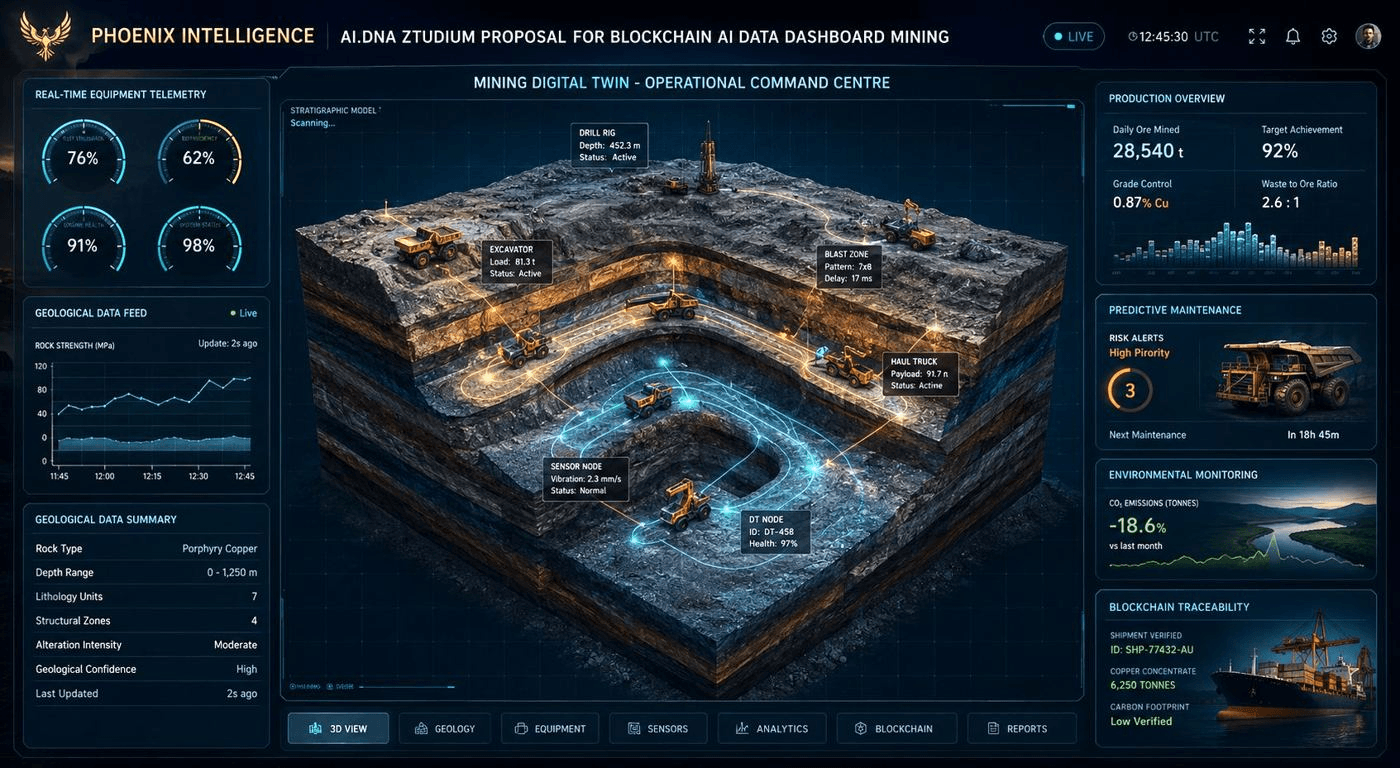
| ztudium AI.DNA mining command-centre twins | Proposal | Combines drone, fleet and sensor data with blockchain provenance (BlocksDNA) for responsible-sourcing verification. The same architecture has been proposed for cobalt provenance in the Democratic Republic of the Congo. |
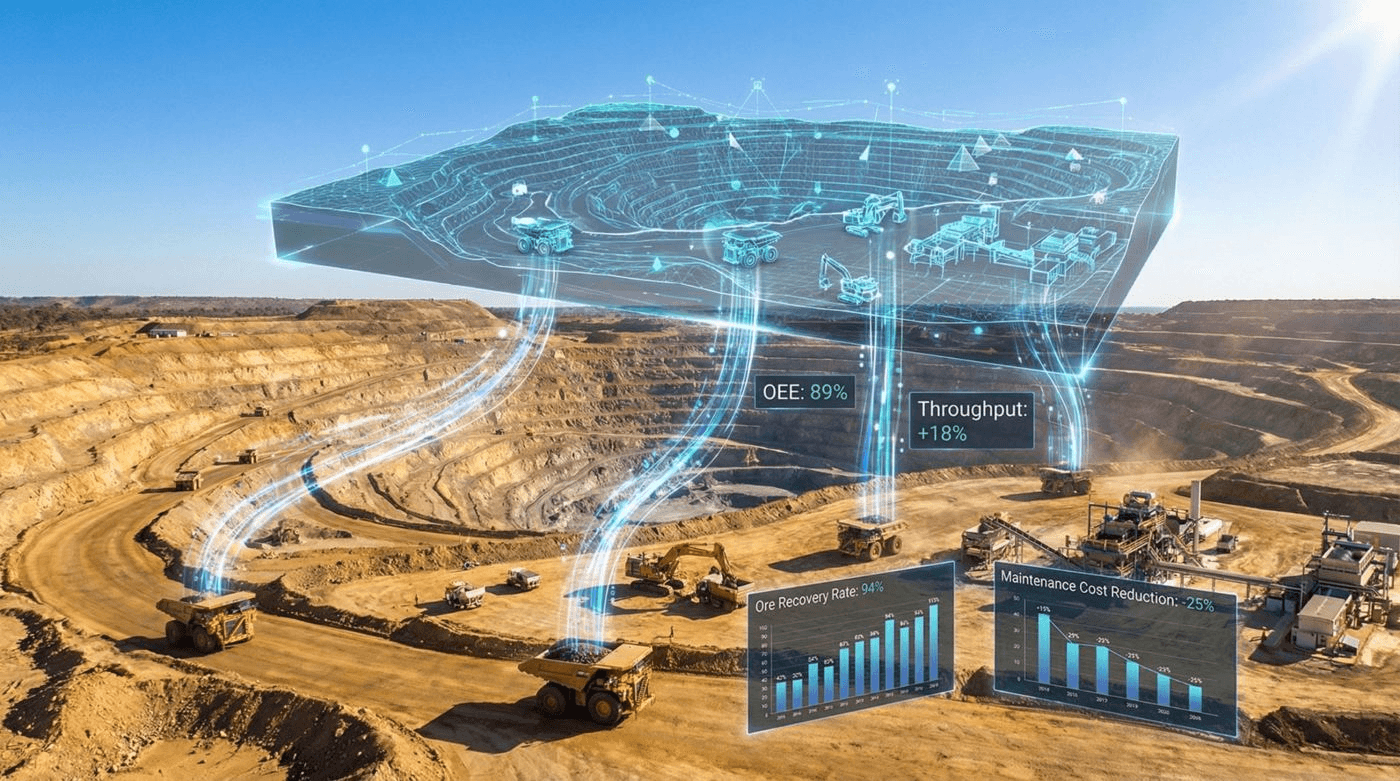

Disclosure: the last two entries are ztudium's own work and are included as design examples.
What the Evidence Says
| Organisation | Status | Platform / partners | Reported impact |
|---|---|---|---|
| Foxconn | Scaling | Fii Omniverse Digital Twin, Isaac, PhysicsNeMo, Siemens | ~50% planning-time cut (estimate); CFD up to 150× faster |
| BMW Group | In production | Omniverse, Figure AI | 30+ plants twinned; collision checks ~4 weeks to ~3 days; 90k parts loaded by humanoids |
| PepsiCo | Scaling | Siemens Xcelerator, Omniverse | 90% issues found pre-build; +20% throughput; −10–15% capex |
| Accenture (CPG client) | Scaling | Physical AI Orchestrator, Mega, Metropolis | +20% throughput; −15% capex |
| Amazon | In production | DeepFleet, 1M+ robots | +10% fleet travel efficiency; 30% more technical roles |
| Hyundai / Boston Dynamics | Pilot to production | Atlas, DeepMind | RMAC opened Sept 2026; ~25,000 Atlas planned; 30k/yr robot factory by 2028 |
| Semiconductor fabs | Scaling | CUDA-X, PhysicsNeMo, Omniverse | 30–85× faster simulation and inference; +30% litho window |
Four patterns
- The biggest savings come before construction. A 10–15% capex saving on a multi-billion-dollar plant dwarfs most operational gains.
- Twins compound. The same model used for planning becomes the training gym for robots and then the operating console.
- Humanoids are real but early. Global humanoid shipments passed 22,000 units in the first half of 2026 (Counterpoint), and the Figure, Atlas and Optimus programmes are measured in thousands of hours and tens of thousands of planned units, not yet millions.
- People do not disappear. Amazon's 30% increase in technical roles and BMW's human-supervised humanoid shifts suggest the frontier is augmentation, at least for now.
Limits of the Evidence
- Vendor-reported. Most results come from NVIDIA, its partners or the adopting companies' own announcements, often at launch events. Independent audits are largely absent.
- Estimates and projections mixed with measurements. Foxconn's 50% is an estimate and BMW's 30% planning-cost saving is a projection. Treat them differently from measured outcomes such as BMW's collision-check times or Figure's runtime hours.
- Selection effects. Published cases are successes. Failed or abandoned programmes rarely issue press releases.
- Single-ecosystem concentration. Nearly every case runs on the NVIDIA and OpenUSD stack, which is the subject of Chapter 4. That is evidence of ecosystem maturity, and also of dependence.
- Employment effects unresolved. Amazon's 30% figure counts specific technical roles. It does not measure net jobs across the network.
Sources
- TechCrunch (21 Oct 2026). Tesla starts Optimus robot production in California as profit falls 43%
- CNBC (21 Oct 2026). Tesla Q3 2026 earnings report
- Reuters via The Star (5 Oct 2026). Foxconn third-quarter revenue soars on AI demand
- Pulse 2.0 (Oct 2026). Agility Robotics and Churchill Capital Corp XI move SPAC deal toward November vote
- Finviz / Business Wire (13 Oct 2026). Agility Robotics S-4 declared effective by SEC
- NVIDIA (14 Oct 2026). NVIDIA and Semiconductor Leaders Advance AI Across Chip Design and Manufacturing for AI-Defined Fabs
- Reply (19 Oct 2026). Reply earns NVIDIA Physical AI Specialization
- Counterpoint Research (19 Aug 2026). Global humanoid robot shipments soar nearly 300% YoY in H1 2026
- SCMP (2026). AgiBot overtakes Unitree as top global humanoid robot vendor
- TechNode (27 Jul 2026). AgiBot starts Hong Kong IPO process
- Gasgoo (Aug 2026). Unitree IPO priced at 150.80 yuan per share
- AI Weekly / Bloomberg (Sept 2026). Skild AI hits US$100M revenue run rate
- Bloomberg Law (27 Mar 2026). Physical Intelligence in talks for US$1 billion at US$11 billion
- GIGAZINE (31 Jul 2026). Google DeepMind announces Gemini Robotics 2
- Microsoft (16 Mar 2026). Microsoft at NVIDIA GTC: Foundry, Azure AI infrastructure and Physical AI
- HPCwire (16 Mar 2026). NVIDIA releases Vera Rubin DSX AI Factory reference design and Omniverse DSX Blueprint
- NVIDIA blog. Omniverse DSX Blueprint
- PTC (17 Mar 2026). PTC connects Onshape to NVIDIA Isaac Sim
- Rockwell Automation. Rockwell brings autonomous operations to life using NVIDIA Omniverse
- Synopsys (17 Jul 2025). Synopsys completes acquisition of Ansys
- Business Wire (9 Mar 2026). ABB Robotics partners with NVIDIA (RobotStudio HyperReality)
- SoftBank Group (8 Oct 2025). Acquisition of ABB Ltd's Robotics Business
- Industrial Machinery Digest (2026). KUKA unveils KUKA AMP at NVIDIA GTC 2026
- NVIDIA. Universal Robots accelerates cobot development with NVIDIA
- heise (2026). 1X to deliver humanoid household robot NEO to US customers in 2026
- SentiSight (19 Mar 2026). Disney Olaf robot walks at NVIDIA GTC 2026
- Boston Dynamics (5 Jan 2026). Boston Dynamics unveils new Atlas robot
- Crypto Briefing (Oct 2026). Nvidia nears $6 trillion market cap
- OECD OPSI. Virtual Singapore – Singapore's virtual twin
Case studies
- NVIDIA. "Foxconn Develops Physical AI-Enabled Smart Factories With Digital Twins" (case study)
- TechInformed (29 Oct 2025). "Foxconn to Use Humanoid Robots at Houston AI Server Plant"
- BMW Group (21 Mar 2023). "Virtual production under way in future plant Debrecen"
- BGR (4 Dec 2025). "Humanoid AI Robot Retired After Working on Over 30,000 BMW X3 Cars"
- Siemens / Manufacturing.net (Jan 2026). "Siemens Bets on Nvidia to Push AI-Driven Manufacturing"
- Accenture (28 Oct 2025). "Accenture Launches Physical AI Orchestrator"
- The Robot Report (1 Jul 2025). "Amazon Launches New AI Foundation Model, Deploys 1 Millionth Robot"
- NVIDIA (28 Oct 2025). "NVIDIA and Partners Build America's AI Infrastructure and Create Blueprint to Power the Next Industrial Revolution"
- TradersDNA (2026). Trading Tools Directory (methodology reference)
Share

Dinis Guarda
Dinis Guarda is an author, entrepreneur, founder CEO of ztudium, Businessabc, citiesabc.com and Wisdomia.ai. Dinis is an AI leader, researcher and creator who has been building proprietary solutions based on technologies like digital twins, 3D, spatial computing, AR/VR/MR. Dinis is also an author of multiple books, including "4IR AI Blockchain Fintech IoT Reinventing a Nation" and others. Dinis has been collaborating with the likes of UN / UNITAR, UNESCO, European Space Agency, IBM, Siemens, Mastercard, and governments like USAID, and Malaysia Government to mention a few. He has been a guest lecturer at business schools such as Copenhagen Business School. Dinis is ranked as one of the most influential people and thought leaders in Thinkers360 / Rise Global’s The Artificial Intelligence Power 100, Top 10 Thought leaders in AI, smart cities, metaverse, blockchain, fintech.


