
Businesses
The Explosion of AI Agents: Dinis Guarda and the Sheaf Founders Ask "Who Stops the AI Agent?"
13 Oct 2026

A 60-minute YouTube podcast and live webinar reveals why every AI agent will need an ID, a passport and a signed record, and the five moves leaders should make this quarter.
AI agents have stopped talking and started acting. They read files, move money, answer customers and increasingly sign in people's names. On October 16, 2026, Dinis Guarda, author, global thought leader, and Creator of Businessabc.net, Citiesabc.com, and IntelligentHQ.com will host ‘The Explosion of AI Agents: NVIDIA OpenShell, What You Need to Do Now,’ a free 60-minute YouTube Webinar for the leaders who must govern them.
Host Dinis Guarda is joined by co-host Goncalo Pratas Pereira, CTO of Ztudium, and by the founders of Sheaf, the company building the mathematical signalling layer for NVIDIA OpenShell: Jack Widman, PhD, a topologist affiliated with Ben-Gurion University, and Phil Grady, founder of UK affordability fintech Castlight Financial.
The winners of the next five years will be the ones who can prove what their agents did and why. An agent without identity is an anonymous insider with your keys. Just as no one crosses a border without a passport, no agent should enter your systems without an ID, an accountable owner, defined limits and a signed record of what it did.
- Dinis Guarda
The problem: 109 machines for every human
Palo Alto Networks' survey of 2,930 security leaders highlight that machine identities now outnumber humans 109 to one in the average enterprise, and roughly 79 of them are AI agents.
The market is growing fast. Analyst forecasts put it at roughly $11 billion this year and $48 to $53 billion by 2030. Yet Gartner expects more than 40% of agentic AI projects to be cancelled by the end of 2027, and McKinsey finds that 62% of organisations are experimenting with agents while only 23% are scaling them.
Most agent failures aren’t dramatic hacks. They’re quiet, plausible decisions made on data nobody checked. The fix is to verify the decision, not just the model.
A single LLM can be fluent and wrong at the same time. When several agents disagree, that disagreement is the cheapest early-warning signal you will ever get. It is important to identify these red flags and take a proactive approach to the problem.
- Goncalo Pratas Pareira.
What the audience will learn
- What NVIDIA OpenShell is. The open-source, Apache 2.0 runtime NVIDIA released at GTC in March sandboxes each agent and enforces, at the kernel level, which files, networks, tools and credentials it may reach. Policy lives outside the agent, so a compromised agent cannot talk its way past it.
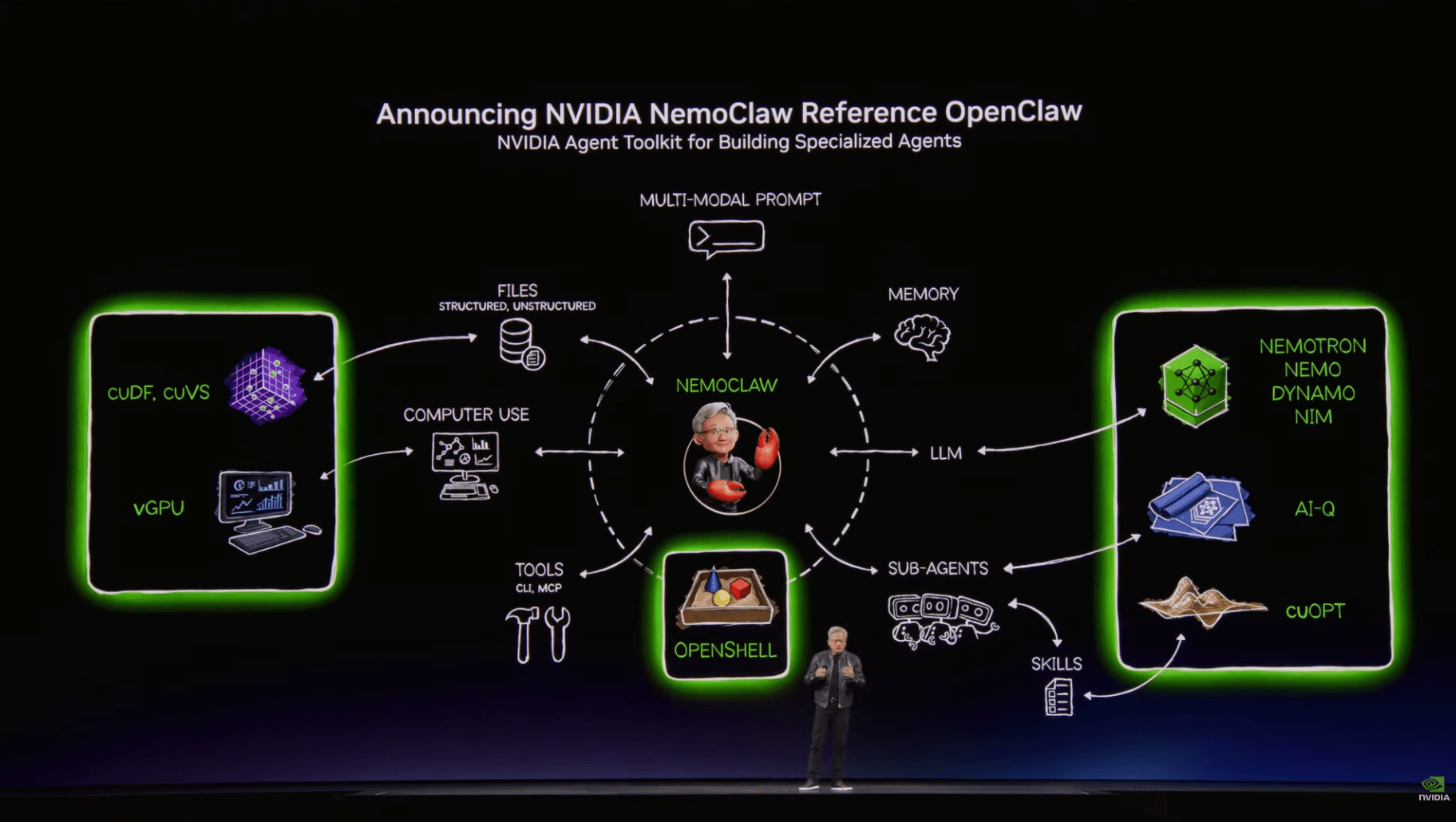
- How Sheaf adds the signals. OpenShell decides what an agent may reach. Sheaf checks whether what it is about to do adds up, using sheaf cohomology to catch contradictions that pairwise checks miss. When three agents each look fine but cannot all be right, Sheaf flags it and a human clears the decision. Every run ends with a signed record that a risk team can sign, a regulator can read and a board can rely on.
- Eight industries in eighteen minutes. One case study, one number, one risk and one fix each for banking, insurance, SMEs, marketing, business, education, entertainment and healthcare, including Mastercard Agent Pay, Allianz Project Nemo, Meta and Manus, Epic and ECU Health.
- The seven-field agent passport. Identity, operator, principal, scope, provenance, record and revocation, and how Visa's Trusted Agent Protocol, Mastercard Agentic Tokens and Google's AP2 point toward "Know Your Agent" as the counterpart to "Know Your Customer."
- A playbook by audience. Five practical moves each for investors, developers, startups, and enterprises and banks.
We also need systems that check the evidence behind an AI’s decisions, flag contradictions, and block actions that violate safety rules, before they happen.
— Jack Widman, PhD, Co-founder of Sheaf
Interactive features
Viewers can join a live poll ("Which industry gets transformed first?") , submit questions for the live Q&A.
How to register
- Open the registration page at https://luma.com/7lnpai8f
- Register your details: name, work email, phone number etc..
- Save the date. Use the confirmation email to add the session to your calendar.
- Join live on October 16, 2026 at 03:00 pm BST. Click the link in your reminder, vote in the poll and post your questions in the chat.
- Check out the AI Agents 101 Atlas in IntelligentHQ from the YouTube Description.
Who should attend
Bank, insurer and enterprise leaders, founders, investors and developers who are deploying, funding or governing AI agents.
About the Dinis Guarda
Dinis Guarda is an author, entrepreneur, founder CEO of ztudium, Businessabc, citiesabc and Wisdomia.ai. Dinis is an AI leader, researcher and creator who has been building proprietary solutions based on technologies like digital twins, 3D, spatial computing, AR/VR/MR. Dinis is also an author of multiple books, including "4IR AI Blockchain Fintech IoT Reinventing a Nation" and others. Dinis has been collaborating with the likes of UN / UNITAR, UNESCO, European Space Agency, IBM, Siemens, and governments like USAID, and Malaysia to mention a few. He has been a guest lecturer at business schools such as Copenhagen Business School. Dinis is ranked as one of the most influential people and thought leaders in Thinkers360 / Rise Global’s The Artificial Intelligence Power 100, Top 10 Thought leaders in AI, smart cities, metaverse, blockchain, fintech.
About Gonçalo Pratas Pereira
Goncalo Pratas Pereira is CTO of Ztudium and co-host of the webinar. He is an IT and technology leader with deep expertise in system integration, cloud computing, data infrastructure and artificial intelligence, and a background in electronics and telecommunications engineering. His work focuses on connecting AI-driven systems, immersive technologies and digital infrastructure with business strategy and real-world impact. He is particularly interested in how AI and emerging technologies can enhance education, cities and large-scale digital transformation.
About Jack Widman, PhD
Jack Widman is co-founder of Sheaf. He holds a PhD in mathematics, specialising in topology, and is an affiliated researcher in the foundations of computer science at Ben-Gurion University.
About Phil Grady
Phil Grady is co-founder of Sheaf. A venture builder, he is the founder of Castlight Financial, one of the UK's leading affordability fintechs.
About Sheaf
Sheaf is building a verification layer for NVIDIA's open-source OpenShell runtime. It checks whether the claims made by different AI agents are consistent with one another, flags contradictions that simple pairwise checks can miss, and hands the decision to a human when they do not.
Share

Sara Srifi
Sara is a Software Engineering and Business student with a passion for astronomy, cultural studies, and human-centered storytelling. She explores the quiet intersections between science, identity, and imagination, reflecting on how space, art, and society shape the way we understand ourselves and the world around us. Her writing draws on curiosity and lived experience to bridge disciplines and spark dialogue across cultures.


