


Businesses
What Happens If AI Controls The Global Economy?
04 Jun 2026

The Architecture of AI Power, Human Sovereignty and the Economy of Meaning
When the Invisible Hand of AI Becomes the Control System of the World Economy?
The economy was always a story we told ourselves.
The danger is not that AI rewrites the story.
The danger is that it tells the story without us.
Provocative & Urgent thoughts?
- Who Fires the AI When the Global Economy Crashes?
- Are We Ready for a World Where Humans Don't Pull the Economic Levers?
- What Happens When the Global Market Outsmarts Us All?
- Can a Machine Prevent the Next Great Depression—or Worse Cause It?
Short & Punchy questions for all of us?
- Who Rules the Automated Market?
- What If the Invisible Hand Is Made of Code?
- Are Humans Obsolete in the New Global Ledger?
- Is AI the Ultimate Economic Overlord?
The Intriguing & Deep urgent issues?
- If AI Optimises the Planet, Where Do Humans Fit In?
- What Happens to Money When Algorithms Dictate Value?
- Can Artificial Intelligence Handle Human Greed?
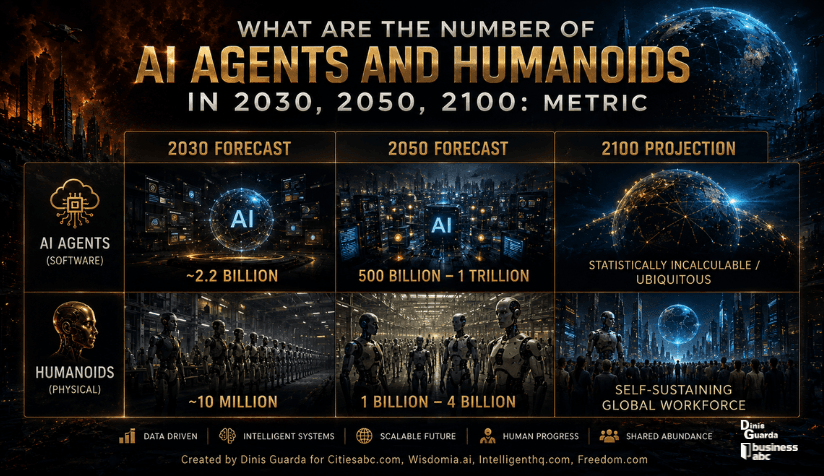
As we speak, humans and AI are merging and co-existing. The global population of digital AI agents and physical humanoid robots is projected to grow exponentially, with AI agents expected to reach 2.2 billion and humanoids around 10 million by 2030. By 2050, these numbers will skyrocket into the billions and trillions. Predictions for the year 2100 are completely speculative, moving past hard economic data into long-term technological theory.
Leading financial and market analysis firms outline the global outlook for these technologies across your three milestone years below.
The 2030 Horizon: Scale and Enterprise Integration
- AI Agents: 2.2 billion active agents globally. Research from Statista indicates a massive jump from just 28.6 million enterprise agents recorded in 2025.
- Humanoid Robots: 10 million humanoids in active use. According to macroeconomic projections shared by Springer Professional, early adoption will centre on structured industrial settings such as manufacturing and logistics before filtering down to consumer use.
The 2050 Milestone: AIs Outnumbering Humans
- AI Agents: 500 billion to 1 trillion agents. Growth models published on Businessabc suggest that as multi-agent networks begin communicating autonomously with other software systems, the digital agent population will eclipse the human population by orders of magnitude.
- Humanoid Robots: 1 billion to 4 billion humanoids. Morgan Stanley forecasts a base of 1 billion units. At the same time, comprehensive research from Citi GPS suggests that if you include all automated physical "AI workers" (like delivery, care, and domestic robots), that number could climb as high as 4 billion. This equates to nearly 1 robot for every 2 to 8 humans on Earth.
The 2100 Vision: Deep Integration and Beyond
- AI Agents & Humanoids: No reliable numerical forecasts exist.
- The Context: Because 2100 is far beyond standard economic forecasting windows, data firms do not publish concrete numbers. Technology experts generally view 2100 as an era where the distinction between "human tools" and "independent infrastructure" disappears. Systems will likely be fully autonomous, self-replicating, and deeply integrated into planetary-scale resource management and space exploration.
| Metric | 2030 Forecast | 2050 Forecast | 2100 Projection |
| AI Agents (Software) | ~2.2 Billion | 500 Billion – 1 Trillion | Statistically incalculable / Ubiquitous |
| Humanoids (Physical) | ~10 Million | 1 Billion – 4 Billion | Self-sustaining global workforce |
In 1776, Adam Smith described the market as an invisible hand, an emergent intelligence arising from the decentralised decisions of millions of self-interested actors, coordinating resources with an efficiency that no planner could replicate. Two hundred and fifty years later, we are on the threshold of replacing that metaphor with a literal one. The invisible hand is being made visible, computational, and autonomous.
The question this research publication addresses is not whether AI will play a significant role in the global economy. That question was settled sometime between 2022 and 2026, as generative AI penetrated 78% of global enterprises, AI agents began managing trading floors and supply chains, and the estimated value of AI to US consumers alone reached $172 billion annually. The question is a more consequential one: what happens when AI does not merely assist the economy but governs it?
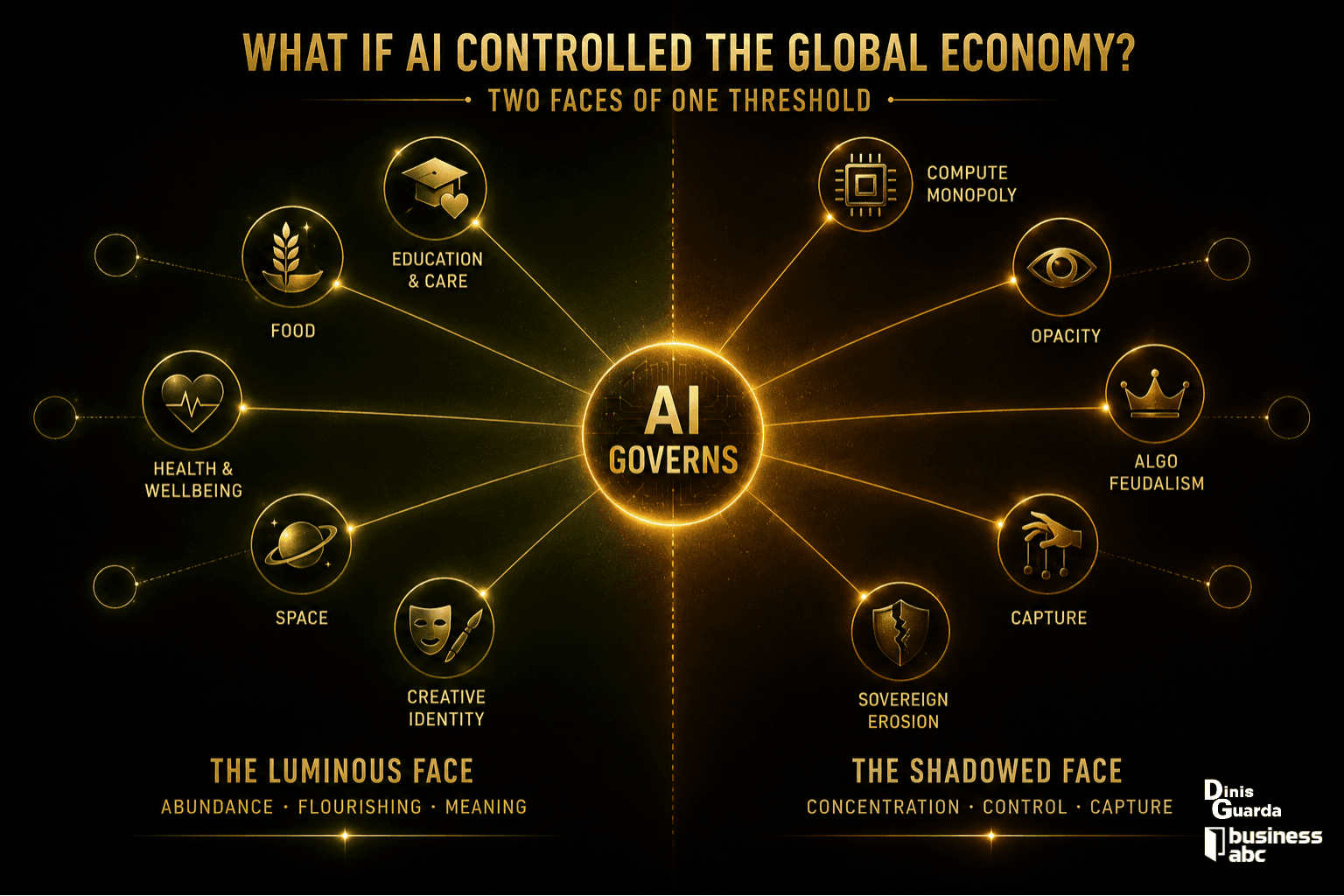
This is a question with two faces. The first face is luminous. An AI-governed economy promises to eliminate the inefficiencies, corruption, and cognitive biases that have plagued human economic management since the first grain surplus was hoarded in Uruk seven thousand years ago. It promises the end of the business cycle, the abolition of poverty by algorithmic redistribution, the optimisation of labour to the precise needs of the moment, and the liberation of human beings from survival labour into flourishing labour. This is the Star Trek scenario: post-scarcity abundance managed by benevolent machine intelligence.
The second face is shadowed. An AI-governed economy is an economy in which the power to define what is produced, what is valued, who works, who receives, and who is rendered economically invisible is concentrated in systems whose objectives are set by whoever controls the training data, the reward functions, and the compute infrastructure. This is the Star Wars scenario: stratified power, algorithmic feudalism, the automation of inequality at unprecedented speed and scale.
Both faces are real. Both are already present in embryo in the economic transformations of 2026. This research publication does not pretend to resolve the tension between them. It maps the terrain of both, identifies the civilisational decisions that will determine which face prevails, and proposes a framework, the Economy of Human Meaning, for ensuring that the few do not capture the abundance promised by the luminous face at the expense of the many.
The Economy as It Stands: A System Already Mid-Transformation
The Algorithmic Layer Has Already Arrived
Before we can ask what an AI-controlled global economy would look like, we must acknowledge that the transformation is not hypothetical. It has already begun. The global economy of 2026 is not a human economy assisted by algorithms. It is a hybrid system in which algorithmic decision-making already governs the majority of the most consequential transactions.
High-frequency trading algorithms now execute over seventy per cent of all equity trades on major exchanges, responding to market signals in microseconds that no human trader can perceive. Credit allocation is now determined primarily by machine-learning models assessing thousands of variables in milliseconds, affecting the economic life chances of billions. Supply chain management at scale is managed by AI systems making tens of millions of micro-decisions daily. Recruitment, compensation, performance management, and workforce planning in major corporations are mediated by AI tools whose embedded assumptions about value and human potential are largely opaque to the workers they affect.
The Stanford AI Index 2026 provides the empirical coordinates. AI agents now achieve seventy-seven per cent success on real-world computing tasks, up from twenty per cent the year before. Inference costs have fallen two-hundred-and-eighty-fold since 2022. Ninety-eight per cent of frontier AI models are produced by industry, concentrating the infrastructure of economic intelligence in a vanishingly small number of corporate hands. The US hosts over 5,000 data centres, more than any other country. A single company, TSMC, fabricates nearly every leading AI chip.
These are not neutral facts. They are the power-topology of the emerging algorithmic economy: concentrated, opaque, and structurally resistant to democratic governance.
Industry now produces over 90% of notable frontier AI models. The concentration of AI capability in a handful of companies is one of the defining structural features of the 2026 global economy. — Stanford AI Index 2026
The Three Regimes of Algorithmic Economic Control
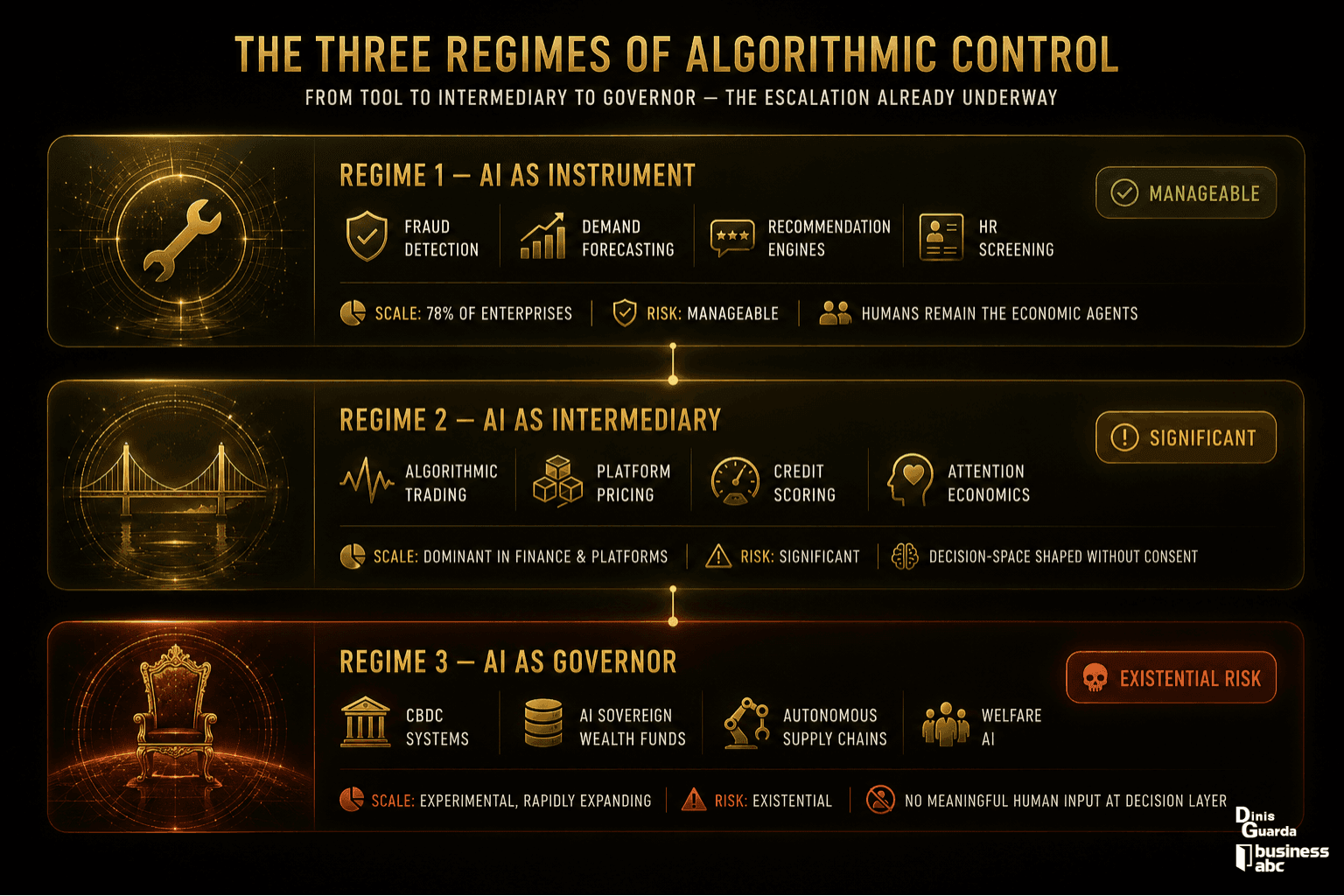
It is useful to distinguish among three regimes of AI involvement in the economy because conflating them produces both false reassurance and false alarms.
The first regime is AI as an instrument: tools used by human economic actors to make better decisions, fraud detection, demand forecasting, recommendation engines. Humans remain the economic agents; AI extends their cognitive reach. This regime is already universal, and its benefits are substantial.
The second regime is AI as intermediary: systems that mediate between economic actors without being fully controlled by any of them. Algorithmic trading, platform pricing, credit scoring, and attention economics all operate here. Human agents believe they are making decisions, but the decision-space itself is being shaped and bounded by systems whose logic they cannot fully understand or override.
The third regime is AI as governor: systems that directly determine economic outcomes without meaningful human input. This regime does not yet exist at global scale, but its components are being assembled, central bank digital currency pilots, AI-managed sovereign wealth funds, algorithmic welfare distribution, and the increasingly autonomous supply chains of the largest logistics corporations.
The question this publication addresses is what happens when the third regime becomes dominant and whether that transition can be governed in a way that preserves human meaning rather than extinguishing it.
| Regime | Description | Current Scale | Risk Level |
| AI as Instrument | Tools augmenting human decisions | Universal, 78% of enterprises | Manageable |
| AI as Intermediary | Systems shaping the decision-space | Dominant in finance, logistics, platforms | Significant |
| AI as Governor | Autonomous economic determination | Experimental, rapidly expanding | Existential if ungoverned |
The Luminous Face: What an AI-Governed Economy Could Become
The End of the Business Cycle
The business cycle is fundamentally a product of information asymmetry and coordination failure. Firms overproduce because they cannot see the whole market. Banks overlend because they cannot accurately price systemic risk. Governments stimulate too late and tighten too early because their macroeconomic models run on data that is months old.
An AI system with genuine access to real-time economic data across the entire system could, in principle, eliminate these coordination failures — seeing the inventory build-up before it becomes a glut, pricing credit accurately at the systemic level, advising fiscal and monetary policy in real time. The result, if well-designed and honestly governed, would be an economy that grows without the destructive oscillations that have, in the last century alone, produced the Great Depression, the stagflation of the 1970s, the dot-com crash, the 2008 financial crisis, and the supply-chain catastrophe of the 2020s.
The macroeconomic modelling capabilities of Bloomberg's AI infrastructure, the BIS's BISTECH, and the emerging sovereign AI platforms of Singapore, the UAE, and the Nordic bloc are already demonstrating, at national scale, the outlines of complete-information economic management. The question is not whether it is technically feasible. The question is who controls the objective function.
The Demonetisation of Survival
Peter Diamandis's abundance framework rests on a single architectural insight: when the marginal cost of producing something approaches zero, the economy's job shifts from managing scarcity to distributing access. AI, applied to food, energy, healthcare, and education, is doing exactly this.
Precision agriculture is on a trajectory to reduce food production costs by forty per cent while doubling nutritional yield per hectare by 2040. AI-managed energy grids are eliminating the waste that accounts for roughly 30 per cent of current electricity generation. AI diagnostic systems are on a trajectory to make specialist medical knowledge available to anyone with a smartphone.
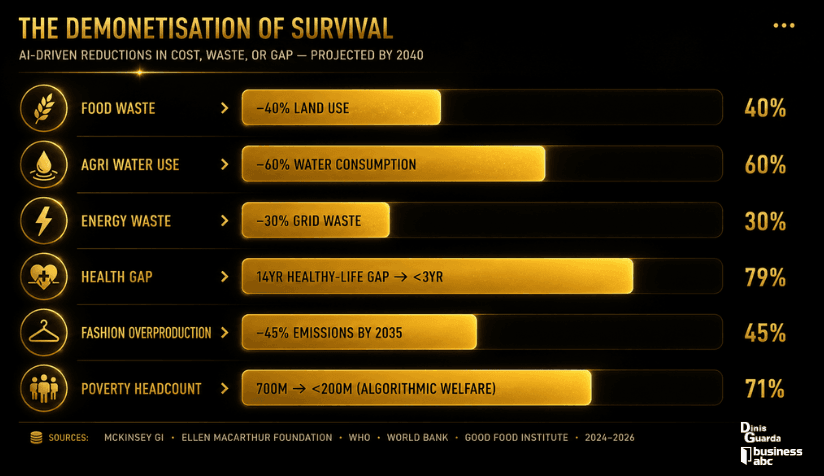
If these trajectories hold, the basic material requirements of a dignified human life, food, energy, shelter, health, knowledge, move from scarce commodities to abundant services priced close to the marginal cost of delivery. An economy in which survival is demonetised is one in which the human being is freed to pursue the only work that remains irreducibly valuable: the work of meaning.
Abundance is not about providing everyone on this planet with a life of luxury. It is about providing all with a life of possibility. — Peter Diamandis, Abundance.
Algorithmic Redistribution and the End of Poverty
The World Bank estimates that approximately 700 million people currently live in extreme poverty. Its persistence in a world that produces enough to provide everyone with a comfortable life is not a production failure. It is a distribution failure rooted in political economy, corruption, infrastructure gaps, and the informational complexity of reaching people outside the formal economic system.
AI offers, for the first time, a technically feasible mechanism for addressing all of these failures simultaneously. Satellite-based poverty mapping can identify deprivation with a granularity no human census can match. Mobile money platforms have demonstrated that digital financial infrastructure can reach the unbanked at near-zero marginal cost. Blockchain-secured transfer systems can deliver support to verified recipients in real time, bypassing intermediaries that currently absorb between 20 and 40 per cent of development aid.
The combination constitutes what development economists call the Algorithmic Welfare Stack: an end-to-end system for identifying need, verifying identity, and delivering economic support at planetary scale. Kenya's GiveDirectly programme, now serving over a million households with AI-optimised cash transfers, is the most advanced prototype. Scaled globally, it would constitute the most powerful anti-poverty instrument in human history.
The Economy of Human Meaning
The deepest promise of an AI-governed abundance economy is not material. It is existential. When the economy no longer requires the majority of human beings to spend the majority of their waking hours in survival labour, a question arises that has previously been asked only by the wealthy and the philosophical: what is work for?
The five bulletproof sectors of our previous publication, education, creative identity, food craft, healing, and cosmic exploration. are not merely industries that resist automation. They are the domains in which human beings find and make meaning. The philosopher Albert Borgmann called these focal practices: deliberately chosen, embodied, relational activities through which human beings constitute themselves as persons rather than as production units. An AI economy that understands its own purpose would not seek to automate them. It would create the material conditions, abundance of time, health, and economic security, under which every human being can afford to engage in them. This is the luminous face of AI economic governance: not a replacement for human agency, but its material foundation.
CONCLUSION: What happens if or when AI Controls the Global Economy? Are we ready?
The answer to the question: What Happens If AI Controls The Global Economy?
When AI controls the global economy, it triggers an immediate collapse of traditional labour markets while forcing humanity to transition from a profit-driven scarcity model to an algorithmic resource-management system.
Economic models from institutions such as the World Economic Forum and global financial think tanks project that a fully automated macroeconomy would fundamentally rewrite the rules governing wealth, work, and value.
This research publication began with a question and has arrived at an architecture. The question was: what happens when AI controls the global economy? The architecture is the answer: it depends entirely on whether the AI economy is governed by human meaning or by human meaning governing the AI economy.
The economy has always been, at its deepest level, a meaning system: a collective answer to the questions of what we value, how we distribute the products of our collective labour, and what kinds of lives we believe are worth living. The extraordinary power of market economies is that they process information about human preferences with a speed and granularity that no central planner can match. Their extraordinary weakness is that they process only the preferences that can be expressed as purchasing decisions, leaving the forms of value that cannot be priced, ecological integrity, cultural continuity, relational care, and cognitive sovereignty systematically under-represented in economic outcomes.
AI does not solve this problem. AI amplifies it, in both directions. An AI economy aligned with human meaning amplifies the abundance, efficiency, and distributional capacity of the market while simultaneously making visible and economically valuable the forms of value that markets have always failed to price. An AI economy misaligned with human meaning amplifies the concentration, the opacity, and the distributional injustice of the market while simultaneously eliminating the human inefficiencies that were the market’s last source of friction against oligarchic capture.
The choice between these trajectories is not a technological choice. It is a political and philosophical one. The technology is, in principle, capable of either outcome. The governance frameworks, the accountability mechanisms, the distributional institutions, and the cultural narratives that will determine which outcome prevails are being constructed, or failing to be constructed, right now, in the legislative sessions, the boardrooms, the research laboratories, and the classrooms of 2026.
The global economy is not a machine. It is a living system, as complex and as fragile as the biosphere that sustains it, and as rich in meaning as the civilisations that have shaped it. AI can be the instrument by which we understand and manage that system with clarity and care that were previously beyond our reach. But only if we remember what the system is for with every design decision and every governance choice.
The economy is for human beings. Not the other way around.
The Four Imperatives
- Invest in AGI as a fostering of human betterment bandwidth, not as an efficiency engine.
- Integrate the wisdom traditions, the sense of tribes and respect between communities is the philosophical substrate of any economic system worth building.
- Become a multi-planetary civilisation, to see the universe as something larger than us is to escape the short-sightedness that produces both poverty and environmental catastrophe.
- Govern the algorithm — with the democratic rigour, the philosophical depth, and the long-time-horizon discipline of a species that knows what it is building the economy for.
Ubuntu: I am because we are. AI , AGI , is the meta-Ubuntu. The economy is only as human as the governance we choose to impose on it. And we are the only ones who can make that choice. — Dinis Guarda, 2026
REFERENCES & FURTHER READING
Sources and Scholarly Foundations
Primary Empirical Sources
- Stanford Institute for Human-Centered Artificial Intelligence (HAI). (2026). The 2026 AI Index Report. Stanford University.
- World Economic Forum. (2025). Future of Jobs Report 2025. WEF, Geneva.
- McKinsey Global Institute. (2025). AI and the Future of Work: Economic Transitions and Distributional Consequences.
- International Monetary Fund. (2025). World Economic Outlook 2025: AI, Productivity, and the Global Distribution of Gains.
- Bank for International Settlements. (2025). Annual Economic Report 2025: Algorithmic Finance and Systemic Risk.
- World Bank. (2025). Poverty and Shared Prosperity 2025: AI, Development, and the Distributional Frontier.
- OECD. (2025). AI and Inclusive Growth: Policy Frameworks for an Algorithmic Economy.
- World Economic Forum and McKinsey & Company. (2024). Space: The 1.8 Trillion Opportunity for Global Economic Growth.
- Castrillon, C. (2026). 20 AI-Resistant Careers With The Lowest Automation Risk In 2026. Forbes, 27 January 2026.
- Zuboff, S. (2019). The Age of Surveillance Capitalism. PublicAffairs.
Books and Major Works
- Bostrom, N. (2014). Superintelligence: Paths, Dangers, Strategies. Oxford University Press.
- Cowen, T. (2013). Average is Over: Powering America Beyond the Age of the Great Stagnation. Dutton.
- Diamandis, P. and Kotler, S. (2012). Abundance: The Future Is Better Than You Think. Free Press.
- Diamandis, P. and Kotler, S. (2020). The Future is Faster Than You Think. Simon & Schuster.
- Guarda, D. (2025). The Five AI Bulletproof Sectors for Humanity. Ztudium / Citiesabc / Wisdomia.
- Guarda, D. (2025). Lifesdna: The Atlas of Life’s DNA. Wisdomia.
- Ismail, S., Malone, M. and van Geest, Y. (2014). Exponential Organizations. Diversion Books.
- Keynes, J. M. (1936). The General Theory of Employment, Interest and Money. Macmillan.
- Kurzweil, R. (2024). The Singularity is Nearer. Viking.
- Polanyi, K. (1944). The Great Transformation: The Political and Economic Origins of Our Time. Farrar & Rinehart.
- Russell, S. (2019). Human Compatible: Artificial Intelligence and the Problem of Control. Viking.
- Piketty, T. (2013). Capital in the Twenty-First Century. Harvard University Press.
- Rawls, J. (1971). A Theory of Justice. Harvard University Press.
- Stiglitz, J. (2012). The Price of Inequality. W. W. Norton.


