
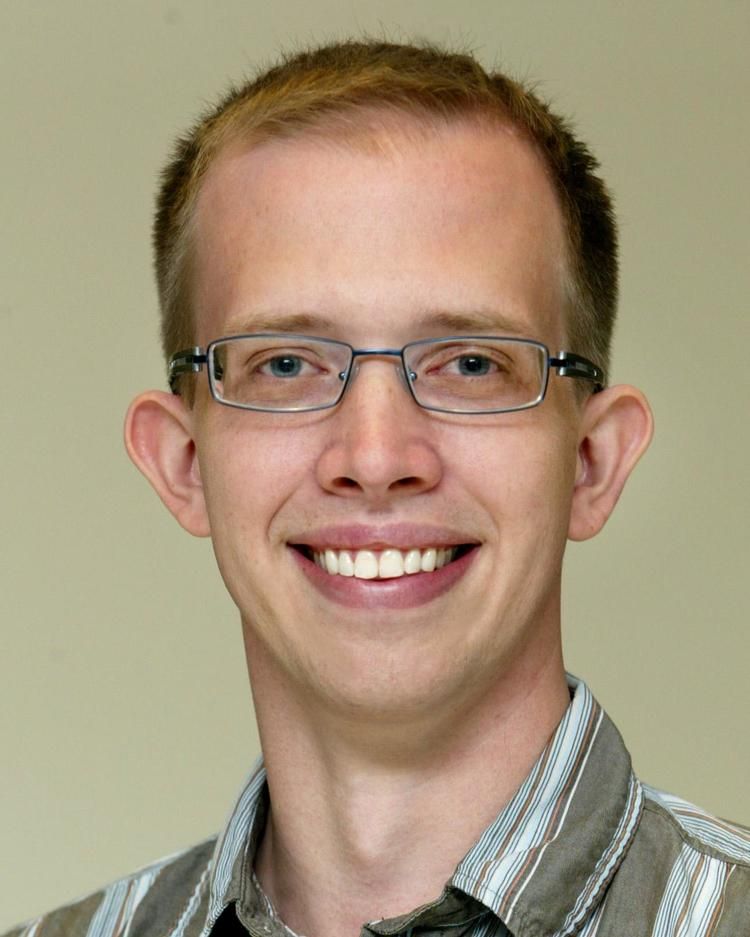
Andrew Houck

Summary
Andrew A. Houck (born 20 June 1979) is an American physicist and quantum information scientist and is the Anthony H.P. Lee ’79 P11 P14 Professor of Electrical and Computer Engineering at Princeton University. He currently serves as Dean of Princeton’s School of Engineering and Applied Science and is also an associated faculty member in physics. He is a fellow of the Princeton Center for Theoretical Science and a Fellow of the American Physical Society. Andrew was the inaugural co-director of the Princeton Quantum Initiative and previously directed the Co-design Center for Quantum Advantage, a national quantum research centre funded by the US Department of Energy.
Andrew grew up in Colts Neck, New Jersey. He studied electrical engineering at Princeton University, where he was valedictorian of the undergraduate Class of 2000. He later completed his PhD in physics at Harvard University in 2005. After his doctorate, he carried out postdoctoral research at Yale University in the laboratory of Robert Schoelkopf.
His research focuses on superconducting electronic circuits for quantum computing and quantum simulation. He is a pioneer of circuit quantum electrodynamics (cQED), a system in which superconducting qubits are strongly coupled to on-chip microwave resonators. In these systems, quantum bits can absorb and emit single microwave photons many times, allowing detailed study and control of quantum behaviour. This work combines quantum mechanics, superconducting electronics, microwave engineering, quantum optics and low-temperature measurement.
At Yale University, Andrew was part of the team that developed the transmon qubit, a design that greatly reduces sensitivity to charge noise and is now widely used in leading quantum computing platforms. He later helped redesign the transmon using tantalum, improving qubit coherence. His group at Princeton studies how to build scalable and robust quantum architectures, addressing challenges such as decoherence, noise, wiring complexity and system integration.
Andrew also works in quantum and non-linear optics using microwave photons, where strong non-linear effects allow access to regimes not easily reached in traditional optical systems. In 2019, his group demonstrated a microchip that simulates particle interactions in a hyperbolic lattice, opening new paths for studying many-body quantum physics.
Alongside his research, Andrew is a committed educator and mentor. He led the creation of Princeton’s first-year engineering curriculum and has advised government and industry on quantum technology strategy. His honours include the Presidential Early Career Award for Scientists and Engineers, the NSF CAREER Award, the Packard Fellowship, the Sloan Research Fellowship, and recognition by MIT Technology Review’s TR35.
Biography
Andrew A. Houck, born on 20 June 1979, is an American physicist and quantum information scientist whose work has played a central role in the development of superconducting quantum computing. He is the Anthony H.P. Lee ’79 P11 P14 Professor of Electrical and Computer Engineering at Princeton University and serves as Dean of the School of Engineering and Applied Science. He is also an associated faculty member in physics and a fellow of the Princeton Center for Theoretical Science. His research and leadership have helped shape both the scientific foundations and institutional direction of quantum science in the United States.
Houck grew up in Colts Neck, New Jersey, in a family that supported academic focus and discipline. He studied electrical engineering at Princeton University, where he graduated as valedictorian of the undergraduate Class of 2000. His early education laid a strong foundation in both engineering and physics, which later defined his research career. After Princeton, he pursued doctoral studies in physics at Harvard University, completing his PhD in 2005.
Following his doctorate, Houck carried out postdoctoral research at Yale University in the laboratory of Robert Schoelkopf. During this period, he was part of the team that developed the transmon qubit, a superconducting qubit design that reduced sensitivity to charge noise. This breakthrough addressed a major problem in early superconducting qubits and became a standard hardware element used in many modern quantum computing systems. His work at Yale placed him at the centre of early progress in circuit quantum electrodynamics, a field that studies the interaction between light and matter using microwave photons in superconducting circuits.
Houck joined the Princeton University faculty in 2008. At Princeton, he established a research group focused on fully quantum mechanical integrated circuits. His work combines quantum mechanics, superconducting electronics, microwave circuits, quantum optics and low-temperature measurement. A key system underlying his research is circuit quantum electrodynamics, where superconducting qubits are coupled to on-chip microwave resonators. In these systems, qubits can absorb and emit single photons many times, allowing precise control and measurement of quantum states.
A major part of Houck’s research addresses the challenge of building scalable quantum computers. While small systems of qubits can be connected using microwave cavities, large-scale systems face problems related to noise, decoherence and increasing circuit complexity. His group studies how to design qubits that are more robust to dominant noise sources and how to connect many components without degrading their performance. This work aims to move quantum computing from small laboratory systems towards practical architectures.
In addition to quantum computing, Houck’s research explores quantum and non-linear optics in microwave systems. In these circuits, oscillating currents and voltages behave as photons and follow the same rules as optical quantum systems. Because non-linear effects are stronger at microwave frequencies, these platforms allow experiments that are difficult to realise with conventional optical devices. His work examines what happens when systems are non-linear in regimes where quantum effects are important.
Houck has also contributed to quantum simulation. In 2019, he led a team that developed a microchip capable of simulating particle interactions on a hyperbolic lattice, enabling experimental study of quantum systems with unusual geometric properties. His group has also studied dissipative phase transitions, photonic bandgap effects and noise suppression in superconducting qubits.
Beyond the laboratory, Houck has played a major leadership role in national quantum initiatives. He was the inaugural co-director of the Princeton Quantum Initiative, which brings together researchers across disciplines to advance quantum science and engineering. He later directed the Co-design Center for Quantum Advantage, a national research centre funded by the US Department of Energy, where he helped coordinate research across universities, national laboratories and industry. He has also consulted widely with government and industry on quantum technology strategy and policy.
Houck is known as a committed teacher and mentor. At Princeton, he led the creation of the university’s first-year engineering curriculum, aimed at giving students a strong and practical foundation in engineering thinking. He has supervised many graduate students and postdoctoral researchers who now work across academia and industry.
His contributions have been recognised through several major honours. These include the Presidential Early Career Award for Scientists and Engineers, the NSF CAREER Award, the Packard Fellowship, the Sloan Research Fellowship, and recognition by MIT Technology Review’s TR35 list. Earlier in his career, he was also a Hertz Fellow. His work has been widely published in leading scientific journals, including Nature, Physical Review Letters, Physical Review X and Nature Physics.
Vision
Andrew Houck’s vision is to make quantum technology practical, reliable and useful for society. He aims to move quantum computing from small laboratory experiments to scalable systems that can solve real problems in science, industry and public policy. His work focuses on building quantum hardware that is stable, easy to control and able to work as part of large systems. He also believes quantum research must be collaborative, linking physics, engineering and industry. Alongside research, he is committed to education, ensuring future engineers understand both fundamental science and real-world impact.
Recognition and Awards
Andrew Houck has received wide recognition for his contributions to quantum science and engineering. He was awarded the Presidential Early Career Award for Scientists and Engineers and the National Science Foundation CAREER Award, both recognising his early impact in research and education. He is a Packard Fellow and a Sloan Research Fellow, honours given to leading researchers at an early stage of their careers. He was named in MIT Technology Review’s TR35 list. Earlier, he was a Hertz Fellow and a runner-up for Science Magazine’s Breakthrough of the Year.
References
- Andrew Houck | Electrical and Computer Engineering | Princeton University
- Andrew Houck | Google Scholar
- Andrew Houck | Wikipedia
- Houck Lab - Princeton University | Houck Lab
- Andrew Houck | Princeton Engineering
- Andrew Houck - Princeton University | LinkedIn
- Andrew Houck | Institute for Robust Quantum Simulation
- Andrew Houck | Princeton University
- Andrew Houck (@nanonoodle) | X
- People | Houck Lab - Princeton University | Houck Lab
- Andrew Houck (0000-0002-9788-5874) | ORCID
- Andrew Houck | Blavatnik Awards for Young Scientists
- Andrew Houck | The David and Lucile Packard Foundation
- Andrew Houck | Hertz Foundation
- Andrew Houck | Wikiwand
Discover up-to-date information on Business, Industry Leaders and Influencers, Organizations, Education, and Investors – connecting you to the knowledge you need.
