
Businesses
AI at Work: Using Microsoft Copilot, ChatGPT, & Claude Safely, Responsibly, & Legally
18 Sept 2026

- Ballantines LLP is organising a LIVE YouTube webinar on October 08, 2026, featuring Yagmur Sahin, Head of Business Development at Data Privacy Simplified and Founder of HumanLoop AI; Dinis Guarda, Founder and CEO of Businessabc.net, citiesabc.com, and Wisdomia.ai, Joanna Moczadlo and Ravinder Singh Johal, Partners at Ballantines LLP.
- The event aims to examine how businesses can use AI systems like Microsoft Copilot, ChatGPT, and Claude safely, responsibly and legally at a time when employees are often adopting AI faster than corporate structures can adapt.
For businesses, artificial intelligence has moved quickly from experimentation to everyday infrastructure. Generative AI is already being used to draft documents, analyse information, support customer service, write code, prepare marketing campaigns and accelerate research, while more advanced AI agents can go further by performing multi-step tasks and interacting with connected business systems.
According to Microsoft's 2026 Work Trend Index, 66% of surveyed AI users said the technology allowed them to spend more time on higher-value work, while 58% said they were producing work they could not have produced a year earlier.
Yet the same research points to a less comfortable reality: only 26% of AI users said their leadership was clearly and consistently aligned around AI, suggesting that individual adoption is often moving faster than organisational strategy.
That gap between employee capability and corporate readiness will be one of the themes surrounding “AI at Work: Using Microsoft Copilot, ChatGPT & Claude Safely, Responsibly and Legally,” a live online webinar presented by Ballantines LLP in collaboration with HumanLoop AI on 8 October 2026 at 12:00 PM UK time.
The discussion will feature Joanna Moczadlo, Partner at Ballantines LLP; Yagmur Sahin, Head of Business Development at Data Privacy Simplified and Founder of HumanLoop AI; and Dinis Guarda, Founder and CEO of ztudium, with Ravinder Singh Johal, Partner at Ballantines LLP, moderating.
- Businesses and professionals can register for the AI at Work webinar here.
AI adoption is a management problem
One of the biggest misconceptions surrounding workplace AI is that adoption primarily depends on buying better technology. Increasingly, the evidence suggests otherwise: Microsoft's 2026 research found that organisational factors such as culture, management support and talent practices had roughly twice the reported impact on AI outcomes as individual effort alone.
That changes how companies should think about AI investment. Licences, models and infrastructure matter, but the value of those investments ultimately depends on whether organisations redesign workflows, train people appropriately, define responsibilities and create processes through which AI-generated work can be verified and improved.
This is particularly relevant for SMEs. As explored in How SMEs Are Building Digital Foundations for an AI-First Future, AI cannot simply be placed on top of fragmented data, weak digital infrastructure or unclear processes and expected to generate transformation. Digital readiness increasingly determines whether AI becomes an operating advantage or another layer of technological complexity.
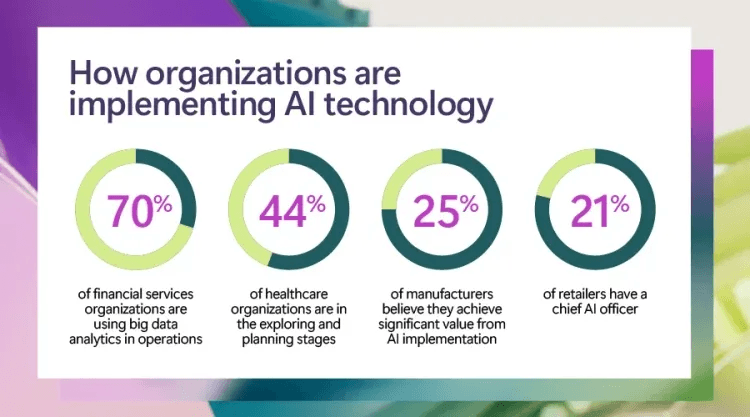
The same principle sits behind the Business AI Health Check, which evaluates AI readiness through leadership, strategy, skills, cybersecurity and organisational culture rather than treating adoption as a purely technical exercise. For businesses, the broader shift is becoming clear: AI strategy is becoming business strategy.
From Copilots To Agents
The risk and opportunity become considerably greater as organisations move from generative AI assistants towards autonomous or semi-autonomous agents. A chatbot can help draft a document, while an agent can potentially identify information, use software, execute actions and complete an entire workflow.
By July 2026, Microsoft reported that more than 30 million paid Microsoft 365 Copilot seats had been deployed globally, while companies were increasingly delegating multi-step processes and recurring activities to AI agents. In its assessment of how AI is changing work, Microsoft described the shift as a move away from measuring AI simply through licences and time saved towards assessing whether it changes business capabilities and operating models.
The distinction is important because an AI assistant mainly generates information, while an AI agent can potentially act on information. An examination of AI agents and their evolution notes that agents differ from conventional applications because they can maintain an internal state, interact with their environment and adapt their behaviour.
That creates a much deeper governance question. If an AI system can access a CRM, send communications, retrieve confidential information, alter records or trigger other processes, organisations need to decide not only what the system knows but also what it is authorised to do.
Who owns AI risk?
As AI becomes embedded across different business functions, responsibility can become fragmented. Technology teams may select platforms, legal departments may examine contracts, cybersecurity teams may review technical risk, HR may introduce AI into recruitment or workforce management, and marketing teams may use entirely different generative AI tools.
This is why AI governance is moving closer to the boardroom. The wider debate around AI governance, corporate risk and accountability increasingly treats AI as more than an IT or compliance matter because its consequences extend into strategic risk, reputation, decision-making and corporate accountability.
The questions for boards are becoming difficult to avoid: Which AI systems does the company use? Who authorised them? What information can they access? Which third parties process company data? What controls exist when an AI system fails? And who is accountable when an automated action creates financial, legal or reputational damage?
The more AI moves into core operations, the harder it becomes to leave those answers scattered across departments.
Shadow AI Creates A Different Kind Of Risk
Official enterprise deployment tells only part of the story because employees can access powerful AI tools through a browser in seconds.
That has contributed to the rise of shadow AI, where employees use generative AI applications without formal approval or oversight. The motivation is often understandable because employees discover that a particular tool can summarise a report, analyse a spreadsheet or complete a task dramatically faster than existing workflows.
From the company's perspective, however, every unofficial AI tool can introduce uncertainty around data storage, confidentiality, security, copyright and regulatory compliance.
This makes blanket prohibition difficult. If AI creates obvious productivity advantages, employees will continue looking for ways to use it, so a more realistic governance model may involve offering approved tools, defining clear boundaries and making responsible use easier than unapproved use.
Regulation Is Becoming Part Of The Business Case
Until recently, many organisations could treat AI regulation as something still being developed. That position is becoming harder to maintain.
On 2 August 2026, the European Commission began enforcing additional provisions of the EU Artificial Intelligence Act, including new transparency obligations for certain AI systems.
For companies operating internationally, AI increasingly sits across privacy, intellectual property, employment law, consumer protection, cybersecurity and sector-specific regulation. This makes compliance part of the commercial calculation because an AI system that reduces operating costs but introduces excessive legal or reputational exposure may not generate the return its productivity figures initially suggest.
This is particularly difficult for smaller organisations. An examination of AI governance challenges facing SMEs highlights how smaller businesses can face many of the same expectations around governance and compliance as larger enterprises while having far fewer legal, technical and risk-management resources.
The result is a difficult balance: move too slowly and a business risks losing competitiveness; move too quickly and risk can accumulate quietly beneath otherwise successful AI adoption.
AI ROI Is Becoming Harder To Measure
The business case for artificial intelligence is often framed around productivity, but time saved and licences used may no longer capture the full value of enterprise AI.
Microsoft found that nearly half of Microsoft 365 Copilot interactions in one analysed period supported cognitive activities such as analysing information, evaluating options, solving problems and creative thinking. In other words, AI is not only accelerating existing work; in some cases, it is changing what an individual employee can realistically accomplish.
This creates a more complicated ROI calculation. The value of AI may come from faster decision-making, increased employee capability, improved customer experience, lower barriers to expertise or the ability to create new services, while implementation costs, governance, cybersecurity, training and the cost of incorrect outputs all need to be included.
The companies gaining the most from AI may therefore not be those buying the greatest number of tools, but those that can identify where AI actually changes the economics of a workflow.
The SME Opportunity Is Significant
This could be particularly transformative for smaller businesses because AI gives SMEs access to capabilities that previously required specialised employees, agencies or expensive enterprise systems.
Marketing research, translation, customer communication, data analysis, coding support and administrative processes can increasingly be augmented through relatively inexpensive AI tools. The growing adoption of AI among UK SMEs already shows how smaller businesses are using AI to improve efficiency and customer engagement.
AI agents could expand that opportunity further. A small business may eventually operate specialised digital agents across finance, marketing, customer service, research and operations, creating major productivity gains but also introducing surprisingly complex AI infrastructure without a dedicated governance function.
The technology may become easier to deploy at the same time as the organisational responsibility becomes harder to manage.
From AI Adoption To AI Absorption
Perhaps the most useful distinction is between adopting AI and absorbing it.
Buying an AI licence is adoption. Changing how the business itself operates because that capability now exists is something deeper.
That requires leadership to decide what humans should continue doing, what AI should handle and where collaboration between the two creates the greatest value. It also means recognising that many existing workflows were designed for a world in which AI did not exist.
Simply inserting AI into those workflows may produce incremental productivity. Redesigning the workflow around new capabilities may create something more significant.
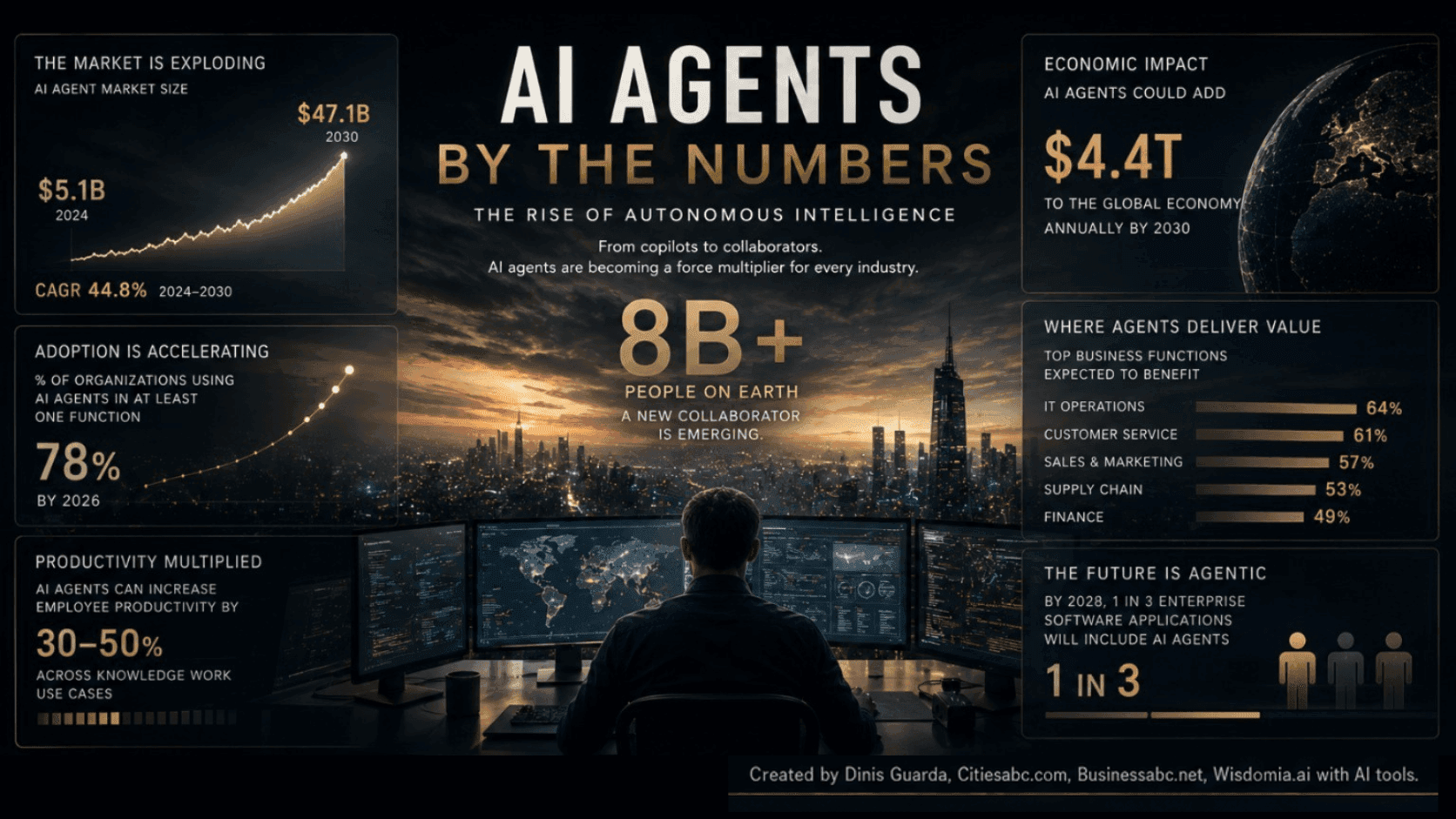
This is where the agentic AI conversation becomes commercially important. In Eight Billion Humans. Eight Billion AI Agents. And Now?, Dinis Guarda examines the possibility of billions of digital agents capable of researching, creating, transacting and communicating at machine speed.
For businesses, the immediate implication is practical rather than futuristic: if companies begin working with not only people and software but also fleets of semi-autonomous digital workers, governance will need to evolve alongside organisational structure.
Responsible AI Is Becoming A Competitive Capability
Responsible AI is sometimes presented as something that restricts innovation, but for businesses the opposite may increasingly be true.
Companies need confidence before they can allow AI to interact with valuable data, critical systems or customers. Employees need clear policies before they can use AI without constantly wondering whether they are creating risk. Customers need confidence that automated decisions remain secure, explainable and accountable, while boards need evidence that the systems operating inside their organisations are visible and controlled.
Governance therefore becomes part of the infrastructure required to scale AI.
The strategic challenge is not choosing between innovation and responsibility but creating enough governance that innovation can move faster without creating unacceptable risk.
That is the business context surrounding the forthcoming AI at Work discussion. The central question is no longer whether organisations will use ChatGPT, Copilot, Claude or AI agents because many already are. The more important question is whether the organisation understands what those systems are doing, what value they create and where human responsibility begins and ends.
AI at Work Webinar
AI at Work: Using Microsoft Copilot, ChatGPT & Claude Safely, Responsibly and Legally
Date: Thursday, 8 October 2026
Time: 12:00 PM UK time
Format: Live online webinar
Presented by: Ballantines LLP in collaboration with HumanLoop AI
Speakers: Joanna Moczadlo, Partner at Ballantines LLP; Yagmur Sahin, Head of Business Development at Data Privacy Simplified and Founder of HumanLoop AI; Dinis Guarda, Founder and CEO of ztudium; and Ravinder Singh Johal, Partner at Ballantines LLP, who will moderate the discussion.
Register for the AI at Work webinar
Sources
- Ballantines LLP (2026). AI at Work: Using Microsoft Copilot, ChatGPT & Claude Safely, Responsibly and Legally. Event registration
- European Commission (2026). Commission starts enforcing AI Act rules and new transparency requirements on 2 August. European Commission
- Microsoft (2026). Agents, Human Agency, and the Opportunity for Every Organization — 2026 Work Trend Index. Microsoft WorkLab
- Microsoft (2026). The New Benchmark for AI Progress: How Our Work Is Changing. Microsoft Source
- Guarda, D. (2026). Eight Billion Humans. Eight Billion AI Agents. And Now? Read the article
- Khosravani, P. (2026). 5 AI Governance Challenges SMEs Face In Regulated Digital Platforms. Read the article
- Singal, P. (2026). How SMEs Are Building Digital Foundations for an AI-First Future. Read the article
Share

Sara Srifi
Sara is a Software Engineering and Business student with a passion for astronomy, cultural studies, and human-centered storytelling. She explores the quiet intersections between science, identity, and imagination, reflecting on how space, art, and society shape the way we understand ourselves and the world around us. Her writing draws on curiosity and lived experience to bridge disciplines and spark dialogue across cultures.


