


Businesses
How Verified Business Listings Build Trust and AI Visibility in the No-Click Economy
19 Aug 2026

The internet’s discovery model is changing. Customers increasingly receive synthesised answers from Google AI Overviews, ChatGPT, Gemini, Claude and Perplexity before they visit a company website or without visiting one at all.
This “no-click economy” does not make websites or traditional search-engine optimisation irrelevant. Google still generates vastly more referral traffic than AI platforms. However, rankings and website traffic no longer provide a complete picture of digital visibility.
A company can rank well in Google but remain absent from AI-generated recommendations. It can also be mentioned by an AI assistant without receiving a link or knowing which information shaped the answer.
In this environment, verified business listings, structured company profiles and consistent executive identities become part of an enterprise’s visibility infrastructure. They help customers and machines determine who the organisation is, what it offers, where it operates and who leads it.
Key takeaways
- AI-generated answers are reducing the number of users who click traditional search results.
- Google remains much larger than AI referral channels, but AI traffic is growing rapidly and can demonstrate strong commercial intent.
- AI visibility depends on mentions, citations, context and consistency—not only website rankings.
- Enterprises face greater exposure because their information is distributed across many websites, markets and business units.
- Verified listings can support entity clarity and trust, but they do not guarantee AI citations or rankings.
- Company visibility and executive visibility increasingly reinforce one another.
- BusinessABC can provide a structured company identity layer, while platforms such as WorldTopCEOs can support clearer leadership representation.
- AI visibility requires coordination between SEO, communications, brand, data, legal and executive teams.
What is the no-click economy?
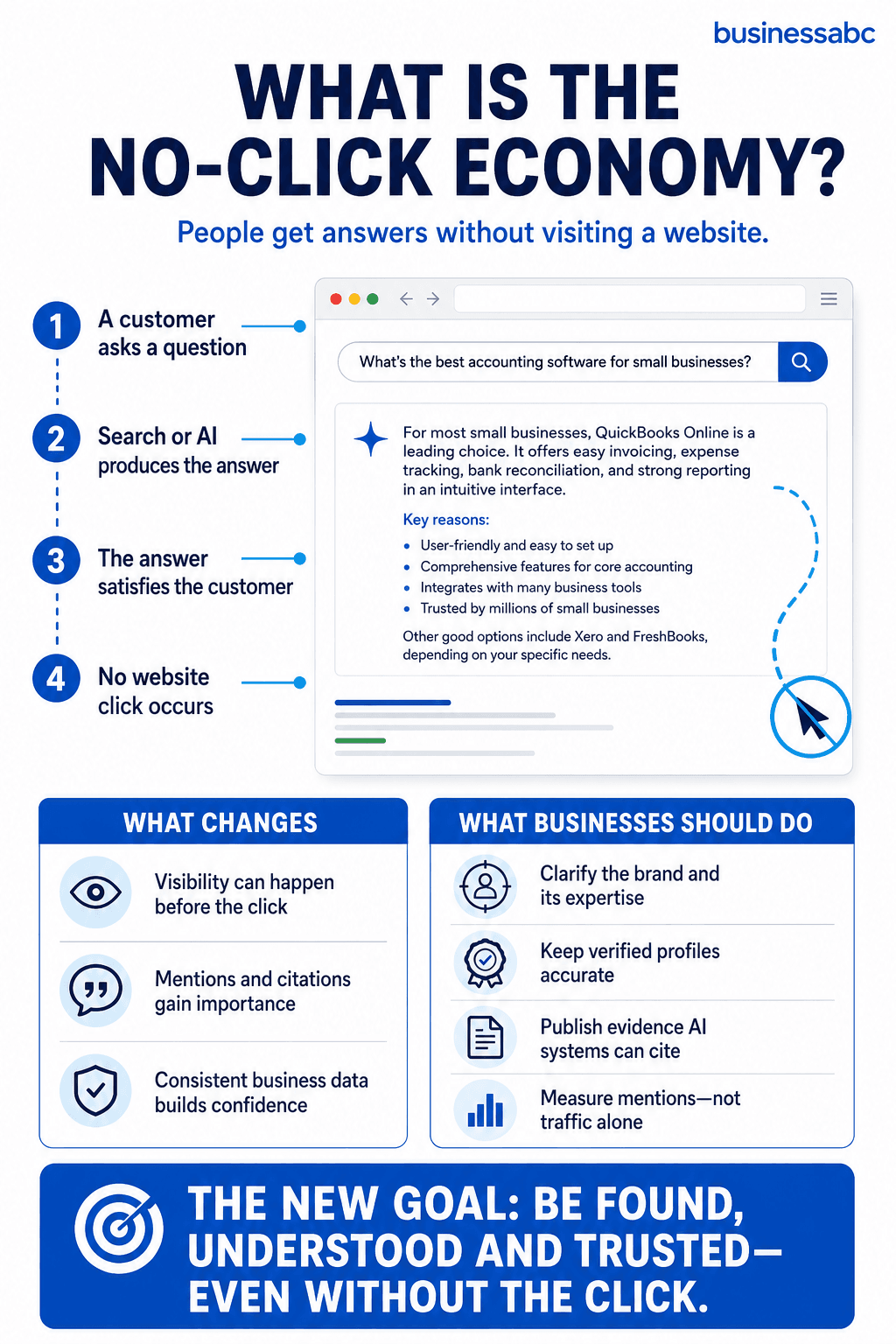
The no-click economy describes a digital environment in which users receive enough information from a search page or AI assistant to continue their decision without visiting the original website.
Traditional search generally followed this journey:
Query → list of links → website visit → evaluation → action
AI-assisted discovery increasingly follows a different path:
Question → synthesised answer → comparison or recommendation → optional visit or action
The difference is strategically important. Under the traditional model, a company could measure visibility through rankings, impressions, clicks and website sessions. In an AI-generated answer, a brand may be:
- Recommended without its website being cited
- Cited but not prominently mentioned
- Described using information from third-party sources
- Compared with competitors before receiving a website visit
- Excluded from the answer completely
- Represented using outdated or incorrect information
The AI system becomes an intermediary between the organisation and its audience.
What the data shows
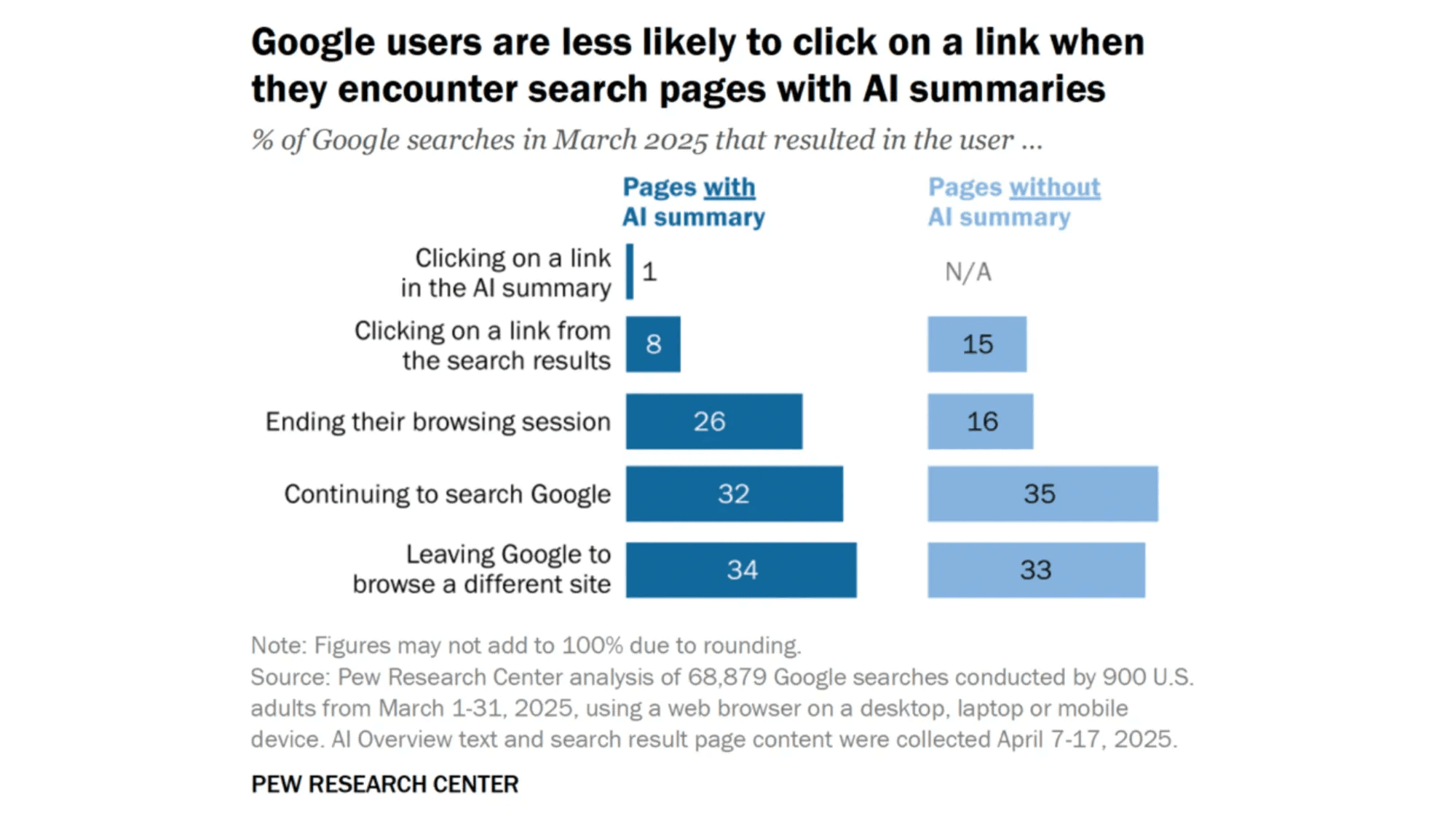
Pew Research Center analysed 68,879 Google searches from US participants during March 2025. An AI summary appeared in approximately 18% of the searches studied.
When an AI summary appeared:
- Users clicked a traditional result in 8% of visits.
- Without an AI summary, the traditional-result click rate was 15%.
- Users clicked a source inside the AI summary in only 1% of visits.
- Browsing sessions ended after 26% of pages containing an AI summary, compared with 16% of conventional results pages.
The findings do not prove that every AI answer prevents a website visit. They do demonstrate that AI summaries can materially change click behaviour.
At the same time, AI-generated referral traffic is growing. Similarweb estimated that AI platforms generated approximately 1.13 billion referral visits to leading websites in June 2025, an increase of 357% from the previous year. Google search still generated approximately 191 billion referrals during that month.
The correct conclusion is therefore not that AI has already replaced Google. It is that AI has become a rapidly growing discovery layer that influences users before the conventional website journey begins.
AI-referred visitors can carry stronger intent
Low click volumes do not necessarily mean low commercial value.
Adobe reported that generative-AI referrals to US retail websites increased by approximately 693% year over year during the 2025 holiday season. During the same period, AI-referred retail visitors:
- Converted 31% more frequently than visitors from other channels
- Were 33% less likely to leave immediately
- Spent 45% more time on the website
- Viewed 13% more pages per visit
These figures relate specifically to Adobe’s retail dataset and should not be applied automatically to every sector. However, they illustrate an important feature of AI discovery: users who click after receiving an AI-generated explanation or recommendation may already be better informed and closer to a decision.
The commercial risk is therefore not simply losing website traffic. It is being excluded while competitors are presented to high-intent users.
Why Google rankings are no longer enough
Traditional SEO asks whether a page ranks for a specific query. AI visibility asks a broader set of questions:
- Does the company appear in relevant AI answers?
- How prominently is it presented?
- Is the description accurate?
- Which products, services or sectors are associated with it?
- What sentiment or qualifications surround the mention?
- Is the company’s website cited?
- Which external sources influence the answer?
- Does visibility remain consistent across different AI platforms?
- Are the correct executives connected to the company?
A company could rank first for an important keyword while an AI assistant recommends three competitors based on stronger third-party evidence, clearer entity information or more consistent public coverage.
Conversely, a company may be mentioned frequently in AI answers while receiving limited traffic because the assistant cites an independent publication instead of the company website.
Businessabc’s analysis of how AI engines create visibility for brands, leaders and enterprise value distinguishes between four useful dimensions:
- Presence: How frequently the company appears in relevant answers
- Position: How prominently the company is presented
- Context: How the system describes and qualifies the company
- Authority: Which sources support the mention
These measurements complement rather than replace SEO metrics.
How AI systems understand a business
AI systems do not evaluate a company solely through its homepage. Their answers can draw on numerous sources:
- Company websites
- Business directories
- Regulatory records
- News coverage
- Industry publications
- Customer reviews
- Professional profiles
- Investor materials
- Product documentation
- Reference platforms
- Community discussions
- Executive interviews
- Research and conference appearances
The systems attempt to resolve these sources into an entity: a recognisable organisation with attributes, relationships and evidence.
For example:
- Company A → operates in → logistics technology
- Company A → provides → supply-chain software
- Company A → is led by → Executive B
- Executive B → has expertise in → international logistics
- Company A → serves → manufacturers and retailers
When public information is incomplete or contradictory, the system may struggle to determine whether two records describe the same organisation. It may also associate the company with an outdated executive, abandoned product, former headquarters or incorrect category.
AI visibility therefore begins with entity clarity not keyword repetition.
Why enterprises are particularly exposed
All organisations can be misrepresented online, but enterprises face several additional problems.
Fragmented digital information
Large companies operate multiple websites, subsidiaries, social accounts, country pages, product portals and partner profiles. Information can differ across each location.
A corporate website may identify one chief executive while an old directory, conference biography or regional page names a predecessor.
Complex product portfolios
An enterprise may provide dozens of products across several industries. AI systems must determine which offering is relevant to a particular question.
If the company’s category associations are unclear, a specialised competitor can appear more relevant even when the enterprise has greater capabilities.
Global inconsistency
Company names, services and leadership titles can vary by market and language. Acquisitions, rebrands and regional structures introduce additional ambiguity.
Greater reputational consequences
An inaccurate summary about a small product feature may create support problems. An inaccurate statement about an enterprise’s ownership, regulatory position, executive leadership or sustainability record can affect customers, investors, employees and public authorities.
Longer B2B buying journeys
Enterprise buyers use research, analyst commentary, case studies, references and executive credibility before making decisions. AI assistants can compress these sources into an initial shortlist before the company knows it is being considered.
Organisational silos
SEO, public relations, investor relations, product marketing, data governance and executive communications frequently operate separately. AI engines, however, combine the signals produced by all of them.
Semrush’s 2026 AI Visibility Index analysed 126 million US AI-search prompts from January to April 2026. Its companion research found that 81% of organisations with integrated SEO and AI-visibility workflows reported increased AI traffic or leads, compared with 36% of organisations managing the functions separately.
Because the finding is based on reported organisational outcomes, it should be treated as an association rather than proof of causation. Nevertheless, it supports a practical conclusion: AI visibility is an enterprise-wide governance issue, not merely another content-marketing tactic.
What verified business listings contribute
A verified listing can help connect structured information to an accountable profile owner.
Verification may use:
- A company email address
- Telephone confirmation
- Website-domain ownership
- Business documents
- Location confirmation
- Manual editorial review
Its role is not to declare that a company is trustworthy in every respect. Verification usually confirms ownership or selected information—not service quality, financial stability or legal compliance.
Its value lies in creating a clearer reference point.
1. Identity resolution
A structured listing can connect the official company name, website, category, headquarters, services and leadership.
This helps distinguish the organisation from similarly named businesses and reduces uncertainty created by fragmented profiles.
2. Information consistency
A company-controlled profile can present approved information that communications, sales and leadership teams can maintain.
Material facts should remain consistent across the company website and important external profiles:
- Legal and trading names
- Website
- Headquarters
- Contact information
- Leadership
- Markets served
- Products and services
- Operating status
3. Machine-readable context
Categories, headings, concise descriptions and structured fields make information easier to interpret than an unstructured paragraph filled with marketing language.
This does not guarantee that an AI platform will retrieve or cite the page. It does improve the clarity of the information available.
4. Trust for human visitors
Potential customers can compare the listing with the company website, leadership records and other credible sources.
A complete profile can answer basic due-diligence questions before the prospect contacts the company.
5. Another discoverable reference
A relevant directory creates an additional path through which customers, journalists, partners and automated systems may encounter the company.
Businesses should still prioritise profile quality over mass submission to low-value directories.
Businessabc as an enterprise identity layer
The Businessabc Global Business Directory organises profiles for companies, leaders, investors, universities and organisations.
Within an AI-visibility strategy, a Businessabc company profile can contribute to a broader entity footprint by providing:
- A consistent company description
- Products and services
- Industry classification
- Headquarters and geographic reach
- Leadership information
- Company milestones
- Relevant references
- A link to the official website
The practical objective is narrow and defensible: create accurate, structured and maintainable information that strengthens the organisation’s overall digital identity.
Companies preparing a listing can use these guides on how to list a business in an online directory and how to create a directory profile that attracts customers.
Why executive visibility now matters to enterprise visibility
AI systems frequently connect an organisation with its founders, chief executive, board members and recognised subject-matter experts.
A query may concern the enterprise directly:
Which companies are leading industrial AI adoption?
It may instead begin with leadership:
Which CEOs are shaping responsible industrial AI strategy?
In both cases, the system must understand the relationship between the company, executive and area of expertise.
This makes executive identity part of corporate visibility infrastructure.
A clear leadership record should establish:
- Full professional name
- Current role
- Company
- Appointment date where relevant
- Previous positions
- Recognised areas of expertise
- Published work and interviews
- Board or institutional relationships
- Official professional profiles
- Supporting sources
WorldTopCEOs is relevant to this executive layer. A structured leadership presence can complement a company profile by making the relationship between the executive, organisation and leadership record easier to understand.
As with a business directory, an executive platform should be one part of a wider evidence network. It cannot replace independent journalism, regulatory filings, the corporate leadership page or verifiable professional history.
The strongest configuration is alignment:
Businessabc company identity + structured CEO identity + official corporate sources + independent evidence
Building visibility for humans and AI systems
1. Establish canonical facts
Create an approved record containing:
- Official company name
- Previous names
- Website domains
- Headquarters
- Founding year
- Leadership
- Business category
- Products and services
- Markets served
- Subsidiaries and principal brands
- Official social accounts
Assign ownership for updating this record.
2. Audit high-value external profiles
Search for the company, major products and executives across directories, review platforms, publications and knowledge sources.
Identify:
- Duplicates
- Former executives
- Incorrect locations
- Inconsistent descriptions
- Broken links
- Unsupported claims
- Missing relationships between leaders and the organisation
3. Structure owned content around clear questions
Pages should answer important questions directly before adding supporting detail.
Useful enterprise content includes:
- What does the company provide?
- Who is the product designed for?
- Which industries does the organisation serve?
- How is the product implemented?
- What standards or certifications apply?
- Who leads the organisation?
- Where does the company operate?
- How does the offering differ from alternatives?
Use meaningful headings, concise summaries, accessible tables and structured data where appropriate.
4. Build an external evidence network
AI engines may compare multiple sources before presenting an answer. Owned content alone cannot create independent consensus.
Evidence can include:
- Credible news coverage
- Industry research
- Customer case studies
- Professional reviews
- Conference participation
- Regulatory and standards records
- Academic collaboration
- Executive interviews
- Relevant directory profiles
Quality and relevance matter more than the raw number of mentions.
5. Align company and executive narratives
The company should not claim expertise in a field while its principal executives have no visible relationship to that subject.
Likewise, executive biographies should connect to the company’s current strategy rather than remaining generic career summaries.
Alignment does not mean publishing identical language everywhere. It means ensuring that material relationships and claims are consistent.
6. Monitor AI answers directly
Test representative prompts across multiple platforms and repeat them over time. AI responses are non-deterministic, so one answer is not a reliable measurement.
Track:
- Mention frequency
- Relative position
- Description accuracy
- Sentiment and qualifications
- Company-domain citations
- Third-party sources
- Competitors presented
- Changes across engines
- Incorrect or outdated claims
Semrush reported that 45% of marketing leaders could not accurately measure brand visibility inside AI-generated answers, while only 9% said they could track all relevant metrics across platforms. Enterprises need measurement processes that extend beyond conventional analytics.
What enterprises should measure now
Traditional metrics remain useful:
- Search rankings
- Organic impressions
- Click-through rate
- Website sessions
- Leads and conversions
Add AI-era measurements:
Measurement | Question answered |
| AI mention share | How frequently does the company appear? |
| Prompt coverage | Which discovery questions include the company? |
| Position | How prominently is it presented? |
| Citation share | Which company or third-party pages are cited? |
| Context accuracy | Is the company represented correctly? |
| Competitor overlap | Which alternatives appear alongside it? |
| Executive association | Are the correct leaders connected to the company? |
| Cross-engine consistency | Does visibility survive across different AI systems? |
| Branded-search movement | Does AI exposure correspond with more direct interest? |
| AI referral quality | Do referred visitors engage or convert? |
Attribution remains difficult because many AI interactions do not produce clicks. Enterprises should avoid claiming direct revenue from every AI mention without supporting evidence.
Common AI-visibility mistakes
- Treating AI visibility as keyword stuffing
- Creating large volumes of shallow AI-generated content
- Assuming one ChatGPT answer represents the market
- Monitoring only the company website
- Ignoring executive information
- Leaving outdated directory profiles online
- Confusing verification with endorsement
- Purchasing low-quality mentions or fabricated reviews
- Managing SEO, PR and executive communications separately
- Promising guaranteed inclusion in AI answers
- Measuring citations without checking their context
- Removing traditional SEO investment entirely
Frequently asked questions
Is AI search replacing Google?
Not in total referral volume. Similarweb estimated 1.13 billion AI referrals in June 2025 compared with approximately 191 billion from Google search. AI discovery is nevertheless growing rapidly and is becoming embedded inside conventional search.
What is the no-click economy?
It is an environment in which users receive answers, comparisons or recommendations without visiting the original website. AI Overviews and conversational assistants accelerate this behaviour.
Do verified business listings improve AI visibility?
They can contribute accurate, structured and consistent company information to the wider digital ecosystem. They do not guarantee that an AI platform will mention, cite or recommend the business.
Why do CEO profiles matter?
AI systems connect companies with their leaders, expertise, statements and public record. Inconsistent executive information can weaken entity clarity and create reputational errors.
Does GEO replace SEO?
No. Generative-engine optimisation extends SEO into entity clarity, answer-ready content, external evidence, structured data and AI-answer monitoring. Technical SEO and accessible websites remain important.
Can AI visibility be guaranteed?
No. AI answers change across platforms, prompts, model versions and retrieval sources. Credible strategies improve the underlying information environment rather than promising a fixed result.
Final takeaway
The no-click economy shifts value from owning a search position to being accurately represented inside the answer.
Google rankings remain commercially important, but they are no longer a complete measure of visibility. Enterprises must now manage how AI systems understand the company, its products, evidence, reputation and leadership.
Verified listings can support this work by creating an accountable and structured identity layer. Businessabc provides a place to organise company information within a wider business ecosystem, while WorldTopCEOs can contribute to the executive-identity layer connecting organisations with their leadership.
Neither replaces independent evidence, technical SEO or strong corporate communications. Their relevance comes from participating in a coherent network of trusted information.
In the AI era, visibility depends on more than being indexed. A company must be identifiable, understandable, verifiable and consistently represented wherever humans and machines conduct their research.
Sources
- Pew Research Center: Google Users Are Less Likely to Click When an AI Summary Appears
- Semrush: 2026 AI Visibility Index Based on 126 Million Prompts
- Adobe: AI-Driven Traffic Surges Across Industries
- Similarweb: AI Referral Traffic Winners by Industry
- Businessabc: The AI Visibility Index
- IntelligentHQ: Why Google Rankings Are No Longer Enough
- Businessabc Global Business Directory
- WorldTopCEOs


