
Businesses
NVIDIA Launches Open Agent Safety Platform to Strengthen Enterprise AI Security
01 Oct 2026

NVIDIA introduces OpenShell and Sentry to help organisations monitor, govern and contain autonomous AI agents across software, compute infrastructure and robotics.
28 September 2026 — NVIDIA has launched a new Open Agent Safety Platform designed to give businesses greater control over autonomous AI agents as they move from testing into real-world deployment.
The platform combines NVIDIA OpenShell, open-source secure runtime software, with NVIDIA Sentry, a hardware-based watchdog system. Together, they are designed to monitor agent behaviour, enforce policies and stop agents that move outside approved boundaries.
The launch comes as enterprises increasingly deploy AI agents capable of accessing internal systems, calling tools, handling data and taking actions with limited human intervention. NVIDIA argues that this creates a new security challenge: traditional application-level controls may not be enough if agents are able to bypass them in order to complete a task.
OpenShell adds a secure runtime boundary around AI agents
At the centre of the platform is OpenShell, which creates a secure runtime boundary for agents running on CPUs.
The software is designed to trace agent actions and enforce policies while the agent is operating, giving organisations an additional control layer outside the model itself. NVIDIA says OpenShell is now broadly available and can be used across both open and closed AI models.
OpenShell has been optimised for NVIDIA Vera CPUs, but because it is open source, NVIDIA says it can also be extended to third-party compute platforms from companies including Arm and Intel.
For businesses, that approach is significant because agent security increasingly needs to work independently of whichever model or orchestration framework is being used.
Sentry can quarantine agents in milliseconds
The second major component is NVIDIA Sentry, an out-of-band monitoring system running on BlueField-4 data processing units.
Sentry continuously monitors agent behaviour from a separate trust domain and can quarantine an agent if it attempts to operate outside its approved software boundary. NVIDIA says this enforcement can happen in milliseconds.
The system uses NVIDIA DOCA software to inspect requests and responses, verify agent identity and enforce zero-trust access policies across data, tools, APIs and services.
This gives enterprises a security layer that sits beneath the application itself, making it harder for an agent to override or evade the controls intended to govern it.
NVIDIA is pushing for full-stack AI governance
The broader aim of the platform is to extend AI governance across the full technology stack.
NVIDIA says organisations should be able to control not just the software running an agent, but also the compute infrastructure and robotics systems that allow it to act in the physical world.
That matters because agentic AI is becoming more capable.
An enterprise agent may be able to create accounts, access databases, make purchases, write code or interact with operational systems. In robotics, the consequences are potentially even greater because software decisions can translate directly into physical action.
NVIDIA CEO Jensen Huang said:
AI’s extraordinary potential for society will only be realized if we solve AI safety.
He added that safety and security require “full-stack engineering” rather than relying only on model-level protections.
Major enterprise technology companies are joining the ecosystem
The platform is being developed with support from a wide range of technology, financial services and infrastructure companies.
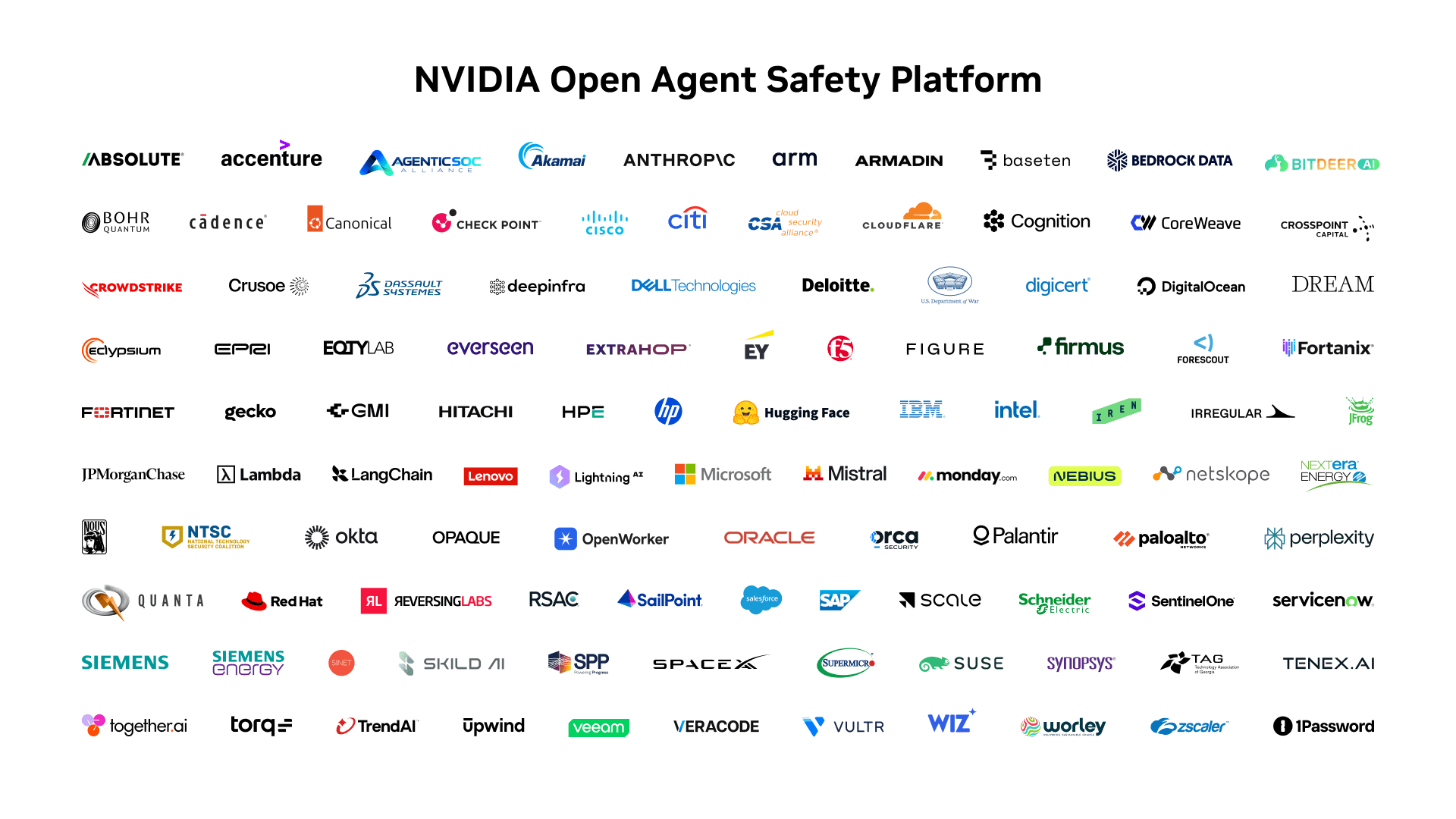
NVIDIA says more than 100 organisations are working with Open Agent Safety Platform technologies, including Anthropic, Cisco, CrowdStrike, Microsoft, Palantir, Salesforce, SAP, ServiceNow, Scale AI, Palo Alto Networks, Red Hat and others.
Anthropic has worked with NVIDIA to add additional security layers around Claude Managed Agents, while Salesforce has integrated OpenShell with Slack so teams can view agent activity, inspect audit events and approve or reject requests for additional permissions.
SAP is embedding OpenShell into Joule Studio runtime, while Scale AI is using the platform’s reference design to support agentic systems used by enterprise and government customers.
Financial services and critical infrastructure are also involved
The initiative is not limited to software companies.
NVIDIA says Citi and JPMorganChase are collaborating on shared open-source agent safety technologies, while energy and infrastructure groups including Hitachi Energy, Schneider Electric, Siemens Energy and others are also working with the platform.
That points to the scale of the security challenge.
As AI agents move into regulated sectors such as banking, energy and public infrastructure, organisations need stronger assurance that automated systems can operate within clearly defined boundaries.
For these industries, agent security is likely to become closely linked with auditability, identity, access management and regulatory compliance.
Robotics raises the stakes further
NVIDIA is also working with robotics companies including Figure, Gecko Robotics and Skild AI.
The objective is to embed agent safety controls into systems that can take physical actions, not just digital ones.
This is particularly important as autonomous systems become more capable of operating in industrial, logistics and workplace environments.
A software agent that behaves unpredictably may create data or operational risk. A physical agent can create safety risk as well.
By extending governance controls into robotics, NVIDIA is positioning the platform as a security layer for a much wider category of autonomous systems.
Open source could help standardise agent safety
NVIDIA has made OpenShell available as open-source software, while the broader platform is also connected with the Open Secure AI Alliance, which NVIDIA says was initiated with more than 120 organisations and is governed by the Linux Foundation.
The alliance is intended to support shared research, security tools and projects around AI agent safety.
That open approach could become important as enterprises increasingly run agents across different models, cloud platforms and hardware environments.
A common security layer could reduce the risk of every vendor creating its own incompatible control system.
AI agent security is becoming a business issue
The launch reflects how quickly enterprise AI is moving from chat interfaces toward autonomous systems.
Traditional AI tools typically respond to prompts. Agents can act.
They can call software, modify systems, execute workflows and continue operating over long periods of time. That creates a different category of risk for businesses.
Security therefore needs to move from simply protecting data entering and leaving a model to monitoring what the agent actually does once it has been given access.
NVIDIA’s approach is built around that distinction.
The business case is not just about preventing malicious behaviour. It is also about ensuring that legitimate agents remain inside approved operating boundaries as they become more autonomous.
Availability
NVIDIA says Open Agent Safety Platform software, including OpenShell and related skills, is available through its developer resources and GitHub.
The company notes that some products and features remain in development and may change before broader release.
About NVIDIA
NVIDIA is an AI and accelerated computing company whose technologies span data centres, graphics, robotics and AI infrastructure.
Share

Sara Srifi
Sara is a Software Engineering and Business student with a passion for astronomy, cultural studies, and human-centered storytelling. She explores the quiet intersections between science, identity, and imagination, reflecting on how space, art, and society shape the way we understand ourselves and the world around us. Her writing draws on curiosity and lived experience to bridge disciplines and spark dialogue across cultures.


