
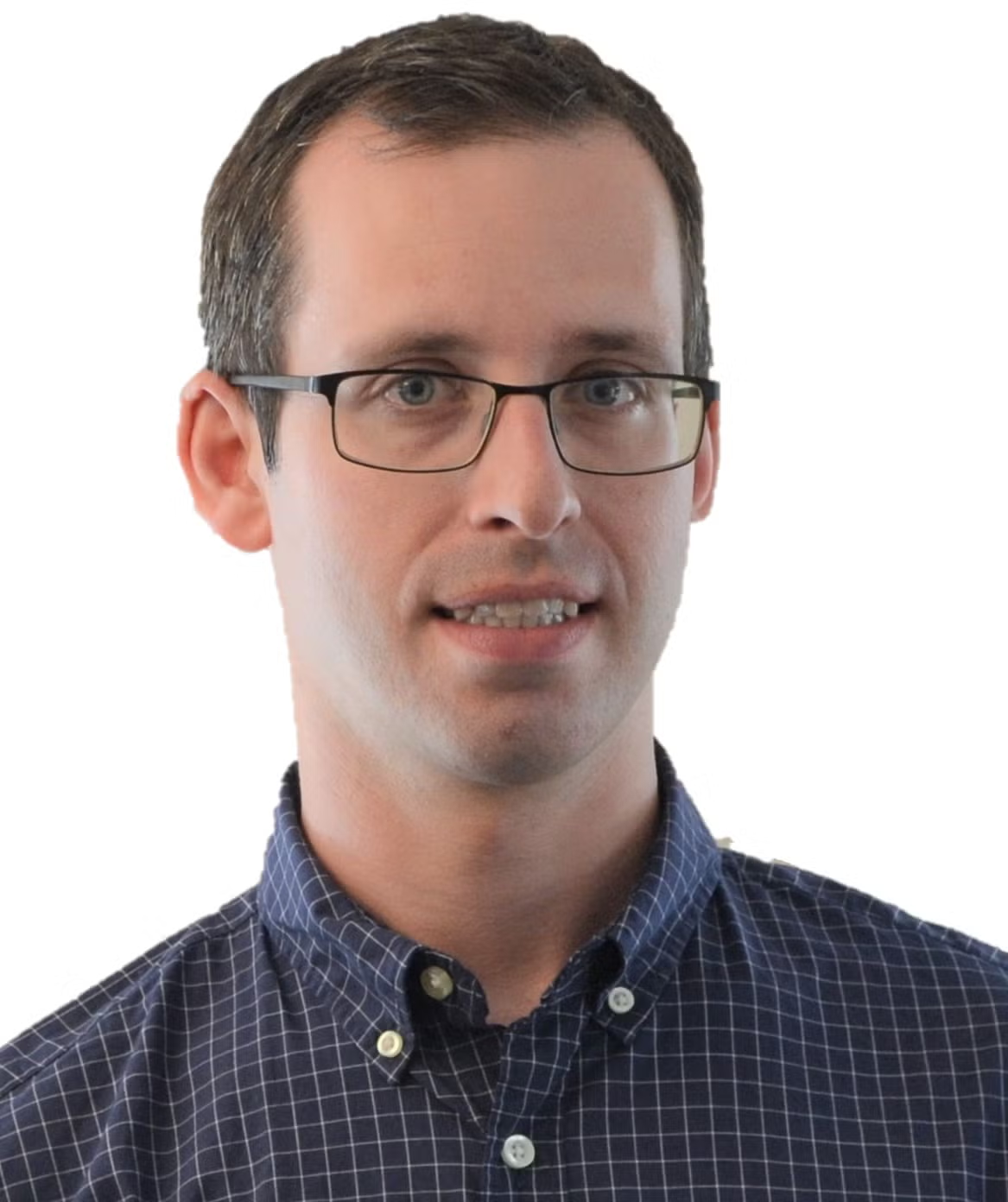
David Gosset

Summary
David Gosset is an Associate Professor in the Department of Combinatorics and Optimization and a faculty member at the Institute for Quantum Computing (IQC) at the University of Waterloo. He joined the University of Waterloo on 1 August 2018. He is also an Associate Faculty member at the Perimeter Institute for Theoretical Physics and a Fellow of the Canadian Institute for Advanced Research (CIFAR) in the Quantum Information Science programme. He can be reached at dgosset@uwaterloo.ca and maintains an academic website at davidgosset.com.
Gosset completed his PhD in Physics at the Massachusetts Institute of Technology in 2011 under the supervision of Edward Farhi. His doctoral research focused on quantum adiabatic algorithms and their power and limitations. This work led to his broader interest in the theory of quantum computing, quantum algorithms, and quantum complexity theory, with a strong connection between physics and computer science. He earned his undergraduate degree in combined honours Physics and Mathematics from the University of British Columbia.
After completing his PhD, Gosset held postdoctoral fellowships at the Institute for Quantum Computing at the University of Waterloo and at the California Institute of Technology. He later joined the IBM T.J. Watson Research Center in 2016 as a Research Staff Member in the Theory of Quantum Computing and Information Group. He went on to manage the Theory of Quantum Algorithms group at IBM, where his research focused on fundamental questions in quantum algorithms and complexity theory, motivated by the development of near-term quantum computers.
Gosset’s research expertise includes quantum algorithms, classical simulation of quantum computation, and the computational complexity of quantum many-body systems. His work has contributed to areas such as quantum advantage with shallow circuits, classical simulation of quantum circuits, stabilizer rank methods, Hamiltonian complexity, and entanglement properties of quantum systems. He has published extensively in leading journals including Science, Nature Physics, Physical Review Letters, Communications in Mathematical Physics, and Quantum, as well as major conference proceedings such as STOC, FOCS, and TQC.
His awards and honours include being named a CIFAR Fellow, receiving multiple Pat Goldberg Memorial Best Paper Awards at IBM Research, an Outstanding Paper Award at TQC 2019, the Sherman Fairchild Postdoctoral Fellowship, an NSERC Postdoctoral Fellowship, and academic honours from both MIT and UBC. Through his academic and industrial roles, Gosset has played an important role in advancing the theoretical foundations of quantum computing.
Biography
David Gosset is a Canadian theoretical physicist and computer scientist whose work focuses on the theory of quantum computing, quantum algorithms, and quantum complexity theory. He is an Associate Professor in the Department of Combinatorics and Optimization and a faculty member at the Institute for Quantum Computing (IQC) at the University of Waterloo, where he joined on 1 August 2018. He is also an Associate Faculty member at the Perimeter Institute for Theoretical Physics and a Fellow of the Canadian Institute for Advanced Research (CIFAR) in the Quantum Information Science programme. Through these roles, he contributes to research, teaching, and supervision at one of the world’s leading centres for quantum information science.
Gosset completed his PhD in Physics at the Massachusetts Institute of Technology in 2011 under the supervision of Edward Farhi. His doctoral research examined quantum adiabatic algorithms, with a focus on understanding their power, limitations, and performance on complex optimisation problems. This work placed him at the intersection of physics and computer science and shaped his long-term research direction. During this period, he developed a strong interest in how physical systems can be studied using computational models and how ideas from computational complexity can be applied to quantum many-body systems.
Before and after completing his doctorate, Gosset contributed to several important research projects on quantum algorithms, quantum Monte Carlo methods, and the behaviour of quantum systems with small spectral gaps. His early publications addressed topics such as quantum adiabatic computation, quantum state restoration, and QMA-complete problems, including work on quantum 3-SAT, stoquastic Hamiltonians, and the Bose–Hubbard model. These studies helped clarify the computational hardness of key quantum problems and remain widely cited in the field.
Following his PhD, Gosset held postdoctoral fellowships at the Institute for Quantum Computing at the University of Waterloo from 2011 to 2014 and later at the California Institute of Technology from 2015 to 2016, where he was a Sherman Fairchild Postdoctoral Fellow. During these years, he expanded his research on Hamiltonian complexity, frustration-free spin systems, correlation length and spectral gaps, and the structure of ground states. His work from this period includes results on area laws, entanglement properties, and the relationship between physical constraints and computational complexity.
In 2016, Gosset joined the IBM T.J. Watson Research Center as a Research Staff Member in the Theory of Quantum Computing and Information Group. At IBM, he focused on questions that were increasingly shaped by the expected availability of small and noisy quantum computers. His research addressed quantum advantage, shallow quantum circuits, and the classical simulation of quantum computation. He later became Manager of the Theory of Quantum Algorithms Group, where he guided research efforts on near-term quantum algorithms, simulation methods, and complexity-theoretic limits of quantum devices.
During his time at IBM, Gosset co-authored several influential papers, including work on quantum advantage with shallow and noisy circuits, classical simulation of Clifford-dominated circuits, stabilizer rank methods, and compressed classical descriptions of quantum states. These results helped clarify when quantum devices can outperform classical methods and when classical simulation remains efficient. His work in this area was recognised with multiple Pat Goldberg Memorial Best Paper Awards from IBM Research.
In 2018, Gosset returned to the University of Waterloo as an Associate Professor at IQC and the Department of Combinatorics and Optimization. In this role, he continues to conduct research on quantum algorithms, classical simulation techniques, and the complexity of quantum many-body systems. His recent work includes studies on quantum partition functions, improved approximation algorithms for local Hamiltonians, stabilizer rank bounds for magic states, and classical algorithms for problems such as forrelation. He has also contributed to research on planar Clifford circuits, quantum mean values, and entanglement laws in two-dimensional systems.
Gosset’s publications appear in leading journals such as Science, Nature Physics, Physical Review Letters, Communications in Mathematical Physics, Journal of Mathematical Physics, Quantum, and Theory of Computing, as well as in major conference proceedings including STOC, FOCS, ICALP, and TQC. His research is known for its clear focus on fundamental questions and for building strong links between physics, mathematics, and computer science.
His academic background includes a combined honours Bachelor of Science in Physics and Mathematics from the University of British Columbia, where he received the Rudi Haering Medal in Physics. He has also received the Marble Presidential Fellowship at MIT, an NSERC Postdoctoral Fellowship, and recognition as a CIFAR Fellow since 2019. Alongside his research, Gosset is involved in teaching, mentoring graduate students, and contributing to the broader quantum research community through collaboration and service.
Vision
David Gosset’s vision is to deepen the theoretical understanding of quantum computing so that future quantum technologies are built on clear and reliable foundations. He aims to explain what quantum computers can and cannot do by studying quantum algorithms, complexity theory, and quantum many-body systems. An important part of his vision is to connect physics, mathematics, and computer science, so that ideas from each field strengthen the others. He also focuses on understanding which quantum advantages are realistic with near-term quantum devices and how classical simulation methods can guide their development. Through research, teaching, and collaboration, he seeks to support steady and meaningful progress in quantum information science.
Recognition and Awards
David Gosset has received several awards and forms of recognition for his work in quantum computing and theoretical physics. He has been a Fellow of the Canadian Institute for Advanced Research since 2019, recognising his contributions to quantum information science. He received the Outstanding Paper Award at the Theory of Quantum Computation, Communication and Cryptography conference in 2019 for work on compressed classical descriptions of quantum states. At IBM Research, he received the Pat Goldberg Memorial Best Paper Award twice, in 2016 and 2018, for research on classical simulation of quantum circuits and quantum advantage with shallow circuits. He has also received the Sherman Fairchild Postdoctoral Fellowship, an NSERC Postdoctoral Fellowship, the Marble Presidential Fellowship at MIT, and the Rudi Haering Medal in Physics from the University of British Columbia.
References
- David Gosset | Institute for Quantum Computing | University of Waterloo
- David Gosset: About Me | David Gosset
- David Gosset | Math Innovation | University of Waterloo
- David Gosset | Google Scholar
- David Gosset | Perimeter Institute
- David Gosset Biography - Keynote Speaker | AAE Speakers
- IQC Fireside Chat with David Gosset | Institute for Quantum Computing
- Faculty | Institute for Quantum Computing | University of Waterloo
- The quest to build a reliable quantum computer | University Affairs
- Advisory board | softwareQ Inc.
Discover up-to-date information on Business, Industry Leaders and Influencers, Organizations, Education, and Investors – connecting you to the knowledge you need.
