
Businesses
12 Unique Business Ideas With Growth Potential in 2026
11 Aug 2026

12 Unique Business Ideas With Growth Potential in 2026
The strongest business ideas in 2026 are not necessarily completely new inventions. Many involve applying new technology, specialised expertise or a better service model to an existing problem.
These 12 unique business ideas were selected because each addresses a recognisable customer need, has a practical path to an initial paid test and is supported by a current economic, technological or demographic demand signal.
Key takeaways
- A unique business usually combines a specific customer, costly problem and differentiated delivery model.
- Service-first businesses allow founders to test demand before investing heavily in technology, inventory or premises.
- AI adoption, population ageing, cybersecurity, energy costs, ecommerce returns and workplace training are creating specialised opportunities.
- Regulation can create demand, but it can also raise the qualifications and insurance required to operate.
- The most reliable validation is a paid pilot, deposit or signed customer—not compliments or social-media engagement.
- These ideas should support, rather than replace, a broader review of realistic small business ideas for 2026.
The 12 unique business ideas at a glance
| Business idea | Likely customers | Lean first offer | Main constraint |
|---|---|---|---|
| Vertical AI workflow studio | Small businesses in one industry | One automated workflow | Data security and integration |
| Ageing-in-place coordinator | Older adults and families | Home-support assessment | Boundaries around regulated care |
| Cybersecurity readiness service | Small businesses and nonprofits | Security-baseline review | Technical competence and liability |
| EV charger uptime service | Hotels, apartments and employers | Site inspection and reporting | Electrical work restrictions |
| Heat-resilience adviser | Property owners and local organisations | Heat-risk walkthrough | Building and contractor expertise |
| Food-waste reduction service | Restaurants, schools and grocers | Waste measurement pilot | Local disposal rules and logistics |
| Digital accessibility studio | Public bodies and their vendors | Manual accessibility review | Legal claims and specialist expertise |
| Drone property documentation | Contractors and property managers | Exterior condition report | FAA certification and airspace rules |
| Ecommerce returns-reduction studio | Online brands | Returns-data diagnostic | Access to reliable store data |
| Home-energy project concierge | Homeowners and landlords | Bill and project review | Certification and contractor quality |
| Multilingual knowledge-base studio | Service businesses and software firms | One translated support workflow | Accuracy, privacy and cultural context |
| Microlearning operations studio | Growing employers | One short onboarding module | Subject-matter accuracy |
1. Vertical AI workflow implementation studio
A vertical AI workflow studio helps businesses in one industry automate a clearly defined administrative process. Instead of selling vague “AI transformation,” it might help dental practices manage routine appointment enquiries, property managers classify maintenance requests or contractors turn site notes into draft customer updates.
The opportunity comes from an adoption gap. The US Census Bureau reported that overall business use of AI remained at approximately 17% to 20% during the period from December 2025 to May 2026, while a larger share expected to use it during the following six months. The SBA has also highlighted increasing AI adoption among small firms.
How to test it
Choose one industry and interview five business owners about repetitive work. Offer to improve one workflow, such as document classification, meeting follow-up or internal knowledge retrieval—for a fixed pilot fee.
What to watch
Do not place confidential customer information into an AI system without appropriate permission, security controls and vendor review. Human approval should remain part of workflows involving financial, medical, employment or legal decisions.
2. Ageing-in-place coordination service
An ageing-in-place coordinator helps older adults and their families organise non-medical support at home. Services could include coordinating home-safety modifications, arranging technology installation, comparing transport options, scheduling vetted contractors and creating a household support plan.
This is different from providing personal care or medical advice. Its value lies in managing fragmented tasks for families who may live far from the person receiving support.
The Bureau of Labor Statistics projects employment of home health and personal care aides to grow by 17% between 2024 and 2034. That does not directly forecast demand for coordinators, but it is a strong indicator of expanding support needs among older and disabled populations.
How to test it
Offer a fixed-price household-support assessment covering immediate concerns, service-provider options and a prioritised action plan.
What to watch
Define the service boundary carefully. Medical care, personal care, occupational therapy, financial advice and some home assessments may require licences or qualified professionals.
3. Small-business cybersecurity readiness service
Many small organisations need help implementing basic security practices but are not ready to hire a full security team. A readiness service could help them inventory devices, introduce multifactor authentication, document backup procedures, review account permissions and prepare a basic incident-response plan.
CISA maintains cybersecurity guidance specifically for small and medium-sized businesses, including resources covering accounts, systems, data and incident preparation. That creates an opportunity for practitioners who can translate guidance into manageable operational steps.
How to test it
Sell a security-baseline assessment that produces a prioritised 30-day improvement plan. Begin with administrative safeguards rather than advanced penetration testing.
What to watch
Never promise that a business will be “completely secure.” Specialist testing, compliance audits and managed security services require suitable qualifications, contracts, insurance and technical controls.
4. EV charger uptime and maintenance coordination
Installing an electric-vehicle charger is only the beginning. Apartment buildings, hotels, workplaces and retail sites also need chargers inspected, cleaned, monitored and repaired when connectors, payment systems or network connections fail.
A specialised operator could provide scheduled inspections, usage reports, fault escalation and coordination between the site owner, charger network and licensed electrician.
The US Department of Energy’s Alternative Fuels Data Center maintains current data on charging infrastructure, reflecting an expanding installed base that must remain operational.
How to test it
Approach independent hotels, multifamily properties or employers with chargers. Offer a one-time condition inspection and uptime report before proposing recurring monitoring.
What to watch
Do not perform regulated electrical work without the required licence. Agreements should clearly distinguish inspection, cleaning and coordination from electrical repair.
5. Heat-resilience adviser for small properties
A heat-resilience adviser helps small commercial properties, apartment buildings, schools or community organisations reduce exposure to extreme heat.
A basic service might assess shade, roof characteristics, indoor hot spots, ventilation, hydration access and operating procedures. The adviser can then coordinate specialists for projects such as cool roofs, shading structures or landscaping.
The Environmental Protection Agency identifies cool roofs, trees, green roofs, cool pavements and related measures as heat-island reduction strategies. It reports that cool roofs can reduce peak cooling demand in air-conditioned residential buildings, although the result varies by climate and building.
How to test it
Conduct a summer heat walkthrough for one small property and produce a plan divided into immediate, low-cost and capital improvements.
What to watch
Avoid presenting a visual inspection as an engineering assessment. Structural work, roofing, electrical changes and formal energy audits may require certified professionals.
6. Food-waste measurement and diversion service
Restaurants, cafeterias, grocers and hospitality businesses may know they waste food without knowing what is wasted, why it happens or which intervention would make the greatest difference.
A food-waste service can measure discarded food, identify patterns, improve purchasing and preparation processes, and coordinate donation, animal-feed or composting partners where permitted.
The EPA’s Excess Food Opportunities Map includes more than 960,000 potential excess-food generators and almost 15,000 potential recipients. The agency also provides tools businesses can use to prevent and divert wasted food.
How to test it
Run a two-week measurement pilot in one restaurant. Record the type, quantity, time and suspected cause of each discarded item, then estimate avoidable waste and recommend two operational changes.
What to watch
Food donation, transport, storage and organics collection are affected by health requirements, contracts and local regulations. Verify the applicable rules before handling food.
7. Digital accessibility testing studio
A digital accessibility studio evaluates websites, documents and online services for barriers affecting users with disabilities. A credible service combines automated tools with manual keyboard testing, screen-reader checks and a prioritised remediation plan.
Public organisations and businesses supplying digital services to them face especially clear accessibility expectations. The Department of Justice’s 2024 Title II web rule applies to state and local governments, with compliance dates depending on population and entity type. It does not automatically make every private website subject to the same rule.
How to test it
Review one customer journey, such as finding a service and submitting an enquiry—and document the most serious barriers, affected users and recommended fixes.
What to watch
An automated scan alone is not a complete accessibility audit. Avoid guaranteeing legal compliance, and involve legal or specialist advisers when a client requires a formal compliance opinion.
8. Drone-based property condition documentation
This business uses drones to create structured visual records for roofing companies, construction firms, property managers, insurers or facilities teams.
The differentiator is not aerial photography alone. It is the delivery of organised, repeatable documentation: labelled images, comparable viewpoints, dated progress records and observations that help a qualified customer make decisions.
Commercial drone operations in the United States generally fall under FAA Part 107. Operators must understand pilot certification, aircraft registration, operating restrictions and controlled-airspace requirements.
How to test it
Offer one contractor a fixed-price exterior progress record with an agreed flight plan, image list and delivery format.
What to watch
A photograph is not automatically an engineering, insurance or roof-safety assessment. Weather, privacy, airspace, property access and insurance must also be addressed.
9. Ecommerce returns-reduction studio
An ecommerce returns-reduction studio helps smaller online brands understand why products come back and reduce avoidable returns.
The service could analyse return codes and customer comments, identify misleading product descriptions, improve sizing information, revise packaging and create routes for resale, refurbishment or donation.
The National Retail Federation projected that 19.3% of online sales would be returned in 2025. That makes returns a significant operational and margin problem rather than a minor administrative task.
How to test it
Review 60 to 90 days of return data for one brand. Identify the three largest causes and propose a measurable intervention for the leading cause.
What to watch
A falling return rate is not always positive if restrictive policies also reduce sales. Track conversion, customer satisfaction, repeat purchases and net margin alongside returns.
10. Home-energy project concierge
A home-energy project concierge helps homeowners or small landlords move from “we should improve efficiency” to a practical sequence of projects.
The service might organise utility data, explain contractor proposals, compare project scopes, identify qualified assessors and coordinate work such as insulation, air sealing or equipment upgrades.
The Department of Energy’s Home Energy Score programme provides a standardised assessment framework delivered by qualified assessors. An independent concierge can help customers navigate the process without claiming to replace a certified assessment.
How to test it
Offer a project-planning session that organises utility bills, household priorities and existing quotations into a staged decision plan.
What to watch
Do not claim certification you do not hold or calculate savings as guaranteed outcomes. Rebates, tax incentives, building rules and contractor requirements can change by location and date.
11. Multilingual customer-support knowledge-base studio
This business helps organisations turn scattered answers, policies and product information into a structured multilingual help centre.
The studio can interview employees, document approved answers, design escalation rules and produce human-reviewed versions for the languages most relevant to the company’s customers.
The opportunity is not simply machine translation. It is the combination of information architecture, translation review, customer-service design and ongoing maintenance. US Census language data can help businesses identify which languages are widely spoken in their target geography.
How to test it
Select the 20 most common customer questions for one business. Build an approved knowledge base in one additional language and measure whether it reduces repeat enquiries.
What to watch
Machine-generated translations should be reviewed by a competent human, especially for safety, contracts, healthcare, finance or regulated services. Establish procedures for personal data and outdated information.
12. Microlearning operations and onboarding studio
A microlearning studio turns long manuals, policies and undocumented employee knowledge into short, role-specific learning materials.
Deliverables might include five-minute lessons, process demonstrations, scenario questions, manager checklists and version-controlled onboarding paths. The best customers are businesses where repeated mistakes, staff turnover or changing procedures make informal training expensive.
The Bureau of Labor Statistics projects employment for training and development specialists to grow by 11% from 2024 to 2034. It cites evolving technology, continuous upskilling and regulatory training as demand drivers.
How to test it
Convert one confusing procedure into a short lesson and checklist. Test it with several employees and compare completion, understanding and error rates with the existing material.
What to watch
Have the customer’s subject-matter expert approve every lesson. The studio should organise and communicate approved guidance—not invent legal, safety or compliance requirements.
What makes these business ideas unique?
“Unique” should not mean unfamiliar to every customer. An idea can be so novel that buyers do not understand why they need it.
A commercially useful form of uniqueness usually comes from one or more of the following:
- Customer specialisation: Cybersecurity specifically for independent accounting firms.
- Problem specialisation: Reducing size-related returns for online clothing brands.
- Delivery specialisation: A fixed two-week paid pilot rather than an open-ended consultancy.
- Geographic specialisation: Heat-resilience assessments for properties in one metropolitan area.
- Business-model specialisation: Recurring monitoring rather than one-time project work.
- Evidence specialisation: Delivering documented measurements instead of general advice.
The business does not need to be unprecedented. It needs to be relevant, credible and sufficiently differentiated from the alternatives available to its intended customer.
How to choose the right unique business idea
Start with the buyer rather than the trend. A fashionable market is not useful if you cannot reach its customers or deliver a trusted result.
Evaluate each idea against five questions:
- Do I understand the customer?
Prior work experience, local knowledge or industry relationships can create an advantage.
- Is the problem expensive or urgent?
Customers act faster when a problem affects revenue, cost, safety, compliance or time.
- Can I demonstrate a result quickly?
A small, measurable outcome is easier to sell than a broad transformation.
- Can I deliver legally and competently?
Check licences, insurance, privacy, contracts and professional boundaries.
- Could the service become repeatable?
Templates, checklists and standard processes make a business easier to price and scale.
For a more detailed decision framework, see What Business Should I Start? How to Choose the Right Business Idea.
How to validate one of these ideas before investing heavily
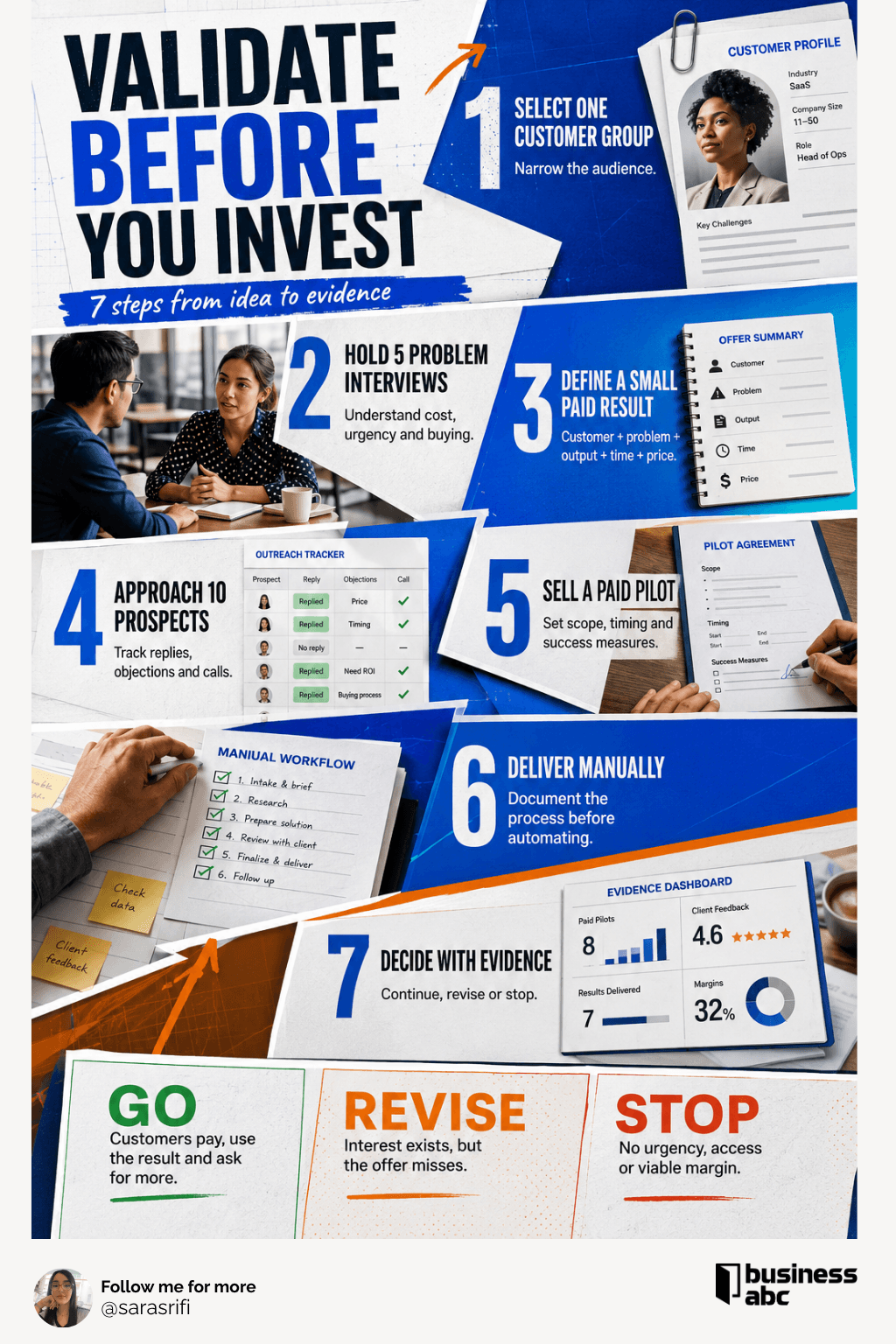
Step 1: Select one customer group
Avoid testing “small businesses” as a single audience. Choose a narrower group, such as independent hotels, roofing contractors or Shopify-based clothing brands.
Step 2: Conduct five problem interviews
Ask how customers currently handle the problem, what it costs, what has already been attempted and who approves a purchase.
Do not start by pitching your proposed solution.
Step 3: Define a small paid result
Turn the idea into a specific offer:
We help [customer] reduce or resolve [problem] by delivering [defined output] within [time] for [price].
Step 4: Approach ten relevant prospects
Use direct, personalised outreach. Record replies, objections, calls, refusals and buying requirements.
Step 5: Sell a paid pilot
A paid test provides stronger evidence than survey enthusiasm. Keep its scope, timeline, responsibilities and success measure clear.
Step 6: Deliver manually
Complete the early work yourself before buying complex software or building a platform. Document each step and identify what can later be standardised.
Step 7: Decide using evidence
Continue when customers pay, use the result and request follow-up work. Revise or stop when the problem lacks urgency, customers cannot be reached or delivery costs exceed realistic pricing.
Founders with limited capital can also use the service-first methods in How to Start a Business With No Money.
Common mistakes when pursuing a unique business idea
Choosing novelty instead of demand
A business can be original without being wanted. Look for existing spending, workarounds, delays or repeated complaints.
Offering too many services
A narrow initial offer is easier to explain, price and improve. Additional services can follow after the first offer works.
Treating regulation as a marketing slogan
Accessibility, cybersecurity, ageing services, energy work and drone operations all involve important professional boundaries. Research the actual rules rather than implying automatic compliance.
Automating before understanding the process
Early manual delivery reveals exceptions, customer expectations and quality problems that software may hide.
Relying on estimated market size alone
National projections do not prove local or niche demand. Customer interviews and paid tests remain necessary.
Copying a trend without building expertise
Customers are unlikely to trust a generalist with sensitive data, building safety or operational risk. Specialised knowledge and transparent limits matter.
Frequently asked questions
What is the most unique business to start in 2026?
There is no single best option. Vertical AI implementation, accessibility testing, heat-resilience planning and returns reduction are relatively differentiated opportunities, but the right choice depends on the founder’s expertise and access to customers.
Which unique business ideas can be started with little money?
AI workflow services, microlearning development, multilingual knowledge-base creation and ecommerce returns analysis can initially be delivered with existing equipment. However, software, insurance, professional advice and customer acquisition may still create costs.
Do I need to invent a completely new product?
No. A distinctive combination of customer, problem, service and delivery method is often more commercially useful than an unfamiliar invention.
How do I know whether a business idea has growth potential?
Look for independent evidence such as demographic change, adoption data, infrastructure expansion, regulation, rising operating costs or a large recurring problem. Then validate the specific offer with real customers.
Which business ideas could produce recurring revenue?
Cybersecurity readiness, charger monitoring, accessibility maintenance, knowledge-base management and employee training updates can support recurring contracts. Recurring revenue only develops if customers continue receiving measurable value.
Are these businesses guaranteed to be profitable?
No. Profitability depends on pricing, customer acquisition, delivery cost, competition, regulation and execution. The demand signals in this article support further investigation; they do not guarantee results.
Final takeaway
The best unique small business ideas in 2026 sit between change and practical execution. Businesses and households are adapting to AI, demographic shifts, digital accessibility, cybersecurity risks, energy pressures and new infrastructure but many need specialised help turning those changes into working systems.
Choose one customer and one costly problem. Sell the smallest useful result before investing heavily. If customers pay, receive value and request further work, the idea has begun to earn the right to grow.
Founders who prefer more established models can compare these opportunities with the top 10 most successful businesses to start.
Sources
- US Census Bureau — Large Firms With at Least 20 Employees Biggest AI Users
- SBA Office of Advocacy — AI in Business: Small Firms Closing In
- US Bureau of Labor Statistics — Home Health and Personal Care Aides
- CISA — Cybersecurity Resources for Small and Medium Businesses
- US Department of Energy — Alternative Fuels Data Center
- US Environmental Protection Agency — Using Cool Roofs to Reduce Heat Islands
- US Environmental Protection Agency — Sustainable Management of Food
- US Department of Justice — Fact Sheet on the 2024 Title II Web Accessibility Rule
- Federal Aviation Administration — Commercial Drone Operators
- National Retail Federation — 2025 Retail Returns Landscape
- US Department of Energy — Home Energy Score
- US Census Bureau — Language Spoken at Home
- US Bureau of Labor Statistics — Training and Development Specialists


